The Hidden Logic Inside Every Price Tag
How Hegel’s syllogisms reveal the contradictions Marx saw in every commodity — and why those contradictions still matter for understanding capitalism’s future.
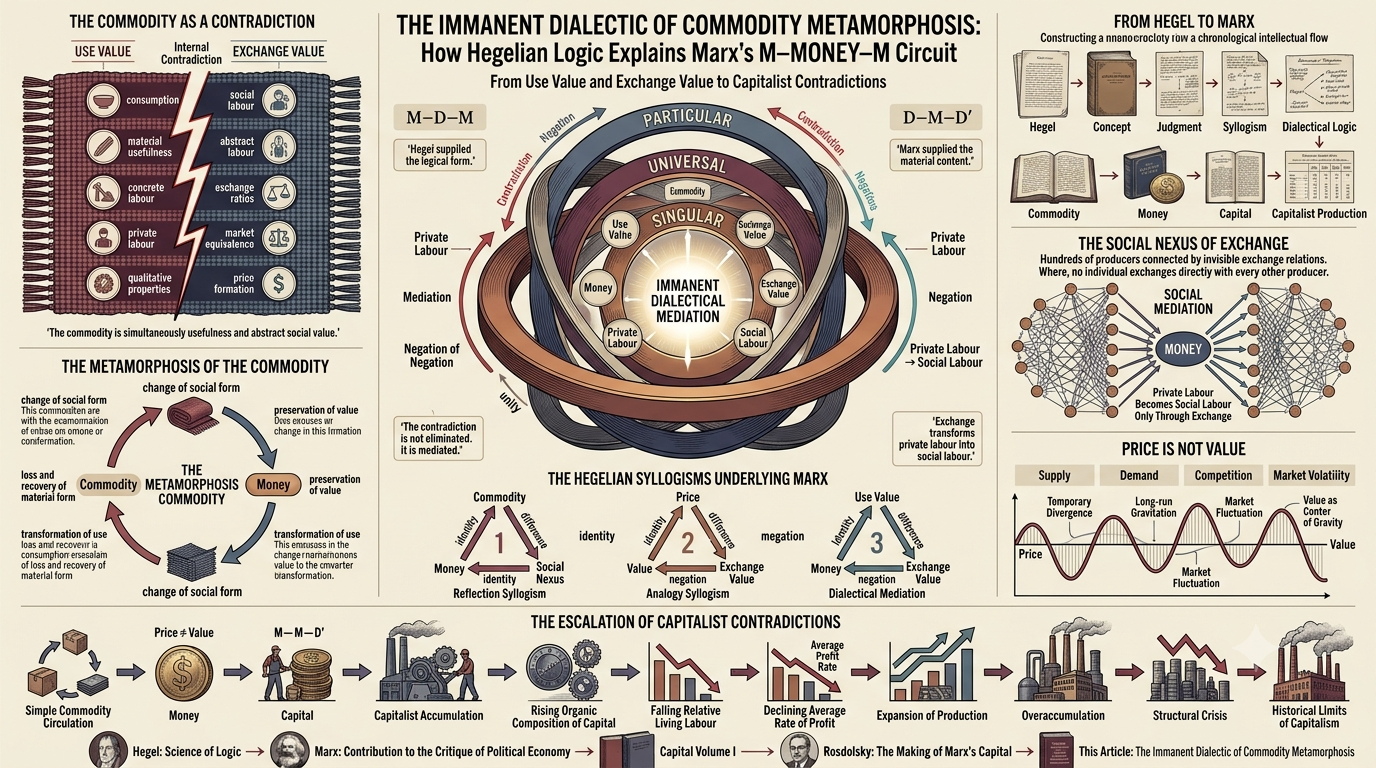
Every time you buy a cup of coffee, two completely different things happen at once. The coffee satisfies a need — warmth, caffeine, pleasure. But it also embodies a social relationship: someone grew the beans, someone roasted them, someone set a price. That double life of every commodity is what Marx called the contradiction between use value and exchange value. An economist recently set out to show that this contradiction follows an exact logical structure — one that Marx sketched but never fully completed.
Why This Paper Exists
Karl Marx built his critique of political economy on the logical scaffolding of the German philosopher G.W.F. Hegel. This is not a minor footnote: Hegel’s dialectical logic — the idea that concepts develop through contradiction, moving from thesis to antithesis to synthesis — is the engine room of Capital. Marx famously said he turned Hegel “right side up,” replacing idealism with materialism. But he kept the machinery.
The problem, as Gómez Julián points out, is that Marx never finished the philosophical job. He used Hegel’s logic to analyze commodities, money, and prices, but he never fully explained how the internal contradictions of the commodity resolve themselves at the level of pure logic. He identified the cycle M–D–M (commodity–money–commodity) and even mapped it onto Hegel’s qualitative syllogism. But then he stopped the philosophical analysis and moved on to economics. This paper tries to pick up where Marx left off.
— Roman Rosdolsky, cited in the article
Three Words You Need: Use Value, Exchange Value, Money
Before going further, let’s make sure the key terms are crystal clear — no economics degree required.
- Use value is what a thing is good for. A coat keeps you warm. Bread feeds you. This is qualitative — it answers the question “what does it do?”
- Exchange value is what a thing can be traded for. The coat might be worth three loaves of bread, or $80. This is quantitative — it answers the question “how much is it worth?”
- Money is the universal translator. It lets every commodity express its exchange value in one common language (dollars, euros, colones). But money also separates buying from selling, creating new contradictions.
The central tension is this: a commodity is both a useful object and a bearer of abstract social value. These two identities don’t sit comfortably together. The article’s claim is that this tension follows a precise logical structure that Hegel’s system can decode.
Hegel’s Toolkit: Concept, Judgment, Syllogism
Hegel’s Science of Logic develops in three stages that mirror how we think. Gómez Julián draws on all three:
The Concept (Begriff) has three “moments”: universality (what something shares with everything in its class), particularity (what distinguishes it within that class), and singularity (the concrete, individual thing that unites both). Think of it this way: “fruit” is universal; “citrus” is particular; “this orange in my hand” is singular.
The Judgment (Urteil) is what happens when those moments are set against each other — when we say something is this but also is not that. It’s the moment of contradiction.
The Syllogism (Schluss) is the resolution. It’s the logical form in which the contradiction finds its movement — not by disappearing, but by developing into something richer. A syllogism has a major term (universal), a minor term (particular), and a middle term (singular) that mediates between them.
Syllogism No. 1 — The Act of Buying and Selling
The first syllogism Gómez Julián develops is what Hegel calls the syllogism of reflection in its exclusive form. It addresses the most basic question: how can a commodity and money — two fundamentally different things — be exchanged at all?
Consider the act of selling (M → D). The seller has a particular commodity — say, a specific handmade chair. Money plays the role of the universal: it’s the general equivalent against which all commodities measure themselves. What bridges the two? The social nexus — the web of production relations, market norms, and shared conventions that make exchange possible in the first place.
In the act of buying (D → M), the logic mirrors itself: money (now universal) is exchanged for a particular commodity, again mediated by the social nexus. The syllogism looks like this:
Buying: D → M Universal (money) — Singular (social nexus) — Particular (commodity)
The key insight is that the social nexus is not an add-on — it is the logical middle term. Without it, the contradiction between a chair and a stack of bills would be irreducible. Marx himself recognized this when he wrote that “a relation of social production appears as something existing outside individuals.” The chair doesn’t inherently “know” it’s worth $200. That knowledge is embedded in social practice.
Syllogism No. 2 — Price vs. Value
The second syllogism tackles a subtler problem. Even after an exchange happens, there’s a gap: the price of a commodity almost never equals its value (the socially necessary labor time embedded in it). Prices fluctuate with supply, demand, speculation, season, mood. Marx acknowledged this explicitly:
Gómez Julián uses Hegel’s syllogism of analogy to model this. In this syllogism, the middle term is a singularity taken in its essential universality — a particular thing considered not just as itself but as representative of its genus. Here’s how it maps:
exchange value (the real labor time, which never appears directly on the market — it enters the “capricious volatility of competition”)Universal:
price (the monetary expression, which carries value inside it but also differs from it — “value in-itself and also value distinct from itself”)Particular:
exchange value over the long run (the average around which supply and demand oscillate)
The punchline is elegant: price and value are never identical at a single point in time, but value is always the gravitational center around which prices orbit. This is not a failure of the system — it’s the way the contradiction moves. As Marx wrote, echoing Hegel: identity here is “the identity of negation.”
Syllogism No. 3 — The Big One Marx Identified But Didn’t Complete
Marx himself noticed that the cycle M–D–M (commodity–money–commodity) can be mapped onto Hegel’s qualitative syllogism P–U–S (particular–universal–singular). The two M’s in the cycle play different roles:
The first M is particular — it’s a specific commodity I own and want to get rid of (say, the chair I made). The D (money) is universal — it can buy anything. The second M is singular — it’s the concrete commodity I actually need (say, groceries). The money mediates, translating my particular surplus into the particular thing I lack.
But here’s where the article makes its most original contribution. Marx only named the syllogism and stopped. Gómez Julián argues that the full Hegelian development reveals something Marx left implicit: the commodity embodies both social labor (exchange value) and private labor (use value). Money — as the “universal equivalent” — is the form in which these two kinds of labor temporarily reconcile. But reconciliation is not resolution. The contradiction persists and drives the system forward.
— Marx, cited in the article
Marx compared this to planetary motion: a body is constantly falling toward the sun and constantly being flung away. The orbit is not a resolution of gravity vs. inertia — it is the contradiction in motion. Commodity circulation works the same way.
From Logic to Collapse: The Tendency of the Rate of Profit to Fall
The paper doesn’t stop at philosophy. It follows the thread all the way to what Marx considered the long-run fate of capitalism: the tendency of the average rate of profit to fall.
The logic runs as follows. The average rate of profit is the weighted average of profit rates across all sectors of the economy:
g'M = Σ wᵢ · g'ᵢwhere
g'M = average profit rate, wᵢ = weight of sector i‘s capital in total social capital, g'ᵢ = profit rate in sector i.
As capitalism develops, technological innovation replaces living labor (variable capital) with machinery and materials (constant capital). This raises productivity — each worker produces more. But it also means each commodity contains less total labor time and therefore less surplus labor time (the source of profit). Even though the proportion of surplus time within each commodity may rise (higher exploitation rate), the absolute mass of surplus per unit falls.
To compensate, capitalists must produce at exponentially larger scales — what Marx called the “faux frais” (overhead costs) of production and circulation. Meanwhile, technological unemployment grows, wages are pressured downward, and social tensions mount. The article presents this as the logical terminus of the contradictions embedded in the commodity itself.
Why Does This Matter?
You don’t have to agree with Marx’s conclusions to appreciate what this paper accomplishes. It demonstrates three things:
- Hegel’s logic is not decorative. The syllogistic structures are not metaphors — they are the formal architecture that makes Marx’s economic categories cohere. Ignoring them leaves Capital half-read.
- Contradictions are not bugs — they’re features. The gap between use value and exchange value, between price and value, between private labor and social labor, is not a flaw in capitalism. It’s the mechanism that keeps it moving. Understanding this changes how you think about crises: they’re not accidents but structural expressions of unresolved logical tensions.
- The long-run trajectory matters. Whether or not capitalism “collapses” in the dramatic sense Marx envisioned, the falling-rate-of-profit framework offers a structural explanation for secular stagnation, financialization, and the persistent pressure to expand into new markets — themes that remain urgently relevant.
At its heart, Gómez Julián’s paper is an invitation to read Marx the way Marx read Hegel — not as a collection of slogans, but as a living logical system where every economic category carries a philosophical skeleton inside it. The commodity is not just a thing with a price. It is a logical knot tying together private desire, social labor, monetary abstraction, and historical trajectory. Untying that knot — or at least seeing its shape — is the first step toward understanding why economies work the way they do, and why they sometimes don’t.