
Espartaco

“Is that to say we are against Free Trade? No, we are for Free Trade, because by Free Trade all economical laws, with their most astounding contradictions, will act upon a larger scale, upon the territory of the whole earth; and because from the uniting of all these contradictions in a single group, where they will stand face to face, will result the struggle which will itself eventuate in the emancipation of the proletariat.”

Karl Heinrich Marx · Marx-Engels Collected Works, Vol. VI, p. 290

25,869 views since December 2020

25,869 visitas desde diciembre de 2020

EnglishEspañol

Category: Quantum Mechanics

  • ON THE VIOLATION OF THE SECOND LAW OF THERMODYNAMICS

    ON THE VIOLATION OF THE SECOND LAW OF THERMODYNAMICS

    1. Additional Information, Part I

    1.1. Argonne researchers posit way to locally circumvent Second Law of Thermodynamics
    For more than a century and a half of physics, the Second Law of Thermodynamics, which states that entropy always increases, has been as close to inviolable as any law we know. In this universe, chaos reigns supreme. But researchers with the U.S. Department of Energy’s (DOE’s) Argonne National Laboratory announced recently that they may have discovered a little loophole in this famous maxim. Their research, published in Nature Scientific Reports, lays out a possible avenue to a situation where the Second Law is violated on the microscopic level.

    The Second Law is underpinned by what is called the H-theorem, which says that if you open a door between two rooms, one hot and one cold, they will eventually settle into lukewarm equilibrium; the hot room will never end up hotter.

    But even in the twentieth century, as our knowledge of quantum mechanics advanced, we didn’t fully understand the fundamental physical origins of the H-theorem.

    “What we did was formulate how these beautiful abstract mathematical theories could be connected to our crude reality.”

    Recent advancements in a field called quantum information theory offered a mathematical construction in which entropy increases.

    “What we did was formulate how these beautiful abstract mathematical theories could be connected to our crude reality,” said Valerii Vinokur, an Argonne Distinguished Fellow and corresponding author on the study.

    The scientists took quantum information theory, which is based on abstract mathematical systems, and applied it to condensed matter physics, a well-explored field with many known laws and experiments.

    “This allowed us to formulate the quantum H-theorem as it related to things that could be physically observed,” said Ivan Sadovskyy, a joint appointee with Argonne’s Materials Science Division and the Computation Institute and another author on the paper. ​“It establishes a connection between well-documented quantum physics processes and the theoretical quantum channels that make up quantum information theory.”

    The work predicts certain conditions under which the H-theorem might be violated and entropy — in the short term — might actually decrease.

    As far back as 1867, physicist James Clerk Maxwell described a hypothetical way to violate the Second Law: if a small theoretical being sat at the door between the hot and cold rooms and only let through particles traveling at a certain speed. This theoretical imp is called ​“Maxwell’s demon.”

    “Although the violation is only on the local scale, the implications are far-reaching,” Vinokur said. ​“This provides us a platform for the practical realization of a quantum Maxwell’s demon, which could make possible a local quantum perpetual motion machine.”

    For example, he said, the principle could be designed into a ​“refrigerator” which could be cooled remotely — that is, the energy expended to cool it could take place anywhere.

    The authors are planning to work closely with a team of experimentalists to design a proof-of-concept system, they said.

    The study, ​“H-theorem in quantum physics,” was published September 12 in Nature Scientific Reports. Other authors on the study were G.B. Lesovik of Russia’s L.D. Landau Institute for Theoretical Physics and Switzerland’s Theoretische Physik; A.V. Lebedev of Theoretische Physik; and M.V. Suslov of the Moscow Institute of Physics and Technology.

    The study was supported by the U.S. Department of Energy’s Office of Science, the Swiss National Foundation, the Pauli Center for Theoretical Studies at ETH Zurich and the Russian Foundation for Basic Research.

    Argonne National Laboratory seeks solutions to pressing national problems in science and technology. The nation’s first national laboratory, Argonne conducts leading-edge basic and applied scientific research in virtually every scientific discipline. Argonne researchers work closely with researchers from hundreds of companies, universities, and federal, state and municipal agencies to help them solve their specific problems, advance America’s scientific leadership and prepare the nation for a better future. With employees from more than 60 nations, Argonne is managed by UChicago Argonne, LLC for the U.S. Department of Energy’s Office of Science.

    The U.S. Department of Energy’s Office of Science is the single largest supporter of basic research in the physical sciences in the United States and is working to address some of the most pressing challenges of our time. For more information, visit the Office of Science website.

    2. Additional Information, Part II

    dibujo20161026-braking-radiation-in-1d-electron-scattering-with-and-without-photon-emission

    The second law of thermodynamics states that entropy cannot decrease. In classical physics, this follows from Boltzmann’s H-theorem, which applies to solutions of his kinetic transport equation. There is no quantum analogue of this equation that would allow a quantum H-theorem to be proved. Physicists at Argonne National Laboratory have published in Scientific Reports a quantum version of the H-theorem for systems whose evolution is governed by a unital quantum channel (channels are used in quantum information theory).

    There are quantum channels that are not unital. For this reason, these physicists, as well as many media outlets reporting on the finding, suggest that local violations of the second law of thermodynamics may be observable (mediated by quantum Maxwell’s demons). However, the article does not present any concrete example; moreover, the two examples of non-unital channels that it does present comply with the second law. Future studies will have to determine whether such local violations are possible in real physical systems, as well as identify a real example of a quantum Maxwell’s demon.”

    The article is G. B. Lesovik, A. V. Lebedev, …, V. M. Vinokur, «H-theorem in quantum physics,» Scientific Reports 6: 32815 (12 Sep 2016), doi: 10.1038/srep32815arXiv:1407.4437 [quant-ph].

    dibujo20161026-one-dimensional-random-walk-of-an-electron-in-two-level-system

    Ludwig Boltzmann’s H-theorem (1872, 1896) is the statistical foundation of the second law of thermodynamics. This theorem states that if f(x,v,τ)f(x,v,\tau) is the spatiotemporal distribution of the density of the molecules of an ideal gas at time τ\tau, at position xx, and with velocity vv, then the entropy given by S=dS/dτ0.dxdvf(x,v,τ)logf(x,v,τ)S=-\int dS/dτ⩾0.\,dx\,dv\,f(x,v,\tau)\,\log f(x,v,\tau) cannot decrease; that is, dS/dτ0dS/d\tau\geqslant{0}. To prove this, Boltzmann’s equation for the function f is used under the assumption that the particles colliding in the gas have velocities independent of their positions (the so-called molecular chaos hypothesis). Quantum mechanics, however, relates positions and velocities through Heisenberg’s uncertainty relations.

    In 1929, John von Neumann proposed a quantum explanation for the origin of entropy growth. Entropy is defined in terms of the density matrix of quantum mechanics ρ^{\hat\rho} as S(ρ^)=kBtr{ρ^logρ^}S(\hat{\rho})=-k_B\text{tr}\{\hat{\rho}\log\hat{\rho}\}. It can be shown that this function does not decrease, even without resorting to a kinetic transport equation, by using the measurement procedure of quantum mechanics. Since then, many physicists have attempted to obtain a quantum version of Boltzmann’s H-theorem (a good overview can be found in the book by Jochen Gemmer, Mathias Michel, and Günter Mahler, Quantum Thermodynamics: Emergence of Thermodynamic Behavior Within Composite Quantum Systems, Lecture Notes in Physics, Springer, 2009).

    dibujo20161026-electrons-and-phonons-in-an-atomic-lattice

    The new article draws on quantum information theory (QIT) and proposes describing the quantum dynamics of a system by means of a quantum channel (QC). In information theory, a (data) channel is the theoretical model of a transmission medium through which information-carrying signals travel from a sender to a receiver. Any quantum system can be interpreted as a (quantum) channel through which information flows. Using quantum channels makes it possible to obtain a quantum formulation of the H-theorem: entropy does not decrease if the evolution of the system is described by a unital quantum channel. The proof presented in the new article applies only to unital channels and makes no claim about non-unital channels.

    A quantum channel is a positive, trace-preserving map of the density matrix, denoted Φ(ρ^){\Phi(\hat\rho)}; it is said to be unital if Φ(1^)=1^\Phi({\hat 1})={\hat 1}. In general, a quantum channel need not be unital; see, for example, G. G. Amosov, “Estimating the output entropy of a tensor product of two quantum channels,” Theoretical and Mathematical Physics 182: 397–406 (2015), doi: 10.1007/s11232-015-0270-6. The new quantum H-theorem concerns unital channels, but it reaches no conclusion about non-unital ones. The authors of this work suggest that, in a quantum system whose evolution is described by a non-unital quantum channel, entropy might decrease locally and the second law of thermodynamics might therefore fail to hold.

    In addition to the mathematical proof of the quantum H-theorem, the article provides three concrete examples of quantum systems modeled by quantum channels. The three figures in this post correspond to each of them. One is unital, while the other two are non-unital. However, in both non-unital systems the second law is still satisfied. As you have read, the article does not present any example of a non-unital channel in which the law is violated, even locally. The authors suggest that such violations may be possible, but they do not provide a demonstration of this claim. This detail appears to have been overlooked by some media outlets reporting on the story.

    In short, this is a very interesting article, but one whose interpretation requires great care. Casually claiming that local violations of the second law of thermodynamics may exist in quantum systems is not the same as presenting a concrete example of such a violation. Quantum physics is subtle, and quantum information theory even more so. Claims of this kind should therefore be treated with caution.
    SOURCES

  • The Shape of a Crisis: A General Theory of Capitalist Cycles

    The Shape of a Crisis: A General Theory of Capitalist Cycles

    Thesis Release · Political Economy

    The Shape of a Crisis

    A general theory of the cycles of the dynamics of the capitalist system in the long run — now available in English

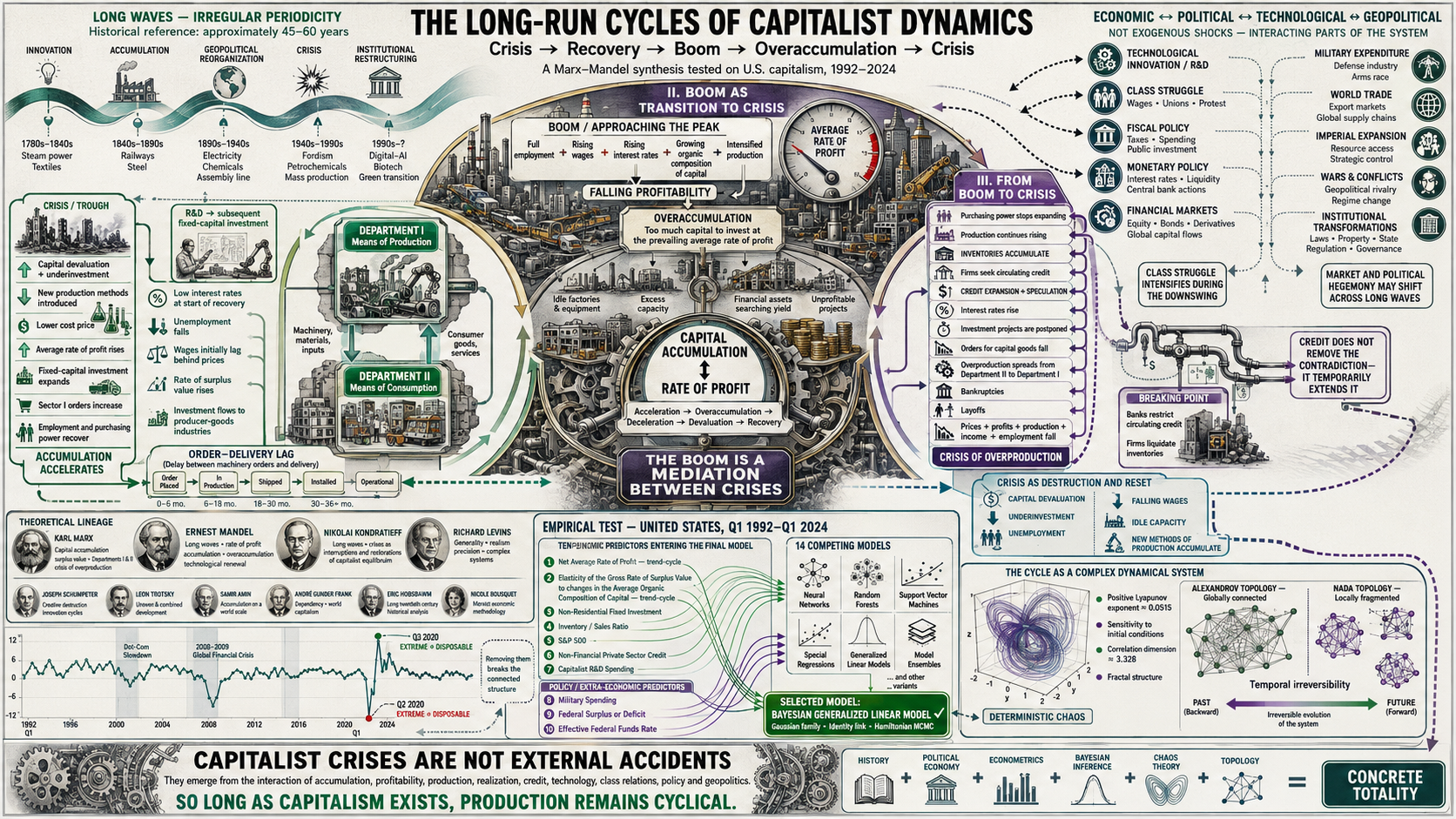
    Every few years the same story is told twice. First, that the economy has entered a new era in which the old rules no longer apply. Then, some months later, that what happened was an accident: a shock, a bubble, a virus, a war. Both tellings share a premise so quiet that it is rarely examined — that the rise and the fall are separate events, and that a good theory of the good years need not be a theory of the bad ones.

    The thesis released today argues the opposite, and then goes to some length to measure it. The boom and the crisis are not two phenomena but two moments of one: the crisis of overproduction is the mechanism by which capitalism restores the conditions of an accumulation that its own success had eroded. Devaluation clears the field; new methods of production are introduced under duress; profitability recovers on the ruins. The recovery is not the negation of the crisis. It is its product.

    That claim is old. What is new here is the attempt to make it decidable — to state it in a form that quarterly data on the United States economy between 1992 and 2024 could have contradicted, and then to check whether they do.

    Three questions, and why the order matters

    The investigation is organised around one general objective — to analyse the long-run cyclical behaviour of U.S. capitalism in the light of the dominant economic theories — and three specific ones, asked strictly in this order:

    • Which theory explains and predicts best? Not which is most elegant, or most widely taught, but which survives being pointed at the data.
    • Which factors generate the cycle? Economic and extra-economic alike — the thesis refuses in advance to treat wars and monetary policy as noise sitting outside a clean economic mechanism.
    • By which rules do those factors interact? A list of causes is not a theory. The theory is in the grammar that binds them.

    The order is not decorative. A great deal of applied economics answers the third question with machinery borrowed from a theory it never subjected to the first. Here the selection of the framework is itself a result, defended before it is used.

    Five families of an old argument

    Before measuring anything, the thesis maps the terrain. Economic thought on the cycle is sorted into five groups: the pre-Kondratieff non-heterodox schools; the Kondratieff school; the post-Kondratieff marginalist and neoclassical schools; the heterodox schools; and the historiographic vision of long waves, which reads the cycle through the archives rather than through the equations.

    With that map in hand, three long-running disputes are adjudicated rather than summarised. Does the crisis originate in overproduction or in underconsumption? Is a sustained expansion of credit a symptom of recovery, or of the exhaustion of the conditions that made recovery possible? Is there really an inverse relation between inflation and unemployment, or is the appearance of one an artefact of the precariousness of the labour market? Each is answered, and each answer carries consequences later, when the model is specified.

    A framework that states its own conditions of failure

    A substantial part of the theoretical apparatus is devoted to a materialist characterization of the dialectical method: its fundamental categories, a Marxist ontology built from a metalogical gnoseology, and an explicit treatment of verification, falsification and decidability. The purpose is unglamorous and indispensable — to fix, in advance, which propositions of the theory are empirically decidable and which are interpretive. Without that boundary, no amount of subsequent statistics can tell you what has been tested.

    Ten dials, seven of them internal

    The empirical core is a Bayesian generalized linear model of the growth of U.S. real output, estimated with Hamiltonian Monte Carlo and cross-validated against machine-learning and deep-learning competitors. It retains thirteen coefficients across ten factors. Seven are economic:

    FactorWhat it registers
    Net Average Rate of Profit (ARoP)The central variable of the accumulation process, and the one whose long-run tendency the theory predicts.
    Elasticity of the gross rate of surplus value to the average organic composition of capitalHow the exploitation of labour power responds when the technical structure of capital changes.
    Non-residential fixed investmentThe pace of accumulation in the productive sector; the hinge between boom and crisis.
    Inventory-to-sales ratioThe gap between producing value and realising it on the market.
    S&P 500Financialization, entering through a natural cubic spline with three degrees of freedom.
    Non-financial private sector creditThe credit system as the accelerator and the brake, splined with two degrees of freedom.
    Capitalist R&D spendingThe innovative impulse; the second largest coefficient in the model.

    And three are extra-economic: military spending (splined with three degrees of freedom), the federal surplus or deficit, and the effective federal funds rate. Their presence is not a concession to realism. It follows from the argument that an imperial economy counteracts the tendency of its own profit rate to fall by means that are not internal to its national accounts.

    The Average Rate of Profit carries the fourth largest coefficient of the thirteen — behind only the intercept, R&D spending, and one basis function of the splined S&P 500. The conclusion the author draws from its behaviour is worth quoting in substance: what is favourable to the global process of capital accumulation is not thereby favourable to the dynamics of aggregate growth. The two are not the same quantity, and treating them as one is precisely the confusion the cycle punishes.

    Note, too, what the splines are doing. Three of the ten factors would not sit still in a straight line. That is not a technical footnote: it is the first quantitative sign that the interaction of these factors involves thresholds and turning points rather than a stable proportionality.

    Not random. Chaotic.

    “Unpredictable” and “random” are not synonyms, and the difference decides what kind of science economics can be. A random system has no internal structure to find. A chaotic one is rigidly determined and still unpredictable at long horizons, because arbitrarily small differences in initial conditions grow exponentially apart.

    Three measurements place the U.S. economy in the second category. The Lyapunov exponent is positive (approximately $0.0515$): small perturbations amplify rather than dissipate. The correlation dimension is not an integer ($3.32798$): the attractor reconstructed by Takens’ theorem has a fractal structure, patterns repeating across scales of time and magnitude — which is what “cyclical, but not periodic” means when it is stated precisely. And recurrence quantification finds high determinism alongside variability in laminarity and in the maximum diagonal line length: underlying deterministic structures that themselves evolve.

    $\lambda > 0 \quad\text{with}\quad D_2 = 3.32798 \notin \mathbb{Z}$

    Read together, these say something a forecaster should find sobering and a theorist should find encouraging. The long-horizon forecast is not merely hard; it is structurally bounded. But the structure that bounds it is real, stable and measurable — which is exactly what a theory of the cycle needs to have something to explain.

    The shape of time

    The most unusual instrument in the thesis is topological. The idea is to stop asking how big the numbers are and start asking which observations can see which. Convert the series into a directed visibility graph — a link from one quarter to another when the second is visible from the first over the intervening data — and study the order structure that results.

    Two topologies are built on it, and they disagree in an informative way.

    • The coarser Alexandrov topology, built on temporal reachability, turns out to be connected. At the level of its order structure the economy is globally a single piece: every observation is bound to every other by chains of temporal visibility. There is no quarter that stands apart.
    • The finer Nada topology is locally fragmented — six components under the natural visibility graph, thirty-six under the horizontal one. Zoom in, and the fabric shows seams: structural discontinuities at the level of closed neighbourhoods.

    Global unity and local rupture at once. That duality is not a contradiction to be resolved; it is the object being described. And a third measurement gives the whole thing a direction: the bitopological analysis yields $D = +4$, meaning that expansions generate more temporal visibility than contractions. The cycle is not symmetric in time. Growth accumulates gradually and in view; collapse happens abruptly and blind. Run the film backwards and it is recognisably the wrong film.

    ⚠️ Why you must not “clean” the crises

    There is a habit in applied work of treating extreme values as contamination and smoothing them away by discontinuous imputation. Here that habit is shown to be a category error with a measurable price. The extreme fluctuations of the 2020 crisis belong to a connected block even under the finer topology; severing them is a topological rupture, not a cleaning operation. The thesis reports the consequence directly: models fitted after such imputation performed worse, because one was using predictors suited to one phenomenon — real output growth — to predict a qualitatively different one: real output growth after the crisis had been removed from it. The crises are not noise around the cycle. They are the cycle.

    The grammar of the cycle

    The third question receives a seven-part answer. The factors interact through feedback (the rate of profit shapes investment, investment shapes the organic composition of capital, which feeds back into the rate of profit); time lags (R&D and fixed investment pay out on a delay, and the delay is itself cycle-generating); non-linearity (thresholds and regime changes, which is why three factors needed splines); deterministic chaos; sectoral interdependence between the department producing means of production and the one producing means of consumption; topological structure, global connectedness with local fragmentation; and the influence of the global context, which is how military spending and the S&P 500 enter a nominally domestic account.

    The unifying claim is that each phase of the cycle contains the seed of its own negation. New methods of production introduced during the crisis lay the foundations of the next boom; the overaccumulation of the boom prepares the ground for the next crisis. Innovation initially arrests the fall of the profit rate and ultimately deepens it — through the way the degree of exploitation of labour power responds, over time, to the very methods introduced to raise it.

    What a cycle is for

    The thesis closes on a question most treatments never pose. If the cycle is a mechanism, what does it accomplish? Two answers, at different depths. Its intermediate practical end is to restart the process of capital accumulation once instability has reached a critical level — this the mechanism achieves, repeatedly, at a cost borne unevenly. Its definitive practical end is to lay the material and spiritual conditions for a reorganization of the fundamental productive structure of society, one capable of a stability beyond what the capitalist mode of production can reach within its own limits.

    What this establishes, and what it does not

    The evidence supports the claim that classical Marxist economic theory possesses the greatest explanatory and predictive capacity for long-run cycles among the theories examined here, on this economy, over this period. It is a comparative result on the United States between 1992 and 2024, quarterly — not a universal proof, and not a forecast. The thesis is explicit about the cost of its own data: the Average Rate of Profit and the average rate of surplus value were available only annually through 2020, and completing the series to 2024 required temporal disaggregation and prediction, which puts a wider band of uncertainty around the most recent quarters. The philosophical, historical, conceptual and statistical scope of each result is distinguished in the text, and results unfavourable to the hypotheses are reported alongside the favourable ones.

    About this edition

    This is the English edition of a thesis originally written in Spanish and submitted to the Universidad Latina de Costa Rica for the degree of Licentiate in Economics. It is interdisciplinary by construction, drawing on Marxist political economy, dialectical and historical materialism, the history and historiography of economic thought, the philosophy and methodology of science, econometrics, Bayesian statistics, the theory of complex systems and topology.

    The edition carries a Note on the Translation that fixes the rendering of the terms whose Spanish usage is technical and not interchangeable with their nearest English cognates — gnoseology, sublation, long wave, solvent demand, technique — and records the editions from which quotations are taken, including the two distinct English and Spanish editions of the Soviet philosophical dictionary, which are cited under different transliterations because they are different books with different pagination.

  • A DIALECTICAL MATERIALIST ANALYSIS ON PATH DEPENDENCE, IRREVERSIBILITY AND TELEOLOGY IN PHYSICAL SYSTEMS

    A DIALECTICAL MATERIALIST ANALYSIS ON PATH DEPENDENCE, IRREVERSIBILITY AND TELEOLOGY IN PHYSICAL SYSTEMS

    Why Broken Eggs Don’t Unbreak — A New Physics of History, Direction, and Purpose
    Physics • Philosophy • Foundations

    Why Broken Eggs Don’t Unbreak

    A philosopher argues that history, not mechanics, is the deepest grammar of the physical world — and that matter itself pursues stability.

    Based on a paper by José Mauricio Gómez Julián ~9 min read

    Why does a broken egg never reassemble itself? Every law governing the motion of its atoms is perfectly reversible — run the film backward and nothing in the mathematics complains. And yet, in the real world, broken eggs stay broken. This gap between what our equations allow and what nature actually does has haunted physics for over a century. A new paper from the University of Costa Rica proposes an answer that is as philosophically bold as it is mathematically precise.

    The Paradox That Won’t Go Away

    In the 1870s, the Austrian physicist Josef Loschmidt challenged Ludwig Boltzmann’s statistical explanation of the second law of thermodynamics. His objection was devastatingly simple: if the equations of motion work the same forwards and backwards in time, how can entropy — disorder — only ever increase? This is Loschmidt’s paradox, and it sits at the intersection of thermodynamics, quantum mechanics, and the philosophy of science.

    Physicists have proposed many partial answers. Some invoke the statistical improbability of reversal (there are astronomically more disordered states than ordered ones). Others appeal to cosmological boundary conditions — the universe simply started in a very special, low-entropy state. More recent work, cited in this paper, turns to information theory and Landauer’s principle (the idea that erasing information has a minimum physical cost).

    But the author — José Mauricio Gómez Julián, writing from the University of Costa Rica — finds all of these solutions insufficient. His central claim is provocative: the paradox is not in nature. It is in our models. We build theories that are fundamentally ahistorical, then act surprised when the real world — which is fundamentally historical — doesn’t obey them. The problem, he argues, is not that reality misbehaves. It is that our theories refuse to remember.

    The Core Move

    Instead of asking “Why is the macroscopic world irreversible?”, the paper reframes the question entirely: “Why do we insist on building reversible models and then call irreversibility a paradox?”

    The Philosophical Engine: Dialectical Materialism

    The paper is grounded in dialectical materialism — a philosophical tradition rooted in Marx and Engels, developed further by Hegel (in its idealist form) and by Soviet physicists like Blokhintsev and Rosental. If that sounds unusual for a physics paper, the author would say: that’s exactly the point.

    Dialectical materialism holds that reality is made of matter in motion, that contradictions are not flaws in our thinking but features of the world, and that quantitative changes eventually produce qualitative leaps. It also insists on a distinction that modern physics has muddled:

    • Epistemology — what we can know and measure (our limitations as observers).
    • Ontology — what actually exists in the world, regardless of our ability to observe it.

    This distinction turns out to be the paper’s sharpest tool. When quantum mechanics says that a particle’s position is “uncertain,” the author asks: is that uncertainty a feature of reality (ontology), or a feature of our knowledge (epistemology)? His answer is nuanced and consequential. The Schrödinger equation itself is fully deterministic — give it an initial state and a Hamiltonian, and it will predict the future wave function with perfect precision. The randomness enters only when we try to measure — when the quantum system meets our macroscopic instruments.

    In other words, probability in quantum mechanics is an epistemological resource — a powerful tool for managing complexity and incomplete knowledge — not a statement that reality itself is fundamentally random. This does not mean quantum mechanics is wrong. It means that its probabilistic character tells us about us, not about the universe.

    The author is careful, however, to distinguish this from classical Laplacian determinism. Heisenberg’s uncertainty principle, he argues, is ontological — it reflects genuine structural features of reality (the complementarity between position and momentum). So the world is deterministic in a deep sense, but not in the naive clockwork sense. It is deterministic in the way a complex, path-dependent system is deterministic: constrained, structured, lawful — but too intricate for any observer to fully predict.

    When the terrain disagrees with the map, trust the terrain

    Path Dependence: History Before Time

    Here is where the paper makes its most original conceptual move. The author argues that path dependence is more fundamental than time itself.

    What does this mean? In complex systems — economies, ecosystems, living organisms — the current state depends not just on the present conditions but on the entire sequence of events that led there. An economy with the same GDP, population, and technology as another can behave very differently because its institutions, crises, and policy choices followed a different historical path. The paper claims this is not just a feature of complex systems. It is a feature of all physical reality, at every scale.

    In this framework, time is reimagined. It is not a background parameter through which things happen (as in Newtonian mechanics), nor a dimension woven into spacetime (as in relativity), but rather a structure that records material transformations — a kind of universal memory. Space and time co-emerge as the necessary fabric for matter to develop and preserve its evolutionary trajectory.

    The author traces this insight back to Hegel’s philosophy of nature (published decades before Einstein’s relativity), where place, space, and time are understood as a unity — and where motion (and therefore matter) arises from their contradiction. The passage is striking:

    Place is spatial singularity… This perishing and regenerating of space in time and of time in space… is movement. This becoming… is the immediate, identical and existing unity of space and time: it is matter.
    — Hegel, Encyclopaedia of the Philosophical Sciences

    If path dependence is fundamental, then irreversibility is not something to be explained — it is something to be assumed, just as mathematicians assume the existence of natural numbers rather than proving it. Every broken egg, every aging star, every evolved species is evidence that the universe remembers its own history.

    A New Equation for a Remembering Universe

    The author doesn’t stop at philosophy. He proposes a concrete mathematical reformulation of the Schrödinger equation — the foundational equation of quantum mechanics — to make path dependence explicit.

    Standard quantum mechanics writes:

    Standard Form

    iℏ ∂ψ/∂t = Ĥ ψ

    where the Hamiltonian Ĥ describes the system’s energy at a given instant.

    The paper’s reformulation introduces a history-dependent Hamiltonian:

    Path-Dependent Form

    iℏ ∂ψ/∂t = Ĥ(t) ψ

    where Ĥ(t) = Ĥ₀ + ∫ K(t, t′) ψ(t′) dt′

    Here, t is not clock time but an interaction index — an ordering of how physical interactions emerged. The kernel K(t, t′) encodes how every prior interaction influences the current one.

    This is a bold move. It says: the state of a quantum system at any moment is shaped by the entire chain of interactions that brought it there — not just by its instantaneous configuration. The author also defines a metric on this “interaction space,” capturing the distance between interactions in terms of both complexity and energy change, and proves it satisfies the standard properties of a mathematical metric (nonnegativity, symmetry, triangle inequality).

    The elegance of this formulation is that it reproduces known physics as special cases:

    • Classical regime (low energy, macroscopic): the metric reduces to ordinary Euclidean geometry.
    • Relativistic regime (high velocity): it reproduces the Minkowski spacetime interval.
    • Quantum regime (entanglement, superposition): the metric captures quantum correlations through entanglement entropy.

    Entanglement Without Spookiness

    The path-dependent framework also offers a fresh take on quantum entanglement — Einstein’s famous “spooky action at a distance.” In the standard picture, measuring one entangled particle seems to instantaneously affect its partner, no matter how far away. In the author’s framework, entangled particles don’t communicate across space. They share a common interaction history. They are “close” in interaction space even when they are far apart in physical space — much like two points on a folded piece of paper that look distant but are actually adjacent when the paper is unfolded.

    Bell’s theorem — which proved that no local realistic theory can reproduce all quantum predictions — is not violated but reinterpreted: the “nonlocality” is real in emergent spacetime but disappears when you consider the deeper interaction space. Locality is preserved at the fundamental level; it only appears broken in the effective spacetime we observe.

    Why Does Matter Seek Stability?

    IV

    The paper’s second major argument is about teleology — the idea that natural processes are directed toward ends or purposes. This is a concept that modern science has largely banished (with some notable exceptions in biology). The author argues it should be restored — but in a materialist, not a mystical, form.

    The claim: physical systems universally tend toward maximum achievable stability within their material constraints. This is not an external force or an intelligent design. It is an inherent property of matter itself, arising from the internal contradictions within material systems.

    The evidence spans every scale of reality:

    • Cosmological: The universe’s laws appear “fine-tuned” for structure and complexity. Cyclic cosmological models suggest a drive to preserve laws conducive to stability.
    • Stellar: Stars burn through nuclear fuel, then transform — into white dwarfs, neutron stars, or supernovae — each outcome representing a reorganization toward the next achievable stable state.
    • Chemical: The pressure-induced transformation of graphite to diamond. Autocatalytic systems that reorganize when reactants deplete.
    • Biological: DNA’s role as a stable transcription template. Gould’s punctuated equilibria — long periods of stasis followed by rapid change. Insect metamorphosis.
    • Neural: The brain reorganizing through neuroplasticity after injury or during learning.
    • Social: Revolutions occurring when existing structures of production become incompatible with productive forces.

    In each case, the pattern is the same: systems seek stability, achieve it temporarily, exhaust the conditions that made it possible, undergo a qualitative transformation, and resume the search in a new configuration. Stability is the attractor; transformation is the mechanism.

    Least Action and Ground States

    The author connects this teleological perspective to two pillars of physics:

    The principle of least action — the mathematical rule that physical systems follow paths that extremize (usually minimize) the “action” functional. This is usually treated as a computational tool. The paper reinterprets it as a teleological law: systems select trajectories in service of their drive toward stability, and the path of least action is the one that best serves this purpose. Sometimes, the system does not take the absolute minimum energy path — because the absolute minimum may not serve the broader goal of sustained stability.

    The ground state tendency — quantum systems’ natural inclination to settle into their lowest energy configuration. The author, drawing on Solovej’s work on the stability of matter, argues this is not merely a mechanical outcome but an expression of matter’s fundamental need for stabilization. Electrons don’t “accidentally” fall into lower energy levels. They are driven there by the internal logic of material reality.

    Key Insight

    Teleology here is not purpose in the human sense — no intentions, no intelligence. It is the tendency of matter to resolve its own internal contradictions by seeking the most stable configuration available. Purpose arises from the inherent contradictions of matter, not from any external guide.

    The Arrow of Time, Revisited

    With path dependence as the foundation, the arrow of time becomes almost trivial to explain. Time flows in one direction because systems are historical. The future depends not only on the present state but on the entire trajectory that led to it. Irreversibility is not a statistical accident or a cosmological boundary condition — it is a structural feature of reality, as basic as the existence of natural numbers in mathematics.

    The author draws an analogy to the Cosmic Microwave Background (CMB) — the faint radiation left over from the early universe, which provides a natural “preferred frame” for cosmic observations without violating relativity. Similarly, the paper proposes that a preferred temporal direction can emerge from path dependence without requiring absolute time. Each observer may have their own “proper time,” but the causal structure — the chain of dependencies — is invariant and objective across all reference frames.

    This bridges a gap between quantum mechanics and general relativity. Quantum theory works with a notion of time closer to the classical (absolute) picture, while relativity treats time as relative and observer-dependent. The path-dependence framework offers a way to reconcile both: the ordering of interactions is fundamental and observer-independent; the measurement of time is relative.

    Testable Predictions

    The paper does not remain in the realm of philosophy. It proposes four concrete experimental protocols:

    • Decoherence studies: Prepare identical quantum systems, give them different interaction histories, and measure whether their decoherence rates differ. The paper predicts they will.
    • Entanglement analysis: Generate entangled photon pairs, expose them to different interaction histories, and check whether entanglement strength decays exponentially with “interaction distance” as the metric predicts.
    • Modified double-slit experiment: Introduce controlled interaction histories before particles reach the slits and look for history-dependent deviations in the interference pattern.
    • Time emergence clocks: Prepare identical atomic clocks with different interaction histories and compare their temporal evolution rates.

    These are technically demanding experiments — requiring millikelvin temperatures, ultra-high vacuum, single-photon detection, and high-fidelity quantum tomography — but they are within reach of current laboratory capabilities. The predictions are specific enough to be falsified, which is exactly what good science requires.

    Why This Matters Beyond Physics

    FOR THE NON-PHYSICIST

    If you are an economist, a political scientist, or simply someone who thinks about how societies change, this paper’s conceptual framework should feel familiar — and provocative.

    The concept of path dependence is already central to institutional economics (think of Douglass North or Paul David’s QWERTY keyboard). The idea that history matters — that you cannot understand a system’s current state without knowing how it got there — is a staple of comparative politics and historical sociology. What this paper does is argue that path dependence is not just a useful metaphor borrowed from physics. It is a fundamental feature of physical reality itself.

    Similarly, the paper’s concept of teleology without intention — systems pursuing stability through the internal logic of their own contradictions — resonates powerfully with Marx’s theory of historical materialism, where modes of production develop, exhaust their potential, and undergo revolutionary transformation. The author draws this connection explicitly, noting that revolutions occur “when existing relations of production become incompatible with developing productive forces.”

    And the distinction between epistemology and ontology — between what we can model and what actually exists — is a question every social scientist should take seriously. When our econometric models fail to predict a financial crisis, is the crisis a “black swan” (an anomaly), or is it evidence that our models are too ahistorical to capture reality?

    The problem is not that reality “contradicts” theory but that theory is a limited abstraction of reality, creating tension when attempting to make reality fit the model instead of developing models that capture reality’s historical-contextual nature.
    — José Mauricio Gómez Julián

    A Bridge Between Worlds

    This is not a paper that will convince everyone. Its philosophical framework — dialectical materialism — is unfamiliar and, for some, politically charged. Its mathematical proposals, while rigorous, are exploratory and await experimental confirmation. Its claim that teleology is a fundamental feature of matter will strike many physicists as a step backward toward pre-modern thinking.

    But that is precisely what makes it worth reading. In a landscape where theoretical physics has fragmented into string theory, loop quantum gravity, and various interpretations of quantum mechanics that all reproduce the same experimental results, a paper that asks “What if we’re starting from the wrong assumptions?” is exactly the kind of provocation that science needs.

    The paper’s deepest contribution may be methodological: a demonstration that philosophy and physics can inform each other without either colonizing the other. The philosophical framework provides the conceptual clarity to ask better questions. The physics provides the experimental discipline to test whether those questions have real answers.

    Whether or not its specific proposals survive experimental scrutiny, the paper succeeds in something more modest but no less important: it makes you see the broken egg differently. Not as a problem to be explained away, but as evidence of a universe that remembers — and that, in remembering, moves irreversibly forward.

    Original paper: “A Dialectical Materialist Analysis on Path Dependence, Irreversibility and Teleology in Physical Systems” by José Mauricio Gómez Julián, University of Costa Rica.

    Available as a preprint: OSF Preprints

    This post is an explanatory summary and does not represent the views of the author or any institution. Errors in interpretation are the blogger’s own.

  • Outlining a Dialectical Hypothesis On The C-Value Paradox In The Light of Quantum Chemistry

    Outlining a Dialectical Hypothesis On The C-Value Paradox In The Light of Quantum Chemistry

    Why an Amoeba Has 200 Times More DNA Than You — A Philosophical Take on the C-Value Paradox
    Explainers · Philosophy of Science · Molecular Biology

    The C-Value Paradox:

    Why an Amoeba Has 200 Times More DNA Than You?

    A philosopher argues that the way we count genes is broken — and proposes a dialectical, quantum-informed fix.

    Blog Post 2025
    ~ 9 min read

    Imagine you are handed two books. One is a slim novella; the other is an encyclopedia the size of a suitcase. Intuitively, you’d guess the encyclopedia contains more information. Now imagine that the novella turns out to encode the instructions for building an entire human being, while the suitcase-sized volume merely describes how to be a single-celled amoeba. Welcome to the C-value paradox — one of the most stubborn puzzles in modern biology — and to a recent paper that proposes a genuinely unusual way of thinking about it.

    The article in question is “Outlining a Dialectical Hypothesis on the C-Value Paradox in the Light of Quantum Chemistry” by the philosopher José Mauricio Gómez Julián, published in the Pitt Philosophy of Science archive (available here). It is not a typical biology paper. It moves fluidly between Hegelian logic, quantum mechanics, selfish genetic elements, and the mathematics of how we measure sets. If that sounds intimidating, don’t worry: by the end of this post, you’ll see why the argument matters — even if you’ve never opened a biology textbook.

    1. The Puzzle: More DNA, But Not More Complexity

    Let’s start with the basics. Every living cell carries a complete copy of the organism’s DNA — its genome. Biologists measure genome size in base pairs (bp) or, for convenience, in megabases (Mb), where 1 Mb = one million base pairs. This measurement is called the C-value.

    In prokaryotes (bacteria and archaea — the simplest forms of life, without a cell nucleus), the relationship is fairly intuitive: bigger genome, more genes, somewhat more complex organism. But when we turn to eukaryotes (everything from yeast to humans, with cells that contain a nucleus), the intuition collapses.

    A Few Striking Numbers
    Organism Genome Size (Mb) Gene Count (approx.)
    Yeast12~6,000
    Fruit fly180~14,000
    Human3,400~20,000–25,000
    Onion18,000
    Amoeba (A. dubia)686,000

    Sources: Latorre & Silva (2013); Pray (2022).

    A single-celled amoeba carries roughly 200 times more DNA than a human being. An onion needs about five times more DNA than we do. Amphibians, as a group, show genome-size variations of up to 91-fold. As the paper notes, citing Latorre and Silva, “it is hard to believe that this may reflect variations of nearly 100 times the number of genes necessary to give rise to the corresponding amphibians.”

    Nor is it simply a matter of how many genes there are. Even the raw count of protein-coding genes doesn’t track complexity well: a pufferfish has roughly the same number as a human (~35,000), and the rice plant has more (~51,000). The disconnect between genome size, gene number, and organismal complexity is the C-value paradox.

    2. Why Should Anyone Outside Biology Care?

    If you’re an economist, a political scientist, or a mathematician, you might be wondering what amoebae have to do with your work. The answer lies not in the biological details but in the type of reasoning the paper employs. Gómez Julián is making an argument about how we measure complexity — and specifically, why our standard tools for counting and measuring break down when the system we’re studying is fundamentally nonlinear.

    This is a problem that recurs everywhere: in financial markets (where small shocks cascade unpredictably), in political systems (where a single event can reshape an entire order), and in ecology (where species interact in webs, not chains). The C-value paradox is, at its core, a case study of what happens when you try to impose a linear accounting framework on a nonlinear reality.

    3. The Philosophy: What Does “Dialectical” Mean Here?

    The paper’s philosophical backbone comes from dialectical materialism — a tradition rooted in Hegel and adapted by Marx, Engels, and later Soviet philosophers. For readers unfamiliar with the term, here is the essence in plain language:

    Things are not only what they are in terms of their current state of development, but also their potential.

    In this framework, reality is a totality: not just what currently exists, but what could exist, what is coming into being, and what is being annihilated. The concept of “contradiction” is central — but not in the colloquial sense of a logical error. A dialectical contradiction means that any complex thing contains opposing developmental tendencies that are simultaneously complementary and mutually exclusive. These tendencies can be nonantagonistic (stable, coexisting) or antagonistic (destabilizing, eventually forcing the system to transform into something qualitatively new).

    Gómez Julián draws an explicit parallel between this philosophical notion and Bohr’s complementarity principle in quantum mechanics: to understand a quantum phenomenon fully, you need both the wave description and the particle description, even though they are mutually exclusive. The paper argues that this isn’t merely an analogy — it reflects a deeper logical structure shared across physics, chemistry, and biology.

    For those with an economics background, the parallel to dialectical reasoning in political economy is direct. Just as a commodity is simultaneously a use-value and an exchange-value — and you cannot understand the commodity by examining only one aspect — so a gene is simultaneously a physical structure (DNA sequence) and a functional agent (information carrier, regulatory element, or “selfish” replicator). Reducing it to just one dimension is precisely what creates the paradox.

    4. The Mathematical Core: Why Linear Counting Fails

    Now we arrive at what will interest the mathematicians and econometricians. The paper makes a precise mathematical claim: the tools we use to count genes assume linearity, but the genetic system is nonlinear.

    Formally, a function φ is called sigma-additive (or countably additive) if the measure of a union of disjoint sets equals the sum of the measures of each set. This is the standard foundation of probability theory and measure theory — the Kolmogorov axioms that every statistician and econometrician relies on.

    A subadditive function, by contrast, only requires that the measure of the union be less than or equal to the sum of the parts. Additive functions are a special case of subadditive ones. In genetics, if you use an additive model, you are assuming a perfect linear relationship between the number of allele copies and the organism’s traits — no dominance, no interaction, no epistasis. As Huang and Mackay (2016) showed, this assumption is empirically inadequate for most quantitative traits.

    Gómez Julián’s argument is that counting genes with sigma-additive functions implicitly treats the genome as a linear system: more genes = proportionally more complexity. But the evidence shows this is false. The complexity emerges from how genes interact, not from how many there are. Therefore, the counting function itself must change.

    5. What Actually Generates Complexity? Eight Factors

    The paper proposes that any meaningful relationship between gene count and organismal complexity must account for eight key aspects of the underlying molecular processes. Here they are, translated into plain terms:

    1. What kind of information is encoded? — Not all genes carry the same type of instruction. Some code for structural proteins; others regulate when and where those proteins are made.
    2. What encoding system is used? — The “language” of the genome is not uniform; different regions operate under different coding rules.
    3. Should we weight protein-coding genes more heavily? — Protein-coding genes make up only about 1.5% of the human genome. Should the other 98.5% count equally?
    4. What type of transcription occurs? — Through alternative splicing, a single gene can produce multiple different proteins. Humans may produce over 500,000 distinct proteins from only ~20,000 genes. The process is not one-to-one.
    5. DNA is a nonlinear dynamical system. — The double helix doesn’t behave like a simple linear chain. Researchers have modeled it using nonlinear Hamiltonians since at least the 1980s, and solitary conformational waves (solitons) can propagate along the strand.
    6. What type of gene is involved? — There are protein-coding genes, RNA genes, regulatory sequences, transposable elements, and more. They don’t all contribute to “complexity” in the same way.
    7. What role do “negative genes” play? — This is one of the paper’s most distinctive contributions. Gómez Julián renames so-called “selfish genes” as “negative genes” — borrowing the concept of negativity from dialectical philosophy. These are genetic elements (like transposons) that replicate for their own benefit, even if they are harmful or neutral to the organism. They exist in a state of unity and struggle with the organism’s “ordinary” genes, and this conflict is, according to Werren (2011), “an important driver of evolutionary change and innovation.”
    8. What happens during and around transcription? — This is when the DNA double helix unwinds and single strands are exposed. It is the moment of maximum vulnerability and maximum creative potential: DNA editing, trans-splicing, and tandem chimerism all occur here. The source of nonlinear complexity, the paper argues, is concentrated in this phase.

    If these eight factors could be incorporated into a new kind of counting function — one that captures nonlinear interactions, gene regulation, and the dialectical interplay between “positive” and “negative” genes — the paradox might dissolve. Genome size and gene number would, at least approximately, map onto organismal complexity.

    6. Quantum Chemistry Enters the Picture

    You might wonder: where does quantum mechanics fit into all of this? The paper’s answer is that the covalent bonds holding DNA together are quantum-mechanical phenomena. As early as the 1920s, Heitler and London showed that covalent bonds can be understood through the Schrödinger equation. The nucleotides in each DNA strand are linked by strong covalent bonds, so the strand’s dynamics — its rigidity, its unwinding, its conformational changes — are ultimately governed by quantum mechanics.

    In practice, solving the full Schrödinger equation for a molecule as large as DNA is computationally staggering. But progress is being made. The paper points to three recent advances:

    Computational Progress

    Analytical and numerical solutions of the Peyrard-Bishop DNA model (a nonlinear model of DNA dynamics) now show strong convergence (Al et al., 2020). Kink and localized solutions for the helicoidal version of the same model have been found and could serve as tools for modeling DNA-to-RNA transcription (Zdravković et al., 2019). And quantum annealing has been applied to de novo genome assembly — solving the combinatorial problem of stitching DNA fragments together using quantum and quantum-inspired optimization (Boev et al., 2021).

    These are early steps, but they suggest that the computational barriers to modeling DNA as a quantum-mechanical, nonlinear system are not permanent. Quantum computing may eventually make the Schrödinger-based analysis of large molecules feasible.

    7. The Bigger Picture: A Self-Teaching Universe

    At this point, the paper makes its most ambitious philosophical move. Drawing on research by Alexander et al. (2021), Gómez Julián describes a universe that is self-organized, deterministic, historically determined, and autodidactic — one that “evolves learning in an autodidactic way its own laws,” applying a process physically equivalent to biological natural selection at a cosmological scale. The universe, in this view, is a system that adds new nonlinearities to itself over time — a kind of spontaneous increase in complexity.

    This is linked to the concept of emergence: the spontaneous appearance of new information (new structures, new behaviors) as a result of a system’s internal dynamics. The laws of physics may themselves be subject to higher-order laws, just as a logic of a certain order is subject to the rules of a higher-order logic.

    For the C-value paradox, the implication is this: you cannot understand the parts (genes) without understanding the whole (the organism and its evolutionary history), and you cannot understand the whole without understanding how it emerged from the parts. The truth, as Hegel would say, is in the totality.

    · · ·

    8. So What Would a Solution Actually Look Like?

    Gómez Julián is careful to say that his paper is a guide, not a solution. He proposes the construction of a “paradox-free gene counting function” (PFGCF) — a new mathematical object that would replace simple sigma-additive counting with something capable of capturing:

    • Nonlinear gene interactions
    • The role of alternative splicing and regulatory elements
    • The dialectical interplay between ordinary genes and “negative” (selfish) genes
    • Quantum-mechanical properties of DNA structure
    • What happens during and around transcription

    This function might not even be a single function at all, but rather a family of functions, each capturing different aspects of genomic complexity. The construction will require, the paper argues, “philosophers, chemists, geneticists, and physicists, as well as the use of high-capacity computational equipment.”

    It is, in the author’s own words, a “legitimate speculation” — grounded in established science but not yet experimentally verified. The value of the paper lies in its identification of which factors matter and what kind of mathematics is needed, rather than in providing a finished model.

    9. Why This Paper Matters (Even If You’re Not a Biologist)

    Let’s return to the question of why a non-biologist should care. Here are three reasons:

    The whole is more than the sum of its parts — and the tools we use to count the parts must reflect that.

    First, the paper is a case study in interdisciplinary thinking. It weaves together philosophy, mathematics, chemistry, and biology in a way that is rare in any field. Whether or not you agree with its dialectical-materialist framework, the attempt to build a bridge between Hegel and quantum chemistry is intellectually stimulating.

    Second, it highlights a general methodological problem: when linear tools fail, what replaces them? Economists face this when GDP doesn’t capture well-being; political scientists face it when vote counts don’t capture democratic health; mathematicians face it whenever measure theory meets real-world complexity. The paper’s call for new counting functions is, at bottom, a call for new mathematics.

    Third, it reminds us that paradoxes are productive. The C-value paradox has been around for decades and hasn’t been solved — but it has forced biologists to discover alternative splicing, transposable elements, non-coding RNA, and epigenetic regulation. The paradox was never a dead end; it was a signpost pointing toward deeper truths. That’s a lesson every discipline can take to heart.

    · · ·

    You can read the full paper by José Mauricio Gómez Julián at the PhilSci Archive: https://philsci-archive.pitt.edu/24513/

  • A New Theory in Physics Claims to Solve the Mystery of Consciousness

    A New Theory in Physics Claims to Solve the Mystery of Consciousness

    Interesante artículo, sin embargo, debe tenerse cuidado de no caer en la tentación del reduccionismo. Tentación a la que parecen sucumbir los investigadores cuando señalan que “la conciencia debe investigarse con las mismas herramientas matemáticas que los físicos usan para otros fenómenos relativistas conocidos”. A pesar de ello, “Ella no usa órganos sensoriales, mide sus representaciones neuronales directamente por la interacción entre una parte de su cerebro con otras partes. Mide sus representaciones neuronales según sus relaciones con otras representaciones neuronales.” es un notable hallazgo en términos de la relación del todo y las partes y en términos de que lo fundamental en los fenómenos son sus relaciones internas. Esto refuerza diversos principios del Materialismo Dialéctico.

    Source: Bar-Ilan University How do 1.4 kg of brain tissue create thoughts, feelings, mental images, and an inner world? The ability of the brain to create consciousness has baffled some for millennia. The mystery of consciousness lies in the fact that each of us has subjectivity, something that is like to sense, feel and think. […]

    A New Theory in Physics Claims to Solve the Mystery of Consciousness