
LISTEN TO THIS POST AS A PODCAST
The Shape of a Crisis
Every few years the same story is told twice. First, that the economy has entered a new era in which the old rules no longer apply. Then, some months later, that what happened was an accident: a shock, a bubble, a virus, a war. Both tellings share a premise so quiet that it is rarely examined — that the rise and the fall are separate events, and that a good theory of the good years need not be a theory of the bad ones.
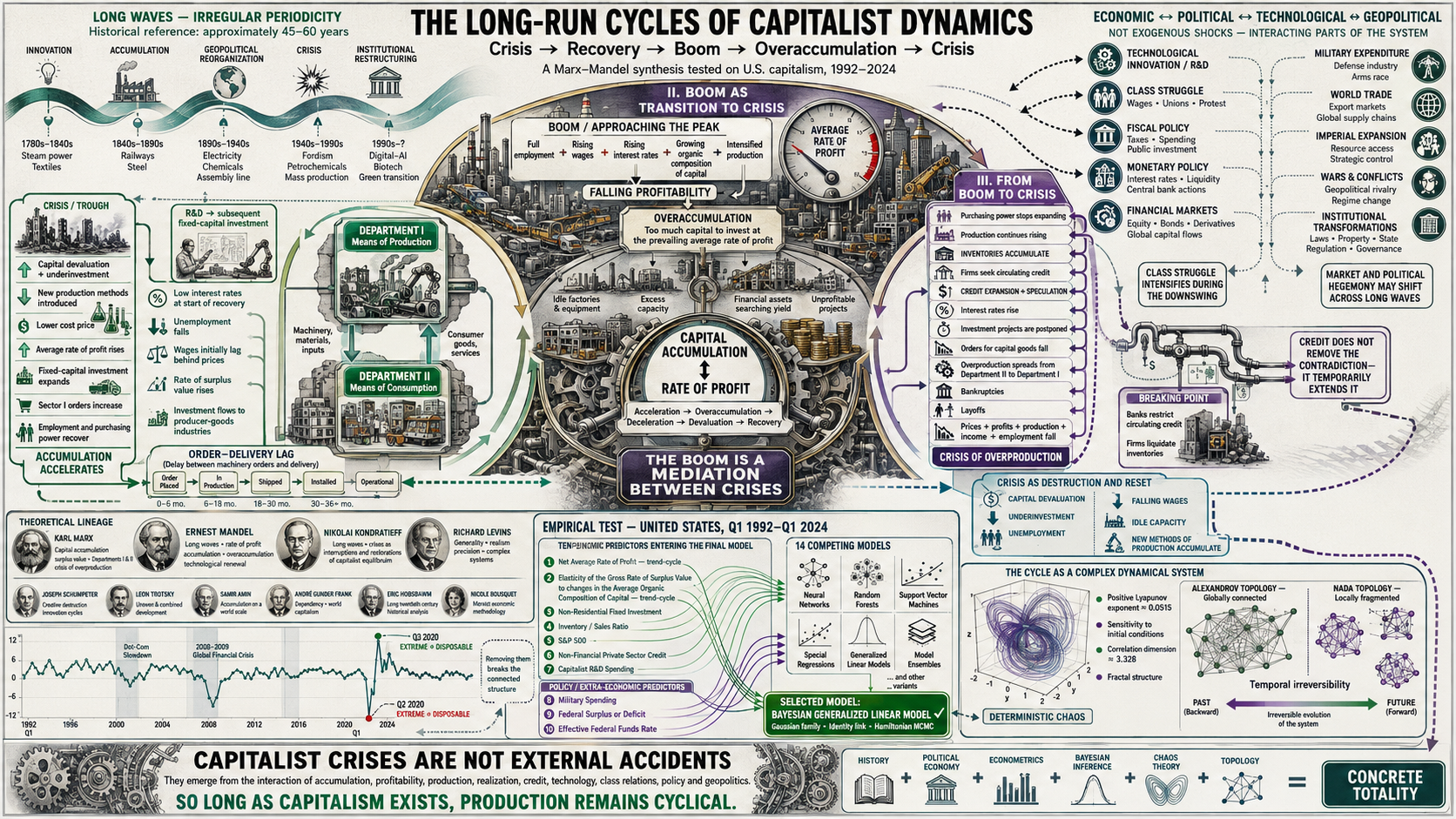
The thesis released today argues the opposite, and then goes to some length to measure it. The boom and the crisis are not two phenomena but two moments of one: the crisis of overproduction is the mechanism by which capitalism restores the conditions of an accumulation that its own success had eroded. Devaluation clears the field; new methods of production are introduced under duress; profitability recovers on the ruins. The recovery is not the negation of the crisis. It is its product.
That claim is old. What is new here is the attempt to make it decidable — to state it in a form that quarterly data on the United States economy between 1992 and 2024 could have contradicted, and then to check whether they do.
Three questions, and why the order matters
The investigation is organised around one general objective — to analyse the long-run cyclical behaviour of U.S. capitalism in the light of the dominant economic theories — and three specific ones, asked strictly in this order:
- Which theory explains and predicts best? Not which is most elegant, or most widely taught, but which survives being pointed at the data.
- Which factors generate the cycle? Economic and extra-economic alike — the thesis refuses in advance to treat wars and monetary policy as noise sitting outside a clean economic mechanism.
- By which rules do those factors interact? A list of causes is not a theory. The theory is in the grammar that binds them.
The order is not decorative. A great deal of applied economics answers the third question with machinery borrowed from a theory it never subjected to the first. Here the selection of the framework is itself a result, defended before it is used.
Five families of an old argument
Before measuring anything, the thesis maps the terrain. Economic thought on the cycle is sorted into five groups: the pre-Kondratieff non-heterodox schools; the Kondratieff school; the post-Kondratieff marginalist and neoclassical schools; the heterodox schools; and the historiographic vision of long waves, which reads the cycle through the archives rather than through the equations.
With that map in hand, three long-running disputes are adjudicated rather than summarised. Does the crisis originate in overproduction or in underconsumption? Is a sustained expansion of credit a symptom of recovery, or of the exhaustion of the conditions that made recovery possible? Is there really an inverse relation between inflation and unemployment, or is the appearance of one an artefact of the precariousness of the labour market? Each is answered, and each answer carries consequences later, when the model is specified.
A framework that states its own conditions of failure
A substantial part of the theoretical apparatus is devoted to a materialist characterization of the dialectical method: its fundamental categories, a Marxist ontology built from a metalogical gnoseology, and an explicit treatment of verification, falsification and decidability. The purpose is unglamorous and indispensable — to fix, in advance, which propositions of the theory are empirically decidable and which are interpretive. Without that boundary, no amount of subsequent statistics can tell you what has been tested.
Ten dials, seven of them internal
The empirical core is a Bayesian generalized linear model of the growth of U.S. real output, estimated with Hamiltonian Monte Carlo and cross-validated against machine-learning and deep-learning competitors. It retains thirteen coefficients across ten factors. Seven are economic:
| Factor | What it registers |
|---|---|
| Net Average Rate of Profit (ARoP) | The central variable of the accumulation process, and the one whose long-run tendency the theory predicts. |
| Elasticity of the gross rate of surplus value to the average organic composition of capital | How the exploitation of labour power responds when the technical structure of capital changes. |
| Non-residential fixed investment | The pace of accumulation in the productive sector; the hinge between boom and crisis. |
| Inventory-to-sales ratio | The gap between producing value and realising it on the market. |
| S&P 500 | Financialization, entering through a natural cubic spline with three degrees of freedom. |
| Non-financial private sector credit | The credit system as the accelerator and the brake, splined with two degrees of freedom. |
| Capitalist R&D spending | The innovative impulse; the second largest coefficient in the model. |
And three are extra-economic: military spending (splined with three degrees of freedom), the federal surplus or deficit, and the effective federal funds rate. Their presence is not a concession to realism. It follows from the argument that an imperial economy counteracts the tendency of its own profit rate to fall by means that are not internal to its national accounts.
The Average Rate of Profit carries the fourth largest coefficient of the thirteen — behind only the intercept, R&D spending, and one basis function of the splined S&P 500. The conclusion the author draws from its behaviour is worth quoting in substance: what is favourable to the global process of capital accumulation is not thereby favourable to the dynamics of aggregate growth. The two are not the same quantity, and treating them as one is precisely the confusion the cycle punishes.
Note, too, what the splines are doing. Three of the ten factors would not sit still in a straight line. That is not a technical footnote: it is the first quantitative sign that the interaction of these factors involves thresholds and turning points rather than a stable proportionality.
Not random. Chaotic.
“Unpredictable” and “random” are not synonyms, and the difference decides what kind of science economics can be. A random system has no internal structure to find. A chaotic one is rigidly determined and still unpredictable at long horizons, because arbitrarily small differences in initial conditions grow exponentially apart.
Three measurements place the U.S. economy in the second category. The Lyapunov exponent is positive (approximately $0.0515$): small perturbations amplify rather than dissipate. The correlation dimension is not an integer ($3.32798$): the attractor reconstructed by Takens’ theorem has a fractal structure, patterns repeating across scales of time and magnitude — which is what “cyclical, but not periodic” means when it is stated precisely. And recurrence quantification finds high determinism alongside variability in laminarity and in the maximum diagonal line length: underlying deterministic structures that themselves evolve.
Read together, these say something a forecaster should find sobering and a theorist should find encouraging. The long-horizon forecast is not merely hard; it is structurally bounded. But the structure that bounds it is real, stable and measurable — which is exactly what a theory of the cycle needs to have something to explain.
The shape of time
The most unusual instrument in the thesis is topological. The idea is to stop asking how big the numbers are and start asking which observations can see which. Convert the series into a directed visibility graph — a link from one quarter to another when the second is visible from the first over the intervening data — and study the order structure that results.
Two topologies are built on it, and they disagree in an informative way.
- The coarser Alexandrov topology, built on temporal reachability, turns out to be connected. At the level of its order structure the economy is globally a single piece: every observation is bound to every other by chains of temporal visibility. There is no quarter that stands apart.
- The finer Nada topology is locally fragmented — six components under the natural visibility graph, thirty-six under the horizontal one. Zoom in, and the fabric shows seams: structural discontinuities at the level of closed neighbourhoods.
Global unity and local rupture at once. That duality is not a contradiction to be resolved; it is the object being described. And a third measurement gives the whole thing a direction: the bitopological analysis yields $D = +4$, meaning that expansions generate more temporal visibility than contractions. The cycle is not symmetric in time. Growth accumulates gradually and in view; collapse happens abruptly and blind. Run the film backwards and it is recognisably the wrong film.
⚠️ Why you must not “clean” the crises
There is a habit in applied work of treating extreme values as contamination and smoothing them away by discontinuous imputation. Here that habit is shown to be a category error with a measurable price. The extreme fluctuations of the 2020 crisis belong to a connected block even under the finer topology; severing them is a topological rupture, not a cleaning operation. The thesis reports the consequence directly: models fitted after such imputation performed worse, because one was using predictors suited to one phenomenon — real output growth — to predict a qualitatively different one: real output growth after the crisis had been removed from it. The crises are not noise around the cycle. They are the cycle.
The grammar of the cycle
The third question receives a seven-part answer. The factors interact through feedback (the rate of profit shapes investment, investment shapes the organic composition of capital, which feeds back into the rate of profit); time lags (R&D and fixed investment pay out on a delay, and the delay is itself cycle-generating); non-linearity (thresholds and regime changes, which is why three factors needed splines); deterministic chaos; sectoral interdependence between the department producing means of production and the one producing means of consumption; topological structure, global connectedness with local fragmentation; and the influence of the global context, which is how military spending and the S&P 500 enter a nominally domestic account.
The unifying claim is that each phase of the cycle contains the seed of its own negation. New methods of production introduced during the crisis lay the foundations of the next boom; the overaccumulation of the boom prepares the ground for the next crisis. Innovation initially arrests the fall of the profit rate and ultimately deepens it — through the way the degree of exploitation of labour power responds, over time, to the very methods introduced to raise it.
What a cycle is for
The thesis closes on a question most treatments never pose. If the cycle is a mechanism, what does it accomplish? Two answers, at different depths. Its intermediate practical end is to restart the process of capital accumulation once instability has reached a critical level — this the mechanism achieves, repeatedly, at a cost borne unevenly. Its definitive practical end is to lay the material and spiritual conditions for a reorganization of the fundamental productive structure of society, one capable of a stability beyond what the capitalist mode of production can reach within its own limits.
What this establishes, and what it does not
The evidence supports the claim that classical Marxist economic theory possesses the greatest explanatory and predictive capacity for long-run cycles among the theories examined here, on this economy, over this period. It is a comparative result on the United States between 1992 and 2024, quarterly — not a universal proof, and not a forecast. The thesis is explicit about the cost of its own data: the Average Rate of Profit and the average rate of surplus value were available only annually through 2020, and completing the series to 2024 required temporal disaggregation and prediction, which puts a wider band of uncertainty around the most recent quarters. The philosophical, historical, conceptual and statistical scope of each result is distinguished in the text, and results unfavourable to the hypotheses are reported alongside the favourable ones.
About this edition
This is the English edition of a thesis originally written in Spanish and submitted to the Universidad Latina de Costa Rica for the degree of Licentiate in Economics. It is interdisciplinary by construction, drawing on Marxist political economy, dialectical and historical materialism, the history and historiography of economic thought, the philosophy and methodology of science, econometrics, Bayesian statistics, the theory of complex systems and topology.
The edition carries a Note on the Translation that fixes the rendering of the terms whose Spanish usage is technical and not interchangeable with their nearest English cognates — gnoseology, sublation, long wave, solvent demand, technique — and records the editions from which quotations are taken, including the two distinct English and Spanish editions of the Soviet philosophical dictionary, which are cited under different transliterations because they are different books with different pagination.
Leave a Comment/Deja un Comentario