
Science, Youth, and the Rebirth of a Central American Nation
The Origins of Scientific Unionism in Central America and Its Unavoidable Future
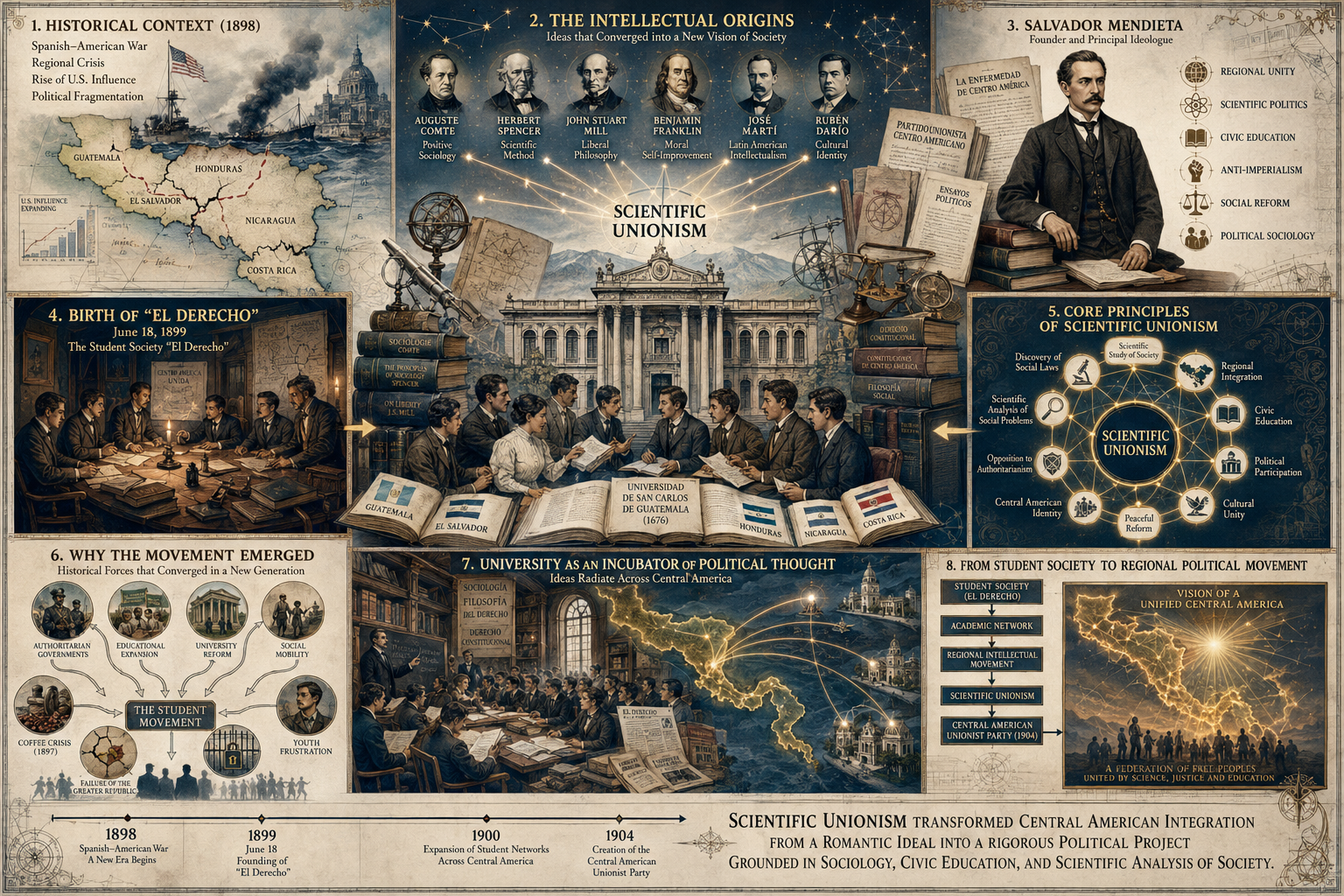
History is rarely kind to fragmented nations. At the dawn of the 20th century, Central America was a collection of small, vulnerable republics plagued by authoritarian rule, economic volatility, and the looming shadow of international imperialism. Yet, from the cloistered halls of the University of San Carlos in Guatemala, a quiet revolution was brewing. It was led not by generals, but by students. This is the story of how a group of young intellectuals pioneered “Scientific Unionism”—a movement to reunite Central America not through romantic nostalgia, but through the rigorous application of social sciences.
Based on Margarita Silva Hernández’s illuminating research, this post explores the historical genesis of this movement. Furthermore, it asks a vital question for today’s political scientists and economists: If Scientific Unionism was valid a century ago, is it not an absolute, long-term historical inevitability for Central America’s survival on the global stage today?
The Catalyst: 1898 and the Shift in Global Power
To understand the birth of Scientific Unionism, we must look at the pivotal year of 1898. The Spanish-American War resulted in a resounding victory for the United States, establishing it as a first-rank global power with expansionist ambitions in the Caribbean and Central America. For a group of young university students, this was not merely a geopolitical shift; it was an existential threat. They perceived the conflict as a clash between the Anglo-Saxon and Latin worlds, sparking a profound anti-imperialist consciousness.
Simultaneously, the region was suffering the aftershocks of the 1897 coffee price crash. The liberal economic model, heavily reliant on agricultural exports and foreign capital (like the newly formed United Fruit Company), had left the isthmus vulnerable. The students saw the economic crisis as a symptom of a deeper disease: the fragmentation of Central America. To them, the petty dictators of the region were complicit in this backwardness, suppressing social mobility and selling out national resources.
The Birth of Scientific Unionism
On June 18, 1899, a clandestine group of students formed a society called El Derecho (The Law). Led by a young Nicaraguan, Salvador Mendieta, these students—mostly in their late teens and early twenties—originated from across the isthmus. They were the children of provincial merchants and professionals, united by a shared frustration with the lack of political mobility under authoritarian regimes.
What set El Derecho apart from previous attempts at Central American unity was their methodological approach. They did not want to simply restore the old Federal Republic of the 1820s through military decrees. Instead, they turned to sociology. Influenced by the positivist ideas of Auguste Comte, Herbert Spencer, and John Stuart Mill, they sought to discover the “social laws” governing Central America.
“They designated their movement ‘scientific unionism’ to evidence the intellectual condition of its founders and the scientific-social bases of their working methods.”
Their thesis was clear: Central America was a single nation artificially divided. To reunite it, one could not rely on mere political pacts (which had repeatedly failed, such as the brief “Greater Republic” in 1898). Instead, they needed to build a cultural unity. They believed that through civic education, the eradication of localism, and the application of scientific principles to governance, they could forge a strong, unified state capable of resisting foreign intervention and achieving modernization.
From Theory to Political Action
The students of El Derecho did not remain in the classroom. They organized five Central American Student Congresses between 1901 and 1911, creating a regional network of young thinkers. They published pamphlets, established night schools for workers, and delivered public conferences. They positioned themselves as the intellectual vanguard destined to replace the old oligarchic guard.
Naturally, this provoked the wrath of local dictators. Manuel Estrada Cabrera in Guatemala met their denunciations with brutal repression. Students were imprisoned—some, like Marciano Castillo, dying in the penitentiary—and the movement was forced into exile. By 1904, the students had evolved into a formal political entity: the Central American Unionist Party (PUCA). The student movement had matured into a regional political force.
A Modern Perspective: The Inevitability of Union
The preceding sections summarize the historical findings of Margarita Silva Hernández. The following section represents the extrapolation of this blog’s author, using the historical foundation of Scientific Unionism to pose contemporary political and economic questions.
When Salvador Mendieta and his peers looked at Central America in 1899, they applied the scientific method to diagnose a fractured region. If we apply modern political science and economic theory to Central America today, does the scientific case for union remain valid? The data suggests not only that it is valid, but that it has become a historical inevitability.
Geopolitical Scale and Relevance: In the 19th century, Mendieta feared absorption by the US. Today, the threat is irrelevance in a multipolar world dominated by giants. A united Central America would encompass a territory of approximately 423,000 square kilometers—larger than Germany. This is not merely a trivia fact; it implies a geopolitical footprint capable of negotiating on equal terms with global powers, managing its own maritime routes, and securing a strategic position between two oceans.
Diversifying the Production Matrix: Historically, the region has suffered from a monoculture export model (coffee then, and various agricultural or low-tier assembly maquilas now). A unified state would possess an unprecedented diversity of microclimates, resources, and cultural demographics. This diversity would allow for a scientifically planned diversification of the production matrix. The agricultural backbone (coffee, bananas, sugarcane, livestock) would not be abandoned, but rather complemented. A single Central American market of over 50 million people provides the necessary domestic consumer base to justify intense, state-sponsored industrialization. It creates a rationale for heavy infrastructure, regional supply chains, and a unified digital economy.
The Science of Scale: Modern economics validates the original premise of Scientific Unionism. Fragmented states suffer from duplicated bureaucratic costs, border frictions, and an inability to capture economies of scale. A unified Central America would eliminate these inefficiencies. It could pool its scientific and intellectual capital—much like the students of El Derecho envisioned—into a single educational and technological ecosystem.
Therefore, the question is no longer merely historical. If Central America wishes to be more than a peripheral zone of extraction for larger economies, union is not a romantic dream of the past; it is a scientific, economic, and historical necessity for the future. The students of 1899 understood the math of their era. We must be brave enough to do the math of ours.
~ Exploring the past to architect the future ~