

POLITICAL ECONOMY · PHILOSOPHY OF SCIENCE
Imperialism, China and International Finance
Debates at IIPPE 2021: value, uneven development and structural determinations of essence
Original publication: September 30, 2021
Revised and expanded edition: November 2, 2026
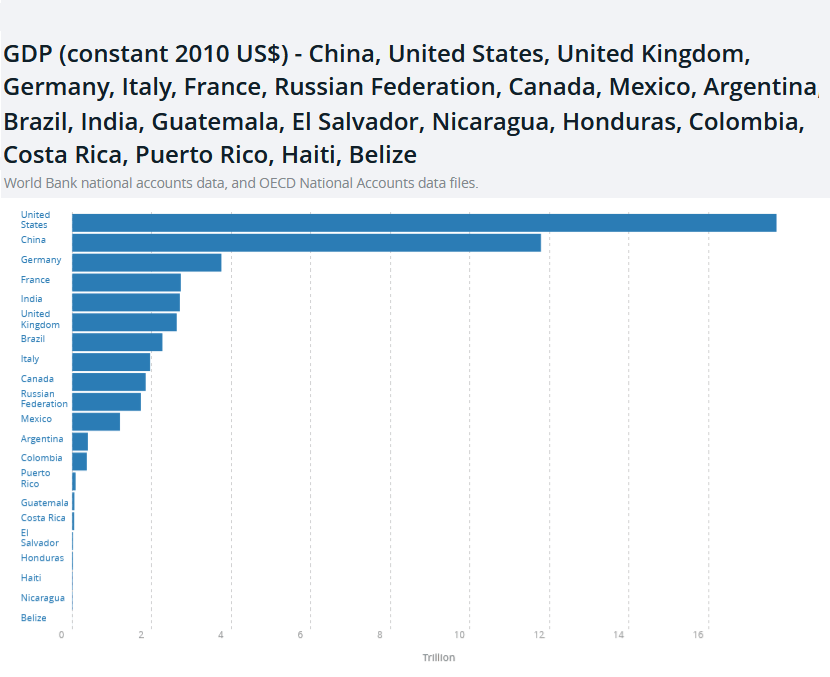
Introduction: a controversy over relations, mechanisms and measurements
Imperialism poses a problem that cannot be resolved by listing powerful countries. It requires an investigation of how the relations that enable particular capitals to appropriate surplus labour generated in other territories are produced and reproduced. Technology, wages, ownership, credit and state power participate in that reproduction, but their roles cannot be established through a single label.
IIPPE—the International Initiative for Promoting Political Economy—is a pluralistic forum for critical research. Its name refers to political economy, a field of inquiry, rather than exclusively to economic policy, understood as public intervention. [1]
Michael Roberts’s review, published in September 2021, provides the documentary starting point. It connects imperialism, China, financialisation and interest, adding a Colombian study that was not presented at the conference. Our purpose is to reconstruct the underlying problems, examine their mediations and clarify the differences between hypotheses, measurements and conclusions. [2]
Three questions guide the essay: Which social relation is being explained? What mechanism is proposed, and under what conditions? Which observation could test it? Convergent findings can strengthen an interpretation without automatically making the models that generate them equivalent.
I. Background: from finance capital to unequal exchange
A genealogy that neither begins nor ends with one author
Hilferding published Finance Capital in 1910; Luxemburg, The Accumulation of Capital in 1913. Bukharin investigated the internationalisation of capital and its articulation with states; Lenin wrote Imperialism, the Highest Stage of Capitalism in 1916, and the book appeared in 1917. Their contributions constitute a historical controversy, not interchangeable stages of a homogeneous theory. [3, 4, 5, 6]
To study this controversy, it is useful to distinguish corporate concentration, the articulation of banking and industry, capital exports, problems of reproduction and interstate rivalry. An author can illuminate one relation without providing a complete explanation of all the others. Lenin’s centrality does not require attributing absolute priority to him over every Marxist investigation of the world economy.
Emmanuel shifted the discussion towards international wage differences and prices of production. His formulations of 1962 must be distinguished from the French book of 1969 and its English edition of 1972. His proposal integrates international exchange into an inquiry into value and the worldwide distribution of surplus. [7]
Emmanuel: economic assumptions and political implications
In his characteristic formulation, capital mobility and restrictions on labour mobility make it possible to examine a tendency towards equal profit rates alongside persistent wage differences. The question is how these assumptions affect international prices and the distribution of social labour. [7]
Evaluating the argument requires making the time horizon, degrees of mobility, wage determination and price formation explicit. Altering an assumption may alter the conclusion. This does not invalidate modelling: it specifies the explanation’s domain.
The implications for international solidarity deserve their own discussion. A relative distributive advantage for some workers does not automatically turn them into owners of the means of production or eliminate their antagonisms with capital. Conversely, acknowledging exploitation within each country does not require denying international hierarchies. Class position and territorial insertion must be examined together.
Explaining Emmanuel’s reception exclusively through political convenience would replace investigation with imputation. Both political conflicts and theoretical disagreements are recognised here. Controversial attributions—for example, that an author treats capital as an autonomous source of value—require precise passages and contexts; they do not follow from the use of simultaneous equations.
II. Value, surplus value and transfers: distinctions that explain
Production and appropriation are different processes
In Marx’s theory, value concerns socially necessary abstract labour, rather than any individually clocked expenditure of effort. The formation of a general profit rate and prices of production makes it possible to investigate differences between the surplus produced by a capital and the surplus it ultimately appropriates. [8, 9]
For an introductory scheme, assume one turnover and that all the constant capital considered is consumed during the period:
Here c is the value of consumed means of production transferred to the product; v, variable capital advanced for labour power; and s, surplus value. The expression organises theoretical categories. Estimation requires deciding which observations represent each term and how labour magnitudes are translated into monetary magnitudes.
The surplus value rate relates the surplus to variable capital. The profit rate relates a flow of profit per period to the relevant total capital advanced, C + V; this must not be confused without justification with consumed costs, c + v. The rates are comparable only when periods, turnover and valuation conventions are aligned.
A teaching example of redistribution
Consider two capitals of 100 units each, with one turnover, full consumption of constant capital and a surplus value rate of 100%. A uses 70 units of constant and 30 of variable capital; B uses 40 and 60. Their surplus values are 30 and 60. Total surplus value is 90, and the hypothetical average profit rate is 90/200 = 45%. If each realises 45 in profit, A appropriates 15 more than it produced and B appropriates 15 less.
This is a teaching construction, neither a historical estimate nor a universal solution to the transformation problem. Costs are held given to isolate the mechanism; a complete system must also explain input prices. Redistribution does not create the 90 units of surplus value: it changes their appropriation.
What zero-sum means—and what it does not
If Tᵢ denotes a net transfer within an accounting universe that is closed and uses the same unit of valuation, then:
This identity concerns the distribution of a given magnitude. It does not imply that every economic interaction or expanded reproduction is zero-sum. Production can generate new value; transfers redistribute its appropriation. If the data do not sum to zero, coverage, valuation and statistical discrepancies must be examined before the residual becomes a theoretical conclusion.
Material welfare, the quantity of use values and the magnitude of value must also be distinguished. Productivity gains can increase available goods without proportionately increasing value per unit. “Benefiting from trade” and “appropriating a net transfer of value” are different questions.
III. One concrete essence and multiple structural determinations
Components, common essence and material totality
The components of a totality, represented through equations articulated within a system, may share determinations of a common essence that makes their unity and differences intelligible. This essence is expressed through set-theoretic, topological, differentiable, metric, operational, and historical and dynamical determinations: each makes particular constitutive relations available for investigation. When a correspondence preserves the relations of a defined structure, an isomorphism can be established at that level; equivalence in one determination can coexist with differences in others.
The articulation of components admits an integrodifferential representation when the problem requires rates of change, distributed effects or accumulated memory. Under determinate initial conditions and constraints, interactions constitute an internal structure of a material nature: objective through the efficacy of its relations, dynamic through its reproduction and transformation, and nonlinear where its functional dependencies have that property. The coherence of this articulation includes the compatibility of its relations and equations alongside antagonisms and tensions that can drive its development.
The totality’s structure, generated through component activity, in turn conditions those components’ possibilities of existence, reproduction and transformation. System composition and structural conditioning form a reciprocal relation: interactions produce organisation, and organisation modifies the conditions under which those interactions continue. Emergent properties are explained through this articulation rather than a simple inventory of isolated components.
The laws guiding the investigation of this genesis and reproduction acquire a generalised realisation within a totality with new mediations. The unity and struggle of opposites allows investigation of the constitution and transformation of antagonistic relations and their processes of emergence and self-organisation; the transformation of quantity into quality concerns regime changes, which can be formalised through bifurcations in particular models; and the negation of the negation examines reorganisations preserving and transforming previous determinations. Chemical synthesis provides a concrete example of material reorganisation and the emergence of properties. These connections are developed by specifying mechanisms and conditions: a general dialectical law does not by itself impose an identical functional form, a bifurcation or self-organised criticality on every system.
Integrodifferential composition and reciprocal conditioning
Representing a component through an equation means selecting variables and relations relevant to the problem. Representing the totality must additionally incorporate couplings between components and the restrictions imposed by their organisation. Integration can capture distributed or accumulated effects; differentiation can describe rates of change. Their articulation expresses a concrete possibility for formalising the thesis.
In a domain where differentiable evolution is an appropriate description, reciprocal conditioning can be schematised as follows:
dS/dt = G(S(t), x(t), Ht; Θ)
x(t) collects the component states; S(t) represents organisational variables or structural constraints; Ht, the relevant history up to that moment; and θi and Θ, model parameters. The first equation expresses how component behaviour depends on the organised totality. The second expresses how that organisation is reproduced or transformed through component activity. Both must satisfy compatible initial conditions and constraints.
Where accumulated memory needs representation, an integral contribution can be added:
Qi represents the contribution of earlier interactions and Ki their present weighting. This formulation allows investigation of how different histories can modify current possibilities. It is a modelling scheme requiring functions, units and observations to be defined for each application; it does not assert that every system must take this specific form.
The structure is material and objective insofar as the represented relations are effective in the object and do not depend on the investigator’s will. The objectivity of a relation and the adequacy of its mathematical representation are connected but distinguishable questions. Structural reproduction can constrain particular actions while those same actions contribute to sustaining or altering it.
Emergence, nonlinearity and generalised lawfulness
The totality contains relations and capacities that cannot be explained by listing isolated components. Explanation requires investigating their organisation and interactions. A dynamics is nonlinear when its functional dependencies do not satisfy the relevant linearity property; couplings can supply concrete mechanisms for this nonlinearity. Explaining the difference between a totality and the sum of its parts requires identifying these organisational relations.
Generalised lawfulness retains the relation between the system’s genesis and reproduction conditions. The processes constituting a structure subsequently operate within an organisation that modifies their scale, mediations and effects. Continuity of lawfulness can coexist with a transformation of its concrete form of realisation. Sharing general principles does not require using an identical equation at every scale.
In the problem of imperialism, capitals participate in general valorisation relations while their worldwide articulation configures production chains, monetary hierarchies and access to technology and credit. These structural relations condition particular capitals’ reproduction, while those capitals reproduce them through investment, production and appropriation. Moving from the national to the international requires investigating this reciprocity and its historical mediations.
The following layered table specifies the determinations of this articulation; section IV develops the three dialectical laws orienting its interpretation.
What a layered interpretation contributes
Essence can be interpreted as the articulation of constitutive relations that makes an object’s identity and reproduction intelligible. Understanding it requires abstractions, but no single abstraction necessarily exhausts that articulation. Mathematics can specify particular relations; the correspondence between formalism and object requires additional justification.
Interpreting essence as an articulation of structural determinations makes it possible to distinguish the following levels. [10]
| Determination | Structural question | Possible formalisation and scope |
|---|---|---|
| Set-theoretic | Which elements or states are distinguished? | A set and correspondences; a bijection preserves cardinality, not every additional relation. |
| Topological | What continuity, neighbourhood and connectedness exist? | A topology; homeomorphisms preserve its structure. |
| Differentiable | Which smooth variations can be described? | A smooth structure; diffeomorphisms compare that structure. |
| Metric | How are lengths or distances quantified? | An appropriate metric; isometries preserve the corresponding geometry. |
| Operational | Which transformations preserve selected relations? | Automorphisms and group actions; Lie groups apply in cases with a compatible smooth structure. |
| Historical and dynamical | How was the system constituted, and which transitions does it admit? | Evolutions, path constraints and categories of transitions; irreversible histories do not reduce to invertible symmetries. |
These layers are articulated determinations of a concrete essence, not six independent substances. Their selection depends on the object. A trade network does not automatically possess a manifold’s topology; an economic inequality does not by itself constitute a mathematical distance. States, relations and observation procedures must be defined in each case.
Adding structure and preserving structure
Equipping a set with a topology differs from establishing a homeomorphism between spaces. Transformations should therefore not be drawn as if they independently created the next level’s structure. For a smooth manifold M with Riemannian metric g, transformations of the object satisfy:
Preserving the metric imposes additional conditions beyond preserving only differentiable structure; preserving the latter imposes additional conditions beyond topological equivalence. The inclusions are not asserted to be universally strict. Moreover, not every topology admits a smooth manifold structure, and this chain does not classify all mathematical structures.
The same underlying space can admit different geometries
On the upper half-plane U = {(x,y): y > 0}, compare:
The set, usual topology and smooth structure coincide. Gaussian curvature differs: K = 0 for gE and K = −1 for gH. No isometry exists between these geometries. Topological equivalence does not decide metric equivalence. [11]
Curvature does not prevent a global metric from existing. Under the usual assumptions—a smooth, Hausdorff, second-countable manifold—Riemannian metrics can be constructed using partitions of unity. A global metric differs from a global chart, a constant matrix in every coordinate system or a globally Euclidean geometry. [11]
Invariance, identity and historical transformation
An invariant is always relative to a class of transformations. Remaining unchanged under coordinate changes, under isometries or during physical evolution are different properties. Knowing an abstract symmetry group is also insufficient to reconstruct uniquely every structure admitting it.
“Operational essence” can designate the restrictions delimiting particular structurally admissible transformations. This does not identify every change that leaves a system recognisable with an exact symmetry. An organism or an economy can persist through dissipative processes that do not preserve a metric.
For irreversible transitions, a category or semigroup may be more suitable than a group. A groupoid permits partial composition and multiple objects, but requires invertible morphisms: having additional objects does not itself introduce irreversibility. Noether’s connection between symmetry and conservation requires variational dynamics and the corresponding assumptions. [12]
From the national to the international scale
The persistence of wage labour, surplus appropriation and competition between capitals makes common relations across scales a legitimate research question. Currencies, borders, jurisdictions, intellectual property and migration restrictions nevertheless introduce specific mediations. An international structure cannot be obtained merely by multiplying a national structure.
Establishing an isomorphism would require defining the compared structures and constructing a correspondence that preserves their relations. Many applications instead involve aggregations, projections or partial correspondences. Sharing a general law does not prove that components are mutually isomorphic, or that each is isomorphic to the whole.
This qualification retains a decisive dialectical insight: general relations are realised under concrete conditions and can acquire new determinations within a more complex totality. Investigating that articulation requires specifying what is preserved, what emerges and what ceases to be equivalent.
IV. Dialectics, complexity and time: connections with conditions
The three dialectical laws in the constitution and transformation of the totality
The constitution and transformation of the totality are examined through three laws: unity and struggle of opposites, transformation of quantity into quality, and negation of the negation. Their function in this essay is to guide a reconstruction of the material totality’s genesis, reproduction and transformation. Each proposed mathematical relation must show which aspect of this reconstruction it expresses.
1. Unity and struggle of opposites. The terms of a contradictory relation presuppose and condition one another within an organisation, while their tendencies can oppose one another. Inquiry must explain both the reproduction of this unity and the tensions transforming it. In the capital–labour relation, for example, capital’s reproduction presupposes wage labour, but surplus appropriation places participants in antagonistic positions over its distribution and control. The totality is constituted through these relations and imposes conditions on their realisation.
The reference to emergence and self-organisation opens a positive question: how do interactions produce an order which subsequently regulates its own reproduction conditions? A model can investigate feedback and emergent constraints to address it. If self-organised criticality is additionally proposed, the mechanism and properties warranting that specific concept must be identified. The analysis of reciprocal organisation thus connects philosophical explanation with a defined research requirement.
2. Transformation of quantity into quality. Accumulated variations can modify a system’s organisation and possibilities until a different regime is constituted. The problem is to investigate what accumulates, which relations mediate that accumulation and when the relevant quality changes. A bifurcation represents this passage when parameter variation changes a dynamics’ qualitative structure. In political economy, a hypothesis about concentration and market power must establish how changes in magnitude reorganise relations between capitals; accumulating figures alone does not demonstrate that change.
3. Negation of the negation. Transformation can supersede an organisational form through processes which that form itself helped generate. The new organisation preserves determinations of the preceding process while transforming their articulation. This perspective investigates historical continuity within qualitative discontinuity: which relations are displaced, which are preserved and in which new configuration they reappear. It does not assume that every trajectory necessarily advances towards a favourable outcome or repeats an identical cycle.
Chemical synthesis illustrates material reorganisation and the emergence of a compound’s properties. Extending this to a general dialectical law requires explaining the mediations and meaning of the negations in the investigated process. The connection requires determining which relations and processes warrant generalising from each example.
The three laws are articulated within the argument: contradictory relations constitute a unity, variations can transform its organisation, and transformation incorporates a history preserving and modifying previous determinations. Integrodifferential modelling and the layers of essence make particular aspects of this articulation available for investigation.
Scope of the mathematical correspondences
The unity and struggle of opposites directs attention to antagonistic relations; it does not by itself imply that a model exhibits self-organised criticality. The latter requires a dynamical definition and evidence of its properties. Similarly, emergence and non-additivity are insufficient to demonstrate mathematical nonlinearity: the relevant equations, operations or functional relations must be identified.
A bifurcation provides one possible formalisation of particular qualitative changes when dynamics change regime as a parameter varies. Not every qualitative change is a bifurcation in the technical sense. Chemical synthesis can illustrate concrete transformations; identifying it with the negation of the negation would require an independent argument.
Self-similarity likewise does not follow from the existence of relations between parts and a whole. It can be exact, approximate or statistical and must be established through a defined scaling transformation. Dialectical inquiry gains precision when mathematical connections become testable problems.
Temporality and simultaneity in the transformation problem
One axis of Marxist debate contrasts simultaneous valuation of inputs and outputs with interpretations that distinguish moments of valuation. It matters, but does not exhaust the classification of schools. Relations between value and price systems, money, reproduction and distributive closure also matter.
Simultaneous equations can represent conditions within a period or states of a dynamic process; they do not automatically deny time’s existence. A temporal formulation does not become historically adequate merely by introducing a subscript t. It must explain what is inherited, what changes and how periods are connected.
The MELT—monetary expression of labour time—connects labour and monetary magnitudes under a chosen formulation. Its definition, units and valuation date must be declared. Labour hours and money cannot be added as a homogeneous magnitude without such mediation.
Differences between models demand more than observing different numerical results. They require comparison with relevant data, explicit closures and assumptions. Not every methodological controversy has an immediate empirical resolution, nor does comparison with other philosophies of statistics settle this debate by itself.
V. Unequal exchange: theories, indicators and evidence
A map of mechanisms
| Approach | Explanatory focus | Question requiring examination |
|---|---|---|
| Emmanuel | Wage differences and international price formation under mobility assumptions. | How do results change with mobility, wages and model closure? |
| Carchedi–Roberts | Transfers estimated through capital composition, surplus value and production prices. | How are theoretical categories translated into national accounts and export sectors? |
| John Smith | Super-exploitation and the international organisation of production. | How are labour-power reproduction and the location of appropriation observed? |
| Andrea Ricci | Unequal-exchange measurement and international productive structure. | Which monetary conversions and sectoral aggregations make labour comparable? |
| Cogliano–Veneziani–Yoshihara | International exploitation, endowments and credit markets in a calibrated model. | What depends on the index’s definition, and what on mechanisms of persistence? |
This table proposes reading questions; it does not equate different mechanisms. Indicators classifying some countries similarly may differ in their measured object and causal explanation. [7, 13, 14, 15, 16]
Carchedi–Roberts: measurement and decomposition
The 2021 presentation estimates trade transfers separately from primary income. Its comparison of methods records $600 billion for 2019, equivalent to 1.3% of reference GDP, and $600 billion in primary income for 2017, equivalent to 1.4%. The graph uses each bloc’s own denominator; it is not a homogeneous time series of one combined sum. [13], slides 16–17

The positive and negative lines need not have equal percentage magnitudes: the same flow can be divided by different GDPs. Nor should they automatically be equated with the rounded 1.5% in the 2021 account. Reproducing the calculation requires specifying the estimation procedure, year and denominator.
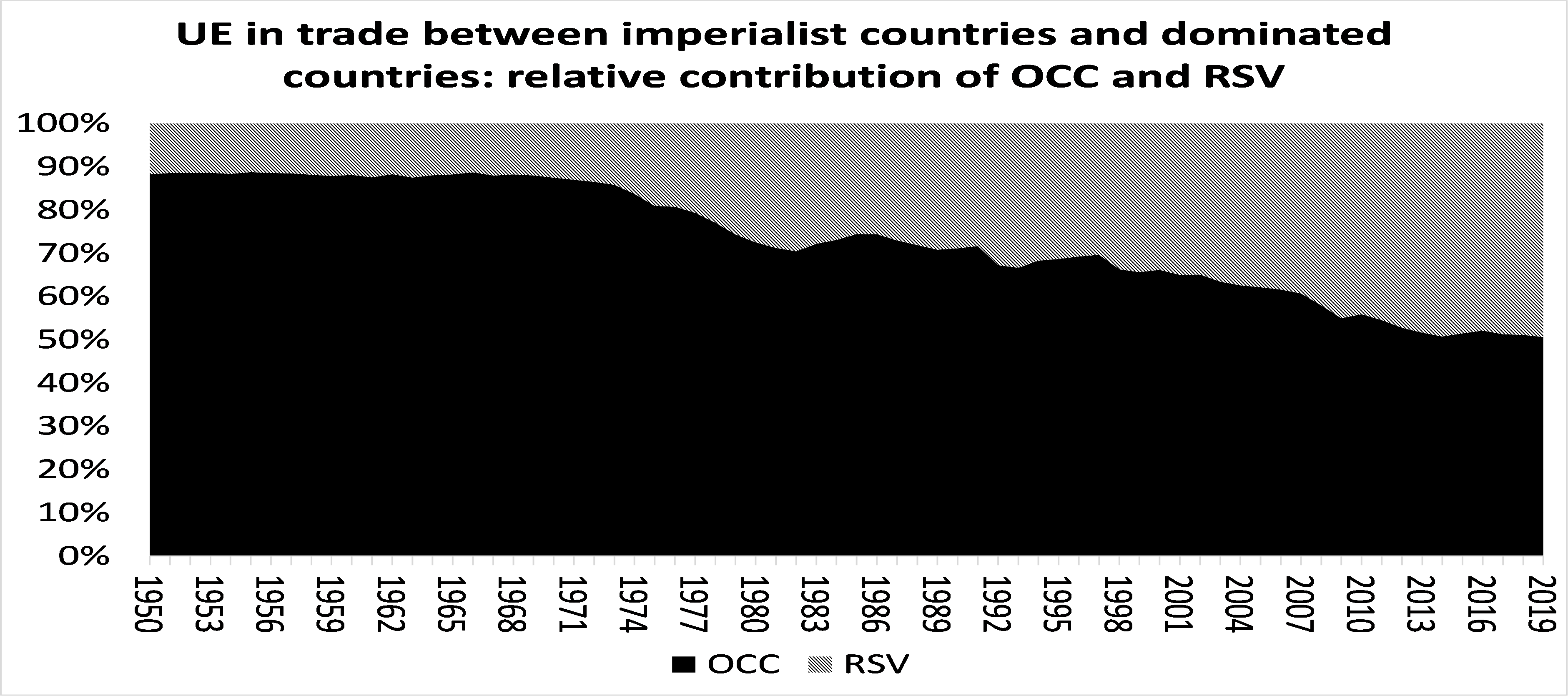
The decomposition between OCC—organic composition of capital—and RSV—rate of surplus value—belongs to the model. A rising relative contribution does not necessarily mean that the other factor’s absolute contribution is falling. Organic composition is not a direct, universal measure of technological superiority: its relation to productivity depends on techniques, wages, prices and sectoral composition.
Super-exploitation: production organisation and appropriation
Smith emphasises working conditions and wages in global production, challenging the identification of where value is generated with where national accounts record its appropriation. His linked study makes it possible to examine the objection without reducing it to terminology. [14]
The disagreement requires distinguishing criticism of an indicator from denial of all unequal exchange. It also requires avoiding identification of the immediate employer with the sole beneficiary without studying contractual and ownership relations. Subcontracting, commercial control and ownership can articulate successive appropriations. Evaluation must follow the chain and its concrete conditions.
Ricci: transfers per person and units of comparison

The figure distinguishes annual amounts per person in current dollars for 1995, 2007 and 2019, and percentage columns for 1995–2019, 1995–2007 and 2007–2019. These percentages must not be presented as growth rates, or the last monetary column mechanically paired with a single annual percentage. [15, 27]
| Region | USD/person 1995 | USD/person 2007 | USD/person 2019 | Mean % 95–19 | Mean % 95–07 | Mean % 07–19 |
|---|---|---|---|---|---|---|
| North America | 761 | 1965 | 2680 | 3.9 | 3.7 | 4.1 |
| EMU | 1720 | 4939 | 4836 | 10.3 | 8.5 | 12.2 |
| West Europe | 2429 | 7531 | 6921 | 12.7 | 10.6 | 14.8 |
| East Asia | 1984 | 1766 | 2540 | 5.8 | 5.9 | 5.7 |
| Oceania | 526 | 2626 | 3638 | 7.1 | 4.5 | 9.8 |
| China | −196 | −810 | −426 | −14.1 | −19.0 | −10.0 |
| Russia | −767 | −1108 | −1850 | −29.7 | −40.9 | −17.2 |
| East Europe | −901 | −615 | −1309 | −14.7 | −18.9 | −9.9 |
| South America | −269 | −472 | −490 | −6.1 | −8.4 | −3.9 |
| Central America | −471 | −379 | −454 | −11.9 | −13.6 | −9.8 |
| Middle East | −1443 | −1502 | −950 | −18.9 | −24.8 | −12.8 |
| South Asia | −77 | −220 | −351 | −21.5 | −20.2 | −23.0 |
| Southeast Asia | −463 | −1350 | −1631 | −46.8 | −53.9 | −40.3 |
| Central Asia | −272 | −380 | −924 | −11.9 | −13.6 | −9.8 |
| North Africa | −426 | −1099 | −1034 | −30.7 | −31.6 | −30.4 |
| S. Sahara Africa | −65 | −120 | −132 | −10.0 | −11.6 | −8.3 |
In particular, South Asia must not be renamed India; East Asia is not simply Japan; and South America and Central America are not one regional observation. The table reports regions, not individual findings for each country.
In Global locational inequality (2022), table 2 shows that percentages are period averages and monetary amounts are nominal dollars. EMU denotes the European monetary union bloc in that classification. Its regions also need not coincide with states: “China” incorporates Hong Kong, Macao and Taiwan in this statistical aggregation; “Russia” includes other countries, and “Central America” includes Mexico and the Caribbean. These groupings follow Ricci’s statistical classification. Findings must be interpreted according to that territorial coverage. [27]
An international index is not the axiomatic article

Yoshihara and Veneziani’s article (2018) examines exploitation’s axiomatic foundations. The Dynamics of International Exploitation by Cogliano, Veneziani and Yoshihara (2022) develops a model of international exploitation. Its basic economy assigns China an index of 0.9935: just on the exploiting side of the threshold 1, with the authors advising against a definite conclusion. [16, 17]
The graph relates exploitation classification to wealth per person in a basic economy. An index close to the threshold requires sensitivity analysis. Partial agreement with other studies must not erase classification differences.
VI. China: three questions that must be distinguished
Transfers, mode of production and international power
Roberts’s presentation When did China become capitalist? argues for a trapped transitional economy: it emphasises state direction and planned investment while acknowledging the law of value’s operation. The argument is documented as a position held in 2021, not a classification accepted by all authors. [18]
| Dimension | Object of investigation | Relevant evidence |
|---|---|---|
| International transfers | Net appropriation under an indicator and period. | Trade, production, primary income, conversion assumptions and sensitivity. |
| Socioeconomic organisation | Ownership, control, labour and surplus allocation. | Corporate governance, investment decisions, labour discipline, planning and markets. |
| Imperialist power | International domination and the reproduction of hierarchies. | Credit, monopolies, coercion, institutions, foreign policy and military capacity. |
Being a net recipient under an indicator does not by itself establish comprehensive imperialist domination; being a net donor does not exclude relations subordinating third parties. Scale matters: different positions may coexist across sectors, firms, partners and territories.
Sam King examines monopoly over technologically complex activities as a mechanism reproducing international hierarchy. His 2021 book, Imperialism and the Development Myth, frames the question of productive upgrading and its limits. [19]
The review also records Walter Daum’s political objection and different positions from Dic Lo and Cheng Enfu. These interventions are acknowledged as disagreements without attributing to them a demonstration that the review does not provide. [2]
What a growth trajectory cannot decide
Growth, poverty reduction and the capacity to sustain investment require explanation. They do not by themselves identify a mode of production. Connecting them causally with an ownership form would require mechanisms, comparators, periodisation and external conditions; a favourable outcome is insufficient to identify its cause.
It would also be circular to declare that every capitalist economy must reproduce precisely one crisis trajectory and exclude any differing case from the category. A theory must specify tendencies, mediations and conditions, and admit observations capable of challenging its scope.
Dates are decisive. A productivity comparison using aggregate data preceding 2021 does not authorise indefinite descriptions of every Chinese industry as technologically backward. Each conclusion’s scope depends on its period, sectoral disaggregation and supporting sources.
VII. Financialisation: specify the hypothesis before rejecting it
One term, several objects
Research can examine finance’s share of value added, credit expansion, household indebtedness, financial income of nonfinancial firms or shareholder power. Each dimension needs its own indicators. None automatically substitutes for every other dimension.
Mavroudeas challenges finance’s independence from productive accumulation. Rabinovich specifically examines the financial rentierisation hypothesis for US nonfinancial corporations, finding that asset and income composition require a more differentiated interpretation. These arguments have different scopes. [20, 21]
Methodologically, a declining sectoral share can coexist with increasing absolute size. An average can conceal corporate concentration. Changes in value added do not directly equal changes in assets, credit or institutional power. Indicator selection must answer a hypothesis defined in advance.
What the percentages 51.2% and 65.9% measure
This distinction changes the evidence’s meaning. Counting countries measures how widespread a sign of change is; it does not measure the aggregate magnitude of that change or automatically weight countries by economic size. The chosen time window also matters for detecting earlier expansion.
Concluding that financialisation explains deindustrialisation requires temporality, mechanisms and alternative variables. An association between sectoral shares does not itself identify causality. Conversely, rejecting an exclusively financial explanation of crises does not eliminate the roles of credit, collateral and liquidity in their transmission.
VIII. Interest and profitability: structural relations and statistical tests
Interest as distribution and as a price
Marx investigates interest as part of profit and examines its division between lender and functioning capitalist. This distributive restriction does not establish a mechanical equality between interest and profit rates at every moment. The analysis itself allows exceptions and distinguishes determinants of fluctuations. [23]
A concrete explanation must specify whether nominal or real magnitudes, expected or realised rates, and equivalent maturities are being compared. Contractual interest can temporarily exceed realised profitability, resulting in losses or default. Two declining trends are insufficient to identify a unique causal relation.
Stravelakis: what the “60%” represents
Nikos Stravelakis’s presentation uses the incremental rate of profit, IROP = ΔPr / I, examining its difference from interest. Slide 7 reports a normalised mutual-information-based measure around 0.606 for 1962–2019. This is not an R² explaining 60% of interest-rate variance, and the statistic alone does not identify causality. [24]
ΔPr is the change in profit, and I is investment as defined in the study. Their ratio depends on the period and does not by definition coincide with the average rate on the capital stock. A statistic’s economic content depends on the variables it relates and how they were constructed.
Roberts reports an observation by Karl Beitel concerning profitability trends and bond yields. The association requires examining the series, definitions and estimation procedure before using it as causal evidence. [2]
IX. Colombia, 1967–2019: evidence with a defined scope

Carlos Alberto Duque García’s document investigates growth, accumulation and the profit rate using a VAR with generalised impulse responses. It uses 53 annual observations and warns about sample size. Its evidence bears on the Marxian models examined, but does not independently prove a universal law or identify a structural causal effect without further assumptions. [25]
The graph uses different scales: growth and profitability on the left axis, accumulation on the right. Comparing visual heights without reading the axes can manufacture similarities or differences. Vertical lines delimit historical periods; they do not automatically constitute statistical tests of breaks.
Evaluation must consider variable definitions, stationarity, lags and stability. Generalised responses’ invariance to variable ordering does not remove the conditions for causal interpretation. Independent replication requires the data and estimation choices, together with an assessment of the findings’ sensitivity.
World in Crisis, edited by Carchedi and Roberts, brings together profitability studies. Cross-country comparison requires methodological alignment before all its series can be treated as one measurement. [26]
X. Assessment: investigate the whole without erasing its mediations
A Marxian perspective can contribute a research programme on surplus production, appropriation and reproduction across scales. Imperialism becomes intelligible through concrete relations between capitals, classes, states and territories, rather than by turning a set of countries into an indivisible subject with homogeneous internal interests.
The layered interpretation of essence supplies a useful discipline: define which relations constitute the object, which abstraction represents them, which transformations preserve that representation and which history explains its configuration. Formalisation establishes consequences under assumptions; material adequacy requires testing and comparison with alternatives.
Political action and scientific inquiry can be articulated without replacing one another. Solidarity among workers requires understanding both shared exploitation and the inequalities shaping their reproduction. Specifying these mediations makes the critique of capitalism more demanding and the discussion of its transformation clearer.
XI. Documentary library
The library brings together works of conceptual reference, axiomatic foundations, econometric analysis and international political economy. Each entry includes its cover or opening page and access to the document.

CONCEPTUAL REFERENCE · PDF
Diccionario filosófico
Rosental · Iudin
Reference dictionary for studying philosophical vocabulary and conceptual relations.
OPEN / DOWNLOAD PDF
AXIOMATIC ARTICLE · PDF
The Theory of Exploitation as the Unequal Exchange of Labour
Naoki Yoshihara · Roberto Veneziani · 2018
Formal foundations of exploitation definitions. Distinct from the later international application.
OPEN / DOWNLOAD PDF
WORKING PAPER · PDF
Economic Growth and the Rate of Profit in Colombia 1967–2019
Carlos Alberto Duque García · 2021
VAR analysis of growth, accumulation and profitability, including its warning about 53 annual observations.
OPEN / DOWNLOAD PDF
EDITED VOLUME · PDF
World in Crisis
Guglielmo Carchedi · Michael Roberts, eds. · 2018
Research on the law of profitability in different countries. Methods need comparison before findings are aggregated.
OPEN / DOWNLOAD PDF
MONOGRAPH · PDF
Value and Unequal Exchange in International Trade
Andrea Ricci · 2021
Study of value, trade and global exploitation, developing the foundations of unequal-exchange measurement.
OPEN / DOWNLOAD PDFXII. References and resources
- IIPPE. About IIPPE. ↩
- Roberts, Michael (2021-09-30). IIPPE 2021: imperialism, China and finance. ↩
- Hilferding, Rudolf (1910). Finance Capital. ↩
- Luxemburg, Rosa (1913). The Accumulation of Capital. ↩
- Bukharin, Nikolai. Imperialism and World Economy. Written 1915 and 1917. ↩
- Lenin, V. I. (written 1916; published 1917). Imperialism, the Highest Stage of Capitalism. ↩
- Emmanuel, Arghiri (1969; English edition 1972). Unequal Exchange: A Study of the Imperialism of Trade. Monthly Review Press. Bibliographic chronology: Arghiri Emmanuel Association. Publisher record. ↩
- Marx, Karl (1867). Capital, vol. I, chapter 1. ↩
- Marx, Karl (1894). Capital, vol. III, chapter 9. ↩
- Gómez Julián, José Mauricio (2026). Geometría, historia y legalidad: fundamentos dialéctico-materialistas de los espacios con estructura métrica. Manuscrito de investigación / Research manuscript. ↩
- Lee, John M. (1997). Riemannian Manifolds: An Introduction to Curvature. Springer. Also: George Voutsadakis, Differential Geometry (2024), chapter 5, construction of Riemannian metrics. Partition-of-unity construction. ↩
- Tong, David. Classical Dynamics, section 2.4: Noether’s Theorem and Symmetries. University of Cambridge. ↩
- Carchedi, Guglielmo & Michael Roberts (2021). The economics foundations of imperialism. IIPPE presentation; title as printed in the PDF. Slides 16–19 discussed here. ↩
- Smith, John. Imperialism in the Twenty-First Century. Study of global production and exploitation. ↩
- Ricci, Andrea (2021). Value and Unequal Exchange in International Trade: The Geography of Global Capitalist Exploitation. Routledge. See also reference 27, table 2. ↩
- Cogliano, Jonathan F., Roberto Veneziani & Naoki Yoshihara (2022-08-10). The Dynamics of International Exploitation. Working paper, figure 2 and table 1. ↩
- Yoshihara, Naoki & Roberto Veneziani (2018). The Theory of Exploitation as the Unequal Exchange of Labour. Economics & Philosophy 34(3), 381–409. DOI: 10.1017/S0266267118000238. ↩
- Roberts, Michael (2021). When did China become capitalist? IIPPE presentation. ↩
- King, Sam (2021). Imperialism and the Development Myth: How Rich Countries Dominate in the Twenty-First Century. Manchester University Press. ↩
- Mavroudeas, Stavros D. (2018). Financialization Hypothesis: A Creative Contribution or a Theoretical Blind Alley? Lecture, Queen Mary University of London, November 22. ↩
- Rabinovich, Joel (2017). The financialisation of the nonfinancial corporation: A critique to the financial rentieralization hypothesis. CEPN working paper 2017-22. ↩
- Subasat, Turan & Stavros Mavroudeas (2023). Financialization Hypothesis: A Theoretical and Empirical Critique. World Review of Political Economy 14(2), 204–233. DOI: 10.13169/worlrevipoliecon.14.2.0204. Figures 6–7. ↩
- Marx, Karl (1894). Capital, vol. III, chapter 22. ↩
- Stravelakis, Nikos (2021). A Reconciliation of Marx’s Theory of Interest and the Risk Premium Puzzle. Presentation, PDF, especially slide 7. ↩
- Duque García, Carlos Alberto (2021, September). Economic Growth and the Rate of Profit in Colombia 1967–2019: A VAR Time-Series Analysis. Working paper, especially sections 5–6 and the sample-size note. ↩
- Carchedi, Guglielmo & Michael Roberts, eds. (2018). World in Crisis: A Global Analysis of Marx’s Law of Profitability. Haymarket Books. ↩
- Ricci, Andrea (2022). Global locational inequality: Assessing unequal exchange effects. Environment and Planning A: Economy and Space 54(7), 1323–1340. DOI: 10.1177/0308518X221107023. Table 2 and appendix 1. ↩
Reading vocabulary
Marxian refers to concepts, problems and arguments associated with Marx; Marxist, to traditions and programmes identifying with Marx’s work. Unequal exchange denotes a family of mechanisms and measurements, not one indicator. Super-exploitation requires an explicit definition relative to labour-power reproduction. MELT is a monetary labour relation defined within each interpretation. PPP means purchasing power parity and cannot simply be interchanged with current dollars. OCC and RSV denote organic composition of capital and rate of surplus value. IC and DC name the imperialist and dominated blocs in the Carchedi–Roberts figures.
Further resources
The following resources extend the essay’s definitions and debates. Research works, explanatory articles and reference materials serve different documentary functions.
Explore conceptual and documentary resources
- Michael Roberts: IIPPE 2021
- Lenin: Spanish PDF
- Emmanuel: Unequal Exchange, PDF
- Self-similarity: conceptual reference
- Totality: systems theory article
- Essence and topology: philosophical study
- Isomorphism: philosophical dictionary
- Law: philosophical dictionary
- Matter: philosophical dictionary
- Laws: conceptual reference
- Induction/generalisation: reference
- Unity and struggle of opposites
- Emergence: conceptual reference
- Self-organisation: reference (not specifically self-organised criticality)
- Quantity and quality: philosophical dictionary
- Bifurcation theory
- Negation of the negation
- Chemical synthesis
- Author’s paper on Bayes estimators and Gaussian mixtures
- Value: archived dictionary entry
- Labour movements in the 1960s: thematic search
- Mediation: philosophical dictionary
- IIPPE: website
- Carchedi–Roberts presentation
- Lenin: English PDF
- John Smith: linked study
- Ricci: referenceed research paper
- Sam King: publisher record
- Sam King: thesis
- IIPPE China: YouTube channel
- Roberts: China presentation
- Roberts on capitalism and China
- Roberts on financialisation and profitability
- Mavroudeas: theoretical lecture
- Rabinovich: empirical paper
- Roberts on Austrian business-cycle theory
- Roberts on interest and stagflation
- Stravelakis: PPTX presentation
- Rosental–Iudin: PDF
- Yoshihara–Veneziani: PDF
- Duque García: PDF
- World in Crisis: PDF
- Andrea Ricci: book PDF
Leave a Comment/Deja un Comentario