The Ancient Judeans of Judea as Direct Ancestors of Contemporary Palestinians
Archaeology, paleogenomics, historiography, epigraphy, and linguistics against the exile and “return” narrative: a synthesis of José Mauricio Gómez Julián’s monograph.
The monograph begins with a historical question carrying direct political implications:
Who, strictly speaking, are the descendants of the ancient Judeans of Judea?
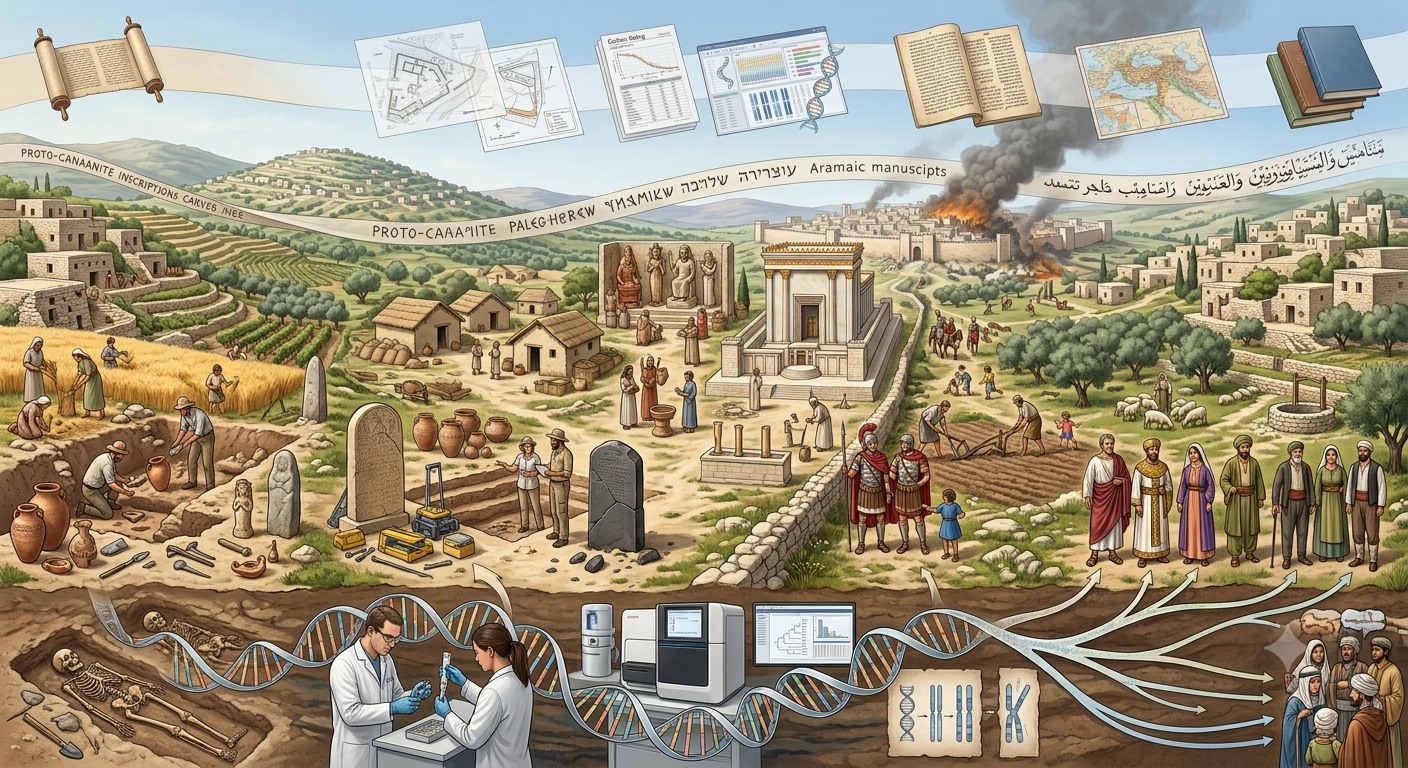
Its thesis is that the convergence of critical archaeology of the southern Levant, historiography, epigraphy, paleogenomics and population genetics, and historical linguistics indicates that contemporary Palestinians constitute the most direct demographic heirs of the ancient populations of the region, including the Judeans of the Kingdom of Judah. Modern Jewish populations, by contrast, exhibit heterogeneous demographic histories, with varying proportions of Levantine ancestry alongside components acquired through migrations, conversions, and admixture with European, African, and Asian populations.
The argument does not depend on a single discipline. Its core lies precisely in the cross-corroboration of independent lines of evidence: the Canaanite origin of the earliest Israelites, the absence of a general Roman expulsion from Palestine, archaeological continuity across the Byzantine and Islamic transitions, genomic evidence, and linguistic and toponymic continuity.
A central methodological caveat: the monograph explicitly distinguishes between robust consensuses, well-founded conclusions, and questions that remain open. It does not claim that every detail carries the same degree of certainty. In particular, no genome from an individual unambiguously identifiable as a “Judean” of the Kingdom of Judah has yet been published in a peer-reviewed journal. The specific connection to the Judeans is therefore inferred through the convergence of archaeological and historical continuity with genetic comparisons involving ancient Levantine populations, rather than through a direct comparison between a “Judean genome” and modern Palestinians.
From the Bible as Foundational Narrative to Critical History
The investigation begins with the methodological problem of using the Bible as though it were a historical chronicle. It reviews the historiographical revolution associated with Thomas L. Thompson, Niels Peter Lemche, Philip R. Davies, and Keith W. Whitelam—the so-called “minimalist school”—and confronts it with maximalist objections and intermediate positions such as those of William G. Dever and Lester Grabbe.
The fundamental point is not that all biblical content is devoid of historicity. The monograph specifically emphasizes that extreme positions have increasingly given way to a middle ground: historically useful material does exist, particularly from the first millennium BCE onward, but the patriarchal narratives, the Exodus, the military conquest of Canaan, and the United Monarchy on the scale depicted in the biblical text do not possess the archaeological support traditionally attributed to them.
Mario Liverani provides one of the study’s key interpretive frameworks through his distinction between “normal history” and “invented history”: the ancient political entities of Israel and Judah must be reconstructed through archaeology, epigraphy, textual criticism, and comparative sources, whereas the great foundational narratives must also be analyzed as political-theological constructions developed by the post-exilic community.
The Earliest Israelites Emerged from Canaan
One of the most robust pillars of the argument is the autochthonous Canaanite origin of the earliest Israelites. Around 1200 BCE, approximately 250 small unwalled villages emerged in the central highlands. Their pottery displays continuity with Late Bronze Age traditions, there are no widespread destruction layers attributable to an external conquest, and the organization of the settlements is compatible with local populations undergoing sedentarization.
Israel Finkelstein and William G. Dever, despite their profound historiographical and chronological disagreements, converge on this point: the populations later identified as Israelites emerged primarily from within Canaanite society, rather than as a foreign population that conquered Canaan from outside.
Epigraphy: Merneptah and Tel Dan
The monograph incorporates a line of evidence that the previous HTML version largely omitted: epigraphy. The Merneptah Stele, dating to approximately 1208 BCE, contains the earliest known extra-biblical reference to “Israel” and identifies it through an Egyptian determinative corresponding to a people or socioethnic group, rather than a territorial state.
The Tel Dan Stele, from the ninth century BCE, contains the sequence generally interpreted as “House of David.” The reading was challenged by some minimalists but is accepted by the majority of specialists. For the monograph, these inscriptions establish a crucial distinction: criticizing the biblical narrative does not require denying the historical existence of Israel or of a Davidic dynasty. What the extra-biblical evidence does not confirm is the Exodus, the conquest of Canaan, or a Solomonic empire on the scale described in the Bible.
From Canaanite Polytheism to Yahwistic Monotheism
Another substantial component of the paper concerns the religious evolution of Israel. Drawing on Mark S. Smith, William G. Dever, Othmar Keel, Christoph Uehlinger, and Thomas Römer, the monograph presents Yahwistic monotheism not as the starting point of Israelite history, but as the outcome of a prolonged historical process.
Textual, archaeological, and epigraphic evidence indicates the coexistence of Yahweh, El, Baal, and Asherah at different moments in Israelite religion. The inscriptions from Kuntillet Ajrud and Khirbet el-Qom, together with Judean pillar figurines, altars, standing stones, and other material remains, document religious practices incompatible with the retrospective image of a primordial monotheistic Israel.
The process appears to have developed from polytheism and monolatry toward increasingly exclusive monotheism, accelerated by the crisis of the Babylonian exile and consolidated during the Persian period. The possible influence of Zoroastrianism on later elements of Judaism—dualism, eschatology, and angelology—is explicitly treated as an open debate, not as an established conclusion.
The Philistine Case
The monograph also uses the Philistines as an example of the historical capacity of the Levantine substrate to absorb migrant populations. Ancient DNA from Ashkelon reveals a component related to southern Europe in the early Iron Age that becomes undetectable roughly two centuries later, coinciding with increasing cultural integration into the Canaanite environment.
This does not lead to the conclusion that Palestinians are simply “descendants of the Philistines.” The argument is broader: contemporary Palestinians represent a historical synthesis of successive populations of the southern Levant—Canaanites, Israelites, Judeans, Samaritans, Philistines, Phoenicians, and other groups—upon a local substrate characterized by strong demographic continuity.
Assyrians, Babylonians, and the Difference Between Deporting an Elite and Emptying a Territory
The monograph repeatedly distinguishes historically documented deportations from the idea of complete demographic emptying. Following the Assyrian conquest of the Kingdom of Israel, part of the population was deported, another part fled toward Judah, and a substantial number remained in the territory. Imperial deportation disproportionately affected political, administrative, and specialized elites; it did not automatically mean eliminating the entire peasant population.
The same principle applies to the Babylonian conquest. Jerusalem suffered profound destruction and real deportations occurred, but other areas—particularly Benjamin—show rural continuity. The so-called “Babylonian exile” is therefore interpreted as a political, institutional, and cultural rupture of enormous importance, but not as the physical disappearance of the population of Judah.
During the Persian period, Judaism progressively consolidated as a differentiated religious system. This transformation provides the historical context within which the monograph situates the composition and reorganization of a fundamental portion of the biblical tradition.
From Ioudaios to “Jew”: Hasmonean Conversions and the Transformation of Identity
The Hasmonean expansion of the second and first centuries BCE constitutes another turning point. John Hyrcanus I imposed circumcision and observance of Jewish law upon the Idumeans; Aristobulus I did likewise with Iturean populations. The Herodian dynasty itself descended from this Idumean population incorporated into Judaism.
Following Shaye J. D. Cohen, the monograph emphasizes the semantic transformation of Ioudaios: from a primarily ethno-geographic designation—“Judean,” an inhabitant of Judea—it came to acquire religious and cultural meanings as well. From that point onward, one could become Jewish without having been born Judean. This transformation constitutes a conceptual precondition for understanding the later expansion of the diaspora.
The Myth of a Total Roman Expulsion
The wars against Rome were devastating. The destruction of the Second Temple in 70 CE and, especially, the Bar Kokhba revolt of 132–135 CE caused enormous human and material losses in Judea. The monograph does not minimize that destruction.
What it rejects is a different proposition: that Rome deported the Jewish population of all Palestine en masse and emptied the land. Hadrian prohibited Jewish access to Aelia Capitolina—Jerusalem—but there is no evidence of a Roman policy of total deportation from Palestine. Settlement continuity in several regions and the relocation of the center of Jewish life toward Galilee contradict such a scenario.
Rabbinic centers arose in Galilee at places such as Usha, Sepphoris, and Tiberias; the Mishnah was compiled there around 200 CE and the Jerusalem Talmud later followed. Roman destruction was therefore enormously significant institutionally and regionally, but it did not result in the physical disappearance of the Jewish population from the land.
- Historiographical consensus: the absence of a mass Roman expulsion of all Jews from Palestine is not a thesis exclusive to Shlomo Sand. Historians such as Israel Bartal and Anita Shapira acknowledge that the idea of a collective exile imposed by Rome belongs much more to popular culture than to specialist historiography.
- Necessary qualification: accepting that there was no general expulsion does not mean denying the deaths, enslavements, local displacements, and destruction produced by the Roman wars.
- Diaspora: major Jewish communities outside Palestine predated the Roman wars and must be explained through a combination of migrations, demographic growth, and conversion rather than through a single episode of expulsion.
From Permanence to Conversion: Continuity of the Palestinian Population
This is one of the central links in the monograph. If the rural population was not generally expelled, the question becomes what happened to it. The proposed answer is a progressive religious transformation upon a largely continuous demographic base.
Between the fourth and seventh centuries, an increasing share of Palestine’s population Christianized under Byzantine rule. Following the Arab conquest of 634–638, Islamization was likewise not immediate. The demographic models and archaeological evidence examined in the paper place the process across several centuries, extending into the later medieval period.
Gideon Avni finds remarkable continuity in settlement patterns and material culture across the Byzantine-Islamic transition. Richard Bulliet and other researchers likewise show that conversion to Islam followed a gradual trajectory. The implication is fundamental to the argument: the population’s religion changed far more rapidly than its biological composition.
Jewish Continuity Never Disappeared Either
The monograph stresses that Jewish presence in Palestine was never completely extinguished. Jewish communities survived throughout Late Antiquity, the Middle Ages, and the Ottoman period; the so-called Musta’arabim, Arabized autochthonous Jews, shared language and many everyday practices with their Muslim and Christian neighbors.
This does not contradict the thesis of Palestinian continuity. On the contrary, for the paper it demonstrates that remaining in the territory did not require preserving any particular religion: different branches of a historically related population could remain Jewish, convert to Christianity, or later convert to Islam.
Ben-Gurion, Ben-Zvi, Borochov, and Belkind
The monograph assigns particular importance to the fact that several early Zionist leaders argued, before the consolidation of the national conflict, that the Palestinian fellahin descended substantially from ancient Jewish and Canaanite populations that had remained on the land and subsequently changed religion.
David Ben-Gurion and Yitzhak Ben-Zvi defended this continuity in works published in 1918; Ber Borochov had articulated a similar thesis in 1905, Israel Belkind rejected in 1928 the idea that Jews had ceased to inhabit the country after Rome, and Ben-Zvi returned to the local ancestry of the fellahin in 1929. The paper argues that this interpretation subsequently lost prominence as the political requirements of the Zionist movement changed.
Paleogenomics: Continuity, Admixture, and the Limits of What DNA Can Demonstrate
Paleogenomics supplies the quantitative dimension of the argument, but the monograph explicitly warns against treating statistical categories as though they were perfectly bounded historical populations.
The study by Agranat-Tamir and colleagues analyzed dozens of genomes from the Bronze and Iron Age Levant. Despite the region’s cultural and political diversity, these individuals exhibit a related genetic base and provide a reference point for studying continuity with present-day populations.
- Contemporary Palestinians: the models examined in the monograph place approximately 81% to 87% of their ancestry in Bronze Age Levantine populations, complemented by later components, including African and European contributions.
- Ashkenazi Jews: different whole-genome studies identify a clearly admixed population. Carmi et al. model it as approximately 50% Middle Eastern and 50% European, while other analyses produce somewhat different ranges depending on methodology. A substantial share of the European component derives from southern Europe.
- Ashkenazi bottleneck: the modern population derives from a severe genetic bottleneck estimated at approximately 350 individuals around 600–800 years ago.
- Erfurt: DNA from 33 medieval Ashkenazi Jews from the fourteenth century reveals greater genetic heterogeneity than exists today, subsequently reduced through genetic drift and endogamy.
- Y chromosome: approximately 70% of Jewish Y chromosomes and 82% of Muslim Palestinian Y chromosomes analyzed by Nebel et al. belonged to the same broad chromosomal pool, dominated by J1 and J2 lineages, indicating a deep shared Levantine patrilineal substrate.
- Mizrahi Jews: they constitute a crucial qualification. The monograph cites Levantine ancestry proportions on the order of 80–90% among different Mizrahi populations, comparable to those of Palestinians.
What the data most precisely permit us to say: contemporary Palestinians exhibit, at the whole-genome level, very high proximity to ancient Levantine populations and greater continuity than that observed among Ashkenazim, whose demographic history includes substantial European admixture. But this does not mean that modern Jews lack Levantine ancestry. The monograph explicitly rejects that symmetrical conclusion.
Nor is there yet a published dataset of genomes unambiguously identified as Judeans of the Kingdom of Judah. The preliminary Kiriath-Jearim data mentioned in the study point toward continuity with Canaanite profiles, but formal publication remains pending. Moreover, tools such as qpAdm lose discriminatory power when historical source populations are closely related, and components generated by programs such as ADMIXTURE are statistical constructs, not historical peoples literally preserved in DNA.
The Khazar Hypothesis
The monograph also distinguishes between the historical existence of conversion to Judaism among the Khazar elite—which is not generally disputed—and the much stronger claim that Khazars constituted the principal origin of Ashkenazi Jews. Modern genomic analyses do not identify the massive Caucasian or Central Asian contribution that such a hypothesis would require. Accordingly, the paper regards the Khazar hypothesis as the primary explanation of Ashkenazi origins as refuted by genomics.
Genetics cannot ground territorial rights; but it can test genealogical claims when those claims are themselves employed as political arguments.
Language: Canaanite → Hebrew → Aramaic → Arabic
The linguistic argument complements the genetic evidence. Hebrew belongs to the Canaanite group of languages. With the expansion of the great Mesopotamian empires, Aramaic progressively became a lingua franca and displaced Hebrew in many everyday functions, without implying replacement of the population.
Following the Islamic conquest, a structurally similar process occurred. Arabic replaced Greek in administration under the Umayyads and progressively displaced Aramaic among the local population. The linguistic transition unfolded over centuries.
Accordingly, the sequence Canaanite → Hebrew → Aramaic → Arabic represents for the monograph not a succession of four peoples replacing one another, but largely a succession of languages spoken over a historically continuous population base.
Toponymy and Ethnography: Memory Preserved in the Landscape
Place names reinforce this interpretation. Beit Lahm (Bethlehem), Beisan (Beth-shean), Bir as-Saba (Be’er Sheva), ‘Anata (Anathoth), Seilun (Shiloh), and numerous other toponyms display the preservation and phonetic transformation of ancient names within Palestinian Arabic.
The study also recovers the ethnographic work of Tawfiq Canaan and Hilma Granqvist. Canaan documented Palestinian peasant practices with possible pre-Islamic and pre-Christian antecedents, including the term ard ba’liyyeh for rain-dependent farmland, which linguistically preserves the name of Baal, the ancient Canaanite storm deity.
Modern Hebrew
The paper contrasts this organic continuity with the modern revival of Hebrew. Drawing particularly on Ghil’ad Zuckermann, it characterizes Israeli Hebrew as a language revitalized in the nineteenth and twentieth centuries upon ancient Semitic foundations but with significant structural influence from European languages—especially Yiddish—spoken by many of the revivalists.
The monograph acknowledges that more radical formulations, such as that of Paul Wexler, do not represent the linguistic consensus. Its argument does not depend upon them: it is sufficient to distinguish between a consciously revitalized language and a dialect chain that evolved historically in the same territory.
The Jewish Diaspora as a Historical Mosaic
If Rome did not collectively expel the population of Palestine, the enormous Jewish diaspora already present in antiquity still requires explanation. The monograph’s answer is not monocausal. The diaspora formed through migration, voluntary conversion, forced conversion, and marital absorption of local populations, with different relative weights depending on place and period.
Hasmonean conversions demonstrate at an early stage that Jewish belonging could be acquired. During the Greco-Roman world, proselytes and “God-fearers” existed, although the precise scale of active proselytism remains debated among specialists such as Louis Feldman and Martin Goodman.
The extraordinary demographic expansion of ancient Judaism—from a comparatively small population after the Babylonian conquest to several million people during the Roman period—constitutes for the paper strong evidence that conversion played a substantial role that natural increase alone would struggle to explain.
The monograph then examines highly diverse cases: the Himyarite kingdom of southern Arabia, the disputed traditions concerning Berber conversions, Beta Israel in Ethiopia, Bene Israel and Cochin Jews in India, the Jews of Kaifeng in China, and Sephardic and Ashkenazi communities in Europe. The result is not a single genealogy but a mosaic of communities with different biological and cultural histories connected through Judaism.
Two simplifications explicitly rejected by the paper:
1. It is not sustainable to claim that all modern Jews descend biologically in a linear and homogeneous manner from the ancient Israelites.
2. It is equally unsustainable to claim that modern Jews have no genetic connection whatsoever to the ancient Levant.
The evidence instead indicates a history of Levantine continuity combined with very different degrees of admixture depending on the community.
The Historiographical and Political Implications
The monograph does not present its demographic conclusions as politically neutral. Its theoretical starting point is explicitly Gramscian: historical narratives can become mechanisms of hegemony when they begin to operate as legitimizing “common sense” within present political relations.
From this perspective, the narrative of an ethnically continuous people expelled by Rome and “returned” two thousand years later performs, according to the paper, a specific political function: it transforms a modern colonization into the restoration of ancestral sovereignty. The investigation contrasts that narrative with the documented history of European Zionism, the Balfour Declaration of 1917, the British Mandate, organized immigration, the 1947 partition, the Nakba of 1948, and the subsequent American patronage of Israel.
The paper therefore situates the State of Israel within the modern history of settler colonialism and Western geopolitical interests in the Middle East, arguing that the biblical-genealogical narrative operates as one of its mechanisms of cultural legitimation.
This interpretation is not presented as a criticism of Judaism or of Jews as a population. The monograph devotes a specific section to Jewish and Israeli critics of Zionism—including Tony Judt, Judith Butler, Norman Finkelstein, and the Israeli “new historians”—precisely in order to distinguish Judaism, Jewish identity, historiography, and the political project of Zionism.
What the Monograph Regards as Established—and What It Does Not
- Robust consensus: the earliest Israelites emerged primarily from the local Canaanite substrate rather than through an external conquest of Canaan of the kind described in Joshua.
- Robust consensus: Rome did not carry out a mass deportation of the entire Jewish population of Palestine following the wars of the first and second centuries CE.
- Robust consensus according to the paper’s synthesis: a predominant share of the Palestinian population descends from ancient populations of the Levant that remained in the region while undergoing successive religious and linguistic transformations.
- Well-founded conclusion, with qualifications: Jewish diaspora communities formed through varying combinations of Levantine ancestry, migration, conversion, and admixture with local populations.
- Well-founded conclusion: the Canaanite–Hebrew–Aramaic–Arabic linguistic sequence is compatible with language shifts without general demographic replacement.
- Well-founded conclusion: Jews and Palestinians share a deep Levantine genetic substrate; present differences reflect divergent later histories of permanence, migration, endogamy, admixture, and genetic drift.
- Open debates and limitations: no DNA has yet been published from individuals unambiguously attributable to the Judeans of the Kingdom of Judah; the relative magnitude of ancient proselytism remains disputed; genetic proportions depend on statistical models and reference populations; and some religious and historiographical questions, such as the extent of Zoroastrian influence, remain open.
Conclusion: Continuity Through Transformation
The monograph’s final thesis is not that Palestinians constitute a biologically “pure” or immutable population. It is almost the opposite: historical continuity can coexist with migrations, admixture, religious change, cultural transformation, and profound linguistic replacement.
Over millennia, the population of the southern Levant absorbed Canaanites, Israelites, Judeans, Samaritans, Philistines, and other groups. Assyrian, Babylonian, Persian, Hellenistic, Roman, Byzantine, and Arab conquests profoundly transformed the region’s institutions, religions, and languages without producing, in most of these episodes, the complete replacement of its population.
Within this historical process, the paper argues that contemporary Palestinians represent the principal demographic continuity of the ancient populations that remained in the territory, including the ancient Judeans, whereas modern Jewish populations follow heterogeneous trajectories: some—particularly Mizrahi populations—retain very high levels of Levantine ancestry; others—such as Ashkenazi Jews—combine substantial Levantine ancestry with an equally substantial European contribution.
The study therefore rejects two extremes simultaneously: both the notion of homogeneous and exclusive biological continuity between all modern Jews and the ancient inhabitants of Judea, and the inverse claim that modern Jews lack Levantine roots.
Finally, the monograph insists upon a fundamental normative boundary: genetics does not confer territorial rights, and genetic proximity does not determine who deserves citizenship, dignity, self-determination, or political rights. Its relevance emerges when a particular historical genealogy is itself used as political justification. In such cases, the author argues, historical, archaeological, linguistic, and genomic sciences are entitled to subject that genealogy to scrutiny.
In this way, archaeology, historiography, epigraphy, genetics, and linguistics converge upon the thesis organizing the entire investigation: the history of Palestine is far more a history of human continuity through successive transformations than a history of total expulsion followed, two thousand years later, by the return of the same population.