
How Can Economic Policy Address Fixed-Capital Surpluses or Deficits Without Resorting to Paper Money?
Starting from a problem outlined only embryonically by Marx in Volume II of Capital, this article examines how a post-capitalist society could address surpluses and deficits of fixed capital without resorting to paper money or, more generally, to monetary policy.
In contemporary economies, it is difficult to conceive of an economic policy intended to manage the surplus or deficit of a commodity without resorting, in one way or another, to monetary policy. The article begins from this observation and focuses the problem on a particularly important variable: fixed capital. Its objective is to demonstrate that, in a post-capitalist society, it would be possible to control surpluses and deficits of fixed capital without resorting to paper money or to variables associated with it.
Introduction: The Problem and Its Scope
The analysis constitutes a complementary theoretical development of a problem raised by Marx in Volume II of Capital. The article uses the same theoretical example as Marx, while noting that the phenomenon may originate from various causes that fall outside the scope of its analysis. Likewise, the imbalance need not occur exclusively between the major sectors of the economy: it can arise at both the intersectoral and intrasectoral levels.
In a capitalist society, the consequences of these imbalances are not essentially different from those caused by the surplus — overproduction — or deficit — scarcity — of any other commodity. Foreign trade may provide a short-term outlet. In the case of a surplus, it can make it possible to transform into means of consumption part of the commodity of Sector I that has become immobilized in monetary form; in the case of a deficit, it can contribute to disposing of the remaining commodities associated with the amortization of fixed capital. But this solution does not eliminate the contradiction: it merely displaces it into a broader sphere, expanding its field of action and potentially the magnitude of its consequences.
The Two Theoretical Scenarios
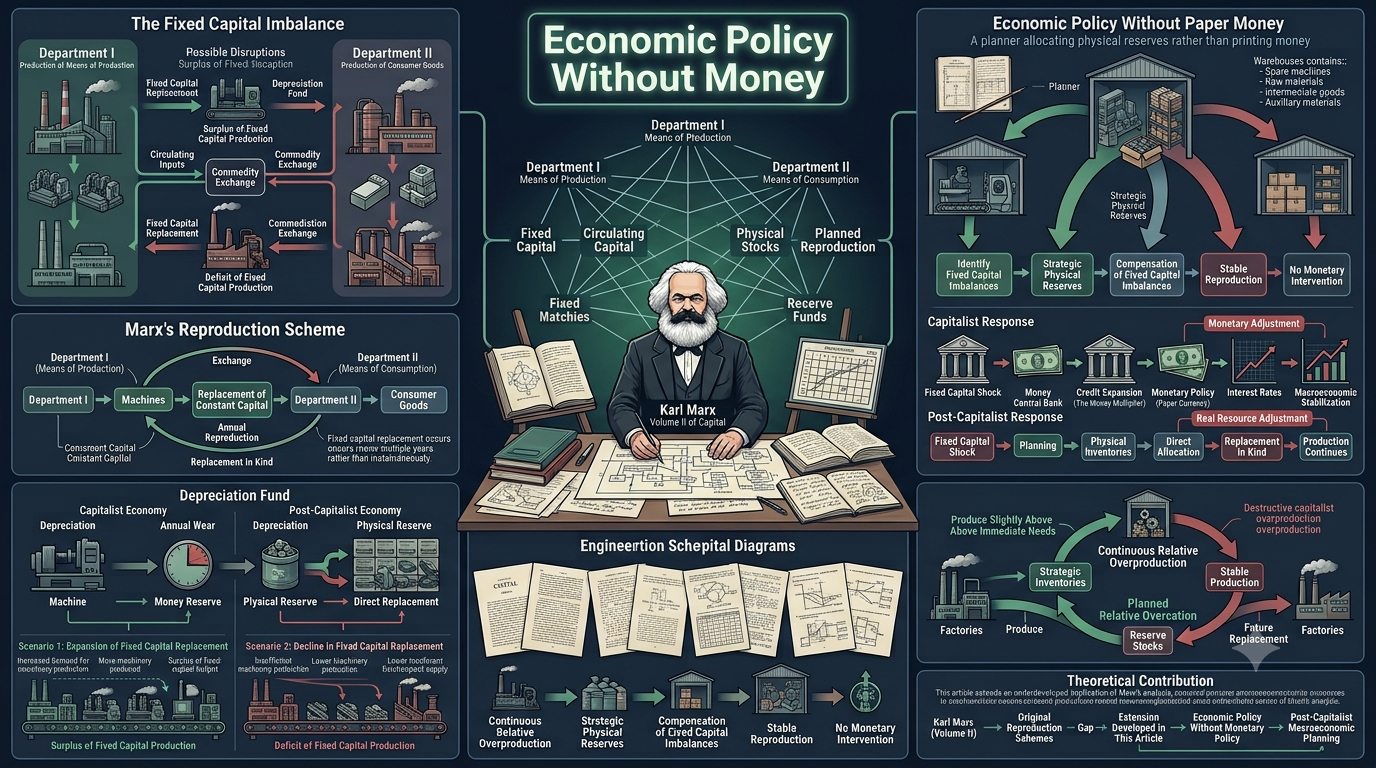
The reasoning is developed through the relationship between two sectors: the sector producing means of production and the sector producing means of consumption. The decisive question is how the relationship between the fixed and circulating components of constant capital changes when the proportion of fixed capital that must be physically replaced varies.
First Scenario
If the portion of the production of means of production devoted to replacing the fixed capital of the sector producing means of consumption increases, while the total production intended to supply that sector with constant capital remains unchanged, the increase in amortization alters the proportion between the replacement of fixed capital and the circulating elements required. A larger portion of the fixed capital restored in monetary form flows toward the sector producing means of production in order to recover its natural form, so that more money circulates with the unilateral function of a means of purchase, while the mass of commodities exchanged between the two sectors changes.
Second Scenario
If the proportion of the fixed capital of the sector producing means of consumption that must be reproduced in kind — that is, physically replaced all at once — decreases, the portion that only needs to be replaced in money through the reserve fund increases correspondingly. The mass of circulating elements of constant capital reproduced by the sector producing means of production remains unchanged, while the production of fixed capital subject to replacement decreases.
The Economic Policy Proposal
The article then takes its decisive step. Once the capitalist mode of production — and, with it, paper money in the terms of the argument being developed — has been abolished, the problem of proportionality between fixed and circulating capital is fundamentally reduced to the fact that the magnitude of fixed capital that is exhausted and must be physically replaced may vary from one year to another. These variations can offset one another successively, while, ceteris paribus, the remaining portion of constant capital required for the annual production of articles of consumption — raw materials, auxiliary materials, and intermediate materials — need not decrease.
These surplus use-values would not be commodities produced without an outlet, but rather a reserve fund. Its function would be to provide the production process with whatever portion of constant capital is required at any given moment: fixed capital when there is a deficit in its fixed component, or circulating elements when the imbalance requires reinforcement of that component. The purpose is to prevent variations in the replacement of fixed capital from reducing or disrupting the reproduction of the system.
In this way, the proposal does not consist in eliminating the material variations that give rise to the imbalances, but rather in consciously maintaining reserves capable of compensating for them. The year-to-year fluctuation in the physical replacement of fixed capital remains; what changes is the social mechanism through which society responds to it.
Why the Same Policy Would Not Work Under Capitalism
The article stresses that such a policy would have a completely different meaning within a capitalist society. There, it would constitute an element of anarchy because planning does not belong to the essence of the system. Moreover, capitalist overproduction is not “relative” in the specific sense employed by the proposal: it generates commercial crises. Nor does it take the form of continuous overproduction consciously maintained as a reserve; instead, commercial crises display a cyclical character.
The fundamental difference therefore lies in the organization of the production process. In the post-capitalist framework proposed by the article, the surplus is deliberately produced as a reserve of use-values in order to guarantee reproduction; under capitalism, overproduction emerges within a system whose dynamics are not governed by such conscious planning and leads to commercial crises.
A Brief Final Assessment
The article concludes by shifting attention from the technical problem to the history of Marxist theory. Gómez Julián points out that the Dictionary of Political Economy by Borisov, Zhamin, and Makarova — which he takes as a synthesis of Soviet economic theory of its time — neither develops nor even mentions this problem in its entries on “Fixed Capital,” “Simple Reproduction,” or “Expanded Reproduction.”
This omission is particularly significant for the author because Marx had already posed the problem, although only in embryonic form, on pages 414–417 of Volume II of Capital. Gómez Julián regards the issue as vitally important both for Marxist theory and for the construction of a communist society or any other post-capitalist society.
From this, he formulates a deliberately severe criticism of Soviet Marxism: he interprets the absence of this theoretical development as evidence that numerous foundations of the theory were not adequately understood either theoretically or practically, and he polemically connects that assessment with the historical outcome symbolized by November 9, 1989.
The Article’s Thesis, in Summary
The argument can be condensed as follows: year-to-year variations in the portion of fixed capital that must be physically replaced generate imbalances between fixed and circulating capital. Under capitalism, these imbalances manifest themselves within a commodity and monetary structure and may result in overproduction, scarcity, and crisis. In a post-capitalist society, by contrast, the article proposes dispensing with paper money in dealing with this problem through continuous relative overproduction of fixed capital and circulating elements, with the resulting surpluses accumulated as reserve funds and used according to the material requirements of reproduction.
Full text: https://dialnet.unirioja.es/servlet/articulo?codigo=9041512
Main references in the article: Karl Marx, Capital, Fondo de Cultura Económica, 2010; Borisov, Zhamin, and Makarova, Dictionary of Political Economy, 1965.
Leave a Comment/Deja un Comentario