
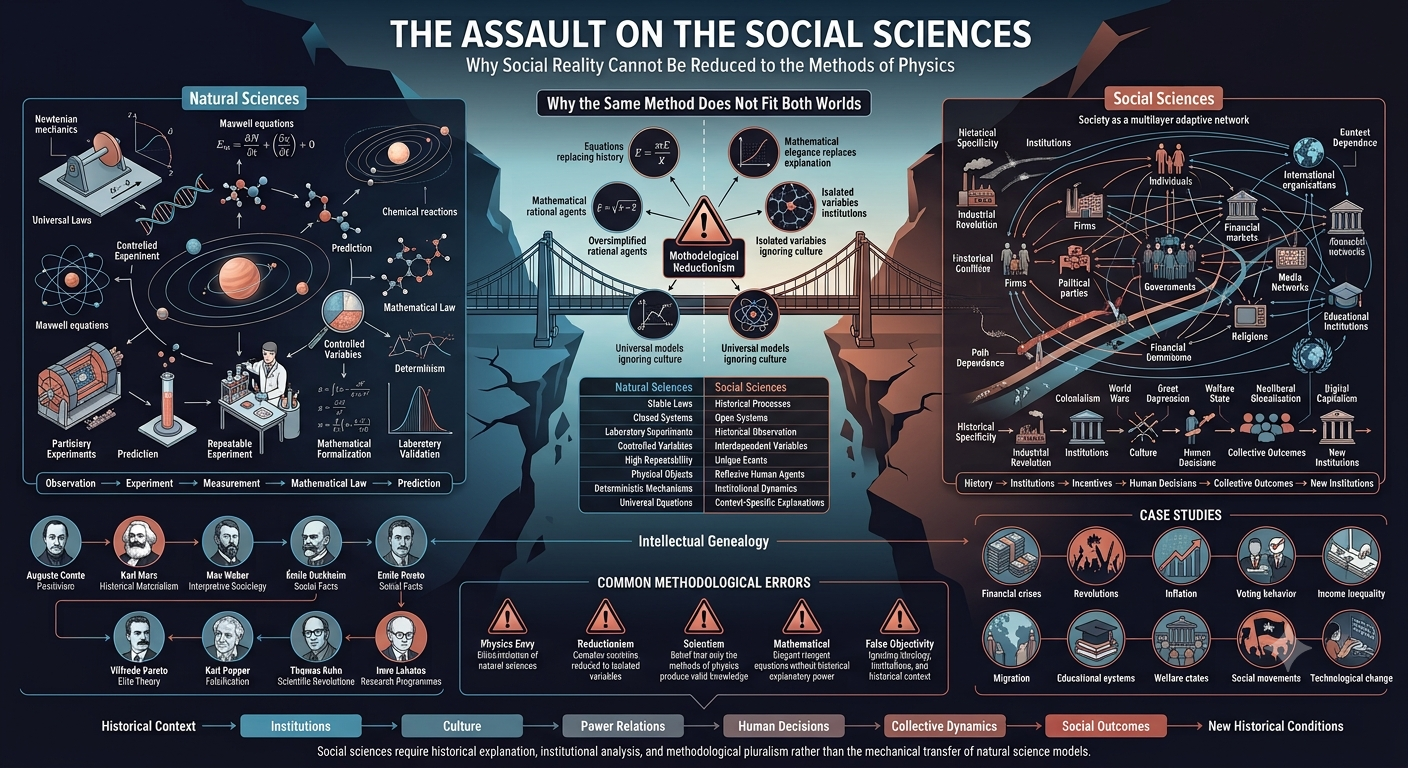
The Assault on the Social Sciences
Why the scientific study of society faces obstacles that cannot be reduced to a simple comparison with the natural sciences
~ 12 min read
There is a deeply rooted inequality in the way we tend to imagine the different sciences. A claim originating in physics, chemistry, or biology seems to acquire, almost immediately, the prestige of objectivity and rigorous demonstration. A claim about economics, politics, or society, by contrast, may be received as merely one opinion among many. Yet this difference in perception does not demonstrate that the social sciences are intellectually inferior. Rather, it reveals the extraordinary difficulty of the object they confront.
This is the problem from which The Assault on the Social Sciences begins. The social sciences cannot reproduce, with the same ease, the experimental conditions available to certain natural sciences. There is no test tube in which a society can be isolated, all its variables held constant, and a revolution, economic crisis, or cultural transformation repeated until its outcomes can be established with experimental precision.
Yet from this methodological difficulty, a conclusion is often drawn that does not necessarily follow from it: that social knowledge is less serious, less formal, or even dispensable. The article challenges precisely this leap.
The Strange Object of the Social Sciences
The social sciences study an object with an exceptional characteristic: those who express opinions about it live permanently within it. We all participate in economic, familial, political, and cultural relations. We all experience some form of society. This everyday familiarity can create the impression that immediate experience is enough to understand scientifically what we live through.
But living within a phenomenon is not the same thing as possessing a theoretical framework, a methodology, and the instruments required to explain its internal relations.
A person may use electricity every day without knowing electrodynamics. One may become ill without knowing molecular biology. Yet when the object is society, our direct participation in it makes it much easier to confuse experience with systematic knowledge.
The problem had already been identified by Destutt de Tracy and was later taken up by Maurice Duverger: those who have never studied the sciences concerned with morality, politics, and society may be sincerely convinced that they possess sufficient competence to make authoritative judgments about them.
A paradox thus emerges. The closer social reality is to our everyday experience, the easier it may become to underestimate the scientific complexity required to understand it.
Knowledge, Superstructure, and Private Interest
But the difficulty of the social sciences is not merely experimental. The argument then takes a decisive step: the production of knowledge takes place within historically determined societies. Scientists, universities, institutions, and theories do not exist suspended outside the material relations of their time.
From a materialist perspective, the social sciences are traversed by the superstructure of each historical formation and, consequently, by the interests of those classes with the capacity to establish dominant frameworks of interpretation.
This becomes especially important because social knowledge can make visible relations that certain interests would prefer to keep naturalized. Research may show that an institution presented as neutral systematically benefits one group; that a distribution of wealth is not spontaneous but historically produced; that a particular economic conception depends upon political assumptions; or that a power relation presented as inevitable had an origin and can therefore also have an end.
Here appears what the article, following Marx, describes as the furies of private interest. A theory of matter may be irrelevant to those occupying a particular economic position. A theory concerning property, distribution, the state, or social classes may be anything but irrelevant.
The disparagement of the social sciences should therefore not be explained solely as an individual intellectual error. The article proposes that it should also be interpreted as a systemic phenomenon, related to the mode of production and to the social conditions under which knowledge is produced and circulated.
The Natural Sciences Do Not Exist Outside Society Either
It would be a mistake, however, to turn this distinction into a simplistic opposition: ideological social sciences on one side and entirely neutral natural sciences on the other. The article itself rejects this caricature.
Richard Lewontin and Richard Levins have insisted precisely that it is naive to portray social science as inevitably contaminated by subjectivity while imagining natural science as an activity completely detached from historical, cultural, and political conditions.
To illustrate this, the article spends considerable time examining genetic determinism and sociobiology. At different moments, complex and partial genetic findings have been transformed, particularly in their public transmission, into much stronger claims about supposed genes responsible for complex forms of human behavior.
The mechanism matters. Finding a statistical association, locating a genetic region, or identifying a possible biological contribution is not equivalent to discovering a single sufficient cause of a phenomenon. Yet the distance between those levels of assertion can quickly disappear when a scientific result becomes a headline.
The case of Dean Hamer occupies a prominent place in the argument. His research into possible genetic associations related to male sexual orientation gave rise to public interpretations far more deterministic than the findings themselves warranted. Years later, Hamer also proposed a relationship between certain genetic characteristics and a predisposition toward religious experiences.
The importance of these examples does not lie simply in deciding whether a particular genetic hypothesis ultimately proved correct or incorrect. The epistemological point is deeper: simplification, extrapolation, ideological conditioning, and interested interpretation can also occur within the natural sciences.
Scientific objectivity, therefore, cannot rest on the fiction of a science situated outside society. It must be critically constructed through theory, evidence, testing, revision, and analysis of the conditions under which knowledge is produced.
Why Do Some Sciences Flourish More Than Others?
The article then introduces a question of political economy: why have the natural sciences experienced extraordinary development while the social sciences remain comparatively underdeveloped?
Part of the answer naturally lies in the differences between their objects and in the ability of certain sciences to conduct highly controlled experiments. But the proposed explanation does not stop there.
Discoveries in the natural sciences can be transformed directly into new technologies, machines, materials, energy sources, and productive procedures. Under capitalism, knowledge capable of increasing productivity therefore acquires immediate economic importance.
Technical progress drives the development of the productive forces and constitutes one of the mechanisms through which capital attempts to expand its possibilities of valorization and counteract its own economic tensions.
The social sciences maintain a different relationship with the existing order. Their discoveries do not merely improve the means by which a society produces. They can also ask who produces, who owns, who decides, who benefits, and why existing relations take precisely the form they do.
Neoliberalization, Individualism, and Social Consciousness
The situation of the social sciences also cannot be separated from the cultural transformations that accompany economic transformations.
The article draws on Zygmunt Bauman to describe a postmodern ethic marked by the weakening of great collective ideals, the growing centrality of the individual, and a conception of social life in which shared commitments may be displaced by the private pursuit of well-being.
This cultural transformation is related to processes of neoliberalization of the world economy. The point is not that every individual mechanically reproduces an economic doctrine, but that particular material relations encourage particular ways of perceiving the individual, other people, and society.
In materialist terms, there is a relationship between Social Being and Social Consciousness. The forms through which a society produces and reproduces its material life also participate in shaping the ideas through which that society interprets itself.
A crisis of the social sciences should therefore not be analyzed as though it were exclusively an internal crisis of university departments, academic publications, or methodologies. It may also be the intellectual expression of much broader contradictions present within the society that produces those sciences.
Two Reductionisms That Impoverish Our Understanding
This criticism leads to another epistemological problem: the tendency to understand complex phenomena through overly simple schemes.
Levins identifies two major orientations that have exerted enormous influence over modern science: mechanical reductionism and idealistic holism.
The first attempts to explain the whole by decomposing it into increasingly elementary parts, as though perfectly knowing each piece were necessarily enough to reconstruct all the properties of the system. The second runs the opposite risk: turning the whole into an abstract totality whose structure becomes detached from the material mechanisms that produce it.
For the social sciences, this tension is especially important. A society cannot be understood exclusively by adding together individual decisions, but neither can it be understood by invoking collective abstractions without explaining the concrete relations through which they emerge and reproduce themselves.
The challenge lies precisely in studying the interactions between parts and totality, individual and structure, history and present, cause and consequence, without erasing any of these levels.
A Political Opinion Does Not Become Immune to Examination Because It Is Political
The essay also questions another everyday assumption: the idea that certain political matters should cease to be discussed because all political discussion is ultimately an irresolvable confrontation between personal opinions.
But a political ideology does not arise from nowhere. It rests upon a particular conception of society, upon assumptions about human beings, and upon causal relationships that can, to a greater or lesser extent, be confronted with reality.
A scientifically serious discussion therefore does not consist in deciding who speaks with greater confidence or who possesses more social authority. It must examine the correspondence between theoretical framework and observable facts; study the available indicators; evaluate the epistemology from which the questions are constructed; and analyze whether the chosen methodology actually allows us to increase our knowledge.
Statistics Do Not Speak for Themselves Either
At this point, one of the article’s most important methodological warnings emerges. Invoking “the data” does not, by itself, resolve a controversy.
Before interpreting an indicator, one must ask how it was constructed. What exactly does it measure? What does it leave out? What population does it use? What categories does it presuppose? What is the reference period? How were the observations selected? What procedure transforms the real phenomenon into the figure ultimately presented?
Interpretation itself must then be examined. Two sets of statistics may describe different dimensions of the same reality, and the interested selection of certain figures while omitting others may produce a misleading representation without falsifying a single number.
This is why the familiar image of numbers as completely “cold” and self-sufficient entities is inadequate for the social sciences. Numbers do not determine for themselves which phenomena should be studied, which variables should be constructed, which models should be estimated, or what meaning should be assigned to their results.
The article applies this warning to economics as well, particularly to formulations of neoclassical theory that may shield their assumptions behind highly technical language. Technical sophistication may be indispensable for precision, but the mathematical complexity of a claim is not, by itself, a guarantee of truth about social reality.
Statistics must be interrogated, reconstructed, and confronted with what they are intended to represent. Precisely because statistics constitute an extraordinarily powerful tool, their use requires equally rigorous criticism.
The Complexity of the Social Sciences
All of this reverses a widespread intuition. The social sciences are not less complex because their conclusions may be less exact than certain predictions in the natural sciences. In many respects, the opposite is true.
They must study open, historical, and changing systems; work with subjects who learn and react; analyze institutions that alter their behavior; distinguish between regularities and contingencies; use data whose own construction has a history; and do so within societies traversed by the very conflicts that constitute their object of investigation.
Nor does this mean idealizing them. The article explicitly recognizes their relative underdevelopment and the need for profound intellectual humility. Defending the social sciences does not mean declaring every theory formulated under their name to be true. It means demanding more from them: better theory, better methods, better evidence, and constant criticism of their own assumptions.
A critical science must even preserve the possibility of revising or replacing its own paradigms when reality ceases to correspond to them.
Knowing Society in Order to Transform It
The argument finally reaches its deepest dimension. Science does not exist merely to accumulate descriptions of the world. Knowledge expands our material capacity to intervene in it.
The natural sciences have transformed our relationship with matter, energy, disease, distance, and production. The social sciences possess an analogous function on another terrain: they allow societies to consciously understand the mechanisms through which they are organized and, by understanding them, expand their capacity to modify them.
Hence the teleological dimension that appears at the end of the article. Scientific inquiry is not merely the reconstruction of what exists; it also involves producing knowledge capable of guiding action toward particular ends.
Historically, the social sciences and political doctrines have served to organize the orders produced by major transformations. Political and economic liberalism, for example, provided fundamental categories through which the bourgeoisie could understand and structure the new order born from the modern revolutions.
This makes the social sciences more than a collection of academic disciplines. They are also among the instruments through which a society can move from being merely the object of forces it does not understand to a conscious subject of its own transformation.
Maurice Duverger imagined precisely this possibility: the development of the social sciences could make possible an increasingly conscious politics, in which people understood the mechanisms through which they might be directed, persuaded, or manipulated.
From this perspective, the disparagement of the social sciences ceases to be a corporate dispute among university faculties. What is at stake is the capacity of a society to know itself.
A society may develop extraordinarily sophisticated technologies while remaining incapable of scientifically explaining the social relations through which those technologies are produced, distributed, and used. It may master natural processes while remaining subordinated to social processes that it has itself created.
Defending the social sciences therefore does not require lowering standards of rigor. It requires exactly the opposite: recognizing the immense complexity of their object and constructing the theoretical, methodological, and empirical instruments adequate to understanding it.
If the natural sciences make it possible to consciously transform nature, the social sciences contain an equally decisive possibility: that humanity may understand the social forces of which it is a part and consciously intervene in them.
The true assault on the social sciences begins when we confuse the difficulty of knowing society with the impossibility — or uselessness — of knowing it scientifically.
Compártelo:
- Share on Facebook (Opens in new window) Facebook
- Share on LinkedIn (Opens in new window) LinkedIn
- Share on Reddit (Opens in new window) Reddit
- Share on Telegram (Opens in new window) Telegram
- Share on WhatsApp (Opens in new window) WhatsApp
- Email a link to a friend (Opens in new window) Email
- Share on Threads (Opens in new window) Threads
- Share on Mastodon (Opens in new window) Mastodon
- Share on X (Opens in new window) X
- Share on Bluesky (Opens in new window) Bluesky
Leave a Comment/Deja un Comentario