
LISTEN TO THIS POST AS A PODCAST
What Counts as “The Economy”?
A Marxist Framework for Measuring Capitalism’s Rate of Profit
Before asking whether the rate of profit falls, we first have to decide whose profit rate we are measuring — and which economic activities actually belong in the theoretical object under study.
Since the empirical work of Anwar Shaikh and Edgardo Ochoa in the 1980s, researchers in Marxian economics have repeatedly tried to measure one of Marx’s most discussed propositions: the long-run tendency of the average rate of profit to fall. Yet underneath the familiar formula lies a prior problem that can materially change the result: which sectors of the economy should enter the calculation in the first place?
Manufacturing? Almost certainly. Finance? Perhaps not. Retail trade? Transportation? Government? Education? Warehousing? Modern national accounts combine activities that occupy very different positions in Marx’s theory of value and capital.
José Mauricio Gómez Julián’s paper argues that this cannot be treated as an arbitrary data-cleaning choice. If the quantity being estimated is specifically a Marxian average rate of profit of productive capital, then the sectoral boundary should itself follow from the theory whose proposition is being measured.
The Measurement Problem Comes Before the Formula
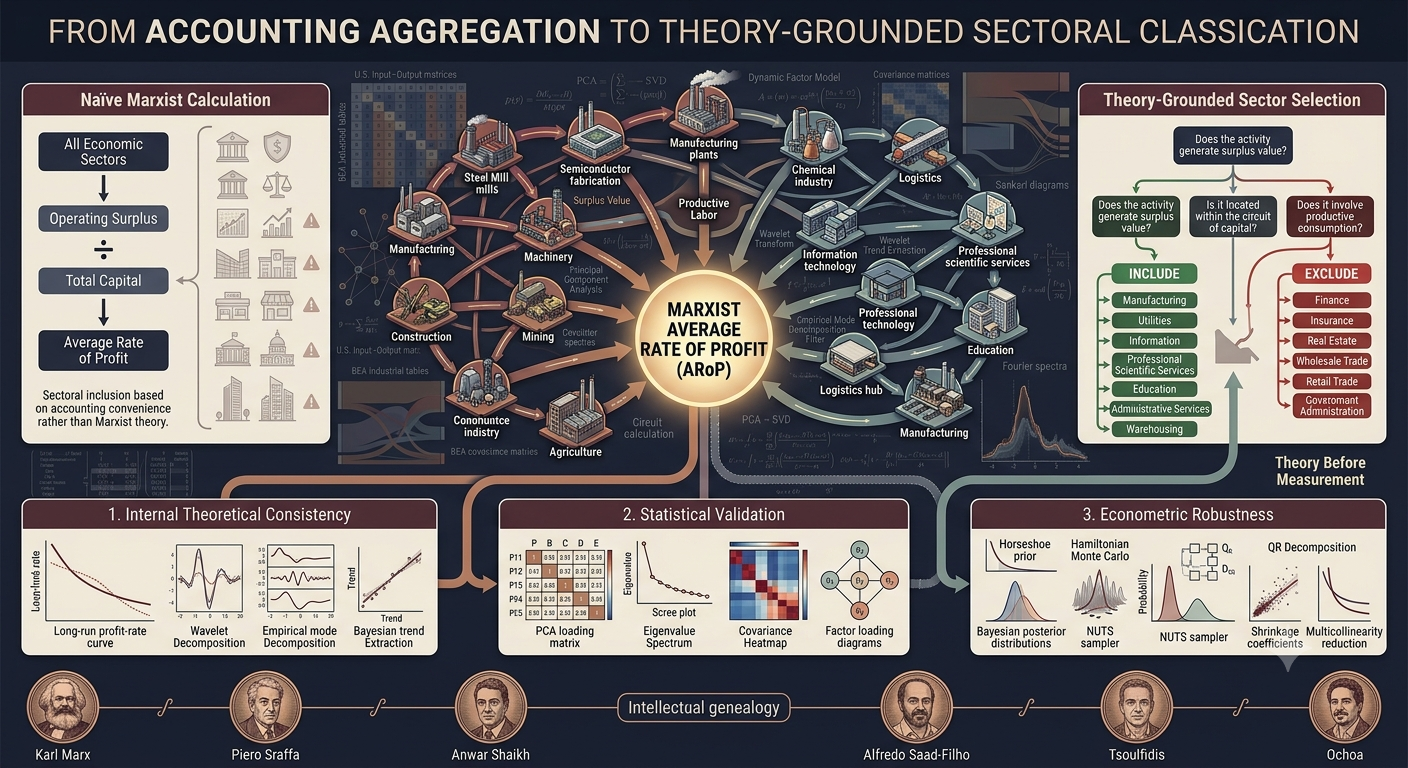
The paper calls the conventional alternative the naive Marxist calculation (nMc): constructing a profit-rate measure from broad national-accounting aggregates without first making a theoretically explicit distinction between productive and unproductive sectors.
The criticism is not that the arithmetic is incorrect. It is that an aggregate combining activities that create surplus value with activities that mainly circulate, redistribute, realize, or consume surplus may fail to correspond closely to the Marxian theoretical object being discussed.
The key point: a profit-rate series is produced not only by a formula, but also by the population of sectors placed inside that formula. Change the population and the historical trajectory can change with it.
Three Pillars: The Theoretical Logic Behind the Criteria
The paper’s framework rests on three interlocking questions drawn from Marx’s political economy. They are meant to determine whether an activity belongs within the productive capital whose profitability is being measured.
1. Productive vs. Unproductive Labor
In Marxian theory, “productive” is a technical category, not a synonym for socially useful. Productive labor is labor employed within the capitalist production process that produces value and surplus value. An activity can be necessary, socially useful, and remunerated while still being classified as unproductive in this specific theoretical sense.
Pure circulation activities are the clearest case. Buying, selling, bookkeeping, and related operations may be indispensable to capitalist commerce, but if their function is only to change the form or ownership of already-produced value, they do not thereby create new value.
The functions of capital in circulation do not, by themselves, create value or surplus value.
— Summary of Marx’s argument in Capital, Volume II2. Location in the Circuit of Capital
Capital moves through production and circulation rather than remaining in one form. The paper therefore asks whether an activity belongs to the productive reproduction of capital or primarily to circulation, redistribution, or a different institutional logic.
This distinction matters because not every activity carried out between production and final sale is automatically unproductive. Transportation is the classic case: changing a commodity’s location can itself constitute a necessary material transformation and can therefore add value.
3. Relationship with Surplus Value
The final question is whether an activity directly produces surplus value or constitutes an indispensable material condition for its production. Activities that merely redistribute or realize value are treated differently from activities whose labor participates in the productive process itself.
The Service-Sector Problem
One of the paper’s strongest theoretical points is that “services” cannot be treated as a single Marxian category. Modern national accounts combine radically different activities under that label.
Drawing partly on the functional approach discussed by Tregenna, the paper distinguishes among services that:
- directly produce surplus value;
- facilitate or materially condition surplus-value production elsewhere;
- remain outside the productive circuit of capital.
Hybrid sectors therefore have to be examined internally rather than included or excluded simply because a statistical agency labels them “services.”
Applying the Criteria: What’s In, What’s Out
Because BEA industry classifications change over time, the paper first consolidates the U.S. data into a common system of 47 economic activities for 1960–2020. The theoretical criteria are then applied to each activity.
Included — Productive
- Farms
- Forestry, fishing & related activities
- Oil & gas extraction
- Mining and mining support
- Utilities
- Construction
- Manufacturing industries
- Transportation
- Warehousing & storage
- Information
- Professional, scientific & technical services
- Management of companies & enterprises
- Administrative & waste management services
- Educational services
- Arts, entertainment & recreation
- Accommodation
- Food services & drinking places
- Other services except government
Excluded — Non-Productive
- Wholesale trade
- Retail trade
- Finance & insurance
- Real estate
- Rental & leasing services
- Health care & social assistance
- Federal general government
- Federal government enterprises
- State & local general government
- State & local government enterprises
The Borderline Cases
Warehousing and storage is included where preservation of a commodity’s physical properties constitutes a material continuation of the productive process. The argument is therefore stronger than the simple claim that storage is commercially useful.
Educational services is a much more difficult case. The statistical category mixes private, public, nonprofit, productive, and potentially unproductive activities. The paper nevertheless includes it because reproduction of skilled labor power is treated as a necessary condition of production in an advanced industrial economy.
Administrative and waste-management services is also heterogeneous. Its inclusion is explicitly conditional: the paper argues that a sufficiently large share of these activities is connected with productive enterprises and supports their production process. The same classification need not automatically hold in every country or period.
Information is included because the modern category encompasses software, informational and cultural products, technical infrastructure, data processing, hosting, and related forms of production. An apparently “immaterial” output is therefore not treated as automatically unproductive.
How the Profit Rate Is Constructed
The empirical calculation combines sectoral surplus with the capital advanced and then aggregates the selected productive sectors. In schematic form:
\[ r_t = \sum_{i\in P} w_{it} \left( \frac{s_{it}}{c_{it}+v_{it}} \right) \]
Here \(P\) is the set of included sectors, \(s_{it}\) is sectoral surplus, \(c_{it}\) constant capital, \(v_{it}\) variable capital, and \(w_{it}\) the corresponding sectoral weight.
The construction is subject to an important data limitation: sufficiently disaggregated fixed-capital and intermediate-input data are not directly available for every sector throughout the full period. The paper therefore uses proportional-disaggregation assumptions inherited from earlier empirical work, including Ochoa’s methodology. These reconstructed magnitudes should not be mistaken for fully observed sectoral capital stocks.
Internal Consistency: Does the Theoretically Constructed Rate Fall?
The paper distinguishes carefully between internal theoretical consistency and the much stronger claim that an entire theory has been proven true.
Marx’s theoretical system contains a proposition concerning a long-run tendency of the average rate of profit to fall. The first empirical question is therefore whether the series generated by the proposed sectoral criteria behaves consistently with that proposition.
Three different trend-extraction methods are used:
- Less-asymmetric Daubechies wavelets, with eight vanishing moments and decomposition depth \(J=4\);
- Empirical Mode Decomposition (EMD), a data-adaptive and nonparametric decomposition;
- an embedded Hodrick–Prescott trend within a Bayesian unobserved-components model estimated through Gibbs sampling.
Periodogram and short-time Fourier analysis are also used beforehand to examine the spectral structure and support the use of additive rather than multiplicative decomposition.
Under the theoretically selected sector set, all three methods produce a declining long-run trend in the net average rate of profit over 1960–2020. The result is not a monotonic straight line: cyclical recoveries and large shocks remain visible around the secular movement.
What Do the Unit-Root Tests Say?
The evidence is more mixed than the original blog version suggested. The paper evaluates 17 specifications across four test families: Augmented Dickey–Fuller, Elliott–Rothenberg–Stock, KPSS, and Phillips–Perron.
ADF and PP frequently fail to reject the unit-root null; some ERS specifications do reject it; and KPSS generally does not reject stationarity, particularly stationarity around a deterministic trend.
The appropriate conclusion is therefore not that every test rejects a unit root. Read jointly with the Wavelet, EMD, and Bayesian UCM-HP evidence, the paper interprets the results as being more consistent with a deterministic, potentially nonlinear trend.
Three Econometric Cross-Checks
The paper then asks whether alternative, statistically generated sectoral cores lead to a substantially different conclusion. Three methods are used: Principal Component Analysis, Regularized Horseshoe Regression, and a Dynamic Factor Model.
A crucial clarification: these procedures do not receive the theoretical productive/unproductive labels as the answers they are supposed to reproduce. But they should not be described as completely theory-free “blind tests” either. In particular, the RHR and DFM specifications use variables chosen because of their Marxian interpretation.
The algorithms are statistical; the research design in which they operate is not theoretically neutral.
Test 1: Principal Component Analysis
The PCA is implemented through Singular Value Decomposition. Seven principal components are retained according to the eigenvalue and explained-variance criteria described in the paper.
Rather than imposing an arbitrary loading cutoff, probability distributions are fitted to sectoral contribution measures, and the upper tail is used to identify unusually large contributions. Operationally, the paper selects the top decile within each retained component.
The union of these selections leaves 26 of the 47 activities. A post-hoc check of the 21 discarded sectors finds that none reaches an eigenvalue-equivalent contribution above one in the first five principal dimensions; the largest reported value is approximately 0.77 for health care.
PC1 deserves a nuance. Although its loadings are visibly associated with corporate and financial activities, the later interpretation notes that contributions to PC1 are relatively uniform and therefore treats it largely as an aggregate size or inertia component rather than the most discriminating structural factor.
Test 2: Regularized Horseshoe Regression
The RHR exercise is deliberately specified in a way connected with the labor theory of value: Total Gross Operating Surplus is modeled using sectoral Variable Capital as predictors.
The model uses a Regularized Horseshoe prior with an expectation of roughly 16 relevant sectors and employs QR reparameterization in Stan to improve computation under extreme multicollinearity.
This multicollinearity is not a minor inconvenience. With 61 annual observations and 47 strongly interdependent predictors, the posterior coefficients are heavily shrunk and no credible claim of conventional individual-sector significance can be sustained.
The robust result is therefore not a list of “significant causal sectors,” but the predictive ordering produced by projpred: which variables enter fastest as predictive performance improves.
The top 15 sectors are:
- Retail Trade
- Textile Mills & Textile Products
- Fabricated Metal Products
- Administrative & Waste Management Services
- Miscellaneous Manufacturing
- Construction
- Educational Services
- Electrical Equipment, Appliances & Components
- Nonmetallic Mineral Products
- Support Activities for Mining
- Printing & Related Support Activities
- Primary Metals
- Food Services & Drinking Places
- State & Local General Government
- Transportation
Test 3: Dynamic Factor Model
The DFM starts from the 47 sectoral series after logarithmic differencing and standardization. The Bai–Ng IC2 criterion selects the number of latent factors, while AIC selects the VAR lag order.
The resulting model contains two factors and one VAR lag. Its estimated transition matrix is:
\[ A = \begin{pmatrix} 0.3329 & 0.3253 \\ 0.1680 & 0.9129 \end{pmatrix} \]
The first diagonal coefficient corresponds to a relatively low-persistence component; the second is highly persistent and is interpreted as reflecting longer-run accumulation dynamics. Together, the two factors explain approximately 34.01% of total variation in the standardized, differenced sectoral panel.
Validation goes well beyond ranking factor loadings. The procedure combines multi-horizon prediction, Elastic Net, stability selection, synchronized block bootstrap, Partial \(R^2\), loading–sensitivity interactions, and a Full-Robust Thresholding procedure whose null distributions correct for factor indeterminacy through Procrustes/Hungarian alignment.
Under the paper’s strict four-part predictive screen, no individual sector survives as a stable unilateral predictor of the aggregate profit rate. This is interpreted as consistent with a systemic rather than single-sector mechanism.
At the same time, the structural synchronization weights are highly unequal. The empirical core is led by Real Estate, State & Local General Government, Federal General Government, Retail Trade, and Food Services, with Utilities and Chemical Products among the industrial baseline.
The Key Revelation: Theoretical and Statistical Cores Diverge
Where Theory and Data Overlap
Manufacturing repeatedly appears among the statistically important sectors and is unambiguously included by the theoretical criteria.
Construction, transportation, utilities, educational services, and administrative services also appear with substantial weight under one or more econometric approaches while belonging to the theoretically selected productive set.
This overlap shows that the theoretical and statistical classifications are not unrelated — but it does not establish that they are measuring exactly the same concept.
Where Theory and Data Diverge
Real Estate carries the highest structural weight in the reported DFM ranking, despite being theoretically excluded.
Federal and state/local government also receive high DFM weights while remaining outside the paper’s theoretical productive-capital boundary.
Retail Trade ranks first under the RHR predictive ordering and also appears prominently in the DFM, yet is excluded theoretically as an activity of circulation.
Finance is prominent in the PCA structure, while health care records the largest post-hoc PCA contribution among the sectors discarded by that selection.
The statistical result is therefore a divergence between the sectoral core defined by Marxian value theory and the sectors that dominate covariance, prediction, or synchronization in the observed national accounts.
The paper interprets this through Marx’s distinction between essence and phenomenal appearance. Activities treated as unproductive in value-theoretic terms can still exert enormous influence over the observable movement of contemporary aggregate profitability.
This distinction is important: the econometrics establishes different statistical rankings and structures. The claim that this difference should be understood as an essence/appearance relation is the paper’s Marxian theoretical interpretation of those empirical results.
Does the Rate of Profit Fall?
The paper’s strongest robustness exercise repeats the long-run trend analysis using four different sectoral selections: the theoretical criterion, PCA, Regularized Horseshoe, and DFM. Each is then passed through the three trend-extraction methods.
- Theoretical sectors + Wavelet → declining
- Theoretical sectors + EMD → declining
- Theoretical sectors + HP → declining
- PCA sectors + Wavelet → declining
- PCA sectors + EMD → declining
- PCA sectors + HP → declining
- RHR sectors + Wavelet → declining
- RHR sectors + EMD → declining
- RHR sectors + HP → declining
- DFM sectors + Wavelet → declining
- DFM sectors + EMD → declining
- DFM sectors + HP → flat/rising exception
In other words, the qualitative declining tendency survives 11 of the 12 combinations.
The DFM–HP exception is not discarded. The paper relates it to the interaction between the state-space HP specification and a DFM sectoral core heavily influenced by real estate and government, whose accounting dynamics may differ from those of productive capital.
EMD yields the most pronounced declining tendency across the comparisons, which the paper associates with its adaptive, nonparametric character.
What the Evidence Does — and Does Not — Establish
The first contribution is methodological standardization. The paper turns sector selection from a largely implicit convention into an explicit and reproducible theoretical procedure.
Second, the theoretically constructed profit-rate series displays the long-run decline predicted by the surrounding Marxian theoretical system. In the terminology of the paper, this supports the internal consistency of the proposed classification.
Third, alternative statistically generated sectoral selections also produce a declining long-run rate in almost every methodological combination. That makes it harder to attribute the qualitative result solely to one hand-picked list of industries.
But none of this logically proves the Marxian theory of value as a whole, nor does one U.S. study establish that the tendency must hold across every country and historical period. The paper explicitly distinguishes consistency within a theoretical system from the much stronger question of the theory’s overall validity.
What Still Needs to Be Tested
The empirical exercise covers one country and one historical period: the United States from 1960 to 2020. The natural next step is replication across other economies, periods, and institutional structures.
Some theoretical classifications are necessarily conditional because broad BEA sectors contain heterogeneous activities. Education and administrative services are particularly clear examples where finer disaggregation could modify the classification.
The RHR exercise is also operating in a difficult \(N=61,\;P=47\) environment with extreme multicollinearity. Its defensible output is predictive ordering, not a set of identified causal effects for individual sectors.
Finally, PCA and DFM answer questions about covariance, synchronization, and statistical structure that are not identical to the Marxian theoretical question of where surplus value is produced. Their value lies in comparing those distinct objects rather than pretending that they are interchangeable.
The most defensible bottom line: the paper does substantially more than show another declining profit-rate graph. It specifies what should count as productive capital, makes that rule reproducible, checks its compatibility with the broader theoretical system, and then tests whether the qualitative result survives very different statistical constructions of the economy.
The answer is strikingly robust: in the U.S. data examined here, the long-run decline survives almost every combination. But the paper is better read as a first systematic piece of a larger empirical program than as the final word on the law itself.
Leave a Comment/Deja un Comentario