
LISTEN TO THIS POST AS A PODCAST
Polemic · Political economy · 2022–2025
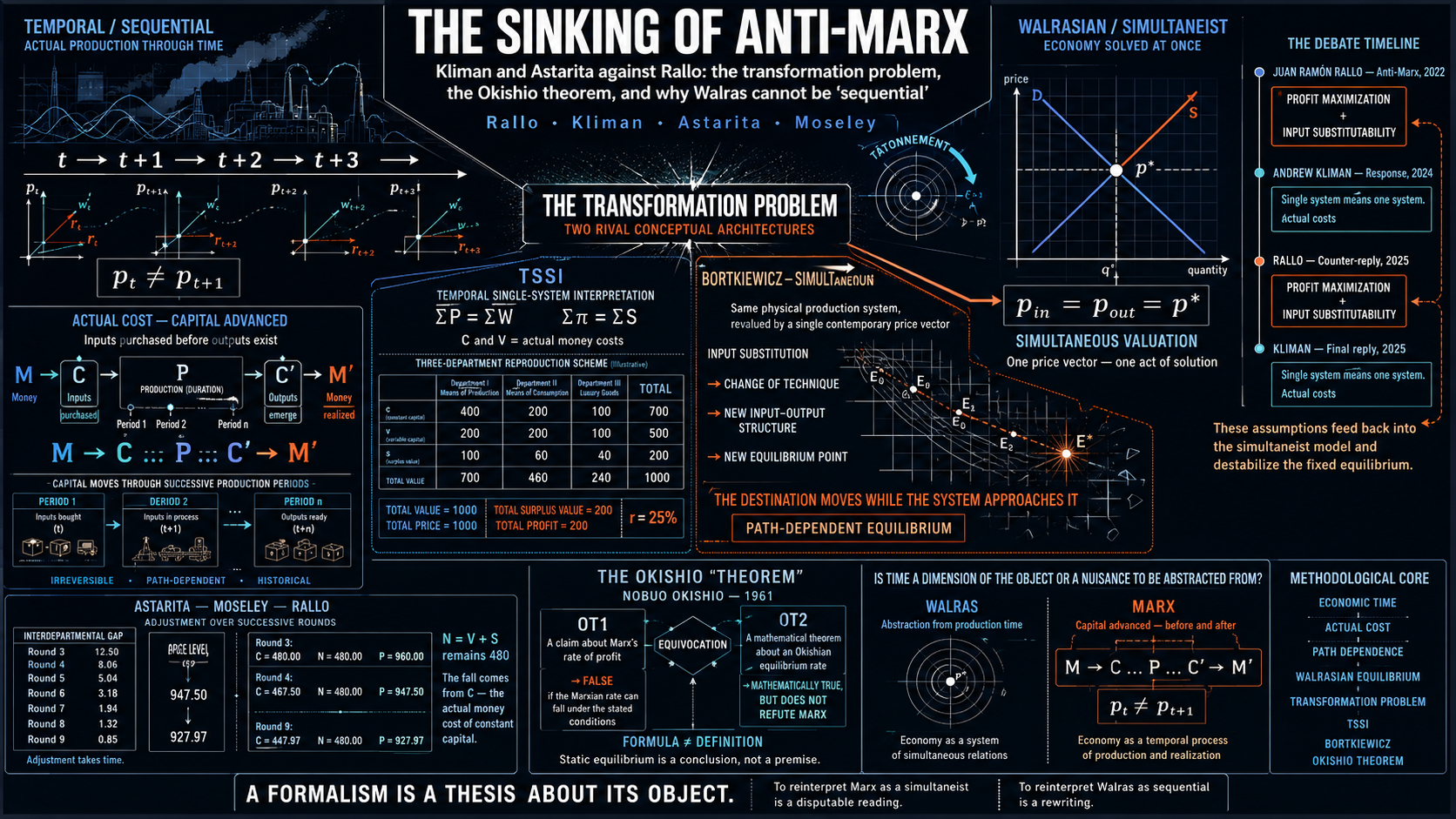
The Sinking of Anti-Marx
Kliman and Astarita against Rallo: the full sequence of a debate on the transformation problem —and a reply on why Walras cannot be “sequential.”
Between 2022 and 2025 a debate unfolded that is almost never read in full. In late 2022 Juan Ramón Rallo published the two volumes of Anti-Marx. Crítica a la economía política marxista, advertised by its publisher as “the most ambitious critique of Marxism written to date.” Andrew Kliman answered in September 2024. Rallo replied in April 2025. Kliman closed in May 2025. In parallel, a year earlier, Rolando Astarita had answered the critique that Anti-Marx directs against Fred Moseley, and Rallo answered him the following day.
What follows is that entire sequence, arranged by argument rather than by date: first what Rallo concedes, then each of his criticisms in its conceptual core, and then the answer it received. Where there is a counter-reply, the counter-reply comes next, and each front closes with the last word of whoever answered. At the end, my own replies.
· · ·
IWhat Rallo concedes
It is worth fixing first what Rallo grants, and not out of courtesy: a good part of Kliman’s argument is built on those concessions, and without them the rest of the discussion is unintelligible. Kliman highlights them, moreover, because they are unusual in anti-Marx literature: Rallo neither hides them nor buries them in a footnote.
Kliman fixes the value of these admissions with a conditional: they are irrelevant only if the demolition that follows works. If it does not, they are “not meaningless concessions about a merely mathematical solution, but significant concessions about a genuine economic solution.” The whole of the rest of the debate is, at bottom, the question of whether the demolition works.
· · ·
IIFirst front: values and prices of production
Round 1 · Rallo (2022) · The critique
Conceptual core. Temporal single-system valuation produces, period after period, changing relative prices between constant and variable capital. If capitalists maximize profits and the elasticity of substitution between means of production and labour-power is non-zero, that change in relative prices forces them to recombine inputs: to use less of what has become dearer and more of what has become cheaper. But then the relations of production of the following period are not those of the previous one, the output produced in t does not match the demand of t+1, and simple reproduction breaks down.
Hence the verdict:
The [temporal single-system interpretation] is not an economic solution to the transformation problem, but a merely mathematical solution with the appearance of an economic solution (since it is a mathematical solution incoherent with the economic conditions that would permit the simple reproduction of capital), whereas the simultaneist solutions to the transformation problem are solutions that respect macroeconomic equilibrium but at the cost of sacrificing either the labour theory of value or the theory of exploitation.
Rallo, Anti-Marx, vol. 2, § 5.4.1
The demand is set out as four conditions that, according to Rallo, any solution must satisfy at once: aggregate equality of value and price of production; aggregate equality of surplus value and profit; static equilibrium (supply = demand sector by sector); and dynamic equilibrium, defined as “the absence of incentives, within the structure of prices of production itself, to modify the relations of production that engendered that structure of prices of production.”
Round 2 · Kliman (September 2024) · The answer
1. The argument is a boomerang
Kliman concedes at the outset what has to be conceded: some production processes require fixed proportions and others allow substitution, and Rallo is right that the latter exist. He concedes profit-maximizing behaviour as well. And he then shows that, once those two premises are accepted, the argument does not strike temporalism alone: it strikes Bortkiewicz first.
The reason is a misidentification. Rallo conflates changes in prices with temporally determined prices. He believes that in the simultaneist “solutions” prices do not change, because input prices are forced to equal output prices. But the transformation, as Bortkiewicz, Sweezy and Rallo himself conceive it, is the move from a system in which commodities exchange at their values to one in which they exchange at their prices of production. That move is, by definition, a change in relative prices. With maximization and substitution, it triggers exactly the recombination of inputs that Rallo demands, and therefore breaks simple reproduction.
Kliman does this with Bortkiewicz’s own numbers. In the “value system” Department III uses Technique A (50 units of Good 1 and 150 units of living labour to produce 200 units of output); in the “price system” Good 1 becomes dearer relative to the wage rate, Technique B (10 units of Good 1 and 225 units of labour) becomes the cost-minimizing method, and firms switch —as Rallo recommends. The result: Department III’s rate of profit rises to 27.7 % against 25 % in the other two, demand for Good 1 falls below supply, excess demand for the wage good appears, and the “price system” is no longer in equilibrium in any sense. Its prices are no longer prices of production, because profit rates are not equalized.
If one rejects any “solution” incompatible with simple reproduction, one must reject not only Marx’s account, but also Bortkiewicz’s “correction” and every existing and potential simultaneist solution.
And with this falls, in passing, Sweezy’s classic formulation —“the passage from value calculation to price calculation has no connection with the question of whether the economic system as a whole is stationary or expanding”—: given the restrictions Rallo himself adds, moving from one calculation to the other has everything to do with that question.
2. What a price of production really is in Marx
The second move is exegetical and decides the rest. Marx treats separately the formation of a general rate of profit (ch. 9 of volume III) and its equalization (ch. 10). Likewise, the formation of prices of production is one thing and exchanges at prices of production are another. Prices of production always exist: as a concept in the heads of capitalists and economists, as a benchmark of success, as a minimum target for viability and —above all— as the average over time of the market prices that fluctuate around them.
Rallo had written that “the concept of a long-run equilibrium price is meaningless within an economy that is not in equilibrium.” Kliman answers with the analogy that circulated most widely of anything in the exchange:
This is like saying that the concept of average family size is meaningless whenever there is no family of average size.
Average U.S. family size in 2022 was 3.13 people. No family had 3.13 members.
3. Two concepts of equilibrium
Hence the distinction that orders the whole front: there is equilibrium as a state of balance (supply equal to demand) and equilibrium as a state of rest (the future repeating the past: stationary prices, simple reproduction, unchanging input–output relations). Marx’s prices of production are balance prices; they need not be, and generally are not, rest prices. Requiring rest is not a requirement of the theory: it is an additional restriction, and often an obstacle, because it may be incompatible with the equalization of profit rates.
4. The generality of the procedure
The close is the one Kliman will repeat in 2025. The data with which Marx calculates are the capital investments, the components of cost price, and the surplus values. Not among the data are the physical input–output relations, the physical quantities, the assumption that input prices equal output prices, or simple reproduction. They are not there because they are irrelevant to the calculation.
In short, Marx’s procedure is completely general. It does not rest on any restrictive assumptions.
Kliman, 2024
In passing, Kliman dismantles Rallo’s attempt (§ 5.3.5 of volume 2) to prove that the law of value does not determine the general rate of profit: what Rallo proves, by altering a few of Bortkiewicz’s figures, is that the law of value does not determine the rate of Bortkiewicz’s “price system” —something Bortkiewicz himself proclaimed. It is a petitio principii: one starts from a model that presupposes Marx was wrong, and uses it to prove that Marx was wrong. Worse: those rates of profit are false, because they presuppose that every department sells everything it produces, and that does not happen once input substitution breaks simple reproduction.
Round 3 · Rallo (13 April 2025) · The counter-reply
1. “Kliman concedes my point without conceding it”
Rallo takes a sentence from Kliman’s close —“it would be fatuous to require that we solve a problem that has no solution”— and reads it as a capitulation: if the problem has no solution, then the transformation problem has no solution, temporalism included. QED.
2. The three “excuses”
He enumerates the cases in which, according to Kliman, temporalism would be compatible with simple reproduction, and dismisses each. That capitalists do not maximize or that substitution is impossible amounts, he says, to admitting there is no general solution —and it suffices that some processes admit substitution for the problem to return. That exchanges take place at prices differing from prices of production is inadmissible if, as Kliman himself defines them, prices of production are the long-run average of market prices. And that inputs and outputs both exchange at prices of production is precisely Bortkiewicz’s case, in which —Rallo holds— the twofold aggregate equality does not hold.
3. The direction of Bortkiewicz’s procedure
The most ambitious move. Kliman is wrong, says Rallo, to read Bortkiewicz’s scheme as a temporal transition from the value system to the price system. The simultaneist solution is atemporal:
Table I is not a temporal antecedent of Table II or Table III; it is a logical antecedent […] there exists a single productive structure derived from the system of prices of production, which can be expressed / represented / computed in terms of values (of hours of social labour).
Rallo, 2025
If this were so, Kliman’s objection would dissolve: there would be no passage from one productive structure to another, and therefore no input substitution and no breakdown of simple reproduction in Bortkiewicz’s scheme. It would occur only under temporal determination.
Round 4 · Kliman (15 May 2025) · The close
1. The decontextualized quotation
Kliman takes up Ángel Barroso’s observation: the quoted passage “presents Kliman as if he were admitting that the Marxist transformation problem has no solution, when in fact he is saying something very different.” What has no solution is the problem as Rallo formulates it, because Rallo demands mutually incompatible conditions. Saying that a problem is insoluble is not the same as saying that a formulation is contradictory.
2. The five-line demonstration
Kliman decides not to argue method and to prove the result directly. In any period, for any sector j:
(1) Wj = Cj + Vj + Sj (2) Pj = Cj + Vj + πj
(3) ∑Pj = ∑Wj by the demonstration in ch. 5 of volume I: exchange redistributes value, it does not create it
(4) ∑Cj + ∑Vj + ∑πj = ∑Cj + ∑Vj + ∑Sj ⇒ (5) ∑πj = ∑Sj
And since the denominator is the same invested capital, the rate of profit “in price” equals the rate “in value.”
The key lies in the definition of C and V: they are the actual cost of the means of production consumed and of hiring the workers. There is no constant capital equal to the value of the means of production and another equal to what was paid for them. Single system means one system. No special-case restriction enters the derivation; therefore no special case can invalidate it. To refute the equalities one would have to refute the demonstration in chapter 5 of volume I —which neither Bortkiewicz nor Rallo attempted.
3. The equalities hold even in Rallo’s own case
Kliman takes Rallo’s “dynamic equilibrium” —which he renames static equilibrium, since there is nothing dynamic about it: “the motionless equilibrium of a dead body, eternally at rest”— and the exact figures from page 204 of Bortkiewicz. Read as a single system, with C and V taken as the money costs actually laid out, they give:
| Dept. | C | V | S | W | π | P | S/(C+V) | π/(C+V) |
|---|---|---|---|---|---|---|---|---|
| I | 288 | 96 | 60 | 444 | 96 | 480 | 15.6 % | 25.0 % |
| II | 128 | 128 | 80 | 336 | 64 | 320 | 31.3 % | 25.0 % |
| III | 64 | 96 | 60 | 220 | 40 | 200 | 37.5 % | 25.0 % |
| Total | 480 | 320 | 200 | 1000 | 200 | 1000 | 25.0 % | 25.0 % |
Total price 1000 = total value 1000; total profit 200 = total surplus value 200; the rate “in price” 25 % = the rate “in value” 25 %. The three equalities hold inside the very case Rallo constructed so that they would fail. And they hold again in a case with the same physical data but different prices, non-stationary and without simple reproduction; and in period 14 of Table 1 of Kliman and McGlone (1988), which Rallo cites in his own book.
The diagnosed error is uncomfortably precise: Rallo does not compare the price and profit of the single system against the value and surplus value of the single system. He compares the price figures of Bortkiewicz’s “price system” against the value figures of a separate “value system” that the temporal single-system interpretation rejects outright. He is assessing a single-system interpretation with dual-system instruments.
4. The three “highly exceptional” cases exhaust the universe
Rallo called “highly exceptional assumptions” the three cases Kliman had enumerated. Kliman crosses them in a two-by-two table —exchange at prices of production yes/no, against maximization with substitution yes/no— and shows that the three, taken together, cover every possible combination. The rhetoric of exceptionality was concealing an exhaustive enumeration.
5. The textual evidence on Bortkiewicz
Against Rallo’s claim about the direction of Bortkiewicz’s procedure, Kliman asks for the evidence and answers: there is none. No quotations, no paraphrase, no page references. Rallo’s justification is that the alternative strikes him as “unthinkable.” Kliman sets against this six textual supports from pages 199–205: Bortkiewicz says he will proceed without reversing Marx’s way of presenting the problem; he states as his third limiting assumption “we shall assume simple reproduction,” with no restriction on its scope; he declares that his equations (1)–(3) satisfy “the conditions of simple reproduction”; he writes that “the problem is now to convert these value expressions into price expressions” and announces his “correct transition from value magnitudes to price magnitudes”; and he obtains his price expressions by multiplying the value expressions by each department’s price/value ratio —that is, by leaving the physical quantities of the value system untouched and revaluing them.
Rallo’s whole story about how Bortkiewicz proceeds is a fabrication.
6. And the direction makes no difference
The final move closes every exit. Suppose, says Kliman, that Rallo were right and the transition ran from prices to values. One gets the same thing: a change in relative prices that induces input substitution, imbalance between supplies and demands, and the breakdown of simple reproduction. The “value system” economy turns out to be physically distinct from the “price system” economy, and comparing their aggregates is comparing Poland’s total price with Russia’s total value. If instead Table I is read as a thought experiment —a merely logical antecedent— the thought experiment violates Rallo’s own substitution restriction: with substitutable inputs, the imaginary change of prices induces imaginary substitution and an imaginary breakdown of simple reproduction. Real apples against imaginary oranges. And if maximization is dropped to avoid this, the capitalists of the imaginary system will optimize something else, or nothing, and will likewise have no incentive whatever to sustain the other system’s physical structure.
The root of the problem is that Rallo imposed the input-substitution restriction on top of the simple-reproduction one. In a transition from one set of relative prices to another, these two restrictions are simply incompatible.
Kliman, 2025
Rallo’s complete set of restrictions can be satisfied in one case only: when relative prices are stationary. Temporal single-system valuation can satisfy it, because it is compatible with stationary prices —as the table above shows. Simultaneist solutions cannot, because on their conception of the transformation, the transformation itself is a change in relative prices.
· · ·
IIISecond front: the Okishio “theorem”
Round 1 · Rallo (2022) · The critique
Conceptual core. Rallo reproduces Kliman’s numerical example and does indeed obtain a falling general rate of profit with rising organic composition and a constant real wage. But he holds that this refutes nothing, because what temporalism “really does […] is estimate a general rate of profit different from the one the Okishio Theorem itself estimates.” And he adds the decisive premise: “Recall that the Okishio Theorem defined the general rate of profit as that value which made it possible to equalize intratemporally (in each period t) the equilibrium prices of inputs and outputs.” If that is the definition, then computing another rate does not refute the theorem: it changes the subject.
Round 2 · Kliman (September 2024) · The answer
1. A formula is not a definition
The claim is false as a matter of fact: the writings of Okishio and Roemer contain no such definition. They contain formulas in which input and output prices are equal, which is not the same thing. “The definition of a mathematical object is given by […] listing the properties the object is required to have”; formulas are not lists of required properties. The static-equilibrium character of the Okishian rate is a conclusion of the theorem, not a premise —something Okishio and Roemer claimed to have deduced, not something they stipulated. Kliman had already explained this on page 118 of Reclaiming Marx’s “Capital”; Rallo does not answer that explanation.
2. The burden of proof
Here is the heart of it. The “theorem” is a claim about Marx’s rate of profit: Okishio wrote that “our conclusions are negative to the Marxian Gesetz des tendenziellen Falls der Profitrate.” The burden of proof therefore falls on whoever claims that this rate cannot fall. And correspondingly, whoever refutes the theorem need only show that the rate as Marx defines it can fall under the conditions in which the theorem says it cannot. He need not show that his rate satisfies Okishio’s preferred definition, or Rallo’s. Defining the rate of profit as a static-equilibrium rate illicitly shifts the burden of proof. And it is obvious that Marx never defined the general rate of profit as the value that intratemporally equalizes the equilibrium prices of inputs and outputs.
3. The OT1 / OT2 equivocation
Kliman revives his analysis of Robin Hahnel’s manoeuvre, which Rallo repeats. Two distinct theorems are invoked alternately under one name. OT1 is a theorem about real capitalism, which would assert that labour-saving technical change does not by itself reduce the rate of profit; it is false. OT2 is a purely mathematical theorem, free of logical flaw, whose “rate of profit” is a mathematical object and not the rate of real capitalism; it is true but harmless. Using the same term in two senses within one argument is an equivocation, and an equivocation invalidates the argument.
As a libertarian, Rallo wants to be free to choose. I have no interest in restricting that freedom. So, Dr. Rallo: which will it be, OT1 or OT2? It is your choice. I only insist that you cannot have it both ways.
Kliman, 2024
Kliman notes further that Rallo’s long analysis of the convergence of the temporal rate toward the Okishian rate if productivity growth stopped forever is not about the matter at issue: it is about conditions contrary to those the theorem is about. And he records the asymmetry of standards: a writer scrupulous about the realism of technological assumptions when it comes to input substitution is wholly unconcerned with that realism when it comes to rising productivity.
There is no counter-reply on this front. In April 2025 Rallo announced that he would examine the arguments against the Okishio theorem in a later text; his reply of that month is confined to the transformation problem and likewise does not directly address the demolition of his attempt to refute the law of value.
· · ·
IVAstarita against Rallo: Moseley and economic time
A year before the exchange with Kliman, Rolando Astarita had answered the critique that Anti-Marx directs against Fred Moseley. Moseley’s thesis is that no transformation of input values is required, because capitalists always acquire them at their prices of production —or at market prices oscillating around them— and because the variables are determined sequentially rather than simultaneously. If that is right, Böhm-Bawerk’s objection, the pillar of nearly all anti-Marx discourse, collapses.
Round 1 · Rallo (2022) · The critique of Moseley
Conceptual core. Rallo grants that in Moseley’s scheme, with inputs and outputs already in prices of production, there is interdepartmental equilibrium: IIc = Iv + Ib = 190. But he holds that the equilibrium is fragile. If the rate of profit varies —say, if wages rise by 20 % and the rate falls from 33 % to 25 %— the prices of constant and variable capital vary, and the equilibrium breaks: IIc = 190 while Iv + Ib = 177.5, a gap of 12.5. Conclusion: Moseley’s sequential method must be replaced by the simultaneous resolution of a system of equations, in Bortkiewicz’s manner.
Round 2 · Astarita (19 March 2023) · The answer
1. Economic time is not abolished by decree
In reality, capitalists acquire constant capital and labour-power at prices of production, so that what they do approximates the sequential method. There is no simultaneous resolution of input and output prices: to assume one is to annul economic time. The use of simultaneous equations may be granted in determinate circumstances, with the framing conditions made explicit; but when the change in variables is as large as a 20 % wage increase, there is no way to pass over the disequilibria and the adjustment dynamics that follow. Moseley, in personal communication, puts it plainly: once the change occurs, “there will be a process of adjustment toward the new equilibrium which will take some time.”
To think of an economy in which new equilibrium prices are established instantaneously is to abstract from the real movements inherent in an economic system in which the law of value imposes itself through permanent oscillations and contradictions.
Astarita, 2023
2. The Austrian contradiction
The second move is ad hominem in the legitimate sense of the term: it points to an incoherence between the position held and the framework from which it is held. To suppress disequilibria by resorting to a system of equations is to return to the disappearance of economic time that Walras carried out in Lesson 20 of the Elements of Pure Economics, where not only are production plans and service prices decided simultaneously, but production occurs instantaneously. And Walras says so himself:
Production requires a certain lapse of time. We shall resolve this second difficulty purely and simply by abstracting from that lapse.
Walras, Elements of Pure Economics, Lesson 20
Astarita underscores the paradox: it is an Austrian who recommends the Walrasian approach, when the Austrian school itself has been its most persistent critic. He cites Huerta de Soto against “the negative effects that mathematical formalism and the pernicious obsession with analyses based on full information and equilibrium have had on the development of our science,” and his call to replace it with “a theory of prices that explains how they are formed dynamically as the result of a sequential and evolutionary process […] and not by the intersection of mysterious curves or functions devoid of all real entity.” Hence the question: “Or is it that when it comes to criticizing Marxists, anything goes?”
3. The disequilibrium closes by itself
The third move is arithmetical. Astarita takes the disequilibrium Rallo exhibits as proof of failure and lets it run through the sequential method: each round’s prices of production enter as the next round’s input prices. The gap between IIc and Iv + Ib behaves as follows:
| Round | 3 | 4 | 5 | 6 | 7 | 8 | 9 |
|---|---|---|---|---|---|---|---|
| Gap | 12.50 | 8.06 | 5.04 | 3.18 | 1.94 | 1.32 | 0.85 |
| Rate of profit | 25.00 % | 25.41 % | — | 25.86 % | 25.90 % | 26.04 % | 26.08 % |
Tendentially, prices of production approach the equilibrium prices between sectors. But this is not an instantaneous solution. There is a process; time counts.
Astarita, 2023
Round 3 · Rallo (20 March 2023) · The answer
1. Walras as a point, not an instant
That I am an Austrian does not mean I accept every argument the Austrian School advances. […] Walrasian equilibrium is relevant not because it must necessarily show us an instantaneous adjustment of all economic variables, but because it shows us the equilibrium point toward which we shall tend to move sequentially through the market. Therefore, if there are perturbations in the market, the only thing that changes is the equilibrium point to which the system will have to adjust. This is not equivalent to holding that the system adjusts instantaneously (however much Walras did indeed neglect to set out that crucial adjustment process).
Rallo, 2023
2. The concession turned into a weapon
If inputs are bought and sold at their prices of production and not at their values, then perturbations in the general rate of profit alter the price of those inputs and hence interdepartmental equilibrium. Which —Rallo notes— Astarita concedes when he sets out how the market sequentially reaches a new equilibrium.
3. The aggregate that does not come back
The real blow. The sequential solution shows that a transformation problem does exist, because the new aggregate of prices of production —927.97 in Astarita’s Table 9— neither coincides nor converges with the initial aggregate of 960. And if, as Marx says, the sum of the prices of production of the total social product must equal the sum of its values, and there has been no change in social labour time in that economy —only the rate of surplus value changed— then the aggregate should not have changed either. It changed. Therefore Moseley’s solution is no solution.
Editorial note: the exchange continued. Astarita published a “Reply to Rallo’s reply” and Rallo added up to a fourth counter-reply. I cut the exposition at this round because it is the one that closes the argument I want to intervene in; the subsequent thread does not alter the conceptual structure of the disagreement.
· · ·
VMy replies
Reply I. Walras is not sequential: the ontological commitment of a formalism
The defence Rallo puts up against Astarita is admirably economical: Walrasian equilibrium —he says— does not claim to show an instantaneous adjustment of all variables, but the point toward which the system tends sequentially; if there are perturbations, the only thing that changes is the destination. In two sentences, simultaneism is converted into a theory of process. I hold that this conversion is not a clarification: it is a conceptual error, and one of the kind that matters.
1. What a theory declares about itself and what its formalism commits it to
I begin with the point of method, because everything else depends on it. Whether instantaneous adjustment is or is not “the relevant thing” for the author’s own subjective consideration is immaterial to the assessment of the theory. A theory is not what its expositor declares about it; it is what its apparatus does. In scientific-theoretical practice, and most especially on formal terrain, the ontological commitment of a formulation is not negotiated by way of gloss: if the system of equations values inputs and outputs with a single price vector, then the system asserts that identity, whatever interpretation the author may prefer to place on it afterwards. There is a difference between self-interpretation and operative commitment, and Rallo’s whole manoeuvre consists in asserting the first against the second.
2. What simultaneism precisely is
In this discussion, “simultaneous equations” does not mean “system of equations” generically. It means simultaneous valuation: inputs and outputs of the same period determined by a single price vector. On that sense —which is the one the term bears in the literature, not a stipulation of mine— the implication is analytic: whoever values in this way is a simultaneist, in the way a bachelor is unmarried. There is no disputable inference to be rescued. I make the criterion explicit because a reader coming from outside this terminological universe may suppose that exhibiting any system of equations suffices to undo the charge, and that door is worth closing in advance:
A system is simultaneist if and only if it values the inputs and the outputs of one and the same production period with one and the same price vector; that is, if its apparatus lacks a temporal index distinguishing pt from pt+1.
It is temporalist if and only if that index exists and operates: the prices at which inputs are bought at the start of the period are not obliged to coincide with the prices of the outputs emerging at the end.
The difference is not notational, and it is seen most clearly where it touches the accounts. Forcing the input price to equal the output price amounts to revaluing the capital advanced at the current prices of the end of the period: constant capital enters the calculation at what it would cost to replace it today. Temporal determination does the opposite: constant capital enters at what was actually laid out when it was bought. Hence Kliman’s insistence, at every step of his demonstration, that C and V are the actual costs. And hence, too, that the Okishian rate of profit is by construction the rate that would obtain if the prices of the outputs emerging from production equalled the prices those same articles had on entering: it is a rate computed at replacement cost, not at actual cost.
On this criterion the Walrasian system is simultaneist in the strict sense, and not by a hostile reading: because in it the determination of all prices and all quantities is a single act of solution, with no temporal index separating input valuation from output valuation. What Rallo calls “the point toward which we shall tend to move sequentially” is, in the apparatus, the solution of the system; and the solution of the system is the object the apparatus determines, not a destination the apparatus describes it as approaching.
3. Walras’s own confession
The commitment does not even need reconstructing: it is declared. In Lesson 20 of the Elements, Walras states the problem and resolves it by elimination: “Production requires a certain lapse of time. We shall resolve this second difficulty purely and simply by abstracting from that lapse.” From which it follows that “productive services can be transformed instantaneously into products.” This is not a consequence imputed to him by his adversaries: it is the methodological decision the author takes, states and justifies. To call “sequential” a system whose builder declared that he had suppressed the period of production is not a generous interpretation; it is a false description.
It will be said that tâtonnement supplies the missing sequentiality. It does not. Walrasian groping is a pre-trading recontracting procedure in which, by construction, no exchange is executed at disequilibrium prices and no production process elapses: it is a computational metaphor for the act of solving the system, not a process in economic time. Groping describes how the solution is found, not how an economy moves. Conflating the two is precisely the slip I am denouncing.
4. The instrument is not neutral
Here one must stop, because something larger than this debate is at stake. There circulates a tacit premise according to which a formalism is a container: a neutral tool applicable to any content and committing one to nothing. It is false, and it is the source of the costliest epistemological errors in the discipline. To choose a formalism is to choose an ontology: to decide what entities there are, what relations order them and what may be predicated of them. An apparatus that suppresses the period of production is not describing in less detail an object that endures; it is describing another object.
From this follows what matters. A historian who characterizes his object as a long-dated process, constituted by an irreversible succession of forms, cannot formalize it with equations that abolish duration without falling into incoherence. It is not a matter of taste, nor of fidelity to the author’s spirit: instruments must be congruent with the theory, because the instrument is a thesis about the object. The inference from “Marx’s object is constituted by irreversible duration” to “the adequate instrument cannot be one that abolishes duration” is not a psychological motive nor a school preference: it is a methodological requirement, and it follows from the non-neutrality of the formalism just stated.
To attribute to an author a formalism incongruent with the ontology he himself declares is not to interpret him: it is to impute an incoherence to him. And whoever imputes, proves.
The corollary reverses the burden of proof, and it is the exact structure Kliman deploys against Okishio on the other front: the burden belongs to whoever asserts. Marx’s simultaneist interpreters never took it up. They assumed the apparatus was neutral and that applying it said nothing about the object. It said everything.
5. The symmetry, and why it is in fact worse
With that in hand, the operation inverse to Rallo’s is precisely describable: packaging Marx as a simultaneist and putting him in the same bag as Walras and Sraffa. Marx was a historical materialist; time is not in his analysis a dispensable, trivial or secondary dimension, but the very form in which the object exists. The circuit M–C…P…C’–M’ is irreversibly ordered; capital advanced precedes value produced; the procedure of chapter 9 of volume III computes prices of production from given cost prices and surplus values, at no point forcing equality between input and output prices; and chapter 6 of that same volume is devoted entirely to what happens when the price of raw material varies after it has been bought —with its tying-up and release of capital—, an analysis wholly without object if inputs and outputs are valued with the same price vector.
It is worth saying what work that textual evidence does, because it is not the work it appears to do. It is not what establishes the point: the point was established in the preceding movement, by methodological route. It does something else, and it is what closes the last available exit: it blocks the escape of conceding the congruence requirement and then holding that Marx was in fact incoherent with himself, or that he lacked the tools and tacitly presupposed stationarity. He did not presuppose it. What he did, chapter after chapter, was analyse precisely the cases in which it does not hold.
And the symmetry breaks against Rallo. In Marx’s case there is a real interpretive gap: Marx wrote no system of equations, so the simultaneist formalism is imposed on him by the interpreter, and there can therefore be argument about whether the imposition is faithful. In Walras’s case there is no gap at all: Walras wrote his equations. The two operations are therefore not equivalent in gravity.
To reinterpret Marx as a simultaneist is a disputable reading. To reinterpret Walras as sequential is a rewriting.
6. The dilemma: either reference or determination
There is, besides, a problem of internal coherence that Rallo’s formulation cannot absorb. Recall what he demanded of Moseley: not that he acknowledge a reference point, but that he replace the sequential method with simultaneous resolution in Bortkiewicz’s manner. That is, that he adopt the simultaneous system as the method of determination of prices of production. Then:
- If Walrasian equilibrium is only a reference point toward which the system tends, it cannot be the method of determination that was to replace Moseley’s —because an attractor does not determine the trajectory, and Moseley’s question is precisely how the prices at which inputs are actually bought get determined.
- If it is the method of determination, then it does assert the simultaneity Rallo says it does not assert, and Astarita’s objection stands without a further line.
Rallo needs both at once. It is the same structure Kliman points out on the other front: one cannot have it both ways.
7. The moving target: his own restrictions destroy the fixity of the point
This is, to my mind, the decisive point, and it is wholly internal to his position. The “fixed point plus sequential approach” defence works only if the equilibrium point can be determined independently of the trajectory. But Rallo is, throughout the debate with Kliman, the one who most insists on two assumptions: capitalists maximize and inputs are substitutable. Combined, those two assumptions imply that every change in relative prices induces a change of technique; every change of technique alters the input–output structure; and an altered input–output structure defines a different equilibrium point. The destination shifts while the system approaches it.
Put otherwise: under Rallo’s restrictions, equilibrium is path-dependent. And a path-dependent equilibrium is not a Walrasian equilibrium; it is precisely what a temporal determination describes. Kliman formulates the same result from his side: when supply and demand curves shift in response to the price changes they themselves provoke, “there ceases to be a unique equilibrium price,” and every price that realizes the average rate of profit with supply equal to demand is a correct price of production. Input substitution, invoked to sink temporalism, sinks the fixity of the Walrasian point first.
8. Arithmetical corollary: the aggregate of 927.97
Rallo’s final blow against Astarita remains to be met: that the aggregate of prices of production falls from 960 to 927.97 without social labour time having changed, and that the Marxist equality is therefore violated. This argument presupposes that the magnitude of total value is fixed by labour time independently of the money costs actually advanced. That is, exactly, a dual-system premise —the very one Kliman diagnoses in 2025— and the arithmetic suffices to show it.
On a single-system reading, the total price of the product is the constant capital actually laid out plus the new value created by living labour. With the figures of Astarita’s own tables:
Round 3 : C = 480.00 + N = 480.00 → P = 960.00
Round 4 : C = 467.50 + N = 480.00 → P = 947.50
Round 9 : C = 447.97 + N = 480.00 → P = 927.97
N = V + S stays at 480 in every round, exactly as Astarita states: aggregate value added does not change. The only thing that falls is C, and the aggregate falls by precisely that magnitude.
The aggregate equality is violated in no round: it holds identically in all of them, because total value is C + N with C measured in money actually advanced. What changes is the aggregate, and it changes for the right reason: the money cost of the means of production fell without the labour time embodied in them falling. To demand that the aggregate remain at 960 is to demand that constant capital be accounted at embodied value rather than at actual cost —that is, to demand two systems where there is one. The 2023 blow against Astarita and the error Kliman diagnoses in 2025 are the same error, two years apart.
A due precision: Kliman classifies Moseley’s reading among the simultaneous single-system ones rather than the temporal ones, whereas Astarita emphasizes its sequential determination. The discrepancy is real and I do not disguise it. But the corollary just set out does not depend on that difference: it depends only on the single-system premise, which Moseley, Astarita and Kliman share and which Rallo, on both fronts, fails to apply.
· · ·
Reply II. On the aggregate equalities
Here I have little to add, and saying so is part of the argument. Rallo’s objection —that in the case of twofold equilibrium the twofold aggregate equality does not hold— has already been answered in the only way such a thing is answered: by deriving it from the premises with no special-case restriction, and then verifying it inside the very case Rallo built for it to fail in. The five-line demonstration and the single-system table on Bortkiewicz’s figures are reproduced above. The rest —the exhaustiveness of the three “highly exceptional” cases, the total absence of textual evidence about the direction of Bortkiewicz’s procedure, the structural incompatibility between input substitution and simple reproduction— is in the text of May 2025, and I refer to it without attempting to improve on it.
Reply III. On the Okishio “theorem”
The same. The matter is settled in two moves that admit no reply: first, that a formula is not a definition, so that the static-equilibrium character of the Okishian rate is a conclusion and not a premise; second, that the burden of proof belongs to whoever asserts that Marx’s rate cannot fall, and that refuting the theorem therefore requires only showing that this rate can fall under the conditions in which the theorem denies it —which Rallo’s own computations confirm. The OT1/OT2 disjunction closes the exit: either the theorem is about real capitalism, and then it is false, or it is about a mathematical object, and then it is harmless. There is no third option, and ambiguity between the two is not a position but a fallacy of equivocation.
· · ·
VIAssessment
The residue of the debate is more precise than is usually admitted. Rallo conceded that temporal single-system valuation is the exegetically most faithful interpretation of Marx, that it preserves the basic equalities of the system and that values continue to regulate production and exchange. He then set out to demolish that interpretation by stacking two restrictions —profit maximization and input substitutability— which, applied consistently, demolish first the simultaneist correction he defends. And the Okishio front never even opened: it closed on the burden of proof.
But what interests me is not the scoreboard. It is the methodological core the two fronts share, and which the exchange with Astarita exhibits in pure form: the question of whether time is a dimension of the object or a nuisance to be abstracted from. Walras answered that question explicitly and chose abstraction. Marx chose the opposite, which is why his central category is capital advanced, a term that means nothing unless there is a before and an after. Between those two options there is no synthesis available by way of gloss. One chooses.
· · ·
Leave a Comment/Deja un Comentario