Mathematics · Artificial intelligence · Open science
Navier–Stokes, LLMs, And The Ownership of Ideas
What OpenAI claims to have proved, why external forcing does count, and what the dispute reveals about the social future of mathematics.
One of the most important and unusual mathematical stories in recent years began with a rumor. Two researchers, Tristan Buckmaster and Levent Alpöge, had spent months developing a line of work on singularities in fluid equations. OpenAI learned that something important was happening, deployed thousands of artificial-intelligence agents, and, a few days later, announced a proof of finite-time blowup for the three-dimensional Navier–Stokes equations.
The story contains every ingredient needed to produce confusion: one of the seven Millennium Prize Problems, a 166-page proof, a Lean formalization, about 10,000 agents, 130 billion tokens, allegations concerning scientific credit and private data, and a conversation that Buckmaster interpreted as pressure against his career. Understanding it requires resisting two simplifications. The first is that a large amount of computation automatically turns a result into scientific understanding. The second is that the presence of an external force makes the proof irrelevant. Neither is correct.
1. The fundamental question
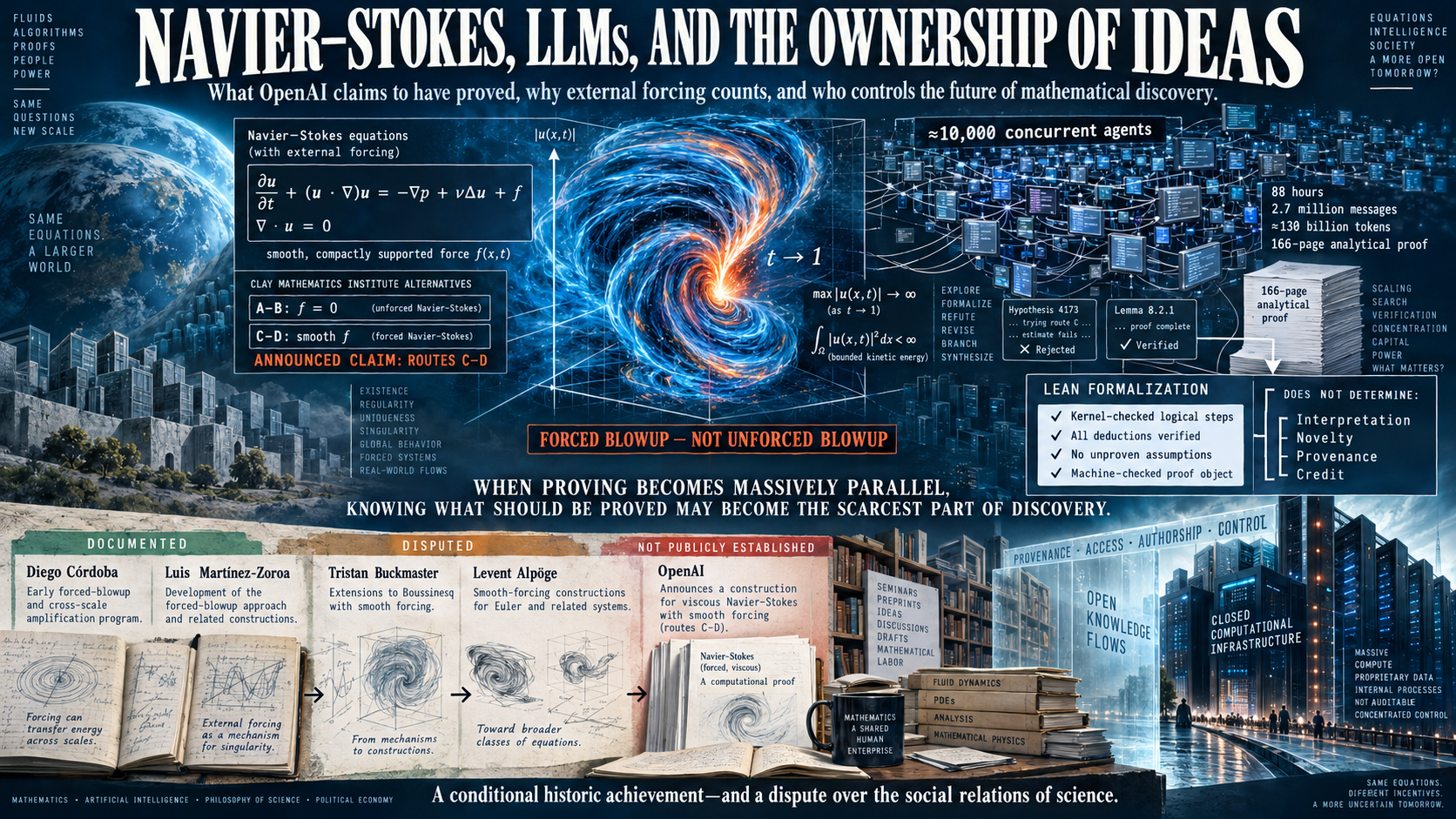
The Navier–Stokes equations describe the motion of viscous fluids such as water and air. They do not track molecules one by one. They treat the fluid as a continuous medium and relate its velocity, pressure, viscosity, and external forces:
In three dimensions, we know how to construct global weak solutions, meaning solutions that satisfy the equations in a generalized sense. What we did not know was whether smooth initial data always produce smooth solutions for all time or whether, under some conditions, velocity can grow without bound in finite time. Such a loss of regularity is called a singularity or blowup.
Viscosity tends to smooth differences in velocity. The nonlinearity represented by (u · ∇)u transports and reorganizes motion. The problem arises from the competition between these effects: is viscous dissipation always enough to prevent infinite concentration, or can three-dimensional dynamics overcome it?
Mathematically infinite velocity does not mean that a real fluid literally reaches that speed. It means that the continuum model loses regularity and ceases to describe the process in the classical way. The question is mathematical, although it is physically motivated.
2. What Clay actually requires
The first indispensable correction belongs here. The official statement written by Charles Fefferman offers four routes. Alternatives A and B ask for global existence and smoothness when the external force is zero, respectively in the whole space and on the three-dimensional torus. Alternatives C and D permit a disproof of global regularity using smooth initial data and an external force that is also smooth, on those same two domains.
| Alternative | Domain | External force | What must be shown |
|---|---|---|---|
| A | ℝ³ | f = 0 | Global existence and smoothness for every admissible initial datum. |
| B | 𝕋³ | f = 0 | The same global regularity in the periodic case. |
| C | ℝ³ | smooth f | Existence of data and a force for which there is no global classical solution of bounded energy. |
| D | 𝕋³ | smooth f | The corresponding breakdown in the periodic case. |
Calling smooth forcing a “loophole” foreign to the prize is therefore technically incorrect. It is written into alternatives C and D. If OpenAI’s proof is correct and satisfies the stated hypotheses exactly, it would resolve the official problem through those routes.
That does not make all results equivalent. Producing a singularity with a specially constructed smooth force is a more limited claim, physically and conceptually, than proving a singularity without external forcing. It resolves the institutional disjunction formulated by Clay, but it does not answer the stronger question of whether unforced dynamics can break down by themselves. Both statements can be true at once, without verbal tricks.
External forcing does not formally invalidate the result; it precisely limits what the result teaches us about fluids.
3. What OpenAI claims to have proved
OpenAI’s paper constructs, for every positive viscosity, velocity and pressure fields that remain smooth up to a critical time, together with a smooth, compactly supported force f(x,t). The fluid starts from rest. As time approaches t = 1, the maximum velocity grows without bound, while total kinetic energy remains uniformly bounded.
The intuitive picture is a vortex that spins, stretches, and concentrates around an increasingly small region. Velocity can rise indefinitely without total energy blowing up because the volume occupied by the extreme motion contracts quickly enough. An imperfect but useful analogy is to concentrate ever greater intensity inside ever less space.
It is not enough to draw a singular flow and then define an infinite force to sustain it. That would be trivial and inadmissible. The difficulty is to make acceleration, pressure, nonlinear transport, and viscosity develop large terms that cancel with extraordinary precision, leaving a perfectly smooth external force as the residual. The paper introduces oscillatory pulses whose internal momentum transport corrects the singular parts of that residual.
- Yes: finite-time velocity blowup for three-dimensional Navier–Stokes with positive viscosity and a smooth external force.
- Yes: uniformly bounded total kinetic energy throughout the evolution.
- Yes, conditional on the proof being correct: alternatives C and D of the official formulation.
- No: a proof of blowup for unforced Navier–Stokes.
- Not yet: stable, independent acceptance by the mathematical community.
4. How the agents worked
According to OpenAI, on September 1 it assigned groups of agents to the different alternatives of several Millennium Prize Problems. The agents could consult a cached copy of the internet, run code, divide into groups, and communicate results. Nearly one hundred agents reportedly first produced a solution for unforced Euler. From that result, the company concentrated its resources on Navier–Stokes.
The decisive group eventually involved on the order of 10,000 concurrent agents. OpenAI reports that the result appeared after about 88 hours; Lean formalization and verification took an additional 17 hours using GPT-6 Astra. The Navier–Stokes effort reportedly involved 2.7 million messages and approximately 130 billion generated tokens.
These numbers neither prove understanding nor disprove it. They describe a new material organization of intellectual labor: massively parallel search, route selection, circulation of partial results, automated consolidation, and formal verification. Reducing this to “mere brute force” hides the coordination architecture; presenting it as an autonomous mathematical consciousness hides the human, bibliographical, and computational scaffolding that made the search possible.
5. The mathematical genealogy
The route did not emerge in a vacuum. Buckmaster attributes the basic idea of the program to Diego Córdoba and Luis Martínez-Zoroa, who had spent years studying forced blowups and mechanisms of amplification across scales. Their work had shown how increasingly concentrated layers of vorticity could amplify while the regularity of the force remained controlled.
Buckmaster and Alpöge took that program as their starting point. With extensive help from Claude and Codex, they say they pushed constructions with rougher forcing to smooth forcing for incompressible porous media, Boussinesq, and three-dimensional incompressible Euler. According to their statement, they obtained the Boussinesq and Euler results on August 15 and verified the first model-generated proof in Lean on August 22.
OpenAI’s announced contribution would be different and later: a construction for viscous Navier–Stokes. Even if it was obtained independently, its historical meaning cannot be narrated as if 10,000 agents had discovered both the problem and the strategy from a blank page. In mathematics, the final proof is only one part of discovery. Recognizing which simplification to attack, which literature matters, and which mechanism may survive new constraints is genuine intellectual work.
6. Timeline of the dispute
| Date in 2026 | Reported event | Source of the claim |
|---|---|---|
| August 15 | Buckmaster and Alpöge obtain smooth-forcing blowup for Boussinesq and Euler. | Buckmaster’s statement. |
| August 22 | Lean verification of their initial proof is completed. | Buckmaster’s statement. |
| September 1 | OpenAI hears rumors and launches agents on the Millennium Prize Problems. | OpenAI’s account. |
| September 3 | Buckmaster privately writes to a mathematician at OpenAI to clarify the rumor. | Email reproduced by Buckmaster. |
| September 5 | OpenAI’s agents reach the Navier–Stokes construction, about 88 hours after starting. | OpenAI’s account. |
| September 6 | OpenAI’s formal verification is completed and two calls with Buckmaster take place. | OpenAI and Buckmaster’s statement. |
| September 8 | OpenAI publishes the article, proof, and formalization; Buckmaster makes his statement public. | The respective publications. |
The temporal proximity fuels the controversy. Buckmaster says that almost nobody was working on this route and that the sudden focus on the forced problem was a warning sign to him. OpenAI responds that it distributed agents among all four official alternatives, first obtained an unforced Euler result, and only then identified Navier–Stokes as the most promising direction.
7. What is established and what is disputed
The public discussion mixes verifiable documents, incompatible accounts, and inferences. They should be separated.
- Publicly documented: an analytical manuscript, a Lean formalization, Buckmaster’s statement, and OpenAI’s recognition of Buckmaster and Alpöge’s priority on forced Euler all exist.
- Claimed by OpenAI: no researcher or agent accessed their specific work before publication; the agents reached different results, and the company does not intend to claim the monetary prize.
- Acknowledged by OpenAI as a remote possibility: it cannot rule out that de-identified data derived from their product usage helped improve its models.
- Claimed by Buckmaster: he received no clear answer about training; he was offered an arrangement in which he would present OpenAI’s result alone and Alpöge would be excluded because he works at Anthropic; he also received statements he interpreted as professional threats.
- Disputed: Sébastien Bubeck rejects Buckmaster’s characterization of the interaction, according to the cited public summary.
- Not publicly established: that private drafts were used to produce OpenAI’s proof or that deliberate appropriation occurred.
Buckmaster himself draws the boundary: he has not seen how the model worked, does not know whether his data were used, and does not present that accusation as an established fact. His stated purpose is to record what he was told, when he was told it, and what arrangements were proposed. This caution does not erase the questions; it prevents them from being answered through condemnation without evidence.
OpenAI’s sentence about de-identified data also does not demonstrate a causal transmission from those drafts to the proof. It does reveal a governance problem: for a researcher placing unpublished work in a tool, an inability to exclude aggregate influence may be scientifically unacceptable even if the handling complied with the service’s contractual terms.
8. What Lean verifies and what it does not
Lean is a proof assistant. A formalized proof is decomposed into steps that a small kernel checks against precise logical rules. This sharply reduces the chance that an algebraic leap, forgotten hypothesis, or invalid inference survives. In a manuscript over one hundred pages long, that guarantee is extraordinarily valuable.
Lean does not, by itself, answer four separate questions:
- Correspondence: whether the formal theorem exactly represents the informal mathematical claim being announced.
- Interpretation: what physical meaning the construction has and how much it depends on a designed force.
- Novelty: which ideas are new and which come from prior work.
- Credit: who formulated the route, supplied the decisive mechanisms, directed the search, and should be named as an author.
A logical certificate does not replace a human exposition. The community still needs to read the manuscript, check that the formalization matches the intended theorem, reconstruct the conceptual mechanism, and place it within the literature. Formal verification strengthens the evidence; it does not exhaust scientific practice.
9. The Deep Blue–Kasparov moment
Buckmaster calls the episode a “Deep Blue–Kasparov moment.” The comparison does not mean that mathematics is simply another game with closed rules. It points to a change in the division of labor: a machine can explore, combine, and verify on a timescale inaccessible to a person, but its productivity depends on a search space structured by historically accumulated problems, theories, formal libraries, and strategies.
In a major problem, the scarce resource is not always writing the last line of a proof. It may be identifying the promising route after years of failed attempts. If revealing that route allows thousands of agents to be mobilized immediately, then selecting the correct intermediate question acquires enormous economic and scientific value.
When proving becomes massively parallelizable, knowing what should be proved may become the scarcest part of discovery.
This could make open mathematics more guarded. A seminar, an informal draft, or a query submitted to a platform would cease to be only an act of cooperation and could become an exploitable signal for institutions with incomparable computing capacity. The danger is not that artificial intelligence participates in science, but that openness becomes unilateral: open knowledge from below and closed appropriative capacity from above.
10. A materialist reading
The controversy cannot be understood solely as a moral conflict between individuals. It expresses a transformation in the productive forces of science. Models, data centers, multi-agent systems, and proof assistants turn enormous quantities of accumulated mathematical labor into an infrastructure capable of producing new combinations at great speed.
At the same time, this productive force is concentrated under private ownership. Researchers contribute questions, drafts, corrections, usage, and tacit knowledge; the platform aggregates those interactions, improves closed models, and can return results at a scale no academic group can match. Even if no concrete appropriation occurred in this case, the structural asymmetry is real.
The decisive question is therefore not whether the machine “really thought,” a metaphysical dispute of little use. We should ask who controlled the means of mathematical production, who chose the direction of the search, which prior labor it depended on, who could audit the process, and how authorship, prestige, and benefits were distributed.
Computation is not an epistemological sin. It can be a genuine force of discovery. But a new productive force organized through opaque relations of ownership and credit can simultaneously expand human capacity and deepen the subordination of scientific labor.
11. The rules we need
The episode suggests a minimum program for AI-assisted research:
- Verifiable confidential mode: unpublished drafts should be excluded from training and any later retrieval, with auditable guarantees rather than contractual language alone.
- Provenance: every major result should retain a record of models, versions, consulted sources, decisive prompts, human intervention, and circulation among agents.
- Compute disclosure: the number of agents, tokens, time, tools, and selection criteria should be treated as part of the method.
- Conceptual genealogy: attribution should recognize not only the final proof but also the prior program that made the route visible.
- Authorship independent of corporate rivalry: a researcher’s affiliation cannot justify excluding a scientifically relevant contribution.
- Open review: the manuscript, formalization, and correspondence between them should remain available for independent examination.
- Public capacity: universities and scientific consortia need shared infrastructure so frontier mathematics does not depend exclusively on private laboratories.
These rules would not settle every priority dispute, but they would make verifiable questions that currently depend on conflicting institutional statements.
12. Conclusion
Did OpenAI solve Navier–Stokes? The rigorous answer is conditional. The announced theorem targets precisely alternatives C and D of Clay’s official statement. The use of a smooth external force is not a trick, although it leaves the stronger unforced question untouched. If the analytical proof and its formalization withstand expert review, the mathematical achievement would be historic.
But the result did not arise outside history. It depends on decades of analysis, on the route opened by Córdoba and Martínez-Zoroa, on the work of Buckmaster and Alpöge, and on extraordinary computational infrastructure. Nor have the questions about data, priority, and institutional pressure been resolved. The most serious allegations should be investigated, neither repeated as facts nor dissolved through public relations.
The deepest lesson is that artificial intelligence does not abolish the social relations of science. It makes them more visible. The more powerful automated proving becomes, the more important it will be to protect openness, record the provenance of ideas, and distribute credit fairly. The future of mathematics will depend not only on what machines can prove, but on the institutions through which we decide what it means to discover.
References
Specified sources
- Julien Cadot, public summary of the controversy.https://x.com/juliencdt/status/2097582940863471900
- Mehdi, technical, epistemological, and political criticism of the announcement.https://x.com/bettercallmedhi/status/2097472336257863722
- Susan Zhang, reproduction of the manuscript and OpenAI’s statement on concurrent work.https://x.com/suchenzang/status/2097376584814432392
- Tristan Buckmaster, statement on the results and conversations with OpenAI.https://cims.nyu.edu/~tristanb/statement.pdf
- Jasper, mathematical analysis and summary of the dispute.https://x.com/zjasper/status/2097547276755619988
Primary technical documents
- OpenAI, “On the Navier–Stokes Millennium Prize Problem.”https://openai.com/index/navier-stokes-solution/
- OpenAI, “Finite Time Blowup for Navier–Stokes.”Analytical manuscript
- Charles L. Fefferman, official formulation of the Millennium Prize Problem.Existence and Smoothness of the Navier–Stokes Equation
- OpenAI, Lean formalization.https://github.com/openai/NavierStokesAndEuler
Leave a Comment/Deja un Comentario