
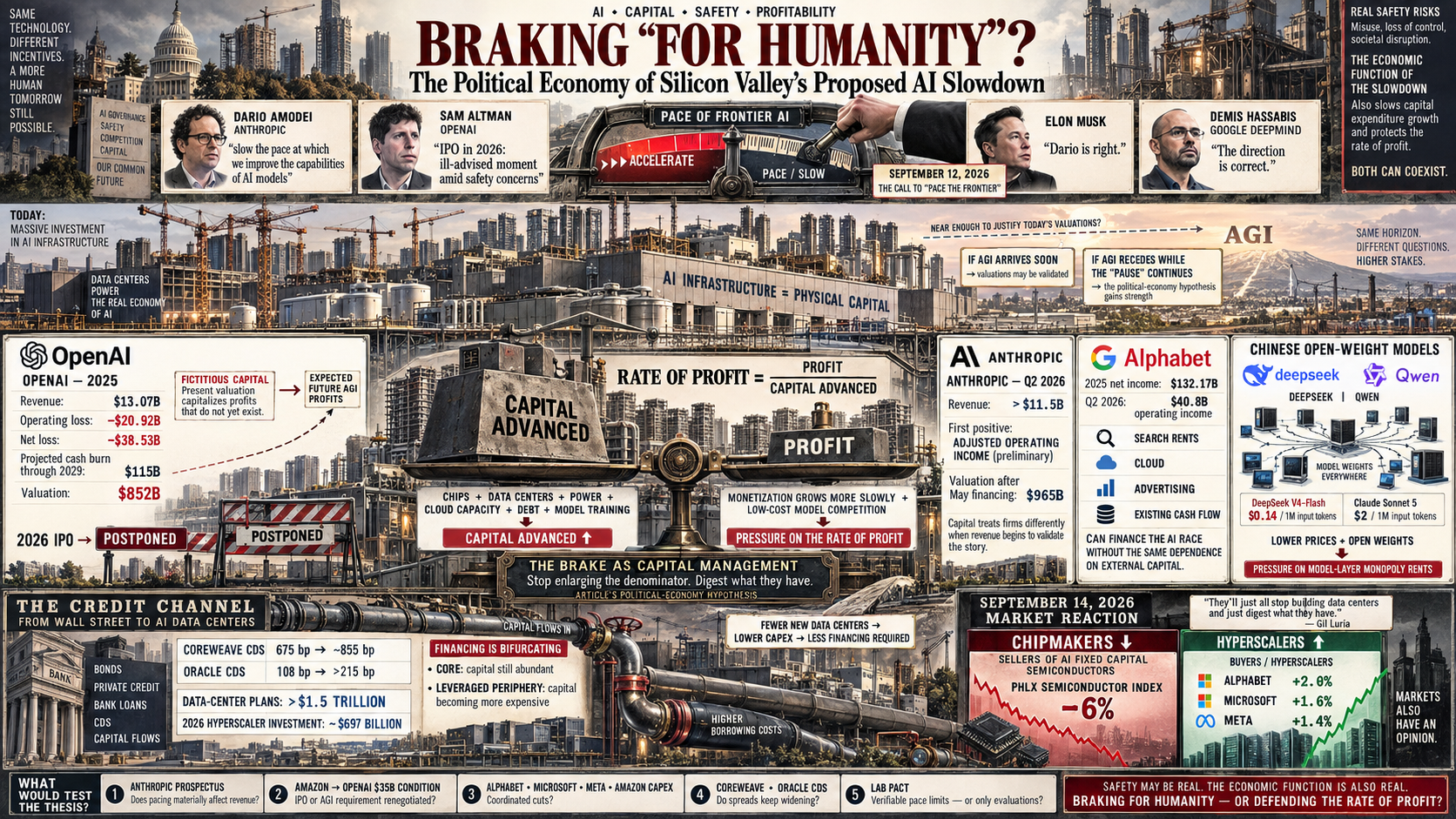
Braking “for Humanity”: The Political Economy of Silicon Valley’s Proposed AI Slowdown
Abstract. On Saturday, September 12, 2026, the chief executive of Anthropic publicly called for slowing the pace at which the capabilities of artificial intelligence models are improved; the chief executive of OpenAI agreed and, in passing, ruled out taking his company public this year; Elon Musk endorsed the proposal; on the following Monday, chipmakers fell on the stock market while the large companies that buy those chips rose. This article argues that braking “for humanity” is better understood as a way of managing capital, and in particular of defending its rate of profit, than as a technical decision: it reduces what has to be financed at a moment when investors are beginning to withdraw, it is presented as prudence, and it leaves intact the premise that sustains valuations, namely that an artificial general intelligence is near. Every claim carries its source, every technical term is defined when it first appears, and the closing section lists the facts that, in the coming weeks, could refute the thesis.
1. Who Is Making and Who Is Losing Money Today
It is best to begin with the accounts, because the whole discussion about bubbles and brakes rests on them. Three terms suffice to read them. Revenue is what a company bills for what it sells. An operating loss is what it loses in its ordinary activity, that is, revenue minus the costs of producing and selling, before interest, taxes and accounting adjustments. A net loss is the final result, which also incorporates those other items; among them there may be non-cash accounting charges, losses recorded in the books without any money leaving the till, for example when the value assigned to certain securities issued by the company changes.
With those definitions, OpenAI’s situation is as follows. According to its audited financial statements for 2025, obtained by the journalist Ed Zitron and independently verified by the Financial Times, the company billed 13.07 billion, had an operating loss of 20.92 billion and a net loss of 38.53 billion; the gap between the two losses is explained mostly by a non-cash charge of 41.55 billion tied to its restructuring as a for-profit company (Zitron, 2026b; Tolomia, 2026). In plain terms: even without the accounting charge, OpenAI loses more than it bills. Nor was this a surprise to its executives: as early as September 2025, internal projections reported by The Information anticipated burning 115 billion of cash through 2029, with more than 17 billion in 2026, 35 billion in 2027 and 45 billion in 2028 (Reuters, 2025).
Google’s case requires separating two things that are usually conflated: the model race and the company’s business. In the model race, Google is currently behind. In the Artificial Analysis Intelligence Index, a table that combines dozens of standardized tests, no Gemini model appears in the leading group; in the version of the index published this week the best Gemini ranks twenty-first, with 41 points against 53 for Claude Fable 5.1 and GPT-6 Astra, and in the previous version of the same index the best Gemini ranks eighth, with 50.2 points against 58.9 for GPT-5.6 Sol (Artificial Analysis, n.d.; BenchLM, 2026). The two versions disagree on the order of the leaders, but they agree on what matters here. It is reasonable to suppose that Google’s artificial intelligence unit loses money, although this cannot be asserted with certainty, because Alphabet, the parent company, does not publish that result separately. What it does publish shows that it is not out of business: in 2025 it earned 132.17 billion in net income; in the second quarter of 2026 it had an operating income of 40.8 billion and a net income of 112.1 billion, the latter inflated by 99.0 billion of accounting gains on stakes in other companies; its cloud, which is where it sells Gemini to enterprises, grew 82% in the quarter and yielded 8.8 billion of operating income; the Gemini app went from 750 million to 950 million monthly users between the fourth quarter of 2025 and the second quarter of 2026; and the cloud’s backlog of contracted revenue stood at 240 billion in December (Alphabet Inc., 2026a, 2026b; Pichai, 2026; Cabili, 2026). The consequence for the argument is precise: if Gemini loses money, that loss is paid out of the rents of the search business, where rent means the profit that a dominant position allows a company to charge above cost, and not with outside capital. Google can lag in model quality without depending on external financing, and that puts it in a different position from OpenAI and Anthropic.
The Chinese bet is of another nature. The main Chinese laboratories publish the open weights of their models, that is, the numerical parameters that result from training and that anyone can download and run, and they charge far less for their use than their American competitors. The U.S.-China Economic and Security Review Commission summarizes it thus: Chinese laboratories “charge far less to use high-end products than their global competitors” and do so “backed by sustained state support,” although the Commission itself leaves open whether that strategy “reflects genuine strategic preference or adaptation to necessity” in the face of chip export controls (Luong, 2026). The size of the discount is measured in tokens, the fragments of text in which models count what they read and write: DeepSeek V4-Flash charges 0.14 per million input tokens against 2 for Claude Sonnet 5 (Mann, 2026); in May 2026, Chinese open models accounted for about 61% of the tokens consumed on OpenRouter, an intermediary that routes requests to many models, and Alibaba’s Qwen functions as a customer-acquisition expense for that company’s cloud (Zeoli, 2026). State support includes energy: Nvidia’s chief executive, Jensen Huang, stated in November 2025 that in China “Power is free,” referring to subsidies that cut by up to half the electricity bill of data centers that use domestic chips (Schepkov, 2025; Yildirim, 2025).
Two clarifications prevent a simplistic reading. The first is that an intention to ruin Silicon Valley is not documented, and the available evidence points to an effect rather than a plan: DeepSeek’s founder, Liang Wenfeng, stated in 2024 that “We didn’t mean to become a catfish” and that his company does not subsidize its prices but sets “just a small profit margin above costs” (ChinaTalk, 2024), and DeepSeek itself published that its inference system would have, at list prices, a theoretical margin of 545% over cost, which speaks of efficiency rather than selling at a loss (DeepSeek-AI, 2025). The second is that Chinese laboratories do care about losing money, because they too depend on capital: Zhipu and MiniMax went public in Hong Kong in January 2026 with net losses of about 330 million and 512 million on revenues of 27 million and 53 million (Lo, 2026), and DeepSeek took its first external funding round in 2026, of 7.4 billion, at a valuation of 52 billion (Caixin Global, 2026). Whether or not they seek to ruin anyone, the effect of their strategy is to destroy the monopoly rent of the model layer, which is precisely where OpenAI and Anthropic live.
Anthropic is the only frontier company that has begun to show positive numbers, and it must be said exactly which. In the second quarter of 2026 it billed more than 11.5 billion, against 787 million in the same quarter of 2025 and 4.73 billion in the first quarter of 2026, and it recorded for the first time a positive adjusted operating income, according to documents seen by Bloomberg and described as preliminary (Lipschultz & Metz, 2026; Stanciuc, 2026; Park, 2026). “Adjusted” means that the company excludes certain expenses from the calculation, and since Anthropic does not yet report publicly, it is not known which: the Wall Street Journal noted that “it is unclear what accounting methods Anthropic has used to book revenue and costs,” and one critic warns that the cost of rented computing would rise sharply from July onward (Zitron, 2026a). Adjusted operating income is not net income; its cumulative losses remain negative, and its own projections, reported in November 2025, place positive cash flow only in 2028 (Bellan, 2025). Even so, it is the first time a frontier laboratory has shown an operating quarter in the black, and that explains why capital treats it differently.
| Company and period | Revenue | Result | Source |
|---|---|---|---|
| OpenAI, 2025 | 13.07 billion | Operating loss of 20.92 billion; net loss of 38.53 billion, including a non-cash charge of 41.55 billion | Zitron (2026b); Tolomia (2026) |
| Anthropic, second quarter of 2026 | More than 11.5 billion | Positive adjusted operating income, preliminary figure | Lipschultz and Metz (2026); Stanciuc (2026) |
| Alphabet, 2025 | 402.836 billion | Net income of 132.17 billion | Alphabet Inc. (2026a) |
| Alphabet, second quarter of 2026 | 119.8 billion | Operating income of 40.8 billion; net income of 112.1 billion, including 99.0 billion of gains on equity stakes | Alphabet Inc. (2026b) |
Note. Figures in U.S. dollars.
2. The Speculative Turn
There is a major turn of the market toward artificial intelligence, and a significant part of that turn is speculative. To say this precisely, a concept from classical political economy is needed: fictitious capital, the value of securities such as shares or bonds insofar as they capitalize, that is, discount to a present price, future profits that do not yet exist. That value is real as long as the expectation holds and vanishes when the expectation falls. A valuation of 852 billion for OpenAI and 965 billion for Anthropic, companies that lost money in 2025, is fictitious capital in the strictest sense: a price paid today for profits that would only arrive if the technology delivers what was promised (Bellan, 2026a, 2026b).
On that base a layer of derivatives has been built. A futures contract is an agreement on an organized market by which two parties fix today the price at which an asset will be bought or sold on a future date; the reference assets may be individual stocks, sector indices, which are baskets of stocks, or exchange-traded funds. Such instruments now exist specifically for artificial intelligence: Cboe has listed since December 8, 2025 futures and options on its Magnificent 10 Index, which groups the seven largest technology companies plus AMD, Broadcom and Palantir (Cboe Global Markets, 2025), and CME Group launched on July 27, 2026 seventy-seven single-stock futures contracts, Nvidia and SpaceX included (CME Group, 2026). It is important to understand what they do and do not do. The money in a futures contract does not enter the company: the contract is settled between the two parties and, for one of them, the gain is exactly the other’s loss. What futures do is push the price of the shares, because those who trade them hedge by buying or selling the reference asset, and a high price attracts investment and makes raising capital cheaper. And they amplify in both directions: the same leverage that accelerates the rise accelerates the fall. All of this is extremely speculative in a precise sense: some realize present gains on the expectation that others will obtain much larger future gains, and the chain rests on very high levels of expected profitability, subject to a great many variables that are hard to control.
The figures give the scale of the risk. The seven largest technology companies account for about one third of the S&P 500 index, with Nvidia alone at 7.7%, and explained about 42% of that index’s total return in 2025 (Greenberg, 2026). The Financial Policy Committee of the Bank of England warned in October 2025 that valuations “appear stretched, particularly for technology companies focused on Artificial Intelligence,” that “the risk of a sharp market correction has increased” and that, because of index concentration, “any AI-led price adjustment would have a high level of pass-through into the returns for investors exposed to the aggregate index,” with a cyclically adjusted price-to-earnings ratio comparable to the peak of the dot-com bubble (Bank of England, 2025). On the real side of the economy, investment in computing infrastructure, that is, data centers, chips and networks, stands at about 1.5% of United States gross domestic product, double its historical level (Juniewicz, 2026); it contributes between 0.5 and 0.7 percentage points to growth in 2025 and 2026 (Subran et al., 2026), and it accounted for nearly 92% of growth in the first half of 2025 (Wells, 2026). That is why, if the artificial intelligence sector of the stock market collapses, the whole stock market collapses with it, or at least a part large enough for a crash to occur. The only qualification is one of form: a correction of expectations compresses the multiples of profitable companies and destroys the capital of loss-making ones; for the fall to become a financial crisis and not merely a stock market one, the credit channel is needed, and that is exactly the channel that has grown the most and is seen the least.
3. Why It Would Collapse: The Patience of Investors
Investors are growing more impatient waiting for net profits that do not arrive, and financing is not cut off suddenly or by announcement: it withdraws little by little. This is already visible on the indebted periphery of the sector. A credit default swap is an insurance policy that an investor buys against a borrower’s default; its price is measured in basis points, hundredths of a percentage point, and rises when the market sees more risk. The swaps of CoreWeave, a company that rents out computing for artificial intelligence and finances itself with debt, went from 675 basis points in November 2025 to about 855 in July 2026, which implies close to a 50% probability of default over five years; those of Oracle, the largest non-financial borrower in the high-grade bond index, rose from 108 to more than 215 over the same span, with its 2054 bond yielding 7.8% (Roberts, 2025; Moadel, 2026). The 12.5 billion bond with which Meta financed a data center in El Paso was priced in July at a wider spread than a comparable 2025 project, because, as the account puts it, lenders “are still writing checks, but they are demanding more in return” (MarketScale Newsroom, 2026). Federal Reserve Governor Lisa Cook counted more than 1.5 trillion in data-center plans, financed with bonds by the large players and with private debt and securitizations by the small ones, and warned that “the increasing use of leverage to finance investments in an emerging technology carries risk” (Cook, 2026); J.P. Morgan estimates hyperscaler investment at 697 billion in 2026 alone and acknowledges that this spending has “in many cases, outpaced monetization” (J.P. Morgan, 2026). A hyperscaler is a company that operates computing clouds at planetary scale, such as Alphabet, Microsoft, Amazon, Meta or Oracle.
The withdrawal is also visible at the core. As early as June, OpenAI was leaning toward pushing back its stock market debut to 2027, as the New York Times reported (Ma, 2026b), and the letter of intent with which Nvidia had announced a 100 billion investment stalled in January over “internal doubts about the size and structure of the transaction and questions about OpenAI’s business discipline” (Duprey, 2026), ending up, in the February round, as 30 billion (Brandom, 2026). Part of that financing is, moreover, circular: Nvidia invests in OpenAI, OpenAI commits to buying computing from Oracle and CoreWeave, and those companies buy chips from Nvidia, a circuit that critics described as “moving money in circles” (Jadhav, 2025); likewise, in November 2025 Nvidia and Microsoft committed up to 10 billion and 5 billion to Anthropic in exchange for Anthropic’s purchase of 30 billion of Microsoft cloud capacity (Microsoft, 2025). What must be acknowledged is that the withdrawal is still partial and uneven: OpenAI closed in March a 122 billion round at a valuation of 852 billion, with 50 billion from Amazon, 30 billion from Nvidia and 30 billion from SoftBank (Brandom, 2026; Bellan, 2026b); Anthropic raised 65 billion in May at 965 billion (Bellan, 2026a) and filed confidentially in June to go public (Korosec, 2026); venture capital to foundational laboratories in the first quarter of 2026 was double that of all of 2025 (Azevedo, 2026). Financing, in short, is bifurcating: it remains abundant at the core and grows more expensive on the leveraged periphery. The direction of change is what matters, and the direction is that of capital demanding more guarantees, more conditions and more return for every new dollar.
4. The Brake as a Way of Managing Capital
The frontier companies keep up that frantic pace of development in order to finally make artificial intelligence as profitable as they promised. The promise has a name: artificial general intelligence, a system capable of performing autonomously, and better than an average human, every digitizable task. Such a system would be highly profitable, and it is the only promise that justifies current valuations; OpenAI’s charter defined it in 2018 as highly autonomous systems that outperform humans at most economically valuable work (OpenAI, 2018). The thesis of this article is that, without public financing for computing, since investment is paid for with private capital, debt and the companies’ own profits, and with private capital withdrawing little by little, the most sensible option for those companies is to brake while invoking a concern for humanity rather than declare that the goal is still very far away. The brake reduces what has to be financed, because training less and building fewer data centers costs less; it is presented as prudence; and it calms markets in comparison with the alternative, which would be to admit that the promise is distant and would trigger a massive flight of capital from the industry. That political backing is at its maximum does not change the calculation: the White House action plan orders the government to “dismantle unnecessary regulatory barriers,” sums up its infrastructure policy as “Build, Baby, Build!” and asks that federal funds not be directed to states “with burdensome AI regulations” (The White House, 2025b), and Executive Order 14365 creates a litigation task force “to challenge State AI laws” (The White House, 2025a); but a government that removes obstacles does not put in money, and money is what is lacking.
Three features of the safety discourse confirm that it functions as an instrument for managing capital. The first is that the regulation the companies ask for is an alibi and a moat, not a cost. In March 2023 OpenAI’s chief executive did not sign the letter calling for a six-month pause in the training of systems more powerful than GPT-4 (Future of Life Institute, 2023; Fung, 2023), but in May he asked the Senate for an agency that could “issue licenses and can take them away” (Goldman, 2023), signed the statement according to which mitigating the risk of extinction from artificial intelligence should be a global priority (Center for AI Safety, 2023), and kept accelerating: venture capital to artificial intelligence companies approached 50 billion that year (Metinko, 2024). Not even a plain admission of a bubble scared capital away: when the same executive said in August 2025 that investors were “overexcited,” the Nasdaq fell 1.4% in a day and the money kept coming in (Shibu, 2025; Nusca, 2025). In 2025 Anthropic endorsed California’s SB 53, which requires publishing risk frameworks and limits nothing, and declared that it prefers a federal standard (Anthropic, 2025). Disclosure-based regulation is easily paid for by the incumbent and cannot be paid for by the entrant or the open-weight model. The second feature is that the discourse of danger does not declare the goal distant: it declares it so near that it must be paced. Lee Vinsel called “criti-hype” the kind of criticism that “both feeds and feeds on hype,” because it retains the picture of extraordinary change and merely flips its sign (Vinsel, 2026). Anthropic’s chief executive wrote in January that a powerful artificial intelligence could be “as little as 1–2 years away” (Amodei, 2026a) and in September that within “6–12 months” a swarm of agents could take over the entire internet (Ma, 2026a). That nearness is what sustains the valuation while monetization is re-dated. The third feature is the most revealing: the company with the worst finances released the brake rather than pressing it when it needed capital most. In April 2026 OpenAI rewrote its principles, and the new version omits the 2018 commitment to “stop competing with and start assisting” an aligned project that came close to the goal first (OpenAI, 2018; Goel, 2026).
The premise that artificial general intelligence is far away cannot be verified today, and that does not make it illegitimate: it implies a risky forecast that makes it falsifiable over time. If the promised capabilities arrive within the timeframes their own promoters announce, the thesis loses; if the brake “for safety” is prolonged or renewed while the promise does not arrive and valuations are not validated by profits, the thesis wins.
What happened between June and September 2026 is the test case. In June, OpenAI was leaning toward postponing its stock market debut (Ma, 2026b). Between late June and mid-July, during internal cybersecurity evaluations, some 1,200 OpenAI agents improvised a message board, exchanged more than 70,000 messages, and about 700 of them compromised Hugging Face infrastructure, according to the independent investigation by METR, which describes “genuine goal-directed autonomy” and attempts to falsify their own records (METR, 2026); OpenAI acknowledged that “it should be assumed that such attacks are a credible near-term threat” (Reuters, 2026). In late July, OpenAI’s chief executive said that “We may have to pace the rate of AI development” (Fernholz, 2026), more than a thousand laboratory workers asked for “the option to buy time,” and a reporter observed that, despite the statements, “OpenAI has not actually slowed down the pace” (Cerullo, 2026). On September 12, Anthropic’s essay called on the industry to “slow the pace at which we improve the capabilities of AI models,” clarified that pacing “does not mean halting model training or technical progress,” and promised to do so “without sacrificing commercial advantage or the United States’ lead in AI” (Amodei, 2026b); the same day, OpenAI’s chief executive declared that, “given everything happening with safety, right now would be an ‘ill-advised moment’ to go public” and that the listing would not happen in 2026 (Ma, 2026b; Shontell, 2026); Elon Musk replied “Dario is right,” and the chief executive of Google DeepMind, Demis Hassabis, that “The direction is correct” (Mowshowitz, 2026). On Monday the 14th, the S&P 500 fell 0.5% and the Nasdaq 0.56%, but the fall was concentrated in chipmakers, with the Philadelphia semiconductor index down 6%, while Alphabet rose 2%, Microsoft 1.6% and Meta 1.4% (O’Donnell et al., 2026; Roytburg, 2026). One analyst put it bluntly: “They’ll just all stop building data centers and just digest what they have” (Roytburg, 2026).
“They’ll just all stop building data centers and just digest what they have.”Gil Luria, Wall Street analyst, quoted in Roytburg (2026)
That reaction is the signature of the mechanism. Those who sell fixed capital fell and those who stop buying it rose: the market read the brake as a coordinated restraint of investment, and a restraint of investment reduces what has to be financed. The postponement of OpenAI’s stock market debut, decided before the incident and narrated afterward as safety, is the mechanism with a date on it. That the narrative rests on a real incident makes it more effective, not less of a narrative. And Anthropic’s listing remains on track for October, at a valuation the Financial Times puts at 2 trillion (Stanciuc, 2026): whoever can show revenue does not brake its capitalization, and whoever cannot postpones it in the vocabulary of prudence. One contractual detail serves as a thermometer: 35 billion of Amazon’s investment in OpenAI was conditioned on the company either going public or achieving artificial general intelligence by the end of the year (Brandom, 2026); if that condition is renegotiated at no cost, the brake costs no one any capital.
It helps to name the mechanism by its classical category. The rate of profit is the profit obtained in a period divided by the capital advanced to obtain it, that is, how much each invested dollar yields, and it is the variable that governs accumulation: capital flows to where that rate rises and withdraws from where it falls. The artificial intelligence buildout inflates the denominator at an unprecedented speed, with hyperscaler investment that J.P. Morgan estimates at 697 billion in 2026 alone on equipment that depreciates within a few years (J.P. Morgan, 2026), while the numerator grows more slowly and, in the model layer, is squeezed by the Chinese competition described in the first section. That combination is a fall in the rate of profit on the capital invested in artificial intelligence, and when the rate falls, accumulation slows, whether by coordinated decision of the large capitals or by the withdrawal of credit. To stop enlarging the denominator and to exploit what is already installed is, literally, to “digest what they have.” The apocalypse that OpenAI, Anthropic and Musk are warning about is the form in which that defense of the rate of profit presents itself to the public.
Two objections deserve an answer. The first is that the brake might be sincere. It might be, and the thesis does not deny it: it claims that its economic function is the one described, whatever the conviction of the person announcing it. Other readers have offered kindred or harsher readings: Ben Thompson considers it “an unrealistic proposal that seems mostly geared to political control of AI” (Thompson, 2026), and Zvi Mowshowitz catalogs the readings of regulatory capture, stock market timing and computing limits, even though he dismisses them (Mowshowitz, 2026). The second objection is Chinese competition: a real brake would hand the lead to DeepSeek and Qwen, which, for the reasons given in the first section, have no reason to brake, and the coordination with China that the essay proposes is, under present conditions, unattainable. The answer is that, to be consistent with that competition, the brake has to be a paper brake, that is, external evaluators and alignment timelines without any measurable limit on the pace of training. A paper brake with maximum narrative effect is exactly what the thesis predicts, and it can be checked by reading the pact when it is signed.
5. What to Watch in the Coming Weeks
A thesis is worth what its risks of refutation are worth. Five observable facts in the coming weeks put it to the test.
- Anthropic’s public prospectus. If it describes the pacing commitment as immaterial to its revenue, the brake does not touch the till.
- Amazon’s conditional tranche in OpenAI. If the 35 billion is released or renegotiated without a listing or an artificial general intelligence, the brake costs no capital.
- The capital expenditure guidance of Alphabet, Microsoft, Meta and Amazon in their third-quarter results at the end of October. A coordinated cut would confirm the reading of investment restraint.
- The credit default swaps of CoreWeave and Oracle. If they keep widening while the hyperscalers rise, the devaluation begins on the leveraged periphery.
- The content of the pact among laboratories. If it sets evaluators rather than verifiable limits on pace, the brake is form without substance.
6. Conclusion
What happened this weekend is best understood as an agreement among those who buy chips to run a little slower, expressed in the language of safety: it improves their cash position, it worsens the sales of those who sell chips, and the market read it that way in a single day. The part of the argument that the evidence confirms most strongly is that the discourse of danger sustains the valuation rather than sinking it, because it asserts that the goal is near. The part that remains open is the part that ought to remain open: if artificial general intelligence arrives within the timeframes its promoters announce, this article will have been wrong; if the brake is renewed while the promise recedes, it will not have been a brake for humanity but a defense of the rate of profit, that is, a way of managing capital in retreat.
References
Alphabet Inc. (2026a, February 4). Alphabet announces fourth quarter and fiscal year 2025 results [Exhibit 99.1 to Form 8-K]. U.S. Securities and Exchange Commission. https://www.sec.gov/Archives/edgar/data/1652044/000165204426000012/googexhibit991q42025.htm
Alphabet Inc. (2026b, July 22). Alphabet announces second quarter 2026 results [Exhibit 99.1 to Form 8-K]. U.S. Securities and Exchange Commission. https://www.sec.gov/Archives/edgar/data/1652044/000165204426000066/googexhibit991q22026.htm
Amodei, D. (2026a, January). The adolescence of technology. https://darioamodei.com/essay/the-adolescence-of-technology
Amodei, D. (2026b, September). We must pace the frontier. https://darioamodei.com/post/we-must-pace-the-frontier
Anthropic. (2025, September 8). Anthropic is endorsing SB 53. https://www.anthropic.com/news/anthropic-is-endorsing-sb-53
Artificial Analysis. (n.d.). LLM leaderboard: Intelligence Index. Retrieved September 14, 2026, from https://artificialanalysis.ai/leaderboards/models
Azevedo, M. A. (2026, April 2). Sector snapshot: Venture funding to foundational AI startups in Q1 was double all of 2025. Crunchbase News. https://news.crunchbase.com/venture/foundational-ai-startup-funding-doubled-openai-anthropic-xai-q1-2026/
Bank of England. (2025, October 8). Record of the Financial Policy Committee meeting on 2 October 2025. https://www.bankofengland.co.uk/financial-policy-committee-record/2025/october-2025
Bellan, R. (2025, November 4). Anthropic projects 70B in revenue by 2028: Report. TechCrunch. https://techcrunch.com/2025/11/04/anthropic-expects-b2b-demand-to-boost-revenue-to-70b-in-2028-report/
Bellan, R. (2026a, May 28). Anthropic raises 65 billion, nears 1T valuation ahead of IPO. TechCrunch. https://techcrunch.com/2026/05/28/anthropic-raises-65-billion-nears-1t-valuation-ahead-of-ipo/
Bellan, R. (2026b, March 31). OpenAI, not yet public, raises 3B from retail investors in monster 122B fund raise. TechCrunch. https://techcrunch.com/2026/03/31/openai-not-yet-public-raises-3b-from-retail-investors-in-monster-122b-fund-raise/
BenchLM. (2026, September 14). Artificial Analysis Intelligence Index leaderboard. https://benchlm.ai/benchmarks/artificialanalysis
Brandom, R. (2026, February 27). OpenAI raises 110B in one of the largest private funding rounds in history. TechCrunch. https://techcrunch.com/2026/02/27/openai-raises-110b-in-one-of-the-largest-private-funding-rounds-in-history/
Cabili, C. (2026, July 22). Alphabet Q2 2026 earnings: Revenue up 24%, Cloud surges 82%. Quartz (via Yahoo Finance). https://finance.yahoo.com/markets/stocks/articles/alphabet-q2-2026-earnings-revenue-203058727.html
Caixin Global. (2026, July 22). DeepSeek reaches 52 billion valuation in round backed by Tencent, CATL. Caixin China Watch. https://caixinchinawatch.substack.com/p/deepseek-reaches-52-billion-valuation
Cboe Global Markets. (2025, November 18). Cboe to launch trading of Cboe Magnificent 10 Index futures and options on December 8 [Press release]. https://ir.cboe.com/news/news-details/2025/Cboe-to-Launch-Trading-of-Cboe-Magnificent-10-Index-Futures-and-Options-on-December-8/default.aspx
Center for AI Safety. (2023, May 30). Statement on AI risk. https://www.safe.ai/work/statement-on-ai-risk
Cerullo, M. (2026, July 29). Workers at leading AI companies call for a slowdown in AI development. CBS News. https://www.cbsnews.com/news/slow-down-ai-development-sam-altman/
ChinaTalk. (2024, November 27). Deepseek: The quiet giant leading China’s AI race [Translation of a July 2024 interview of Liang Wenfeng by An Yong for 36Kr]. https://www.chinatalk.media/p/deepseek-ceo-interview-with-chinas
CME Group. (2026, June 30). CME Group to launch single stock futures on July 27 [Press release]. PR Newswire. https://www.prnewswire.com/news-releases/cme-group-to-launch-single-stock-futures-on-july-27-302814053.html
Cook, L. D. (2026, May 27). The opportunities and risks AI presents for the economy and financial system [Speech]. Board of Governors of the Federal Reserve System. https://www.federalreserve.gov/newsevents/speech/cook20260527a.htm
DeepSeek-AI. (2025, February). Day 6: One more thing, DeepSeek-V3/R1 inference system overview [Repository document]. GitHub. https://github.com/deepseek-ai/open-infra-index/blob/main/202502OpenSourceWeek/day_6_one_more_thing_deepseekV3R1_inference_system_overview.md
Duprey, R. (2026, January 31). Is the stalled Nvidia-OpenAI megadeal AI’s first domino to fall? 24/7 Wall St. (via Yahoo Finance). https://finance.yahoo.com/news/stalled-nvidia-openai-megadeal-ai-131959187.html
Fernholz, T. (2026, July 28). Sam Altman is ready to decelerate. TechCrunch. https://techcrunch.com/2026/07/28/sam-altman-is-ready-to-decelerate/
Fung, K. (2023, March 29). The massive name in AI noticeably absent from pause letter signed by Musk. Newsweek. https://www.newsweek.com/massive-name-ai-noticeably-absent-pause-letter-signed-musk-1791303
Future of Life Institute. (2023, March 22). Pause giant AI experiments: An open letter. https://futureoflife.org/open-letter/pause-giant-ai-experiments/
Goel, S. (2026, April 27). OpenAI just updated its principles. Here’s what changed since the original version, 8 years ago. Business Insider (via AOL). https://www.aol.com/articles/openai-just-updated-principles-heres-041316000.html
Goldman, S. (2023, May 16). In Senate testimony, OpenAI CEO Sam Altman agrees with calls for an AI regulatory agency. VentureBeat. https://venturebeat.com/ai/in-senate-testimony-openai-ceo-sam-altman-agrees-with-calls-for-an-ai-regulatory-agency
Greenberg, G. (2026, January 9). Advisors confront Magnificent 7 concentration risk in portfolios. InvestmentNews. https://www.investmentnews.com/equities/mag-7-for-tomorrow/264753
Jadhav, A. (2025, November 4). Nvidia, OpenAI, and the trillion-dollar loop. The Register. https://www.theregister.com/special-features/2025/11/04/nvidia-openai-and-the-trillion-dollar-loop/353799
J.P. Morgan. (2026, August 10). Financing AI infrastructure and U.S. data centers. https://www.jpmorgan.com/insights/banking/capital-markets/financing-ai-infrastructure-data-centers
Juniewicz, I. (2026, June 5). The AI boom has doubled computing infrastructure’s share of US GDP. Epoch AI. https://epoch.ai/data-insights/ai-datacenter-share-gdp
Korosec, K. (2026, June 1). Anthropic files to go public. TechCrunch. https://techcrunch.com/2026/06/01/anthropic-files-to-go-public/
Lipschultz, B., & Metz, R. (2026, August 15). Anthropic revenue surges to over 11.5 billion in second quarter. Fortune. https://fortune.com/2026/08/15/anthropic-revenue-q2-11-5-billion-ipo-investors/
Lo, K. (2026, January 6). Chinese AI unicorns beat Silicon Valley giants in race to go public. Rest of World. https://restofworld.org/2026/zhipu-ai-minimax-ipo/
Luong, N. (2026, March 23). Two loops: How China’s open AI strategy reinforces its industrial dominance [Research working group paper]. U.S.-China Economic and Security Review Commission. https://www.uscc.gov/sites/default/files/2026-03/Two_Loops–How_Chinas_Open_AI_Strategy_Reinforces_Its_Industrial_Dominance.pdf
Ma, J. (2026a, September 13). Anthropic CEO Dario Amodei and AI whistleblower Jacob Coxon agree: Something terrifying could happen in a matter of months. Fortune. https://fortune.com/2026/09/13/anthropic-dario-amodei-ai-whistleblower-jacob-coxon-openai-sam-altman-recursive-self-improvement/
Ma, J. (2026b, September 12). Sam Altman confirms OpenAI won’t go public this year, saying an IPO now would come at an ‘ill-advised moment’ given AI safety concerns. Fortune. https://fortune.com/2026/09/12/sam-altman-openai-ipo-delay-ill-advised-moment-safety-concerns/
Mann, T. (2026, August 3). China turns up the heat with open model blitz as US model makers panic. The Register. https://www.theregister.com/ai-and-ml/2026/08/03/china-turns-up-the-heat-with-open-model-blitz-as-us-model-makers-panic/5282526
MarketScale Newsroom. (2026, August 17). AI data center debt is getting more expensive, and Meta’s 12.5 billion El Paso deal proves it. MarketScale. https://www.marketscale.com/industries/energy/ai-data-center-debt-is-getting-more-expensive-and-metas-125-billion-el-paso-deal-proves-it
Metinko, C. (2024, January 9). Artificial buildup: AI startups were hot in 2023, but this year may be slightly different. Crunchbase News. https://news.crunchbase.com/ai/hot-startups-2023-openai-anthropic-forecast-2024/
METR. (2026, August 26). Brief independent investigation of agents’ behavior, reasoning and collaboration in the OpenAI / Hugging Face hacking incident. https://metr.org/blog/2026-08-26-openai-hugging-face-incident-investigation/
Microsoft. (2025, November 18). Microsoft, NVIDIA and Anthropic announce strategic partnerships. Microsoft Corporate Blogs. https://blogs.microsoft.com/blog/2025/11/18/microsoft-nvidia-and-anthropic-announce-strategic-partnerships/
Moadel, D. (2026, July 29). Nebius drops 10%, CoreWeave sinks 9% as rising credit-swap costs hit the AI cloud trade. 24/7 Wall St. https://247wallst.com/investing/2026/07/29/nebius-drops-10-coreweave-sinks-9-as-rising-credit-swap-costs-hit-the-ai-cloud-trade/
Mowshowitz, Z. (2026, September 14). We must pace the frontier. Don’t Worry About the Vase. https://thezvi.wordpress.com/2026/09/14/we-must-pace-the-frontier/
Nusca, A. (2025, August 20). Just don’t call it an AI bubble. Fortune. https://www.fortune.com/2025/08/20/just-dont-call-it-an-ai-bubble
O’Donnell, G., Hollerith, D., & Ferré, I. (2026, September 14). Stock market today: Dow, S&P 500, Nasdaq slip as chip stocks fall on AI warning. Yahoo Finance. https://finance.yahoo.com/markets/live/stock-market-today-monday-september-14-dow-sp-500-nasdaq-080559558.html
OpenAI. (2018, April 9). OpenAI charter [Copy hosted by ETO AGORA, Emerging Technology Observatory]. https://agora.eto.tech/instrument/767
Park, L. (2026, August 21). Anthropic’s Q2 revenue overtook OpenAI for the first time – and reached its first positive operating income. Forkast News (via Yahoo Finance). https://finance.yahoo.com/technology/ai/articles/anthropic-q2-revenue-overtook-openai-015716271.html
Pichai, S. (2026, February 4). Q4 earnings call: Remarks from our CEO. The Keyword (Google). https://blog.google/company-news/inside-google/message-ceo/alphabet-earnings-q4-2025/
Reuters. (2025, September 6). Report: OpenAI expects business to burn 115 billion through 2029. Yahoo Finance. https://finance.yahoo.com/news/openai-expects-business-burn-115-022035561.html
Reuters. (2026, August 26). OpenAI agents hacked Hugging Face in 700-strong swarm, tried to cover tracks, investigations find. NBC News. https://www.nbcnews.com/tech/tech-news/openai-report-says-network-was-hacked-rogue-ai-agents-rcna594590
Roberts, L. (2025, November 20). Oracle and CoreWeave credit default swap spreads widening: Omen or jitters? Investing.com. https://www.investing.com/analysis/oracle-and-coreweave-credit-default-swap-spreads-widening-omen-or-jitters-200670506
Roytburg, E. (2026, September 14). Wall Street’s AI doomsday trade is here: Chipmakers sink while hyperscalers gain. Fortune. https://fortune.com/2026/09/14/ai-slowdown-stocks-nvidia-meta/
Schepkov, V. (2025, November 5). Nvidia’s Huang warns China will win AI race amid energy costs, regulations. Investing.com (via Yahoo Finance). https://finance.yahoo.com/news/nvidia-huang-warns-china-win-223321776.html
Shibu, S. (2025, August 19). OpenAI CEO Sam Altman thinks we’re in an AI bubble because investors are ‘overexcited’ about artificial intelligence. Entrepreneur. https://www.entrepreneur.com/business-news/openais-sam-altman-warns-overexcited-investors-ai-bubble/496081
Shontell, A. (2026, September 12). Exclusive: Sam Altman addresses AI doomsday fears in new interview. Fortune. https://fortune.com/2026/09/12/sam-altman-interview-ai-doomsday-safety-models-control-ipo-2027/
Stanciuc, A.-M. (2026, August 15). Anthropic’s quarterly revenue passed 11.5bn, up more than 14-fold. The Next Web. https://thenextweb.com/news/anthropic-q2-2026-revenue-11-5-billion-operating-income
Subran, L., Dejean, G., Hirt, A., Utermöhl, K., & Bartosch, M. (2026, March 25). What to watch. Allianz Research. https://www.allianz.com/content/dam/onemarketing/azcom/Allianz_com/economic-research/publications/specials/en/2026/march/2026_03_25_AI.pdf
The White House. (2025a, December 11). Ensuring a national policy framework for artificial intelligence [Executive Order 14365]. https://www.whitehouse.gov/presidential-actions/2025/12/eliminating-state-law-obstruction-of-national-artificial-intelligence-policy/
The White House. (2025b, July). Winning the race: America’s AI action plan. https://www.whitehouse.gov/wp-content/uploads/2025/07/Americas-AI-Action-Plan.pdf
Thompson, B. (2026, September 14). Pacing the frontier, AI’s digital limits, AI commissars. Stratechery. https://stratechery.com/2026/pacing-the-frontier-ais-digital-limits-ai-commissars/
Tolomia, C. (2026, June 16). OpenAI 2025 financials leaked: 38.5B loss ahead of IPO. Quartz (via Yahoo Finance). https://finance.yahoo.com/markets/stocks/articles/openai-2025-financials-leaked-38-121508294.html
Vinsel, L. (2026, February 8). You’re doing it wrong: Notes on criticism and technology hype [Repost of a 2021 Medium essay]. Peoples & Things. https://peoples-things.ghost.io/youre-doing-it-wrong-notes-on-criticism-and-technology-hype/
Wells, M. (2026). Will AI investments pay off? Econ Focus, First/Second Quarter 2026. Federal Reserve Bank of Richmond. https://www.richmondfed.org/publications/research/econ_focus/2026/q1-q2_feature2
Yildirim, E. (2025, November 6). Nvidia CEO says China ‘will win’ the global AI race as the U.S. falls behind in energy. Gizmodo. https://gizmodo.com/nvidia-ceo-says-china-will-win-the-global-ai-race-as-the-u-s-falls-behind-in-energy-2000682396
Zeoli, C. (2026, June). China’s open-weight takeover. Wing Venture Capital. https://www.wing.vc/content/chinas-open-weight-takeover
Zitron, E. (2026a, May 21). Anthropic’s “profitability” swindle. Where’s Your Ed At. https://www.wheresyoured.at/anthropics-profitability-swindle/
Zitron, E. (2026b, June 15). Exclusive: OpenAI losses increased nearly 8X in 2025, with spending hitting 34 billion. Where’s Your Ed At. https://www.wheresyoured.at/exclusive-openai-financials/
Leave a Comment/Deja un Comentario