“Is that to say we are against Free Trade? No, we are for Free Trade, because by Free Trade all economical laws, with their most astounding contradictions, will act upon a larger scale, upon the territory of the whole earth; and because from the uniting of all these contradictions in a single group, where they will stand face to face, will result the struggle which will itself eventuate in the emancipation of the proletariat.”
Karl Heinrich Marx · Marx-Engels Collected Works, Vol. VI, p. 290
Science, Youth, and the Rebirth of a Central American Nation
The Origins of Scientific Unionism in Central America and Its Unavoidable Future
History is rarely kind to fragmented nations. At the dawn of the 20th century, Central America was a collection of small, vulnerable republics plagued by authoritarian rule, economic volatility, and the looming shadow of international imperialism. Yet, from the cloistered halls of the University of San Carlos in Guatemala, a quiet revolution was brewing. It was led not by generals, but by students. This is the story of how a group of young intellectuals pioneered “Scientific Unionism”—a movement to reunite Central America not through romantic nostalgia, but through the rigorous application of social sciences.
Based on Margarita Silva Hernández’s illuminating research, this post explores the historical genesis of this movement. Furthermore, it asks a vital question for today’s political scientists and economists: If Scientific Unionism was valid a century ago, is it not an absolute, long-term historical inevitability for Central America’s survival on the global stage today?
The Catalyst: 1898 and the Shift in Global Power
To understand the birth of Scientific Unionism, we must look at the pivotal year of 1898. The Spanish-American War resulted in a resounding victory for the United States, establishing it as a first-rank global power with expansionist ambitions in the Caribbean and Central America. For a group of young university students, this was not merely a geopolitical shift; it was an existential threat. They perceived the conflict as a clash between the Anglo-Saxon and Latin worlds, sparking a profound anti-imperialist consciousness.
Simultaneously, the region was suffering the aftershocks of the 1897 coffee price crash. The liberal economic model, heavily reliant on agricultural exports and foreign capital (like the newly formed United Fruit Company), had left the isthmus vulnerable. The students saw the economic crisis as a symptom of a deeper disease: the fragmentation of Central America. To them, the petty dictators of the region were complicit in this backwardness, suppressing social mobility and selling out national resources.
The Birth of Scientific Unionism
On June 18, 1899, a clandestine group of students formed a society called El Derecho (The Law). Led by a young Nicaraguan, Salvador Mendieta, these students—mostly in their late teens and early twenties—originated from across the isthmus. They were the children of provincial merchants and professionals, united by a shared frustration with the lack of political mobility under authoritarian regimes.
What set El Derecho apart from previous attempts at Central American unity was their methodological approach. They did not want to simply restore the old Federal Republic of the 1820s through military decrees. Instead, they turned to sociology. Influenced by the positivist ideas of Auguste Comte, Herbert Spencer, and John Stuart Mill, they sought to discover the “social laws” governing Central America.
“They designated their movement ‘scientific unionism’ to evidence the intellectual condition of its founders and the scientific-social bases of their working methods.”
Their thesis was clear: Central America was a single nation artificially divided. To reunite it, one could not rely on mere political pacts (which had repeatedly failed, such as the brief “Greater Republic” in 1898). Instead, they needed to build a cultural unity. They believed that through civic education, the eradication of localism, and the application of scientific principles to governance, they could forge a strong, unified state capable of resisting foreign intervention and achieving modernization.
From Theory to Political Action
The students of El Derecho did not remain in the classroom. They organized five Central American Student Congresses between 1901 and 1911, creating a regional network of young thinkers. They published pamphlets, established night schools for workers, and delivered public conferences. They positioned themselves as the intellectual vanguard destined to replace the old oligarchic guard.
Naturally, this provoked the wrath of local dictators. Manuel Estrada Cabrera in Guatemala met their denunciations with brutal repression. Students were imprisoned—some, like Marciano Castillo, dying in the penitentiary—and the movement was forced into exile. By 1904, the students had evolved into a formal political entity: the Central American Unionist Party (PUCA). The student movement had matured into a regional political force.
A Modern Perspective: The Inevitability of Union
The preceding sections summarize the historical findings of Margarita Silva Hernández. The following section represents the extrapolation of this blog’s author, using the historical foundation of Scientific Unionism to pose contemporary political and economic questions.
When Salvador Mendieta and his peers looked at Central America in 1899, they applied the scientific method to diagnose a fractured region. If we apply modern political science and economic theory to Central America today, does the scientific case for union remain valid? The data suggests not only that it is valid, but that it has become a historical inevitability.
Geopolitical Scale and Relevance: In the 19th century, Mendieta feared absorption by the US. Today, the threat is irrelevance in a multipolar world dominated by giants. A united Central America would encompass a territory of approximately 423,000 square kilometers—larger than Germany. This is not merely a trivia fact; it implies a geopolitical footprint capable of negotiating on equal terms with global powers, managing its own maritime routes, and securing a strategic position between two oceans.
Diversifying the Production Matrix: Historically, the region has suffered from a monoculture export model (coffee then, and various agricultural or low-tier assembly maquilas now). A unified state would possess an unprecedented diversity of microclimates, resources, and cultural demographics. This diversity would allow for a scientifically planned diversification of the production matrix. The agricultural backbone (coffee, bananas, sugarcane, livestock) would not be abandoned, but rather complemented. A single Central American market of over 50 million people provides the necessary domestic consumer base to justify intense, state-sponsored industrialization. It creates a rationale for heavy infrastructure, regional supply chains, and a unified digital economy.
The Science of Scale: Modern economics validates the original premise of Scientific Unionism. Fragmented states suffer from duplicated bureaucratic costs, border frictions, and an inability to capture economies of scale. A unified Central America would eliminate these inefficiencies. It could pool its scientific and intellectual capital—much like the students of El Derecho envisioned—into a single educational and technological ecosystem.
Therefore, the question is no longer merely historical. If Central America wishes to be more than a peripheral zone of extraction for larger economies, union is not a romantic dream of the past; it is a scientific, economic, and historical necessity for the future. The students of 1899 understood the math of their era. We must be brave enough to do the math of ours.
Bitopological Spaces: Listening to the Direction of Time When It Matters
Bitopological Spaces: Listening to the Direction of Time When It Matters
How two topologies — built from the same data — can hear the difference between past and future
June 2026 · 15 min read
Most of the tools we use to analyze sequences of data — averages, correlations, spectral analyses — treat time as a label that could run in either direction without changing the answer. Reverse the order of your data points and many standard methods give you identical results. But in the real world, the direction of time matters profoundly. Economies expand slowly and crash suddenly. Heartbeats rise smoothly and fall steeply. A method blind to direction is a method blind to one of the most fundamental features of how systems change.
A recent paper by independent researcher José Mauricio Gómez Julián introduces a construction that addresses this gap. Taking a known method from graph theory and extending it to directed graphs, the paper produces a pair of topologies — mathematical frameworks for understanding structure and connectivity — whose divergence is a topological fingerprint of temporal irreversibility. Applied to three decades of American economic data, the method recovers a picture that is both mathematically precise and economically interpretable. Here is a walk through the main ideas.
Seeing and Being Seen
The starting point is a beautifully simple idea introduced by Lucas Lacasa and collaborators in 2008. Imagine plotting a time series — say, 129 consecutive quarterly growth rates of U.S. GDP — as points above a timeline. Now connect two points with a line if they can “see” each other: the straight segment between them passes above every intermediate data point, as if you stood at one point and shone a flashlight toward the other with no obstacles in the way.
The result is a visibility graph: a network whose nodes are time points and whose edges encode a geometric relationship. Visibility graphs have been used to classify chaotic systems, detect heartbeat anomalies, and distinguish between types of economic regimes. They translate the shape of a time series into the structure of a graph, opening the door to the vast toolkit of network science.
But standard visibility graphs are undirected: an edge between two points does not record which one came first. If you orient each edge from the earlier time point to the later one, you obtain a directed visibility graph — a directed acyclic graph in which the arrows always point forward in time. This orientation carries information about temporal asymmetry that the undirected graph throws away entirely.
From Networks to Structure
Here is where the paper’s contribution begins.
In 2018, Huda Nada and collaborators introduced a procedure for turning any undirected graph into a topological space. For those unfamiliar with the term, a topology is a mathematical framework that defines what it means for groups of points to be “open,” for sets to be “connected,” and for spaces to have “structure.” It operates at a level more abstract than distances or coordinates — it captures the pattern of how sets overlap and separate.
The Nada construction works as follows. For each vertex of the graph, compute its closed neighborhood: the vertex itself plus all of its immediate neighbors. Take this family of neighborhoods and generate a topology by closing it under two operations: finite intersections (combine neighborhoods by overlapping them) and arbitrary unions (combine neighborhoods by collecting them). The result is a topology on the vertex set, and its invariants — connected components, separation properties, component counts — capture structural features of the graph.
This procedure is universal: it works for any family of subsets of any set. The mathematical content lies in identifying the right family to use.
Gómez Julián’s key observation is that for a directed graph, you do not get one family of neighborhoods — you get two. For each vertex:
The forward closed neighborhood includes the vertex itself and all the vertices it points to — the later time points it can see. The backward closed neighborhood includes the vertex itself and all the vertices that point to it — the earlier time points from which it is visible.
Apply the Nada procedure to the forward neighborhoods and you get a topology τ+. Apply it to the backward neighborhoods and you get a topology τ−. The resulting triple (V, τ+, τ−) is what mathematicians call a bitopological space: a set equipped with two topologies simultaneously, a concept introduced by John Kelly in 1963.
The extension is, in a precise mathematical sense, trivial — the topology axioms do not care where the generating family came from. But recognizing this trivial extension as the right thing to do, and showing that the resulting bitopological structure captures something real about temporal asymmetry, is the paper’s central insight.
When Two Topologies Disagree
If the process generating your data is symmetric — equally likely to go up as down, at the same speed — then the forward and backward neighborhoods are statistically exchangeable. The two topologies τ+ and τ− look the same, and the bitopological structure adds nothing beyond the undirected construction.
But if the process is asymmetric, the two topologies diverge. Consider the prototypical asymmetry of economic and physical systems: gradual expansion followed by sudden contraction. Forward visibility through a gradual rise connects many points — each point can see far ahead through the gentle slope. Backward visibility through an abrupt drop connects few — the sharp fall blocks the line of sight. The forward topology ends up more connected (fewer separate components) than the backward topology.
This divergence is the topological fingerprint of temporal irreversibility. The paper defines three quantitative measures of it:
The asymmetry direction Δ = C− − C+, where C+ and C− are the numbers of connected components in the forward and backward topologies. Positive Δ means the forward topology is more connected. The component-count irreversibility indexIC, which normalizes the difference to lie between 0 and 1. And the base-size irreversibility indexIB, which measures the analogous difference in the sizes of the generating bases.
These are pure numbers — no calibration, no free parameters, no training data. They emerge from the structure of the data and the construction itself.
If you reverse the direction of time in your data and the topologies change, something in the process that generated the data is irreversible — and the gap between the two topologies measures exactly how much.
Peeling the Onion: Three Layers of Structure
One of the paper’s most clarifying contributions is the identification of three nested layers of topological structure on the same time series, each revealing different information.
Layer 1 — The Alexandrov topology (reachability). For a directed acyclic graph, the most basic topology treats as “open” any set that is closed under forward reachability: if a node is in the set, all its descendants are too. This topology has exactly one connected component for any weakly connected graph, because every node can reach every later node through some directed path. At this level, the system is globally indecomposable. It tells us what we already know: the economy is a single connected process in which each quarter influences every subsequent quarter through chains of causation.
Layer 2 — The undirected Nada topology (local fragmentation). When you apply the Nada construction to the undirected shadow of the visibility graph, the topology fragments dramatically. The intersection closure of the neighborhoods reveals clusters of time points that share local structural similarity — groups of observations linked by overlapping visibility neighborhoods — that go beyond mere reachability. This layer uncovers genuine structure that the reachability topology hides entirely.
Layer 3 — The bitopological layer (temporal asymmetry). When you split the construction into forward and backward, a further distinction emerges. The forward and backward topologies have different component counts — and the difference is invisible to the undirected construction and invisible to the Alexandrov construction. It lives only in the gap between the two directed topologies.
Each layer is contained within the next: the Alexandrov topology is a subtopology of the Nada topology (a theorem proved in the paper), which in turn underlies the bitopological structure. But each coarser layer hides information that the finer layer reveals.
What the American Economy Looks Like Through a Topological Lens
The paper applies the full pipeline to the quarterly growth rate of U.S. real GDP from Q1 1992 to Q1 2024 — 129 observations spanning the dot-com bust, the Global Financial Crisis, and the COVID-19 shock. Two graph constructions are used: the Horizontal Visibility Graph and the Natural Visibility Graph, both in their directed forms.
The headline finding is that Δ = +4 in both constructions. The forward topology has 4 fewer connected components than the backward topology, regardless of which visibility-graph variant you use. This positive value is consistent with the well-documented asymmetry of the American business cycle over this period: expansions are gradual and sustained (1992–2000, 2001–2007, 2009–2020), while contractions are sharp and short-lived (2001, 2008–2009, 2020). Forward visibility through a gradual expansion is unobstructed; backward visibility through an abrupt contraction is fragmentary.
What makes this finding compelling is its invariance. The HVG and NVG produce very different graphs — 248 vs. 406 edges, different base sizes, different absolute component counts — yet they agree on the sign and magnitude of Δ. The signal appears robust: a feature of the underlying data, not an artifact of how you choose to draw the graph.
Another detail worth noting: the base-size irreversibility index IB is exactly zero in both constructions. The forward and backward topologies are generated by bases of equal size (250 and 250 for the HVG, 239 and 239 for the NVG). The asymmetry lives entirely in the structure of those base elements and how their intersections distribute — not in how many there are. The two topologies are built from the same number of building blocks, but those blocks fit together differently depending on whether you are looking forward or backward through time.
A Single Shock
Perhaps the most striking empirical finding is what the topology says about the COVID-19 shock.
The second quarter of 2020 recorded the sharpest contraction in U.S. GDP on record — an annualized rate of roughly −31%. The third quarter recorded the sharpest rebound — roughly +33%. These are the two most extreme observations in the entire 129-quarter series, opposite in sign and opposite in economic interpretation.
A naive analysis would naturally separate them: one is the worst crash, the other the best recovery. They sit at opposite ends of the value spectrum.
But the Nada topology classifies them together. Under both the undirected and directed topologies, under both the HVG and NVG, these two observations belong to the same connected component.
Why? Because the topology is not a proximity measure. It does not group points by how close their values are. It groups them by the structure of their visibility neighborhoods — which other points they can see, and how those visibility patterns intersect. Despite their extreme and opposite values, the two quarters share neighborhoods that overlap substantially. The intersection closure, which drives the Nada construction, puts them in the same cluster.
This matches the interpretation most economists give to the event: the contraction and the rebound are two phases of a single exogenous shock, driven by the same underlying cause — the pandemic and the policy response to it. The topology recovers this interpretation from the geometry of the data alone, without any economic priors built in.
What the topology does not claim: it does not say that the two quarters are “similar” in value (they are the two most distant observations in the entire series). It says they are structurally linked — that no topological open set separates them. The construction responds to the combinatorics of visibility, not to the metric of distance.
Certifying the Construction
The paper takes reliability seriously at three levels.
Machine-checked proofs. The central theorem and related core results have been formalized in Lean 4, a proof assistant, against the Mathlib mathematical library. A computer has verified that the proofs are logically correct, with no gaps or hidden assumptions. The formalization is archived alongside the paper as part of a reproducibility bundle on Zenodo.
Polynomial-time algorithms. Every step of the construction has an explicit algorithm with proven complexity bounds. The connected components of each topology can be computed in polynomial time without enumerating the full topology, which can be exponentially large. The key trick is to work through a combinatorial proxy for the topology called the specialization preorder, using bitset operations that are highly efficient in practice.
Honest uncertainty. A three-valued decision procedure for pairwise connectedness reports “pairwise connected,” “pairwise disconnected,” or “undecided” — the last when the computation exhausts its resource budget. Rather than guessing, the algorithm honestly reports that it has not finished the work. This is a methodological commitment as much as a technical one: a topological statement counts as established only when the computation has completed the work that establishes it.
No free parameters. The construction has no tuning knobs. The topological invariants — component counts, base sizes, irreversibility indices — are determined entirely by the data and the definitions. There is nothing to calibrate, nothing to overfit.
A New Lens
The paper does not propose to replace existing methods of time series analysis. Correlation, spectral analysis, regime-switching models, and the many other tools of econometrics and statistics capture information that topology cannot see: amplitude, frequency, distributional shape. The paper is explicit about this complementarity.
What the topological construction offers is a new lens — one that responds to the relational structure of a time series rather than its metric structure. It asks not “how big is this change?” but “what does this change connect to, and what does it disconnect from, and is the answer different depending on which direction in time you are looking?”
For systems where temporal asymmetry is a defining feature — business cycles, climate dynamics, physiological signals, causal event sequences — this lens may reveal structure that traditional tools, by their very construction, cannot see.
The application to U.S. GDP is a proof of concept. The construction is general: it applies to any time series that can be turned into a directed visibility graph, which is to say, any time series at all. Whether the invariants it produces are useful features for classification, prediction, or interpretation in broader contexts is an empirical question that the paper opens but does not close.
What it does establish is this: there exists a construction that takes a time series, produces two topologies from it, and quantifies the gap between them as a measure of temporal irreversibility. The construction is mathematically sound, mechanically verified, algorithmically tractable, parameter-free, and — when applied to the American economy across three turbulent decades — gives answers that make economic sense.
Fiscal and Monetary Policy Usually Hold Hands: What 60 Years of U.S. Data Reveal About Economic Independence
Economic Policy · Econometrics
Fiscal and Monetary Policy Usually Hold Hands
What 60 years of U.S. data reveal about the myth of independent economic instruments
Based on research by José Mauricio Gómez JuliánPublished in Revista Cubana de Economía Internacional, Vol. 10, No. 2 (2023)
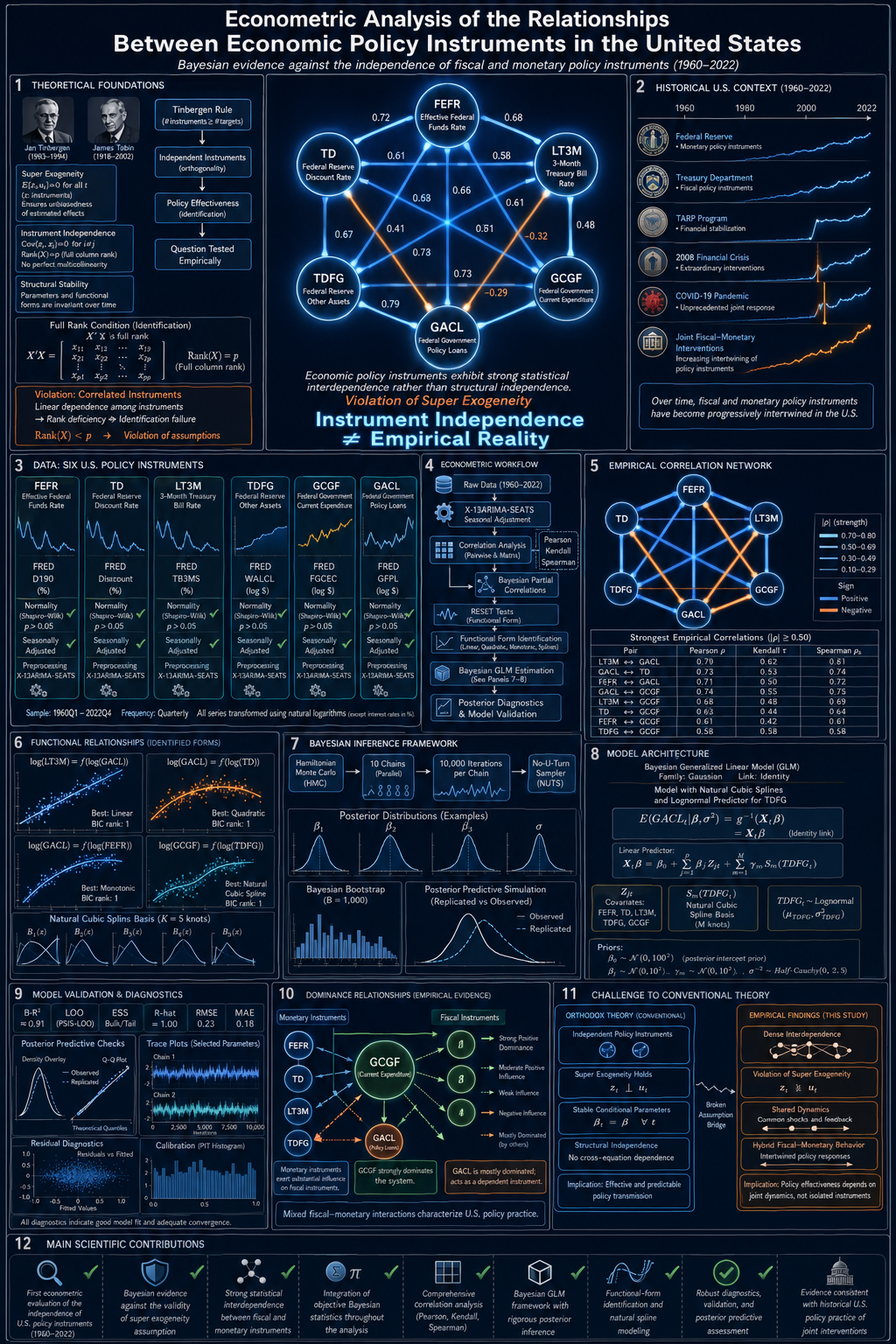
Imagine you are steering a ship with two sets of controls—one for the rudder and one for the engine. Conventional wisdom says these controls work independently: you can adjust the rudder without affecting the engine, and vice versa. For more than seventy years, this is essentially how mainstream economics has treated a country’s fiscal policy (government spending and lending) and its monetary policy (interest rates and central bank operations). Each set of tools was supposed to be independent of the other, allowing policymakers to pursue multiple goals at the same time without interference.
A new study published in the Revista Cubana de Economía Internacional challenges that assumption head-on. Using six decades of quarterly U.S. data—from January 1960 to October 2022—and a battery of modern Bayesian statistical techniques, economist José Mauricio Gómez Julián finds that American fiscal and monetary instruments are far from independent. They are, in fact, deeply intertwined, both in straightforward linear ways and in more complex, nonlinear patterns. The implications ripple outward from econometric theory into the practical world of how governments manage economies.
The Rule That Started It All
The story begins in 1952, when the Dutch economist Jan Tinbergen—who would later share the first Nobel Memorial Prize in Economic Sciences—formulated a deceptively simple principle: to achieve n independent policy goals, you need at least n independent policy instruments. Known today as the “Tinbergen Rule,” this idea became a cornerstone of economic policy theory. It told governments that if they wanted to control inflation, unemployment, and growth simultaneously, they needed at least three tools that did not overlap in their effects.
The American economist James Tobin later sharpened this: instruments are independent when “the effects of any instrument on the targets are not proportional to those of any other, or of any combination of others.” In modern econometrics, this independence assumption has been formalized as super exogeneity—a technical condition saying that the statistical relationships between economic variables remain stable even when policymakers intervene. If super exogeneity holds, a central bank can freely adjust interest rates without worrying that the Treasury’s spending decisions will systematically interfere with those adjustments.
“If a central bank is free to choose the adjustments to its instruments to pursue its final objectives, it has instrument independence.”
— Laurence H. Meyer, former Federal Reserve Governor
The problem? Despite its foundational role in economic theory, nobody had rigorously tested this assumption econometrically for the U.S. case—until now.
Six Instruments, Six Decades
The study examines six economic policy instruments, divided into two groups:
Instruments Studied
Fiscal instruments: Federal government current spending (GCGF) and federal government policy lending (GACL)
Monetary instruments: The effective federal funds rate (FEFR), the Federal Reserve discount rate (TD), other assets held by the monetary authority (TDFG), and the 3-month Treasury bill secondary market rate (LT3M)
Data sourced from the Federal Reserve Economic Data (FRED) database and YCharts, spanning 252 quarterly observations.
With these variables in hand, the researcher embarked on a two-stage investigation. First, he tested whether each pair of instruments showed any meaningful statistical association. Then, he built a predictive model to see whether one instrument could be reliably forecasted from the others—which would be impossible if they were truly independent.
Stage One: Mapping the Web of Connections
The preliminary analysis used three different correlation measures—Pearson, Kendall, and Spearman—in both their classical (frequentist) and Bayesian versions. The results were striking. Eight pairs of instruments showed significant correlations, with partial correlation coefficients at or above 0.5 in absolute value. For context, a Pearson correlation of 0.5 means one variable explains about 25% of the variation in another—a substantial relationship by any standard.
Some highlights from the correlation analysis:
The 3-month Treasury bill rate and federal policy lending showed a strong positive correlation (Pearson partial correlation of approximately 0.78).
Federal policy lending and the discount rate were also strongly positively correlated (about 0.77).
Federal government spending and federal policy lending were negatively correlated (about −0.69), suggesting that as one rises, the other tends to fall.
Government spending showed negative correlations with all three monetary interest rate instruments (around −0.59 to −0.61).
The fact that these correlations held across different statistical measures and survived the stationarity adjustments (seasonal corrections applied via the X-13ARIMA-SEATS method) gives them added credibility. The seasonality adjustments also provided strong evidence that the variables follow approximately normal distributions, further validating the correlation analysis.
Linearity, Quadratics, and Beyond
Correlation tells you that two variables move together, but not how they move together. Is the relationship a straight line? A curve? Something more exotic? To answer this, the study employed Bayesian linear regression models and RESET tests (a standard diagnostic for detecting nonlinear relationships), both reinforced with Bayesian bootstrapping—a resampling technique that generates thousands of synthetic datasets to test the robustness of results.
The findings revealed that most instrument pairs have linear relationships, but in two notable cases—the discount rate versus policy lending, and the federal funds rate versus government spending—quadratic (curved) relationships also play a role. This means the effect of one instrument on another is not constant; it changes depending on the level of the variable, adding a layer of complexity that the Tinbergen framework simply does not account for.
For example, the relationship between the federal funds rate and government spending follows a parabolic pattern: at lower spending levels, the federal funds rate behaves one way, and at higher spending levels, it behaves differently. This kind of interaction is precisely what “independence” was supposed to rule out.
Stage Two: Building the Model
Armed with a clear map of which instruments are connected and how, the researcher constructed a Bayesian Generalized Linear Model (BGLM) to predict federal government policy lending (GACL) from the other instruments. This was not an arbitrary choice: among all the instruments studied, GACL emerged as the most consistently dominated—meaning it is explained by other instruments 75% of the time rather than explaining them. It was the natural candidate for the response variable.
To handle the nonlinear relationships identified in Stage One, the model used natural cubic splines—flexible mathematical curves that can bend to fit complex patterns without requiring the researcher to guess the exact shape in advance. Think of splines as a series of smoothly connected curve segments that together approximate any function, much like a skilled draftsman’s French curve. The model also incorporated the central bank’s asset holdings (TDFG) as a log-normally distributed random variable, based on the best-fitting distribution identified through empirical testing.
Model Performance at a Glance
Average R-squared: 0.908—the model explains about 91% of the variation in federal policy lending
Mean Absolute Error: 68.5 (on a variable that ranges from 146 to 1,682)
Root Mean Squared Error: 92.8
Convergence (R-hat): 1.0—indicating the Markov Chain Monte Carlo simulations ran cleanly
Multicollinearity check: Generalized VIF values below 10 for all effective predictors
In plain terms: a fiscal instrument can be predicted with high accuracy from a combination of fiscal and monetary instruments. If these tools were truly independent, this would be impossible. The model’s strong performance is the mathematical proof that the independence assumption does not hold.
What Does History Say?
The econometric findings do not exist in a vacuum. The study enriches its statistical conclusions with historical evidence from American economic policy, and the alignment is remarkable.
Consider the Troubled Asset Relief Program (TARP), launched during the 2008 financial crisis. As former Federal Reserve Vice Chairman Alan Blinder has written, TARP “was not about cutting taxes, spending money, or lowering interest rates.” It was not purely fiscal policy, nor was it purely monetary policy. It was a hybrid—designed jointly by the Treasury and the Federal Reserve, using taxpayer money to purchase potentially depreciating financial assets. It was, in Blinder’s words, “financial stability policy, something the U.S. government had not needed since the Great Depression.”
“TARP was not about cutting taxes, spending money, or lowering interest rates. Instead, it was about putting taxpayer money at risk by purchasing assets that could decline in value. The program was also jointly designed by the Treasury and the Federal Reserve.”
— Alan S. Blinder, A Monetary and Fiscal History of the United States, 1961–2021 (2022)
The same pattern recurred with the bank stress tests announced in February 2009—again a joint product of the Treasury and the Fed, again neither purely fiscal nor purely monetary. And it happened once more in 2020, when the COVID-19 pandemic demanded unprecedented coordination between fiscal stimulus checks and the Fed’s asset purchases. Each crisis forced policymakers to blur the lines between fiscal and monetary tools, confirming at the practical level what the data confirm statistically.
So Which Side Dominates?
One of the study’s more intriguing findings is a pattern of fiscal dominance. In five out of eight significant instrument pairings, the fiscal instrument is the “dominant” variable—meaning it serves as the predictor rather than the predicted. Federal government spending (GCGF) in particular emerges as a highly dominant instrument, while federal policy lending (GACL) is predominantly the variable being explained.
However, this is not a clean sweep for fiscal policy. In two cases, monetary instruments dominate fiscal ones, and in one case the direction depends on whether the relationship is modeled linearly or quadratically. The overall picture is one of asymmetric but bidirectional interdependence—fiscal instruments tend to drive the relationship, but monetary instruments are far from passive.
Why This Matters Beyond the Ivory Tower
If you are not an economist, you might wonder why the independence of policy instruments matters. The answer is practical and consequential.
Central bank independence—the idea that monetary authorities should operate free from political pressure—is one of the most widely advocated institutional designs of the past four decades. But this advocacy typically focuses on independence from electoral cycles: the Fed should not cut interest rates simply because an election is approaching. The study’s findings do not challenge that kind of independence. What they challenge is a different, more technical assumption: that the tools themselves operate in separate silos.
The study concludes that fiscal and monetary authorities in the U.S. are not independent in their instruments—the Treasury’s spending decisions and the Fed’s rate decisions are statistically entangled. This does not mean that central bank independence from political cycles is undesirable or unviable. Quite the opposite: the author suggests that if fiscal and monetary instruments are this deeply intertwined, both fiscal and monetary authorities should perhaps enjoy independence from electoral pressures, not just the central bank.
Moreover, the finding that fiscal instruments tend to dominate has a subtle but important implication: in complex economic scenarios—financial crises, pandemics, supply shocks—monetary policy alone may be insufficient. The historical record confirms this. The U.S. recovery from the 2008 crisis, which “eventually broke all longevity records,” was driven not by monetary easing alone but by an unprecedented combination of fiscal stimulus and monetary accommodation working in concert.
Limitations and Open Questions
The author is admirably transparent about what the study does and does not accomplish:
The analysis is specific to the United States and to the 1960–2022 period. Whether the same patterns hold in other economies remains an open question.
The study examines instrument-to-instrument relationships but does not directly model how these instruments jointly affect policy goals like growth, employment, and price stability—though the author recommends this as a natural next step.
The model presented is robust but not necessarily the best possible model. The goal was to test the independence assumption, not to optimize predictive power, and for that purpose the model is more than adequate.
The strong coordination between U.S. fiscal and monetary authorities may partly explain the findings, but the author argues that the underlying economic dynamics themselves also contribute—the variables are intertwined not just because policymakers coordinate, but because the real economy forces them to.
The Bottom Line
For over seven decades, mainstream economic theory has assumed that fiscal and monetary policy instruments are independent of each other. This assumption underpins the Tinbergen Rule, shapes how economic models are built, and influences how central banks are designed. The study by Gómez Julián applies modern Bayesian econometrics to 60 years of American data and finds, with considerable statistical rigor, that this assumption does not hold.
The instruments of U.S. economic policy are deeply interdependent—in linear ways, in curved ways, and in historically documented, crisis-tested ways. A fiscal instrument can be predicted with over 90% accuracy from a combination of other fiscal and monetary instruments. The Tinbergen Rule’s condition of independent instruments is not just violated; it is violated comprehensively.
This does not invalidate the Tinbergen framework entirely, but it does suggest that a new paradigm is needed—one that starts from the reality of interdependence rather than the ideal of independence. The economic instruments of the world’s largest economy do not work in isolation. Perhaps it is time our theories stopped assuming they do.
· · ·
Reference: Gómez Julián, J. M. (2023). “Análisis econométrico de las relaciones entre los instrumentos de política económica en Estados Unidos.” Revista Cubana de Economía Internacional, 10(2), 72–97. Available at: revistas.uh.cu
The Hidden Logic Inside Every Price Tag — Reading Marx Through Hegel’s Syllogisms
Political Economy × Philosophy
The Hidden Logic Inside Every Price Tag
How Hegel’s syllogisms reveal the contradictions Marx saw in every commodity — and why those contradictions still matter for understanding capitalism’s future.
Based on: Gómez Julián, J. M. (2017). “Sobre la dialéctica inmanente en la metamorfosis mercantil.” Revista de Filosofía, Universidad de Costa Rica, LVI (145), 45–53.
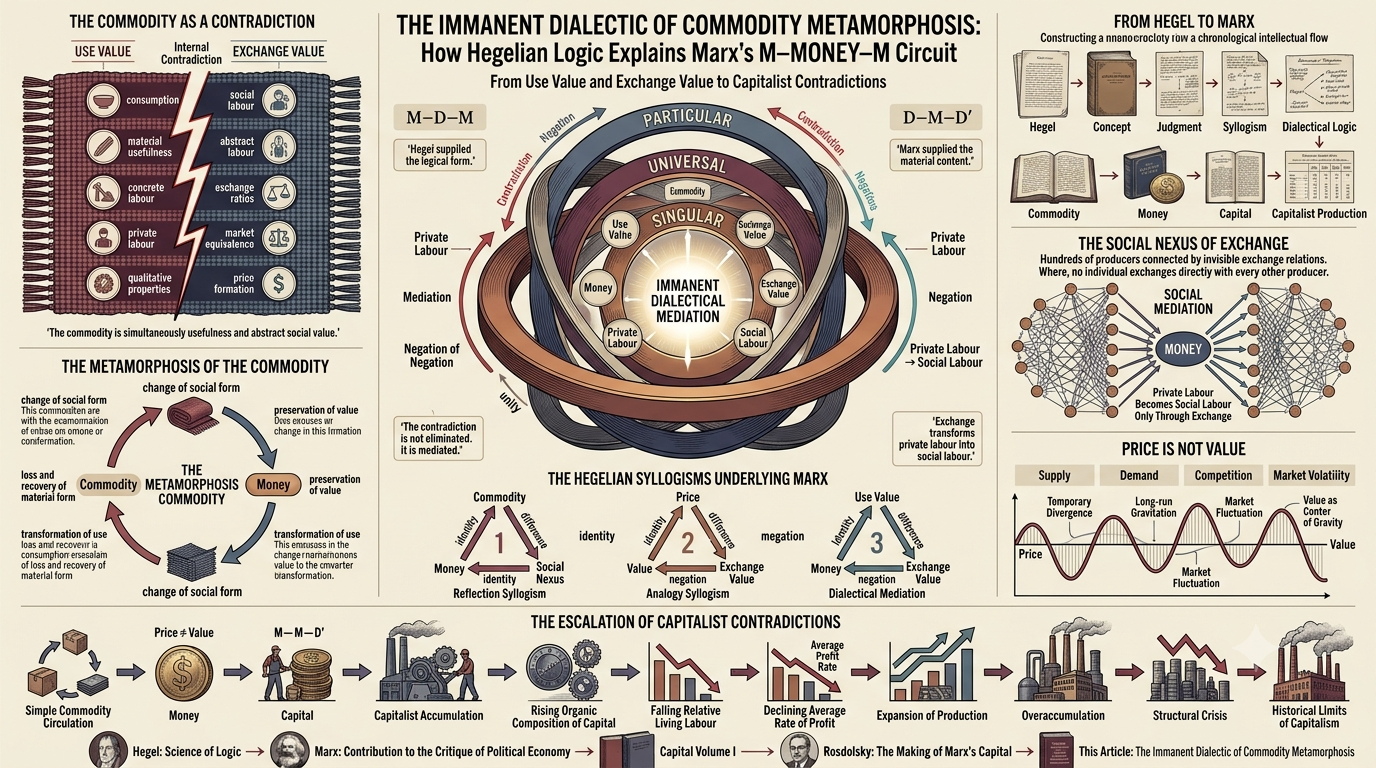
Every time you buy a cup of coffee, two completely different things happen at once. The coffee satisfies a need — warmth, caffeine, pleasure. But it also embodies a social relationship: someone grew the beans, someone roasted them, someone set a price. That double life of every commodity is what Marx called the contradiction between use value and exchange value. An economist recently set out to show that this contradiction follows an exact logical structure — one that Marx sketched but never fully completed.
Why This Paper Exists
Karl Marx built his critique of political economy on the logical scaffolding of the German philosopher G.W.F. Hegel. This is not a minor footnote: Hegel’s dialectical logic — the idea that concepts develop through contradiction, moving from thesis to antithesis to synthesis — is the engine room of Capital. Marx famously said he turned Hegel “right side up,” replacing idealism with materialism. But he kept the machinery.
The problem, as Gómez Julián points out, is that Marx never finished the philosophical job. He used Hegel’s logic to analyze commodities, money, and prices, but he never fully explained how the internal contradictions of the commodity resolve themselves at the level of pure logic. He identified the cycle M–D–M (commodity–money–commodity) and even mapped it onto Hegel’s qualitative syllogism. But then he stopped the philosophical analysis and moved on to economics. This paper tries to pick up where Marx left off.
“The contradiction between use value and exchange value is one of the most fundamental discoveries of Marxian Economics, a principle without which all the conclusions of the theory of value and money remain dead.” — Roman Rosdolsky, cited in the article
Three Words You Need: Use Value, Exchange Value, Money
Before going further, let’s make sure the key terms are crystal clear — no economics degree required.
Use value is what a thing is good for. A coat keeps you warm. Bread feeds you. This is qualitative — it answers the question “what does it do?”
Exchange value is what a thing can be traded for. The coat might be worth three loaves of bread, or $80. This is quantitative — it answers the question “how much is it worth?”
Money is the universal translator. It lets every commodity express its exchange value in one common language (dollars, euros, colones). But money also separates buying from selling, creating new contradictions.
The central tension is this: a commodity is both a useful object and a bearer of abstract social value. These two identities don’t sit comfortably together. The article’s claim is that this tension follows a precise logical structure that Hegel’s system can decode.
Hegel’s Toolkit: Concept, Judgment, Syllogism
Hegel’s Science of Logic develops in three stages that mirror how we think. Gómez Julián draws on all three:
The Concept (Begriff) has three “moments”: universality (what something shares with everything in its class), particularity (what distinguishes it within that class), and singularity (the concrete, individual thing that unites both). Think of it this way: “fruit” is universal; “citrus” is particular; “this orange in my hand” is singular.
The Judgment (Urteil) is what happens when those moments are set against each other — when we say something is this but also is not that. It’s the moment of contradiction.
The Syllogism (Schluss) is the resolution. It’s the logical form in which the contradiction finds its movement — not by disappearing, but by developing into something richer. A syllogism has a major term (universal), a minor term (particular), and a middle term (singular) that mediates between them.
Everyday Analogy
Imagine a job market. Workers (particular individuals) want wages (universal standard). The job interview is the singular mediation — the concrete encounter where “this worker” meets “the market price for labor.” The contradiction between what a worker needs and what the market offers doesn’t vanish; it plays out in the negotiation. Hegel’s syllogism captures the logical skeleton of exactly this kind of process.
Syllogism No. 1 — The Act of Buying and Selling
The first syllogism Gómez Julián develops is what Hegel calls the syllogism of reflection in its exclusive form. It addresses the most basic question: how can a commodity and money — two fundamentally different things — be exchanged at all?
Consider the act of selling (M → D). The seller has a particular commodity — say, a specific handmade chair. Money plays the role of the universal: it’s the general equivalent against which all commodities measure themselves. What bridges the two? The social nexus — the web of production relations, market norms, and shared conventions that make exchange possible in the first place.
In the act of buying (D → M), the logic mirrors itself: money (now universal) is exchanged for a particular commodity, again mediated by the social nexus. The syllogism looks like this:
Selling: M → D
Particular (commodity) — Singular (social nexus) — Universal (money)
Buying: D → M
Universal (money) — Singular (social nexus) — Particular (commodity)
The key insight is that the social nexus is not an add-on — it is the logical middle term. Without it, the contradiction between a chair and a stack of bills would be irreducible. Marx himself recognized this when he wrote that “a relation of social production appears as something existing outside individuals.” The chair doesn’t inherently “know” it’s worth $200. That knowledge is embedded in social practice.
Syllogism No. 2 — Price vs. Value
The second syllogism tackles a subtler problem. Even after an exchange happens, there’s a gap: the price of a commodity almost never equals its value (the socially necessary labor time embedded in it). Prices fluctuate with supply, demand, speculation, season, mood. Marx acknowledged this explicitly:
“The price-form … allows for the possibility of a quantitative incongruity between price and the magnitude of value — that is, a deviation of the former from the latter.”
Gómez Julián uses Hegel’s syllogism of analogy to model this. In this syllogism, the middle term is a singularity taken in its essential universality — a particular thing considered not just as itself but as representative of its genus. Here’s how it maps:
Price–Value Relation: S — U — P
Singular: exchange value (the real labor time, which never appears directly on the market — it enters the “capricious volatility of competition”)
Universal: price (the monetary expression, which carries value inside it but also differs from it — “value in-itself and also value distinct from itself”)
Particular: exchange value over the long run (the average around which supply and demand oscillate)
The punchline is elegant: price and value are never identical at a single point in time, but value is always the gravitational center around which prices orbit. This is not a failure of the system — it’s the way the contradiction moves. As Marx wrote, echoing Hegel: identity here is “the identity of negation.”
Think of It Like This
A stock’s price on any given day can be wildly off from its “intrinsic value” (however you measure it). But over time, market forces push the price back toward something like fair value. The deviation is not noise — it’s how the market processes information. Gómez Julián is arguing that this pattern is not just an empirical regularity but a logical necessity embedded in the structure of commodities.
Syllogism No. 3 — The Big One Marx Identified But Didn’t Complete
Marx himself noticed that the cycle M–D–M (commodity–money–commodity) can be mapped onto Hegel’s qualitative syllogism P–U–S (particular–universal–singular). The two M’s in the cycle play different roles:
The first M is particular — it’s a specific commodity I own and want to get rid of (say, the chair I made). The D (money) is universal — it can buy anything. The second M is singular — it’s the concrete commodity I actually need (say, groceries). The money mediates, translating my particular surplus into the particular thing I lack.
But here’s where the article makes its most original contribution. Marx only named the syllogism and stopped. Gómez Julián argues that the full Hegelian development reveals something Marx left implicit: the commodity embodies both social labor (exchange value) and private labor (use value). Money — as the “universal equivalent” — is the form in which these two kinds of labor temporarily reconcile. But reconciliation is not resolution. The contradiction persists and drives the system forward.
“The development of the commodity does not suppress this contradiction: rather, it creates the forms in which it can move.” — Marx, cited in the article
Marx compared this to planetary motion: a body is constantly falling toward the sun and constantly being flung away. The orbit is not a resolution of gravity vs. inertia — it is the contradiction in motion. Commodity circulation works the same way.
From Logic to Collapse: The Tendency of the Rate of Profit to Fall
The paper doesn’t stop at philosophy. It follows the thread all the way to what Marx considered the long-run fate of capitalism: the tendency of the average rate of profit to fall.
The logic runs as follows. The average rate of profit is the weighted average of profit rates across all sectors of the economy:
Average Rate of Profitg'M = Σ wᵢ · g'ᵢ
where g'M = average profit rate, wᵢ = weight of sector i‘s capital in total social capital, g'ᵢ = profit rate in sector i.
As capitalism develops, technological innovation replaces living labor (variable capital) with machinery and materials (constant capital). This raises productivity — each worker produces more. But it also means each commodity contains less total labor time and therefore less surplus labor time (the source of profit). Even though the proportion of surplus time within each commodity may rise (higher exploitation rate), the absolute mass of surplus per unit falls.
To compensate, capitalists must produce at exponentially larger scales — what Marx called the “faux frais” (overhead costs) of production and circulation. Meanwhile, technological unemployment grows, wages are pressured downward, and social tensions mount. The article presents this as the logical terminus of the contradictions embedded in the commodity itself.
For Non-Economists
Imagine a bakery that replaces bakers with machines. Each loaf now costs less labor to make, so the profit per loaf shrinks. The bakery compensates by selling far more loaves — and by cutting the remaining workers’ wages. Scale this across the whole economy, and you get Marx’s picture: profits per unit fall, production must explode, workers are squeezed, and the system becomes increasingly fragile. That’s the “falling rate of profit” thesis.
Why Does This Matter?
You don’t have to agree with Marx’s conclusions to appreciate what this paper accomplishes. It demonstrates three things:
Hegel’s logic is not decorative. The syllogistic structures are not metaphors — they are the formal architecture that makes Marx’s economic categories cohere. Ignoring them leaves Capital half-read.
Contradictions are not bugs — they’re features. The gap between use value and exchange value, between price and value, between private labor and social labor, is not a flaw in capitalism. It’s the mechanism that keeps it moving. Understanding this changes how you think about crises: they’re not accidents but structural expressions of unresolved logical tensions.
The long-run trajectory matters. Whether or not capitalism “collapses” in the dramatic sense Marx envisioned, the falling-rate-of-profit framework offers a structural explanation for secular stagnation, financialization, and the persistent pressure to expand into new markets — themes that remain urgently relevant.
· · ·
At its heart, Gómez Julián’s paper is an invitation to read Marx the way Marx read Hegel — not as a collection of slogans, but as a living logical system where every economic category carries a philosophical skeleton inside it. The commodity is not just a thing with a price. It is a logical knot tying together private desire, social labor, monetary abstraction, and historical trajectory. Untying that knot — or at least seeing its shape — is the first step toward understanding why economies work the way they do, and why they sometimes don’t.
Why Broken Eggs Don’t Unbreak — A New Physics of History, Direction, and Purpose
Physics • Philosophy • Foundations
Why Broken Eggs Don’t Unbreak
A philosopher argues that history, not mechanics, is the deepest grammar of the physical world — and that matter itself pursues stability.
Based on a paper by José Mauricio Gómez Julián~9 min read
Why does a broken egg never reassemble itself? Every law governing the motion of its atoms is perfectly reversible — run the film backward and nothing in the mathematics complains. And yet, in the real world, broken eggs stay broken. This gap between what our equations allow and what nature actually does has haunted physics for over a century. A new paper from the University of Costa Rica proposes an answer that is as philosophically bold as it is mathematically precise.
The Paradox That Won’t Go Away
In the 1870s, the Austrian physicist Josef Loschmidt challenged Ludwig Boltzmann’s statistical explanation of the second law of thermodynamics. His objection was devastatingly simple: if the equations of motion work the same forwards and backwards in time, how can entropy — disorder — only ever increase? This is Loschmidt’s paradox, and it sits at the intersection of thermodynamics, quantum mechanics, and the philosophy of science.
Physicists have proposed many partial answers. Some invoke the statistical improbability of reversal (there are astronomically more disordered states than ordered ones). Others appeal to cosmological boundary conditions — the universe simply started in a very special, low-entropy state. More recent work, cited in this paper, turns to information theory and Landauer’s principle (the idea that erasing information has a minimum physical cost).
But the author — José Mauricio Gómez Julián, writing from the University of Costa Rica — finds all of these solutions insufficient. His central claim is provocative: the paradox is not in nature. It is in our models. We build theories that are fundamentally ahistorical, then act surprised when the real world — which is fundamentally historical — doesn’t obey them. The problem, he argues, is not that reality misbehaves. It is that our theories refuse to remember.
The Core Move
Instead of asking “Why is the macroscopic world irreversible?”, the paper reframes the question entirely: “Why do we insist on building reversible models and then call irreversibility a paradox?”
The Philosophical Engine: Dialectical Materialism
The paper is grounded in dialectical materialism — a philosophical tradition rooted in Marx and Engels, developed further by Hegel (in its idealist form) and by Soviet physicists like Blokhintsev and Rosental. If that sounds unusual for a physics paper, the author would say: that’s exactly the point.
Dialectical materialism holds that reality is made of matter in motion, that contradictions are not flaws in our thinking but features of the world, and that quantitative changes eventually produce qualitative leaps. It also insists on a distinction that modern physics has muddled:
Epistemology — what we can know and measure (our limitations as observers).
Ontology — what actually exists in the world, regardless of our ability to observe it.
This distinction turns out to be the paper’s sharpest tool. When quantum mechanics says that a particle’s position is “uncertain,” the author asks: is that uncertainty a feature of reality (ontology), or a feature of our knowledge (epistemology)? His answer is nuanced and consequential. The Schrödinger equation itself is fully deterministic — give it an initial state and a Hamiltonian, and it will predict the future wave function with perfect precision. The randomness enters only when we try to measure — when the quantum system meets our macroscopic instruments.
In other words, probability in quantum mechanics is an epistemological resource — a powerful tool for managing complexity and incomplete knowledge — not a statement that reality itself is fundamentally random. This does not mean quantum mechanics is wrong. It means that its probabilistic character tells us about us, not about the universe.
The author is careful, however, to distinguish this from classical Laplacian determinism. Heisenberg’s uncertainty principle, he argues, is ontological — it reflects genuine structural features of reality (the complementarity between position and momentum). So the world is deterministic in a deep sense, but not in the naive clockwork sense. It is deterministic in the way a complex, path-dependent system is deterministic: constrained, structured, lawful — but too intricate for any observer to fully predict.
When the terrain disagrees with the map, trust the terrain
Path Dependence: History Before Time
Here is where the paper makes its most original conceptual move. The author argues that path dependence is more fundamental than time itself.
What does this mean? In complex systems — economies, ecosystems, living organisms — the current state depends not just on the present conditions but on the entire sequence of events that led there. An economy with the same GDP, population, and technology as another can behave very differently because its institutions, crises, and policy choices followed a different historical path. The paper claims this is not just a feature of complex systems. It is a feature of all physical reality, at every scale.
In this framework, time is reimagined. It is not a background parameter through which things happen (as in Newtonian mechanics), nor a dimension woven into spacetime (as in relativity), but rather a structure that records material transformations — a kind of universal memory. Space and time co-emerge as the necessary fabric for matter to develop and preserve its evolutionary trajectory.
The author traces this insight back to Hegel’s philosophy of nature (published decades before Einstein’s relativity), where place, space, and time are understood as a unity — and where motion (and therefore matter) arises from their contradiction. The passage is striking:
Place is spatial singularity… This perishing and regenerating of space in time and of time in space… is movement. This becoming… is the immediate, identical and existing unity of space and time: it is matter.
— Hegel, Encyclopaedia of the Philosophical Sciences
If path dependence is fundamental, then irreversibility is not something to be explained — it is something to be assumed, just as mathematicians assume the existence of natural numbers rather than proving it. Every broken egg, every aging star, every evolved species is evidence that the universe remembers its own history.
A New Equation for a Remembering Universe
The author doesn’t stop at philosophy. He proposes a concrete mathematical reformulation of the Schrödinger equation — the foundational equation of quantum mechanics — to make path dependence explicit.
Standard quantum mechanics writes:
Standard Form
iℏ ∂ψ/∂t = Ĥ ψ
where the Hamiltonian Ĥ describes the system’s energy at a given instant.
The paper’s reformulation introduces a history-dependent Hamiltonian:
Path-Dependent Form
iℏ ∂ψ/∂t = Ĥ(t) ψ
where Ĥ(t) = Ĥ₀ + ∫ K(t, t′) ψ(t′) dt′
Here, t is not clock time but an interaction index — an ordering of how physical interactions emerged. The kernel K(t, t′) encodes how every prior interaction influences the current one.
This is a bold move. It says: the state of a quantum system at any moment is shaped by the entire chain of interactions that brought it there — not just by its instantaneous configuration. The author also defines a metric on this “interaction space,” capturing the distance between interactions in terms of both complexity and energy change, and proves it satisfies the standard properties of a mathematical metric (nonnegativity, symmetry, triangle inequality).
The elegance of this formulation is that it reproduces known physics as special cases:
Classical regime (low energy, macroscopic): the metric reduces to ordinary Euclidean geometry.
Relativistic regime (high velocity): it reproduces the Minkowski spacetime interval.
Quantum regime (entanglement, superposition): the metric captures quantum correlations through entanglement entropy.
Entanglement Without Spookiness
The path-dependent framework also offers a fresh take on quantum entanglement — Einstein’s famous “spooky action at a distance.” In the standard picture, measuring one entangled particle seems to instantaneously affect its partner, no matter how far away. In the author’s framework, entangled particles don’t communicate across space. They share a common interaction history. They are “close” in interaction space even when they are far apart in physical space — much like two points on a folded piece of paper that look distant but are actually adjacent when the paper is unfolded.
Bell’s theorem — which proved that no local realistic theory can reproduce all quantum predictions — is not violated but reinterpreted: the “nonlocality” is real in emergent spacetime but disappears when you consider the deeper interaction space. Locality is preserved at the fundamental level; it only appears broken in the effective spacetime we observe.
Why Does Matter Seek Stability?
IV
The paper’s second major argument is about teleology — the idea that natural processes are directed toward ends or purposes. This is a concept that modern science has largely banished (with some notable exceptions in biology). The author argues it should be restored — but in a materialist, not a mystical, form.
The claim: physical systems universally tend toward maximum achievable stability within their material constraints. This is not an external force or an intelligent design. It is an inherent property of matter itself, arising from the internal contradictions within material systems.
The evidence spans every scale of reality:
Cosmological: The universe’s laws appear “fine-tuned” for structure and complexity. Cyclic cosmological models suggest a drive to preserve laws conducive to stability.
Stellar: Stars burn through nuclear fuel, then transform — into white dwarfs, neutron stars, or supernovae — each outcome representing a reorganization toward the next achievable stable state.
Chemical: The pressure-induced transformation of graphite to diamond. Autocatalytic systems that reorganize when reactants deplete.
Biological: DNA’s role as a stable transcription template. Gould’s punctuated equilibria — long periods of stasis followed by rapid change. Insect metamorphosis.
Neural: The brain reorganizing through neuroplasticity after injury or during learning.
Social: Revolutions occurring when existing structures of production become incompatible with productive forces.
In each case, the pattern is the same: systems seek stability, achieve it temporarily, exhaust the conditions that made it possible, undergo a qualitative transformation, and resume the search in a new configuration. Stability is the attractor; transformation is the mechanism.
Least Action and Ground States
The author connects this teleological perspective to two pillars of physics:
The principle of least action — the mathematical rule that physical systems follow paths that extremize (usually minimize) the “action” functional. This is usually treated as a computational tool. The paper reinterprets it as a teleological law: systems select trajectories in service of their drive toward stability, and the path of least action is the one that best serves this purpose. Sometimes, the system does not take the absolute minimum energy path — because the absolute minimum may not serve the broader goal of sustained stability.
The ground state tendency — quantum systems’ natural inclination to settle into their lowest energy configuration. The author, drawing on Solovej’s work on the stability of matter, argues this is not merely a mechanical outcome but an expression of matter’s fundamental need for stabilization. Electrons don’t “accidentally” fall into lower energy levels. They are driven there by the internal logic of material reality.
Key Insight
Teleology here is not purpose in the human sense — no intentions, no intelligence. It is the tendency of matter to resolve its own internal contradictions by seeking the most stable configuration available. Purpose arises from the inherent contradictions of matter, not from any external guide.
The Arrow of Time, Revisited
With path dependence as the foundation, the arrow of time becomes almost trivial to explain. Time flows in one direction because systems are historical. The future depends not only on the present state but on the entire trajectory that led to it. Irreversibility is not a statistical accident or a cosmological boundary condition — it is a structural feature of reality, as basic as the existence of natural numbers in mathematics.
The author draws an analogy to the Cosmic Microwave Background (CMB) — the faint radiation left over from the early universe, which provides a natural “preferred frame” for cosmic observations without violating relativity. Similarly, the paper proposes that a preferred temporal direction can emerge from path dependence without requiring absolute time. Each observer may have their own “proper time,” but the causal structure — the chain of dependencies — is invariant and objective across all reference frames.
This bridges a gap between quantum mechanics and general relativity. Quantum theory works with a notion of time closer to the classical (absolute) picture, while relativity treats time as relative and observer-dependent. The path-dependence framework offers a way to reconcile both: the ordering of interactions is fundamental and observer-independent; the measurement of time is relative.
Testable Predictions
The paper does not remain in the realm of philosophy. It proposes four concrete experimental protocols:
Decoherence studies: Prepare identical quantum systems, give them different interaction histories, and measure whether their decoherence rates differ. The paper predicts they will.
Entanglement analysis: Generate entangled photon pairs, expose them to different interaction histories, and check whether entanglement strength decays exponentially with “interaction distance” as the metric predicts.
Modified double-slit experiment: Introduce controlled interaction histories before particles reach the slits and look for history-dependent deviations in the interference pattern.
Time emergence clocks: Prepare identical atomic clocks with different interaction histories and compare their temporal evolution rates.
These are technically demanding experiments — requiring millikelvin temperatures, ultra-high vacuum, single-photon detection, and high-fidelity quantum tomography — but they are within reach of current laboratory capabilities. The predictions are specific enough to be falsified, which is exactly what good science requires.
Why This Matters Beyond Physics
FOR THE NON-PHYSICIST
If you are an economist, a political scientist, or simply someone who thinks about how societies change, this paper’s conceptual framework should feel familiar — and provocative.
The concept of path dependence is already central to institutional economics (think of Douglass North or Paul David’s QWERTY keyboard). The idea that history matters — that you cannot understand a system’s current state without knowing how it got there — is a staple of comparative politics and historical sociology. What this paper does is argue that path dependence is not just a useful metaphor borrowed from physics. It is a fundamental feature of physical reality itself.
Similarly, the paper’s concept of teleology without intention — systems pursuing stability through the internal logic of their own contradictions — resonates powerfully with Marx’s theory of historical materialism, where modes of production develop, exhaust their potential, and undergo revolutionary transformation. The author draws this connection explicitly, noting that revolutions occur “when existing relations of production become incompatible with developing productive forces.”
And the distinction between epistemology and ontology — between what we can model and what actually exists — is a question every social scientist should take seriously. When our econometric models fail to predict a financial crisis, is the crisis a “black swan” (an anomaly), or is it evidence that our models are too ahistorical to capture reality?
The problem is not that reality “contradicts” theory but that theory is a limited abstraction of reality, creating tension when attempting to make reality fit the model instead of developing models that capture reality’s historical-contextual nature.
— José Mauricio Gómez Julián
A Bridge Between Worlds
This is not a paper that will convince everyone. Its philosophical framework — dialectical materialism — is unfamiliar and, for some, politically charged. Its mathematical proposals, while rigorous, are exploratory and await experimental confirmation. Its claim that teleology is a fundamental feature of matter will strike many physicists as a step backward toward pre-modern thinking.
But that is precisely what makes it worth reading. In a landscape where theoretical physics has fragmented into string theory, loop quantum gravity, and various interpretations of quantum mechanics that all reproduce the same experimental results, a paper that asks “What if we’re starting from the wrong assumptions?” is exactly the kind of provocation that science needs.
The paper’s deepest contribution may be methodological: a demonstration that philosophy and physics can inform each other without either colonizing the other. The philosophical framework provides the conceptual clarity to ask better questions. The physics provides the experimental discipline to test whether those questions have real answers.
Whether or not its specific proposals survive experimental scrutiny, the paper succeeds in something more modest but no less important: it makes you see the broken egg differently. Not as a problem to be explained away, but as evidence of a universe that remembers — and that, in remembering, moves irreversibly forward.
Why an Amoeba Has 200 Times More DNA Than You — A Philosophical Take on the C-Value Paradox
Explainers · Philosophy of Science · Molecular Biology
The C-Value Paradox:
Why an Amoeba Has 200 Times More DNA Than You?
A philosopher argues that the way we count genes is broken — and proposes a dialectical, quantum-informed fix.
Blog Post2025
~ 9 min read
Imagine you are handed two books. One is a slim novella; the other is an encyclopedia the size of a suitcase. Intuitively, you’d guess the encyclopedia contains more information. Now imagine that the novella turns out to encode the instructions for building an entire human being, while the suitcase-sized volume merely describes how to be a single-celled amoeba. Welcome to the C-value paradox — one of the most stubborn puzzles in modern biology — and to a recent paper that proposes a genuinely unusual way of thinking about it.
The article in question is “Outlining a Dialectical Hypothesis on the C-Value Paradox in the Light of Quantum Chemistry” by the philosopher José Mauricio Gómez Julián, published in the Pitt Philosophy of Science archive (available here). It is not a typical biology paper. It moves fluidly between Hegelian logic, quantum mechanics, selfish genetic elements, and the mathematics of how we measure sets. If that sounds intimidating, don’t worry: by the end of this post, you’ll see why the argument matters — even if you’ve never opened a biology textbook.
1. The Puzzle: More DNA, But Not More Complexity
Let’s start with the basics. Every living cell carries a complete copy of the organism’s DNA — its genome. Biologists measure genome size in base pairs (bp) or, for convenience, in megabases (Mb), where 1 Mb = one million base pairs. This measurement is called the C-value.
In prokaryotes (bacteria and archaea — the simplest forms of life, without a cell nucleus), the relationship is fairly intuitive: bigger genome, more genes, somewhat more complex organism. But when we turn to eukaryotes (everything from yeast to humans, with cells that contain a nucleus), the intuition collapses.
A single-celled amoeba carries roughly 200 times more DNA than a human being. An onion needs about five times more DNA than we do. Amphibians, as a group, show genome-size variations of up to 91-fold. As the paper notes, citing Latorre and Silva, “it is hard to believe that this may reflect variations of nearly 100 times the number of genes necessary to give rise to the corresponding amphibians.”
Nor is it simply a matter of how many genes there are. Even the raw count of protein-coding genes doesn’t track complexity well: a pufferfish has roughly the same number as a human (~35,000), and the rice plant has more (~51,000). The disconnect between genome size, gene number, and organismal complexity is the C-value paradox.
2. Why Should Anyone Outside Biology Care?
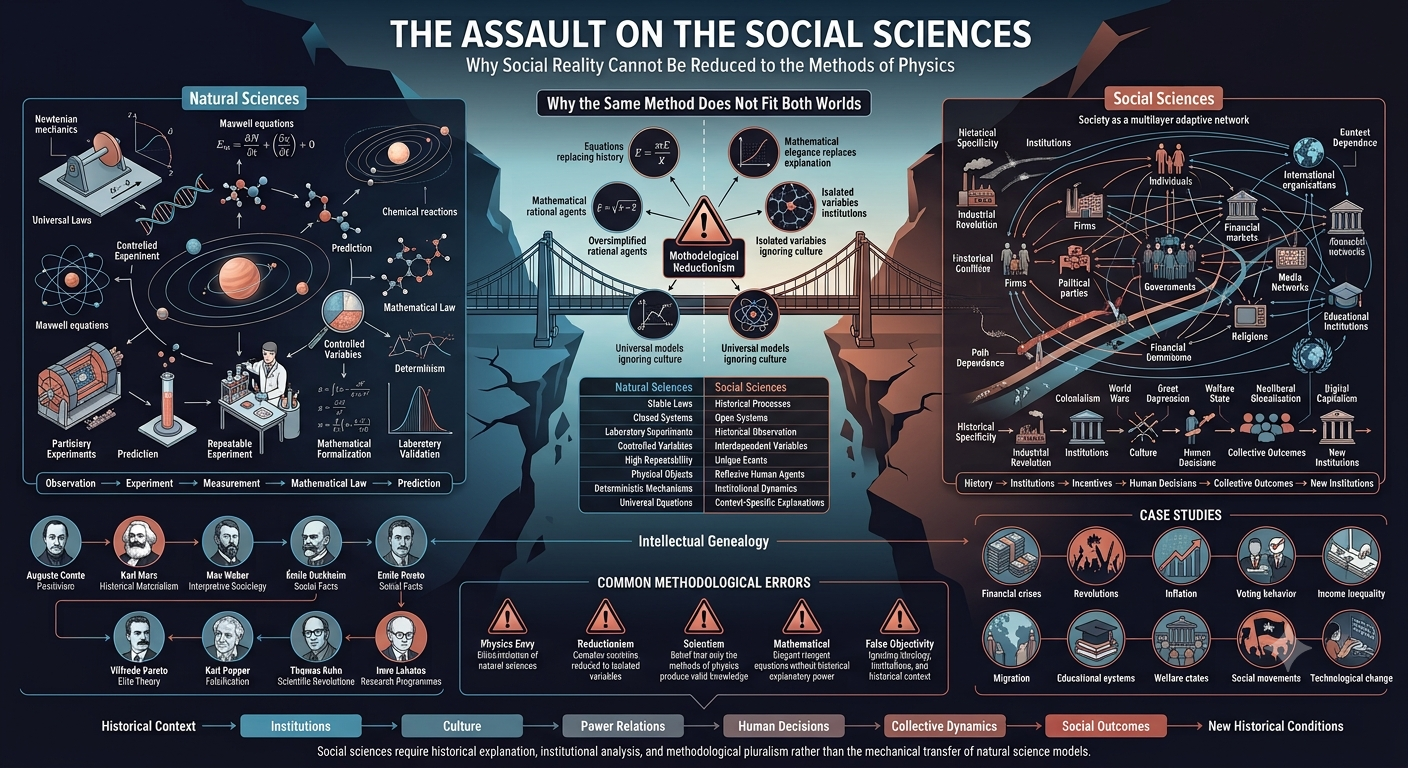
If you’re an economist, a political scientist, or a mathematician, you might be wondering what amoebae have to do with your work. The answer lies not in the biological details but in the type of reasoning the paper employs. Gómez Julián is making an argument about how we measure complexity — and specifically, why our standard tools for counting and measuring break down when the system we’re studying is fundamentally nonlinear.
This is a problem that recurs everywhere: in financial markets (where small shocks cascade unpredictably), in political systems (where a single event can reshape an entire order), and in ecology (where species interact in webs, not chains). The C-value paradox is, at its core, a case study of what happens when you try to impose a linear accounting framework on a nonlinear reality.
3. The Philosophy: What Does “Dialectical” Mean Here?
The paper’s philosophical backbone comes from dialectical materialism — a tradition rooted in Hegel and adapted by Marx, Engels, and later Soviet philosophers. For readers unfamiliar with the term, here is the essence in plain language:
Things are not only what they are in terms of their current state of development, but also their potential.
In this framework, reality is a totality: not just what currently exists, but what could exist, what is coming into being, and what is being annihilated. The concept of “contradiction” is central — but not in the colloquial sense of a logical error. A dialectical contradiction means that any complex thing contains opposing developmental tendencies that are simultaneously complementary and mutually exclusive. These tendencies can be nonantagonistic (stable, coexisting) or antagonistic (destabilizing, eventually forcing the system to transform into something qualitatively new).
Gómez Julián draws an explicit parallel between this philosophical notion and Bohr’s complementarity principle in quantum mechanics: to understand a quantum phenomenon fully, you need both the wave description and the particle description, even though they are mutually exclusive. The paper argues that this isn’t merely an analogy — it reflects a deeper logical structure shared across physics, chemistry, and biology.
For those with an economics background, the parallel to dialectical reasoning in political economy is direct. Just as a commodity is simultaneously a use-value and an exchange-value — and you cannot understand the commodity by examining only one aspect — so a gene is simultaneously a physical structure (DNA sequence) and a functional agent (information carrier, regulatory element, or “selfish” replicator). Reducing it to just one dimension is precisely what creates the paradox.
4. The Mathematical Core: Why Linear Counting Fails
Now we arrive at what will interest the mathematicians and econometricians. The paper makes a precise mathematical claim: the tools we use to count genes assume linearity, but the genetic system is nonlinear.
Formally, a function φ is called sigma-additive (or countably additive) if the measure of a union of disjoint sets equals the sum of the measures of each set. This is the standard foundation of probability theory and measure theory — the Kolmogorov axioms that every statistician and econometrician relies on.
A subadditive function, by contrast, only requires that the measure of the union be less than or equal to the sum of the parts. Additive functions are a special case of subadditive ones. In genetics, if you use an additive model, you are assuming a perfect linear relationship between the number of allele copies and the organism’s traits — no dominance, no interaction, no epistasis. As Huang and Mackay (2016) showed, this assumption is empirically inadequate for most quantitative traits.
Gómez Julián’s argument is that counting genes with sigma-additive functions implicitly treats the genome as a linear system: more genes = proportionally more complexity. But the evidence shows this is false. The complexity emerges from how genes interact, not from how many there are. Therefore, the counting function itself must change.
5. What Actually Generates Complexity? Eight Factors
The paper proposes that any meaningful relationship between gene count and organismal complexity must account for eight key aspects of the underlying molecular processes. Here they are, translated into plain terms:
What kind of information is encoded? — Not all genes carry the same type of instruction. Some code for structural proteins; others regulate when and where those proteins are made.
What encoding system is used? — The “language” of the genome is not uniform; different regions operate under different coding rules.
Should we weight protein-coding genes more heavily? — Protein-coding genes make up only about 1.5% of the human genome. Should the other 98.5% count equally?
What type of transcription occurs? — Through alternative splicing, a single gene can produce multiple different proteins. Humans may produce over 500,000 distinct proteins from only ~20,000 genes. The process is not one-to-one.
DNA is a nonlinear dynamical system. — The double helix doesn’t behave like a simple linear chain. Researchers have modeled it using nonlinear Hamiltonians since at least the 1980s, and solitary conformational waves (solitons) can propagate along the strand.
What type of gene is involved? — There are protein-coding genes, RNA genes, regulatory sequences, transposable elements, and more. They don’t all contribute to “complexity” in the same way.
What role do “negative genes” play? — This is one of the paper’s most distinctive contributions. Gómez Julián renames so-called “selfish genes” as “negative genes” — borrowing the concept of negativity from dialectical philosophy. These are genetic elements (like transposons) that replicate for their own benefit, even if they are harmful or neutral to the organism. They exist in a state of unity and struggle with the organism’s “ordinary” genes, and this conflict is, according to Werren (2011), “an important driver of evolutionary change and innovation.”
What happens during and around transcription? — This is when the DNA double helix unwinds and single strands are exposed. It is the moment of maximum vulnerability and maximum creative potential: DNA editing, trans-splicing, and tandem chimerism all occur here. The source of nonlinear complexity, the paper argues, is concentrated in this phase.
If these eight factors could be incorporated into a new kind of counting function — one that captures nonlinear interactions, gene regulation, and the dialectical interplay between “positive” and “negative” genes — the paradox might dissolve. Genome size and gene number would, at least approximately, map onto organismal complexity.
6. Quantum Chemistry Enters the Picture
You might wonder: where does quantum mechanics fit into all of this? The paper’s answer is that the covalent bonds holding DNA together are quantum-mechanical phenomena. As early as the 1920s, Heitler and London showed that covalent bonds can be understood through the Schrödinger equation. The nucleotides in each DNA strand are linked by strong covalent bonds, so the strand’s dynamics — its rigidity, its unwinding, its conformational changes — are ultimately governed by quantum mechanics.
In practice, solving the full Schrödinger equation for a molecule as large as DNA is computationally staggering. But progress is being made. The paper points to three recent advances:
Computational Progress
Analytical and numerical solutions of the Peyrard-Bishop DNA model (a nonlinear model of DNA dynamics) now show strong convergence (Al et al., 2020). Kink and localized solutions for the helicoidal version of the same model have been found and could serve as tools for modeling DNA-to-RNA transcription (Zdravković et al., 2019). And quantum annealing has been applied to de novo genome assembly — solving the combinatorial problem of stitching DNA fragments together using quantum and quantum-inspired optimization (Boev et al., 2021).
These are early steps, but they suggest that the computational barriers to modeling DNA as a quantum-mechanical, nonlinear system are not permanent. Quantum computing may eventually make the Schrödinger-based analysis of large molecules feasible.
7. The Bigger Picture: A Self-Teaching Universe
At this point, the paper makes its most ambitious philosophical move. Drawing on research by Alexander et al. (2021), Gómez Julián describes a universe that is self-organized, deterministic, historically determined, and autodidactic — one that “evolves learning in an autodidactic way its own laws,” applying a process physically equivalent to biological natural selection at a cosmological scale. The universe, in this view, is a system that adds new nonlinearities to itself over time — a kind of spontaneous increase in complexity.
This is linked to the concept of emergence: the spontaneous appearance of new information (new structures, new behaviors) as a result of a system’s internal dynamics. The laws of physics may themselves be subject to higher-order laws, just as a logic of a certain order is subject to the rules of a higher-order logic.
For the C-value paradox, the implication is this: you cannot understand the parts (genes) without understanding the whole (the organism and its evolutionary history), and you cannot understand the whole without understanding how it emerged from the parts. The truth, as Hegel would say, is in the totality.
· · ·
8. So What Would a Solution Actually Look Like?
Gómez Julián is careful to say that his paper is a guide, not a solution. He proposes the construction of a “paradox-free gene counting function” (PFGCF) — a new mathematical object that would replace simple sigma-additive counting with something capable of capturing:
Nonlinear gene interactions
The role of alternative splicing and regulatory elements
The dialectical interplay between ordinary genes and “negative” (selfish) genes
Quantum-mechanical properties of DNA structure
What happens during and around transcription
This function might not even be a single function at all, but rather a family of functions, each capturing different aspects of genomic complexity. The construction will require, the paper argues, “philosophers, chemists, geneticists, and physicists, as well as the use of high-capacity computational equipment.”
It is, in the author’s own words, a “legitimate speculation” — grounded in established science but not yet experimentally verified. The value of the paper lies in its identification of which factors matter and what kind of mathematics is needed, rather than in providing a finished model.
9. Why This Paper Matters (Even If You’re Not a Biologist)
Let’s return to the question of why a non-biologist should care. Here are three reasons:
The whole is more than the sum of its parts — and the tools we use to count the parts must reflect that.
First, the paper is a case study in interdisciplinary thinking. It weaves together philosophy, mathematics, chemistry, and biology in a way that is rare in any field. Whether or not you agree with its dialectical-materialist framework, the attempt to build a bridge between Hegel and quantum chemistry is intellectually stimulating.
Second, it highlights a general methodological problem: when linear tools fail, what replaces them? Economists face this when GDP doesn’t capture well-being; political scientists face it when vote counts don’t capture democratic health; mathematicians face it whenever measure theory meets real-world complexity. The paper’s call for new counting functions is, at bottom, a call for new mathematics.
Third, it reminds us that paradoxes are productive. The C-value paradox has been around for decades and hasn’t been solved — but it has forced biologists to discover alternative splicing, transposable elements, non-coding RNA, and epigenetic regulation. The paradox was never a dead end; it was a signpost pointing toward deeper truths. That’s a lesson every discipline can take to heart.
An Essay on Science, Society & Material Interest ✦ Rebelión
Essay & Analysis
The Assault on the Social Sciences
Why the scientific study of society faces obstacles that cannot
be reduced to a simple comparison with the natural sciences
An accessible explanation of knowledge, power, methodology,
and social transformation
~ 12 min read
There is a deeply rooted inequality in the way we tend to imagine
the different sciences. A claim originating in physics, chemistry,
or biology seems to acquire, almost immediately, the prestige of
objectivity and rigorous demonstration. A claim about economics,
politics, or society, by contrast, may be received as merely one
opinion among many. Yet this difference in perception does not
demonstrate that the social sciences are intellectually inferior.
Rather, it reveals the extraordinary difficulty of the object they
confront.
This is the problem from which The Assault on the Social
Sciences begins. The social sciences cannot reproduce, with the
same ease, the experimental conditions available to certain natural
sciences. There is no test tube in which a society can be isolated,
all its variables held constant, and a revolution, economic crisis,
or cultural transformation repeated until its outcomes can be
established with experimental precision.
Yet from this methodological difficulty, a conclusion is often drawn
that does not necessarily follow from it: that social knowledge is
less serious, less formal, or even dispensable. The article challenges
precisely this leap.
The difficulty of experimentally isolating a society does not lessen
the need to study it scientifically; it makes that study an even
more complex problem.
✦ ✦ ✦
The Strange Object of the Social Sciences
The social sciences study an object with an exceptional
characteristic: those who express opinions about it live permanently
within it. We all participate in economic, familial, political, and
cultural relations. We all experience some form of society. This
everyday familiarity can create the impression that immediate
experience is enough to understand scientifically what we live
through.
But living within a phenomenon is not the same thing as possessing a
theoretical framework, a
methodology, and the instruments required
to explain its internal relations.
A person may use electricity every day without knowing
electrodynamics. One may become ill without knowing molecular biology.
Yet when the object is society, our direct participation in it makes
it much easier to confuse experience with systematic knowledge.
The problem had already been identified by Destutt de Tracy and was
later taken up by Maurice Duverger: those who have never studied the
sciences concerned with morality, politics, and society may be
sincerely convinced that they possess sufficient competence to make
authoritative judgments about them.
A paradox thus emerges. The closer social reality is to our everyday
experience, the easier it may become to underestimate the scientific
complexity required to understand it.
✦ ✦ ✦
Knowledge, Superstructure, and Private Interest
But the difficulty of the social sciences is not merely experimental.
The argument then takes a decisive step: the production of knowledge
takes place within historically determined societies. Scientists,
universities, institutions, and theories do not exist suspended
outside the material relations of their time.
From a materialist perspective, the social sciences are traversed by
the superstructure of each historical
formation and, consequently, by the interests of those classes with
the capacity to establish dominant frameworks of interpretation.
This becomes especially important because social knowledge can make
visible relations that certain interests would prefer to keep
naturalized. Research may show that an institution presented as
neutral systematically benefits one group; that a distribution of
wealth is not spontaneous but historically produced; that a particular
economic conception depends upon political assumptions; or that a
power relation presented as inevitable had an origin and can therefore
also have an end.
The social sciences do not merely study objects: they study human
relations in which interests, power, and conflict exist, and their
knowledge can alter the way those relations are understood.
Here appears what the article, following Marx, describes as the
furies of private interest. A theory of matter may
be irrelevant to those occupying a particular economic position.
A theory concerning property, distribution, the state, or social
classes may be anything but irrelevant.
The disparagement of the social sciences should therefore not be
explained solely as an individual intellectual error. The article
proposes that it should also be interpreted as a
systemic phenomenon, related to the mode of
production and to the social conditions under which knowledge is
produced and circulated.
✦ ✦ ✦
The Natural Sciences Do Not Exist Outside Society Either
It would be a mistake, however, to turn this distinction into a
simplistic opposition: ideological social sciences on one side and
entirely neutral natural sciences on the other. The article itself
rejects this caricature.
Richard Lewontin and Richard Levins have insisted precisely that it
is naive to portray social science as inevitably contaminated by
subjectivity while imagining natural science as an activity completely
detached from historical, cultural, and political conditions.
To illustrate this, the article spends considerable time examining
genetic determinism and
sociobiology. At different moments, complex and
partial genetic findings have been transformed, particularly in their
public transmission, into much stronger claims about supposed genes
responsible for complex forms of human behavior.
The mechanism matters. Finding a statistical association, locating a
genetic region, or identifying a possible biological contribution is
not equivalent to discovering a single sufficient cause of a
phenomenon. Yet the distance between those levels of assertion can
quickly disappear when a scientific result becomes a headline.
The case of Dean Hamer occupies a prominent place in the argument.
His research into possible genetic associations related to male
sexual orientation gave rise to public interpretations far more
deterministic than the findings themselves warranted. Years later,
Hamer also proposed a relationship between certain genetic
characteristics and a predisposition toward religious experiences.
The importance of these examples does not lie simply in deciding
whether a particular genetic hypothesis ultimately proved correct or
incorrect. The epistemological point is deeper:
simplification, extrapolation, ideological conditioning, and
interested interpretation can also occur within the natural
sciences.
Scientific objectivity, therefore, cannot rest on the fiction of a
science situated outside society. It must be critically constructed
through theory, evidence, testing, revision, and analysis of the
conditions under which knowledge is produced.
✦ ✦ ✦
Why Do Some Sciences Flourish More Than Others?
The article then introduces a question of political economy:
why have the natural sciences experienced extraordinary development
while the social sciences remain comparatively underdeveloped?
Part of the answer naturally lies in the differences between their
objects and in the ability of certain sciences to conduct highly
controlled experiments. But the proposed explanation does not stop
there.
Discoveries in the natural sciences can be transformed directly into
new technologies, machines, materials, energy sources, and productive
procedures. Under capitalism, knowledge capable of increasing
productivity therefore acquires immediate economic importance.
Technical progress drives the development of the
productive forces and constitutes one of
the mechanisms through which capital attempts to expand its
possibilities of valorization and counteract its own economic
tensions.
The social sciences maintain a different relationship with the
existing order. Their discoveries do not merely improve the means by
which a society produces. They can also ask
who produces, who owns, who decides, who benefits, and why
existing relations take precisely the form they do.
A society may have enormous incentives to perfect the techniques by
which it transforms nature while simultaneously resisting an equally
radical investigation of the relations through which it organizes
itself.
✦ ✦ ✦
Neoliberalization, Individualism, and Social Consciousness
The situation of the social sciences also cannot be separated from
the cultural transformations that accompany economic transformations.
The article draws on Zygmunt Bauman to describe a postmodern ethic
marked by the weakening of great collective ideals, the growing
centrality of the individual, and a conception of social life in
which shared commitments may be displaced by the private pursuit of
well-being.
This cultural transformation is related to processes of
neoliberalization of the world economy. The point is
not that every individual mechanically reproduces an economic
doctrine, but that particular material relations encourage particular
ways of perceiving the individual, other people, and society.
In materialist terms, there is a relationship between
Social Being and
Social Consciousness. The forms through
which a society produces and reproduces its material life also
participate in shaping the ideas through which that society
interprets itself.
A crisis of the social sciences should therefore not be analyzed as
though it were exclusively an internal crisis of university
departments, academic publications, or methodologies. It may also be
the intellectual expression of much broader contradictions present
within the society that produces those sciences.
✦ ✦ ✦
Two Reductionisms That Impoverish Our Understanding
This criticism leads to another epistemological problem: the tendency
to understand complex phenomena through overly simple schemes.
Levins identifies two major orientations that have exerted enormous
influence over modern science:
mechanical reductionism and
idealistic holism.
The first attempts to explain the whole by decomposing it into
increasingly elementary parts, as though perfectly knowing each piece
were necessarily enough to reconstruct all the properties of the
system. The second runs the opposite risk: turning the whole into an
abstract totality whose structure becomes detached from the material
mechanisms that produce it.
For the social sciences, this tension is especially important.
A society cannot be understood exclusively by adding together
individual decisions, but neither can it be understood by invoking
collective abstractions without explaining the concrete relations
through which they emerge and reproduce themselves.
The challenge lies precisely in studying the
interactions between parts and totality, individual and
structure, history and present, cause and consequence,
without erasing any of these levels.
✦ ✦ ✦
A Political Opinion Does Not Become Immune to Examination Because It Is Political
The essay also questions another everyday assumption: the idea that
certain political matters should cease to be discussed because all
political discussion is ultimately an irresolvable confrontation
between personal opinions.
But a political ideology does not arise from nowhere. It rests upon a
particular conception of society, upon assumptions about human beings,
and upon causal relationships that can, to a greater or lesser extent,
be confronted with reality.
A scientifically serious discussion therefore does not consist in
deciding who speaks with greater confidence or who possesses more
social authority. It must examine the correspondence between
theoretical framework and observable facts;
study the available indicators; evaluate the epistemology from which
the questions are constructed; and analyze whether the chosen
methodology actually allows us to increase our knowledge.
Recognizing that a question has political consequences does not make
it immune to investigation; it makes it even more necessary to state
explicitly the theory, evidence, and method through which we attempt
to understand it.
✦ ✦ ✦
Statistics Do Not Speak for Themselves Either
At this point, one of the article’s most important methodological
warnings emerges. Invoking “the data” does not, by itself, resolve a
controversy.
Before interpreting an indicator, one must ask
how it was constructed. What exactly does it measure?
What does it leave out? What population does it use? What categories
does it presuppose? What is the reference period? How were the
observations selected? What procedure transforms the real phenomenon
into the figure ultimately presented?
Interpretation itself must then be examined. Two sets of statistics
may describe different dimensions of the same reality, and the
interested selection of certain figures while omitting others may
produce a misleading representation without falsifying a single
number.
This is why the familiar image of numbers as completely “cold” and
self-sufficient entities is inadequate for the social sciences.
Numbers do not determine for themselves which phenomena should be
studied, which variables should be constructed, which models should
be estimated, or what meaning should be assigned to their results.
The article applies this warning to economics as well, particularly
to formulations of neoclassical theory that may shield their
assumptions behind highly technical language. Technical sophistication
may be indispensable for precision, but
the mathematical complexity of a claim is not, by itself,
a guarantee of truth about social reality.
Statistics must be interrogated, reconstructed, and confronted with
what they are intended to represent. Precisely because statistics
constitute an extraordinarily powerful tool, their use requires
equally rigorous criticism.
✦ ✦ ✦
The Complexity of the Social Sciences
All of this reverses a widespread intuition. The social sciences are
not less complex because their conclusions may be less exact than
certain predictions in the natural sciences. In many respects, the
opposite is true.
They must study open, historical, and changing systems; work with
subjects who learn and react; analyze institutions that alter their
behavior; distinguish between regularities and contingencies; use
data whose own construction has a history; and do so within societies
traversed by the very conflicts that constitute their object of
investigation.
Nor does this mean idealizing them. The article explicitly recognizes
their relative underdevelopment and the need for profound
intellectual humility. Defending the social sciences
does not mean declaring every theory formulated under their name to be
true. It means demanding more from them: better theory, better
methods, better evidence, and constant criticism of their own
assumptions.
A critical science must even preserve the possibility of revising or
replacing its own paradigms when reality ceases to correspond to them.
✦ ✦ ✦
Knowing Society in Order to Transform It
The argument finally reaches its deepest dimension. Science does not
exist merely to accumulate descriptions of the world. Knowledge
expands our material capacity to intervene in it.
The natural sciences have transformed our relationship with matter,
energy, disease, distance, and production. The social sciences possess
an analogous function on another terrain: they allow societies to
consciously understand the mechanisms through which they are organized
and, by understanding them, expand their capacity to modify them.
Hence the teleological dimension that
appears at the end of the article. Scientific inquiry is not merely
the reconstruction of what exists; it also involves producing
knowledge capable of guiding action toward particular ends.
Historically, the social sciences and political doctrines have served
to organize the orders produced by major transformations. Political
and economic liberalism, for example, provided fundamental categories
through which the bourgeoisie could understand and structure the new
order born from the modern revolutions.
This makes the social sciences more than a collection of academic
disciplines. They are also among the instruments through which a
society can move from being merely the
object of forces it does not understand to a conscious subject
of its own transformation.
To understand society scientifically is to expand the possibility
that human beings may cease to experience their own structures as
alien and inevitable forces.
Maurice Duverger imagined precisely this possibility: the development
of the social sciences could make possible an increasingly conscious
politics, in which people understood the mechanisms through which
they might be directed, persuaded, or manipulated.
From this perspective, the disparagement of the social sciences
ceases to be a corporate dispute among university faculties. What is
at stake is
the capacity of a society to know itself.
A society may develop extraordinarily sophisticated technologies
while remaining incapable of scientifically explaining the social
relations through which those technologies are produced, distributed,
and used. It may master natural processes while remaining subordinated
to social processes that it has itself created.
Defending the social sciences therefore does not require lowering
standards of rigor. It requires exactly the opposite:
recognizing the immense complexity of their object and
constructing the theoretical, methodological, and empirical
instruments adequate to understanding it.
If the natural sciences make it possible to consciously transform
nature, the social sciences contain an equally decisive possibility:
that humanity may understand the social forces of which it is a part
and consciously intervene in them.
The true assault on the social sciences begins when we confuse
the difficulty of knowing society with the impossibility — or
uselessness — of knowing it scientifically.
You can also find this library at CRAN and download it directly from R and RStudio.
Also, we recommend viewing the mind map summary at the end of the article to better understand the relationship between the functions of the package.
LISTEN TO THIS POST AS A PODCAST:
R Library Review
Meet gdpar
General Dynamic Parameter Models via Reference Anchoring
In the fleeting calculus of a two-second decision—overtaking a car on a narrow road—the human brain performs a remarkable statistical trick. It does not build a model of the approaching driver from scratch. Instead, it retrieves a baseline: the average driver, representing typical reaction times and modal aggression. In a split second, it reads the specific signals of the actual driver—relative speed, vehicle type, micro-movements—and estimates how this specific driver deviates from the baseline. The decision to overtake emerges from that synthesis.
This cognitive recipe—population reference + individual deviation—is the philosophical bedrock of the R package gdpar (General Dynamic Parameter models via Reference Anchoring) by José Mauricio Gómez Julián. The package takes this intuition, formalizes it as a rigorous statistical decomposition, proves the conditions under which it is mathematically identifiable, ships a Stan-based Bayesian engine to estimate it, and layers on causal inference, geometry-adaptive sampling, and dependence-robust inference.
❦
The Anatomy of Deviation
Every layer of gdpar is an elaboration of a single, elegant equation. For each observation $i$ with covariates $x_i$:
Read it as: the parameter of individual $i$ equals a population reference, plus a deviation that is itself a function of the individual’s covariates and of the reference itself.
That final clause is where the architecture pivots from classical statistics. The deviation $\Delta$ does not merely depend on who you are (your covariates $x_i$); it depends on what the reference is. If you transplant the model to a new population, the deviation function behaves differently because $\theta_{\text{ref}}$ is one of its arguments. This structural dependence is the defining feature of “reference anchoring.” It distinguishes gdpar from random-effects or varying-coefficient models, where the deviation is structurally separate from the reference.
So, what is the shape of $\Delta$? The package singles out a specific functional form called the Additive–Multiplicative–Modulated (AMM) decomposition:
Three mechanisms, cleanly separated and independently interpretable:
$a(x)$ — A pure additive shift. Think of this as a traditional fixed-effect driven by covariates.
$b(x)\odot\theta_{\text{ref}}$ — A covariate-dependent scaling of the reference (using the Hadamard/elementwise product). This is where “the deviation depends on the reference” enters multiplicatively.
$W(\theta_{\text{ref}})\,x$ — Covariates are mixed through a matrix $W$ that is, itself, tuned by the reference. This is the explicit, structural reference-dependent channel.
Standard models drop out as special cases. Set $\Delta \equiv 0$ and you have fixed-effects regression. Set $W \equiv 0$ and you have a hierarchical model with multiplicative interaction. Set $b \equiv 0$ and you have a varying-coefficient model. The AMM is the smallest natural family that contains all three and elevates the reference to an active argument of the deviation.
❦
The Three Estimation Engines
gdpar defines three complementary engines for estimating $\Delta$. Crucially, only one is executable in the current release—a deliberate choice to promise a mathematical scope that exceeds the executable surface, and to say so honestly.
Path
Engine
Representation
Status
Path 1
Hierarchical Bayesian (Stan)
Parametric AMM
✅ Operational
Path 2
Varying-coefficient (splines)
Smooth $\beta(z)$
🚧 Conceptual
Path 3
Hypernetwork / Neural Net
Net generates $\theta_i$
🚧 Conceptual
Paths 2 and 3 are documented to “reference grade”—full asymptotic theory (contraction rates, Bernstein–von Mises) is developed in the Wiki—but they abort with gdpar_unsupported_feature_error if invoked. Path 1 places priors on every component ($\theta_{\text{ref}}, a, b, W$) and samples the joint posterior with HMC, yielding native, full-posterior uncertainty.
A Tale of Two Posteriors: EB vs. FB
Within Path 1, gdpar offers two inferential regimes. Full Bayes (FB) via gdpar() samples the joint posterior, remaining most faithful to the cognitive analogy. Empirical Bayes (EB) via gdpar_eb() estimates the hyperparameters by maximizing a marginal likelihood via a Laplace approximation, then samples the remaining parameters conditionally.
The EB vs FB Comparator
Rather than forcing a choice, gdpar treats them as parallel routes. It ships a dedicated comparator, gdpar_compare_eb_fb(), which quantifies agreement on $\theta_{\text{ref}}$ and the reduced parameter vector $\xi$. The Wiki develops the theory to first-class depth: EB and FB lower-level posteriors agree asymptotically (Theorem 7A), while EB intervals under-cover by $O(n^{-1})$ (Proposition 7B). If you have ever wondered if EB is “good enough” for your data, gdpar lets you answer that empirically.
Distributional Regression: Every Parameter is a Slot
gdpar is not constrained to modeling the mean. A probability distribution has multiple parameters—location, scale, shape, tail index, zero-inflation probability—and each one can carry its own AMM decomposition. The package indexes these by $k = 1, \dots, K$:
$$ \theta_i^{(k)} = \theta_{\text{ref}}^{(k)} + \Delta^{(k)}(x_i, \theta_{\text{ref}}^{(k)}), \qquad k = 1, \dots, K $$
The built-in roster covers Gaussian, Poisson, negative binomial, Bernoulli, Beta, Gamma, Student-$t$, Tweedie, ZIP, ZINB, and hurdle families. Zero-inflated and hurdle models receive an especially elegant treatment: both the zero-inflation probability $\pi_i$ and the count parameter $\theta_i$ are anchored to their respective references—a dual deviation design.
❦
The Causal Bridge
Because the AMM form produces individual parameters, individual treatment effects emerge naturally. gdpar_causal_bridge() implements a T-learner: fit the anchored model separately under treatment and control, then read the conditional average treatment effect (CATE) at $x_i$ as the difference of the anchored individual predictions:
A second layer, gdpar_compare_meta_learners(), benchmarks the AMM-based learner against external meta-learners via pluggable adapters: grf::causal_forest on the R side and EconML’s CausalForestDML on the Python side (via reticulate). The framework’s causal claims are benchmarked, not asserted.
Mechanics & Clockwork
Several engineering decisions elevate gdpar from a theoretical exercise to a serious computational environment:
Stan Code Generator: Composes programs from canonical pieces—AMM blocks for $p=1$ and $p \geq 1$, EB marginal/conditional blocks, distributional-$K$ blocks—selected by the resolved $(K, p, \text{family}, W, \text{parametrization}, \text{group})$. The $W$ basis supports B-splines with Stan-side Cox–de Boor evaluation, ensuring differentiability inside HMC.
Identifiability Pre-flight: Before any sampling, gdpar_check_identifiability() runs a Gram-matrix check (Proposition 1C), a per-coordinate cross-component check (C4-bis) for $p > 1$, and a per-group anti-aliasing check (C7). If your design is non-identifiable, you find out before the sampler burns your CPU, accompanied by a structured gdpar_identifiability_error naming the dependent directions.
Data-Driven Reparametrization: Treats the parametrization of $b(x) \odot \theta_{\text{ref}}$ as a pre-fit decision. A short pilot computes an information ratio, dispatching to CP, NCP, or—gdpar‘s root-cause resolution—a linear reparametrization that samples the product $\theta_{\text{ref}} \cdot b$ directly, sidestepping bilinear funnels altogether.
Opt-in Power Tools
Two advanced capabilities are switched off by default, documented as thoroughly as the core path.
1. Geometry-Adaptive Sampling
Hierarchical AMM posteriors can be geometrically hostile—funnels, near-determinism, heavy tails. The opt-in geometry engine climbs a ladder of Riemannian metrics: Euclidean → Fisher/SoftAbs → sub-Riemannian → relativistic/Finsler. A certifying orchestrator diagnoses the pathology, selects a metric, tunes the integrator, and emits a certificate. If full sampling is certified infeasible, a Laplace fallback provides a plug-in posterior with ELPD on par with mgcv-REML or INLA-Laplace.
2. Dependence-Robust Inference
gdpar does not model temporal or spatial dependence in its point structure; instead, it makes the inference robust to dependence (a working-independence + sandwich-variance stance in the spirit of Liang & Zeger, 1986). You receive diagnostics (Durbin–Watson, Ljung–Box, Moran’s $I$) and robust SEs via block bootstrap—moving or circular blocks in time (with the Politis–White flat-top automatic block length), tiled randomized-origin blocks in space. Point estimates remain pristine; only the uncertainty is made honest.
⚠️ Honest Limitations
The Wiki is admirably forthright about scope. Only Path 1 is executable in 0.1.0. Dependence is not modelled—only the inference is made robust. The package’s mathematical scope exceeds its executable surface by design. Read the “Implementation status” notes carefully before relying on a feature.
❦
TL;DR
gdpar takes one of the most natural ideas in human prediction—predict an individual as a deviation from a population reference, where the deviation itself depends on the reference—and transforms it into a fully specified, identifiability-checked, Stan-powered Bayesian regression framework. It is theoretically rigorous, computationally serious, and unusually honest about what it does and does not yet do. If your work involves individual heterogeneity, distributional regression, or causal effect estimation with principled uncertainty, gdpar demands a careful look.
How Can Economic Policy Address Fixed-Capital Surpluses or Deficits Without Resorting to Paper Money?
A Blog for the Curious Economist — and Everyone Else
The Capital Question
Marxist Political EconomyEconomic Policy8 min read
How Can Economic Policy Address Fixed-Capital Surpluses or Deficits Without Resorting to Paper Money?
Starting from a problem outlined only embryonically by Marx in Volume II of Capital, this article examines how a post-capitalist society could address surpluses and deficits of fixed capital without resorting to paper money or, more generally, to monetary policy.
MG
José Mauricio Gómez Julián Contribuciones a la Economía • January 2016 • ISSN 1696-8360
In contemporary economies, it is difficult to conceive of an economic policy intended to manage the surplus or deficit of a commodity without resorting, in one way or another, to monetary policy. The article begins from this observation and focuses the problem on a particularly important variable: fixed capital. Its objective is to demonstrate that, in a post-capitalist society, it would be possible to control surpluses and deficits of fixed capital without resorting to paper money or to variables associated with it.
Introduction: The Problem and Its Scope
The analysis constitutes a complementary theoretical development of a problem raised by Marx in Volume II of Capital. The article uses the same theoretical example as Marx, while noting that the phenomenon may originate from various causes that fall outside the scope of its analysis. Likewise, the imbalance need not occur exclusively between the major sectors of the economy: it can arise at both the intersectoral and intrasectoral levels.
In a capitalist society, the consequences of these imbalances are not essentially different from those caused by the surplus — overproduction — or deficit — scarcity — of any other commodity. Foreign trade may provide a short-term outlet. In the case of a surplus, it can make it possible to transform into means of consumption part of the commodity of Sector I that has become immobilized in monetary form; in the case of a deficit, it can contribute to disposing of the remaining commodities associated with the amortization of fixed capital. But this solution does not eliminate the contradiction: it merely displaces it into a broader sphere, expanding its field of action and potentially the magnitude of its consequences.
The central problem is not simply how much fixed capital exists, but how to maintain its proportionality with circulating capital when the physical replacement of the former varies from one year to another.
The Two Theoretical Scenarios
The reasoning is developed through the relationship between two sectors: the sector producing means of production and the sector producing means of consumption. The decisive question is how the relationship between the fixed and circulating components of constant capital changes when the proportion of fixed capital that must be physically replaced varies.
1
First Scenario
If the portion of the production of means of production devoted to replacing the fixed capital of the sector producing means of consumption increases, while the total production intended to supply that sector with constant capital remains unchanged, the increase in amortization alters the proportion between the replacement of fixed capital and the circulating elements required. A larger portion of the fixed capital restored in monetary form flows toward the sector producing means of production in order to recover its natural form, so that more money circulates with the unilateral function of a means of purchase, while the mass of commodities exchanged between the two sectors changes.
Outcome → SURPLUS IN FIXED-CAPITAL PRODUCTION
2
Second Scenario
If the proportion of the fixed capital of the sector producing means of consumption that must be reproduced in kind — that is, physically replaced all at once — decreases, the portion that only needs to be replaced in money through the reserve fund increases correspondingly. The mass of circulating elements of constant capital reproduced by the sector producing means of production remains unchanged, while the production of fixed capital subject to replacement decreases.
Outcome → DEFICIT IN FIXED-CAPITAL PRODUCTION
The Economic Policy Proposal
The article then takes its decisive step. Once the capitalist mode of production — and, with it, paper money in the terms of the argument being developed — has been abolished, the problem of proportionality between fixed and circulating capital is fundamentally reduced to the fact that the magnitude of fixed capital that is exhausted and must be physically replaced may vary from one year to another. These variations can offset one another successively, while, ceteris paribus, the remaining portion of constant capital required for the annual production of articles of consumption — raw materials, auxiliary materials, and intermediate materials — need not decrease.
The answer proposed by the article is continuous relative overproduction: producing a certain quantity of fixed capital beyond immediate requirements and maintaining stocks of raw materials, auxiliary materials, and intermediate materials above annual needs.
These surplus use-values would not be commodities produced without an outlet, but rather a reserve fund. Its function would be to provide the production process with whatever portion of constant capital is required at any given moment: fixed capital when there is a deficit in its fixed component, or circulating elements when the imbalance requires reinforcement of that component. The purpose is to prevent variations in the replacement of fixed capital from reducing or disrupting the reproduction of the system.
In this way, the proposal does not consist in eliminating the material variations that give rise to the imbalances, but rather in consciously maintaining reserves capable of compensating for them. The year-to-year fluctuation in the physical replacement of fixed capital remains; what changes is the social mechanism through which society responds to it.
Why the Same Policy Would Not Work Under Capitalism
The article stresses that such a policy would have a completely different meaning within a capitalist society. There, it would constitute an element of anarchy because planning does not belong to the essence of the system. Moreover, capitalist overproduction is not “relative” in the specific sense employed by the proposal: it generates commercial crises. Nor does it take the form of continuous overproduction consciously maintained as a reserve; instead, commercial crises display a cyclical character.
The fundamental difference therefore lies in the organization of the production process. In the post-capitalist framework proposed by the article, the surplus is deliberately produced as a reserve of use-values in order to guarantee reproduction; under capitalism, overproduction emerges within a system whose dynamics are not governed by such conscious planning and leads to commercial crises.
• • •
A Brief Final Assessment
The article concludes by shifting attention from the technical problem to the history of Marxist theory. Gómez Julián points out that the Dictionary of Political Economy by Borisov, Zhamin, and Makarova — which he takes as a synthesis of Soviet economic theory of its time — neither develops nor even mentions this problem in its entries on “Fixed Capital,” “Simple Reproduction,” or “Expanded Reproduction.”
This omission is particularly significant for the author because Marx had already posed the problem, although only in embryonic form, on pages 414–417 of Volume II of Capital. Gómez Julián regards the issue as vitally important both for Marxist theory and for the construction of a communist society or any other post-capitalist society.
From this, he formulates a deliberately severe criticism of Soviet Marxism: he interprets the absence of this theoretical development as evidence that numerous foundations of the theory were not adequately understood either theoretically or practically, and he polemically connects that assessment with the historical outcome symbolized by November 9, 1989.
The Article’s Thesis, in Summary
The argument can be condensed as follows: year-to-year variations in the portion of fixed capital that must be physically replaced generate imbalances between fixed and circulating capital. Under capitalism, these imbalances manifest themselves within a commodity and monetary structure and may result in overproduction, scarcity, and crisis. In a post-capitalist society, by contrast, the article proposes dispensing with paper money in dealing with this problem through continuous relative overproduction of fixed capital and circulating elements, with the resulting surpluses accumulated as reserve funds and used according to the material requirements of reproduction.
Original Article
Gómez Julián, José Mauricio. “¿Cómo realizar política económica ante superávit o déficit de capital fijo sin recurrir al papel moneda?” Contribuciones a la Economía, January 2016, ISSN 1696-8360.
Full text: https://dialnet.unirioja.es/servlet/articulo?codigo=9041512
Main references in the article: Karl Marx, Capital, Fondo de Cultura Económica, 2010; Borisov, Zhamin, and Makarova, Dictionary of Political Economy, 1965.