
Topology · Graph Theory · Complex Systems · Collective Biology
Topological and Metric Distances
Structure, interaction, and stability in collective animal behaviour
In mathematics and the natural sciences, a distinction repeatedly appears which, although taking different forms in different fields, is of enormous importance: the difference between properties that depend on a particular metric realization and those that depend primarily on the structure of relations among the components of a system. This distinction does not authorize us to identify different mathematical concepts with one another, but it does allow us to investigate a common problem: what changes when a system is deformed, and what relations remain relevant to its behaviour?
Graph theory provides a first intuitive way into the problem. Collective bird behaviour then offers an especially interesting empirical application. In the latter case, an apparently simple question —does a bird interact with those situated within a certain number of metres, or with a certain number of neighbours?— leads to two radically different structures of interaction.
The decisive question is not whether a property can be measured in metres or represented by a graph, but which objective relation actually organizes the behaviour of the system under study.
1. Graphs, structure, and geometric representation
In graph theory, a graph is a pair:
where \(V\) is a set of vertices and \(E\) is a set of edges relating pairs of vertices. A graph may be drawn on a plane, but the drawing must not be confused with the mathematical object itself. The exact positions of the points, the angles, and the lengths of the lines used to represent it may change without changing the structure of the graph.

An elementary graph. The particular geometry of the drawing does not by itself constitute the combinatorial structure. Image source: Wikimedia.
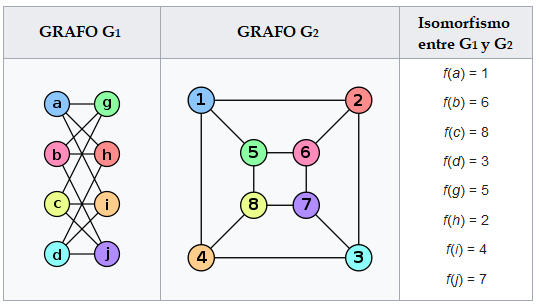
Now consider two graphs \(G_1\) and \(G_2\). A graph isomorphism is a bijection:
that preserves adjacency:
If such a function exists, the graphs possess the same combinatorial structure even when their geometric representations look quite different.

The same pattern of connections may admit different geometric representations. Image source: Jose (2020).
Preservation of edges also implies preservation of graph distance, understood as the minimum number of edges that must be traversed to connect two vertices:
This does not mean that a graph isomorphism preserves the Euclidean distances of a particular drawing. Two vertices may be two centimetres apart in one representation and twenty centimetres apart in another without changing the graph. What remains is the structure of adjacency and, as a consequence, the combinatorial distance.

Example of a correspondence between isomorphic graphs. Image source: Wikipedia.
2. Three different meanings of “topological”
Before turning to collective behaviour, an important qualification is required. The word topological appears in different mathematical and scientific contexts, but the use of the same word does not make those concepts equivalent.
| Concept | What it preserves or measures | What it must not be confused with |
|---|---|---|
| Graph isomorphism | The adjacency structure among vertices. | An isometry of a geometric drawing. |
| Homeomorphism in general topology | Topological structure: open sets, continuity, and properties invariant under continuous deformation. | Preservation of lengths or distances. |
| Topological distance or range in flocks | Neighbour rank: first neighbour, second neighbour, third neighbour, and so on. | Graph distance or a metric belonging to general topology. |
A homeomorphism, for example, need not preserve distances. A transformation that preserves a metric exactly is an isometry, which is a stronger condition. Likewise, the “topological distance” used in flocking studies is neither graph distance nor a topological metric: operationally, it is the ordinal rank of a neighbour.
If bird \(j\) is the third closest individual to bird \(i\), its topological rank relative to \(i\) is \(n=3\), whether it happens to be one, three, or five metres away. This is the relevant meaning of “topological” in the experiment considered below.
There is nevertheless a legitimate structural analogy between these fields. Each requires us to distinguish a particular metric realization from relations that can remain identifiable while that realization changes. The analogy can be philosophically fruitful provided it is not converted into mathematical identity.
3. The problem of animal flocks
Models of collective behaviour seek to explain how local interactions among individuals can generate macroscopic properties: coordinated motion, cohesion, group formation, and collective responses to perturbations.
A natural way of constructing such models is to suppose that interaction depends on metric distance. If \(r_{ij}\) is the physical distance between two birds, we may imagine an interaction intensity:
where, in general terms, influence decreases as \(r_{ij}\) increases, or vanishes once a certain radius \(r_c\) is exceeded.
Under such a model, a bird might interact with all individuals located within five metres. The consequence is immediate: the number of relevant neighbours depends on flock density. For the same metric radius, a dense flock contains more neighbours than a sparse one.
The alternative hypothesis makes interaction depend on neighbour rank. If \(n_{ij}\) represents the rank of bird \(j\) among the neighbours of bird \(i\), we may write schematically:
In its simplest form, each individual interacts primarily with its first \(n_c\) neighbours, regardless of the number of metres separating them.
In the metric paradigm, a spatial radius remains fixed while the number of individuals may vary. In the topological paradigm, the number of relevant neighbours remains approximately fixed while the spatial radius containing them may vary.
4. The empirical evidence from STARFLAG
For a long time, the choice between these two structures was made mainly through modelling assumptions. The situation changed when the STARFLAG project succeeded in reconstructing the three-dimensional positions of individual birds within large starling flocks.
This spatial reconstruction made it possible to study not only the distances between individuals but also the angular distribution of each neighbour relative to a focal bird and to the direction of motion of the flock.
The first striking result was marked anisotropy: the nearest neighbour was not equally likely to appear in every direction. In particular, there was a relative scarcity of neighbours lying exactly along the direction of travel.

Angular distribution of the nearest neighbour around a focal bird. The structure is not isotropic. Source: Instituto dei Sistemi Complessi / STARFLAG.
The distribution of the tenth nearest neighbour, by contrast, was much closer to an isotropic distribution. This suggested that the structure created by interaction weakened as neighbour rank increased.

For sufficiently high neighbour ranks, the angular distribution approaches the isotropic case. Source: Instituto dei Sistemi Complessi / STARFLAG.
5. Anisotropy and interaction range
Ballerini et al. (2008) quantified this structure by means of an anisotropy factor \(\gamma(n)\). It is important to define it correctly, because this is not the parameter \(\gamma\) used with entirely different meanings in geophysics, mechanics, or wave theory. The use of the same Greek letter does not imply identity between the quantities.
Let \(\vec u_i^{(n)}\) be the unit vector pointing from bird \(i\) toward its \(n\)-th nearest neighbour. Construct the matrix:
The unit eigenvector \(\vec W^{(n)}\) associated with the smallest eigenvalue of \(M^{(n)}\) identifies the direction of minimum density of the vectors pointing to the \(n\)-th neighbour. If \(\vec V\) represents the direction of collective motion, define:
For an isotropic spatial distribution, the expected value is:
Systematic values above \(1/3\) indicate anisotropic structure relative to the direction of motion. In the starling data, \(\gamma(n)\) falls as neighbour rank increases until it reaches approximately the isotropic value.
The point at which the structure becomes indistinguishable from the isotropic state allows an interaction range \(n_c\) to be defined. The central empirical result was:
In other words, each starling appeared to respond, on average, to a relatively stable number of neighbours —approximately six or seven— rather than to every individual contained within a fixed distance measured in metres.
6. The decisive test: changing density
A single value of \(n_c\) is not by itself sufficient to distinguish the hypotheses, because a particular number of neighbours could also arise accidentally from a metric radius in a flock of a particular density. The difference becomes identifiable when flocks of different densities are compared.
Let \(r_1\) denote the average distance to the nearest neighbour, serving as a measure of flock sparseness, and let \(r_c\) be the physical distance corresponding to the neighbour at the topological limit \(n_c\).
If interaction were fundamentally metric, we would expect \(r_c\) to remain approximately constant as density changed. The number of neighbours contained inside that radius would therefore have to vary.
If interaction were fundamentally topological, we would expect \(n_c\) to remain approximately constant, while \(r_c\) would become larger in sparse flocks and smaller in dense flocks.

A metric rule preserves a spatial radius; a topological rule preserves neighbour rank. Changing density makes the two hypotheses empirically distinguishable. Source: Instituto dei Sistemi Complessi.
The results of Ballerini et al. clearly favoured the second hypothesis. Topological range remained approximately stable across flocks of different densities, while the corresponding metric range changed with flock sparseness.
Two birds separated by five metres in a sparse flock may occupy the same neighbour rank as two birds separated by one metre in a dense flock. If interaction depends on topological rank, these two relationships can be dynamically equivalent despite the large metric difference.
7. Cohesion and robustness under perturbation
The distinction is not merely descriptive. It has dynamical consequences. Suppose a flock governed by a metric radius expands abruptly in response to a predator. If inter-individual distances exceed the interaction radius, some links may disappear precisely when the system is undergoing an intense perturbation.
A rule based on a number of neighbours is less sensitive to this kind of expansion: although physical separation increases, each bird can continue responding to roughly the same number of individuals. Simulations accompanying the STARFLAG results showed substantially greater cohesion under topological interactions than under a standard metric rule.
This gives a concrete dynamical meaning to structural stability. What remains is not a particular geometric distance, but a relation of neighbourhood capable of surviving substantial changes in density and shape.
A flock may contract, expand, deform, or divide without preserving the same metric distances; what matters for its cohesion may instead be the persistence of certain relations among individuals.
8. Interaction rules can change
The preceding result should not, however, be converted into a new universal claim that all collective animal behaviour is “topological.” Later research offers an even more interesting lesson.
Ling et al. (2019), studying wild jackdaws through three-dimensional trajectory reconstruction, found that the same species could use different interaction rules depending on ecological context.
| Context | Observed dominant rule | Approximate scale |
|---|---|---|
| Transit flight toward the roost | Topological interaction | Approximately 7–8 neighbours |
| Collective anti-predator mobbing | Metric interaction | Approximately 5 metres |
This profoundly changes the interpretation. An interaction rule need not be an eternal property of a species. It may instead be a property of the concrete dynamical regime in which the individuals find themselves.
During coordinated transit, maintaining relations with a relatively stable number of neighbours may favour collective order across different densities. In a localized anti-predator situation, a metric rule may permit a different organization of responses. The effective structure of interaction changes with the material conditions of behaviour.
Far from weakening the importance of the topological result, this plasticity prevents an empirical regularity from becoming a dogma. It obliges us to investigate which relation is objectively dominant in each process.
9. A structural interpretation
We may now return to the starting point. In graph theory, geometrically very different representations may possess the same adjacency structure. In the starling flocks studied by STARFLAG, different densities and metric distances could preserve approximately the same interaction range. These results belong to different fields and must not be mathematically conflated. But both allow us to pose the same philosophical question: which properties of a system are contingent upon a particular realization, and which actually organize its behaviour?
It would not be correct to define a “topological distance” in general as a distance that remains invariant under perturbations. Mathematical topology is not defined in this manner, and homeomorphisms do not necessarily preserve distances. Nor would it be correct to identify STARFLAG’s ordinal neighbour rank with graph distance.
We can, however, make a more precise and, in my view, more important statement: a relational property may prove more stable and explanatorily deeper than a particular metric magnitude. When a system changes density while preserving a neighbourhood rule, that regularity constitutes objective information about its organization.
From a materialist standpoint, what is essential cannot be determined by terminological decree. We cannot assume in advance that “the topological” is always the essence and “the metric” merely an appearance. The evidence from jackdaws itself shows that a metric rule may become the dynamically relevant relation under particular conditions.
Essence, if we wish to employ that category, must be sought in the ensemble of relations that generate, reproduce, and transform the behaviour of the system under concrete conditions. The same material form may pass through different regimes and, with them, change the effective structure of its interactions.
What is most intimate and characteristic of a phenomenon is not whatever a particular branch of mathematics happens to call “topological,” but whatever investigation demonstrates to organize objectively its movement, stability, and transformations.
The case of bird flocks is especially instructive because this determination can be subjected to empirical test. The question “metres or neighbours?” is not settled by philosophical preference. It is settled by reconstructing positions, comparing densities, measuring anisotropies, and observing which variable retains explanatory power.
Here lies the methodological importance of the example. Mathematics offers different ways of representing an object; science must determine which of them corresponds, within the relevant limits, to the real relations that produce the phenomenon.
References
Ballerini, M., Cabibbo, N., Candelier, R., Cavagna, A., Cisbani, E., Giardina, I., Lecomte, V., Orlandi, A., Parisi, G., Procaccini, A., Viale, M., & Zdravkovic, V. (2008). Interaction ruling animal collective behavior depends on topological rather than metric distance: Evidence from a field study. Proceedings of the National Academy of Sciences, 105(4), 1232–1237. https://doi.org/10.1073/pnas.0711437105
Cavagna, A., Giardina, I., Orlandi, A., Parisi, G., Procaccini, A., Viale, M., & Zdravkovic, V. (2008). The STARFLAG handbook on collective animal behaviour: 1. Empirical methods. Animal Behaviour, 76(1), 217–236.
Ling, H., Mclvor, G. E., Westley, J., van der Vaart, K., Vaughan, R. T., Thornton, A., & Ouellette, N. T. (2019). Behavioural plasticity and the transition to order in jackdaw flocks. Nature Communications, 10, 5174. https://doi.org/10.1038/s41467-019-13281-4
Wilson, A. (2010). Limited interactions in flocks: relating model simulations to empirical data. Related modelling literature on STARFLAG anisotropy and interaction range.
Leave a Comment/Deja un Comentario