
Marxist Philosophy of Science · Essay
A Multidisciplinary Interpretation of Eigenspaces, Eigenvectors, and Eigenvalues
Structure, transformation, and knowledge: from linear algebra to data analysis and quantum mechanics.
I · THE PROBLEMWhat remains under a transformation?
A transformation can stretch, compress, reflect, or combine the coordinates of a vector. Among the many possible outcomes, one is particularly revealing: the transformed vector may be a scalar multiple of the original. In the real plane, this means that its image remains on the same line through the origin, although it may change in length, reverse its orientation, or become the zero vector.
A vector with this property is called an eigenvector, also known as a characteristic vector or proper vector. The scalar expressing the proportionality is its eigenvalue, also called a characteristic value or proper value. These terms refer to the same objects across different terminological traditions.
The concept matters because a complex transformation can become more intelligible once its eigendirections are identified. That understanding, however, depends on the operator under consideration: a vector may be an eigenvector of one transformation without being an eigenvector of another. The property expresses a relationship between the two objects. [1]
II · THE FORMAL LANGUAGEEigenvectors, eigenvalues, and eigenspaces
Let V be a vector space over a field K, and let T: V → V be a linear operator. A scalar λ ∈ K is an eigenvalue of T if there is a nonzero vector v such that T(v) = λv. In finite dimensions, once a basis has been chosen, this operator can be represented by a square matrix A.
We should distinguish the vector space, the operator acting on it, and its matrix representation. A particular matrix is an element of the space of matrices of the corresponding size; it may also represent a linear map. Neither statement requires the dimension to be large or infinite.
For a given eigenvalue, the eigenspace contains all vectors satisfying the proportionality relation, including the zero vector:
Including zero makes this set a subspace. The zero vector itself is not an eigenvector. If v is an eigenvector, any multiple cv with c ≠ 0 is also an eigenvector for the same eigenvalue. When Eλ has dimension one, it is called an eigenline.
In finite dimensions, eigenvalues are found by solving det(A − λI) = 0. The choice of field matters: a 90° rotation in the plane has no real eigenvectors, although its matrix does have complex eigenvalues and eigenvectors. Moreover, the existence of eigenvalues does not guarantee a basis of eigenvectors; diagonalization requires additional conditions. [1] [2]
III · AN ELEMENTARY CASETwo directions that reveal the structure
Consider a transformation of the plane represented by the following matrix:
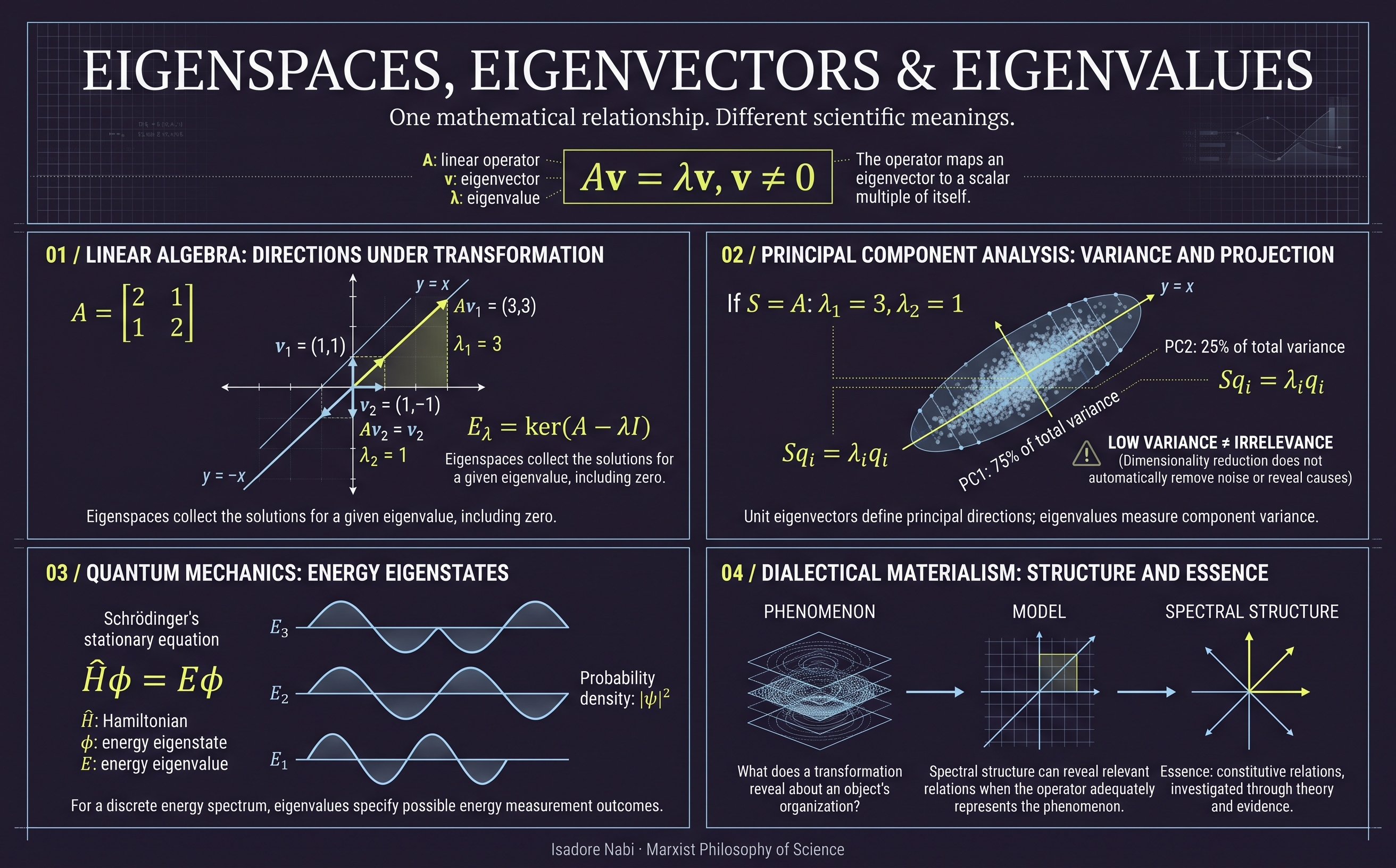
Applying it to v1 = (1, 1) gives Av1 = (3, 3) = 3v1. Applying it to v2 = (1, −1) gives Av2 = (1, −1) = v2. The eigenvalues are 3 and 1, respectively.
The eigenspaces are the lines y = x and y = −x. The transformation triples the vectors on the first and leaves those on the second unchanged. A general vector combines both contributions:
This example clarifies what remains: for nonzero eigenvalues, the eigenline is preserved, though individual vectors on it need not remain unchanged. Only eigenvalue 1 leaves its eigenvectors fixed. The distinction between invariance of a subspace and a vector remaining unchanged will matter when interpreting the applications.
IV · DATA SCIENCEDimensionality, information, and noise
An observation described by p numerical variables can be represented as a vector in ℝp. This representation should be distinguished from the sample space of probability theory: the set of possible outcomes of an experiment does not necessarily have a vector-space structure.
Principal component analysis (PCA) constructs linear combinations of variables that concentrate the variation in the data. Observations are centered and, when their units and scales warrant it, standardized as well. Choosing between covariances and correlations changes the geometry of the analysis and may change its results. [3]
Let S be the covariance matrix. Since it is real, symmetric, and positive semidefinite, it admits an orthonormal basis of eigenvectors and nonnegative eigenvalues. For a unit eigendirection qi, the component is the projection of the centered observation onto that direction:
Reduction consists in retaining k < p components and representing the observations through those coordinates. The retained subspace is spanned by the selected directions; it may contain eigenvectors associated with different eigenvalues and therefore need not be a single eigenspace.
In the preceding example, if A were the covariance matrix, its eigenvalues 3 and 1 would indicate that the first direction accounts for 75% of the total variance. Its unit eigenvector would be (1, 1)/√2. Retaining only that component amounts to projecting onto the line y = x; the reconstructed observation loses its contribution along the perpendicular direction.
Nor does reduction require us to claim that parts of the real phenomenon are destroyed. Its representation changes, and certain differences become inaccessible through that representation. The scientific value of the operation depends on what is preserved, what is discarded, and the purpose for which the object is analyzed.
V · QUANTUM MECHANICSStates, observables, and measurement outcomes
In the usual formulation, the pure states of a quantum system are represented by vectors in a Hilbert space, subject to the corresponding physical equivalences. These spaces may be finite- or infinite-dimensional. An ideal spin-½ system, for example, can be described using a two-dimensional state space. High dimensionality alone does not define what is quantum.
Observables are represented by self-adjoint operators; in finite dimensions, by Hermitian matrices. In a problem with a discrete spectrum, an eigenvalue relation takes the form:
A general state may be a superposition of eigenstates of the chosen observable. In an orthonormal eigenbasis, the expansion coefficients determine the probabilities of the outcomes. For a nondegenerate eigenvalue, the probability is the squared modulus of its coefficient; in the presence of degeneracy, the contributions from the entire corresponding eigenspace are summed. [4]
The algebraic action of an observable should not be identified with the physical process of measuring it. In the model of an ideal projective measurement, the outcome selects an eigenspace, and the state is updated through the corresponding projection followed by normalization. The physical interpretation of that update is part of the measurement problem. The formalism alone does not decide among the different interpretations of the theory.
The wave function and the Schrödinger equation
The wave function is a representation of the state; the Schrödinger equation determines its evolution in time. In the position representation for a single particle, the normalized wave function provides a probability density through ρ(x, t) = |ψ(x, t)|2. The probability of finding the particle in a region is obtained by integrating that density over the region.
An energy eigenstate evolves with a global phase factor e−iEt/ℏ. Under these conditions, its probability density remains constant, although its vector representation changes in phase. This stationarity does not imply immunity to every external perturbation: if the Hamiltonian changes, the state may cease to be an eigenstate. [5]
Continuous spectra require additional tools: not every possible value of an observable corresponds to a normalizable eigenvector within the Hilbert space. The elementary picture of a list of vectors and values should therefore be understood here as an introduction to the discrete case. [n. 1]
VI · THE COMPARISONOne formal structure, different meanings
The proportionality pattern reappears across several disciplines. Its specific meaning depends on what the operator represents, the units of the quantities involved, and the theory linking the model to the phenomenon.
| Context | Operator or matrix | Interpretation |
|---|---|---|
| Linear geometry | A transformation of the space | A proportionality factor along an eigendirection. |
| PCA | Covariances or correlations | The variance of the component defined by a unit eigenvector. |
| Quantum mechanics | A self-adjoint observable | A possible measurement outcome in the discrete case. |
| Linear dynamics | The matrix governing evolution | Growth, decay, or oscillation of eigenmodes. |
In a continuous-time system dx/dt = Ax with a constant matrix, an eigenmode evolves through eλt; if all eigenvalues have strictly negative real parts, the origin is asymptotically stable. In a discrete-time system xt+1 = Axt, the corresponding criterion requires all eigenvalues to have modulus strictly less than one. Boundary cases require further examination of the operator’s structure. [6]
The sign of an eigenvalue therefore has no universal meaning. A negative eigenvalue may indicate a reversal of orientation in a real transformation or decay in a real continuous-time dynamical mode. The shared algebraic form allows us to compare the cases, but interpreting them requires preserving their differences.
VII · PHILOSOPHICAL INTERPRETATIONEssence as a question of relations
The philosophical interest of spectral analysis arises from its ability to make explicit relationships that an immediate description may leave concealed. Rather than considering each coordinate in isolation, it allows us to identify modes of organization within an operator. From a materialist and dialectical perspective, this possibility invites us to investigate how a structure manifests itself through its transformations.
In this essay, essence designates the constitutive relations through which the organization and behavior of a phenomenon can be understood. It does not presuppose an immobile substance behind its manifestations. Identifying it requires studying the genesis of the object, its conditions of existence, its internal and external relations, and the limits within which it retains a certain organization.
The persistence of a relation under a transformation can provide access to the structure of an object; its significance depends on what the operator transforms and how it represents the phenomenon.
The eigenvalue relation provides a precise example of preservation under transformation: acting on an eigenvector, the operator produces a result proportional to it. This structure admits a philosophical reading as a unity of persistence and modification. That reading, however, is an argued interpretation of the formalism; the mathematical definition does not by itself demonstrate an ontological thesis about reality as a whole.
The operator as a mediation of knowledge
For spectral analysis to contribute to our knowledge of a material phenomenon, the operator employed must be justified. In an empirical study, the selected variables, units, measurement design, and model assumptions matter. The robustness of the results across reasonable choices forms part of that justification.
Two situations should be distinguished here. A change of basis represents the same operator in another way and preserves its eigenvalues. By contrast, selecting different variables or changing their weighting in a statistical analysis may construct a different operator and alter its spectrum. Independence from coordinates does not amount to independence from modeling.
The algebraic property must also be distinguished from persistence over time. An eigendirection may correspond to a mode that grows rapidly, dies away, or remains constant. Being an eigenvector does not generally imply durability, stability, or resistance to perturbations.
The scope of a materialist reading
In PCA, concentrating variance may facilitate the description of a regularity, but it does not yet identify its causes. In quantum mechanics, an eigenvalue characterizes a possible outcome for a specified observable without thereby summarizing all the properties of the system. Explaining a phenomenon requires connecting spectral relationships with the theory and evidence of the relevant discipline.
The defensible thesis is therefore conditional: when an operator adequately represents relevant relations of an object, its spectral structure can contribute to our understanding of aspects of that object’s organization. The material relevance of those aspects must be established through investigation. This formulation preserves the ambition of the multidisciplinary approach while offering criteria for examining its results.
The movement of knowledge thus proceeds from observed manifestations toward the construction of explanatory relations, then returns to those manifestations to test them. Eigenvectors and eigenvalues participate in that mediation: they provide a formal structure whose scientific content is determined through its concrete application.
VIII · CONCLUSIONKnowing a structure through its transformation
An eigenvector is a nonzero vector whose image under an operator is proportional to it. The eigenvalue expresses that proportionality; the eigenspace contains the corresponding solutions, including zero. These relationships allow us to decompose and understand particular aspects of a transformation.
Their applications span geometry, statistics, physics, and the study of dynamical systems. In each field, the theory of the phenomenon gives the mathematical objects their specific meaning. Multidisciplinary comparison is productive when it makes explicit both the shared structure and the conditions of each application.
From the philosophical perspective developed here, spectral analysis is a tool for investigating constitutive relations, regularities, and modes of organization. The task is to justify the representation, delimit its inferences, and test what it reveals. Through this work, it can contribute to knowledge of essence understood as the material and relational organization of a phenomenon.
CRITICAL APPARATUSNotes
In infinite dimensions, the spectral theory of self-adjoint operators encompasses discrete and continuous spectra, spectral measures, and domain questions. This discussion concentrates on the discrete case to develop the comparison without identifying the entire spectrum with eigenvalues associated with normalizable vectors. See reference [5], section 4. ↩
The philosophical section expresses the interpretation developed in this essay. The mathematical and physical sources support the definitions and applications discussed; the proposed philosophical thesis is not attributed to them.
SOURCES AND FURTHER READINGReferences
- Margalit, D., and Rabinoff, J. Interactive Linear Algebra. Georgia Institute of Technology. Section 5.1, Eigenvalues and Eigenvectors. ↩
- Strang, G. (2021). ZoomNotes for Linear Algebra. Wellesley–Cambridge Press; available through MIT OpenCourseWare, course 18.06SC. Course notes. ↩
- NIST/SEMATECH. e-Handbook of Statistical Methods. Sections 6.5.5, Principal Components, and 6.5.5.1, Properties of Principal Components. ↩
- Cappellaro, P. (2012). Quantum Theory of Radiation Interactions. MIT OpenCourseWare, course 22.51. Complete course notes. ↩
- Zwiebach, B. (2013). Wave Mechanics. MIT OpenCourseWare, course 8.05, chapter 1. Wave functions, stationary states, and spectra. ↩
- Massachusetts Institute of Technology. (2025). Linear Differential Equations and Complex Exponentials. Course 6.3100, prelab 3. Natural modes and stability. ↩
Leave a Comment/Deja un Comentario