
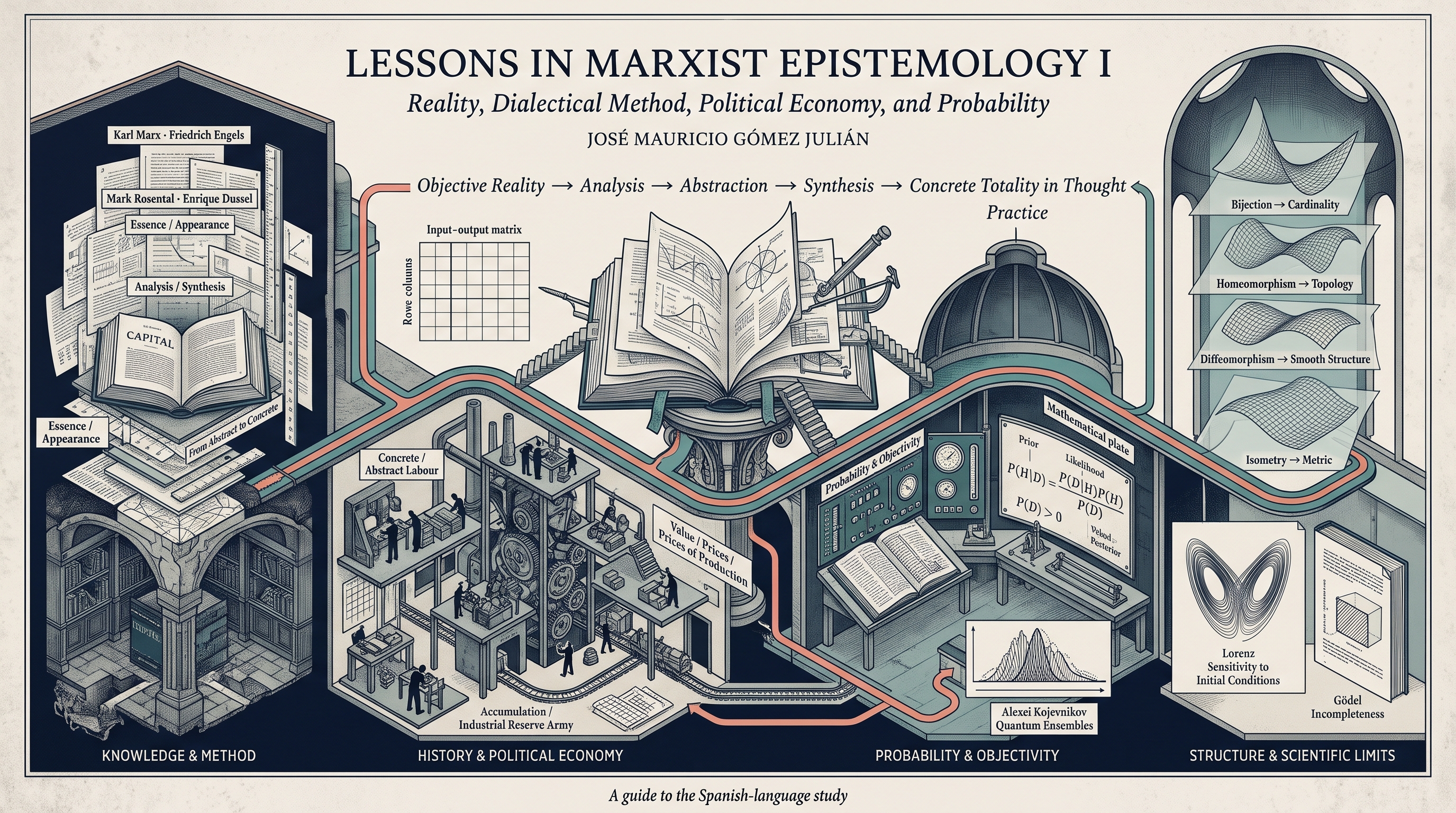
Marxist Philosophy of Science
Science and its philosophy from a Marxist perspective
Theory of knowledge · First instalment
Lessons in
Marxist Epistemology I
Knowledge, dialectical method, and the critique of political economy
An inquiry into objective reality, the forms of thought, and scientific practice through Marx, Engels, and the materialist dialectical tradition.
I · The projectAn inquiry into knowledge
Understanding a changing reality also requires investigating how the categories through which we know it develop. How are experience, abstraction, and practice related? What distinguishes an immediate appearance from the relations that produce it? How can a theory reconstruct a historical process while keeping the order of its concepts grounded in that process? These questions guide the Lessons in Marxist Epistemology.
This first instalment develops a thematic study of Mark Rosental’s Los problemas de la dialéctica en «El Capital» de Marx—the problems of dialectics in Marx’s Capital. It brings that work into conversation with Marx and Engels, the philosophical dictionaries of Rosental and Iudin and of Frolov, and contributions by Hegel, Lenin, and Enrique Dussel. Selected passages are accompanied by my own comments, which extend, clarify, or discuss their arguments. [1]
The preface places this investigation within a five-part project: three studies of works by Rosental; a fourth on Eli de Gortari’s Introducción a la lógica dialéctica; and a fifth combining Richard Levins’s A Response to Orzack and Sober: Formal Analysis and the Fluidity of Science with Alkistis Elliott-Graves’s The Value of Imprecise Prediction. A subsequent synthesis is intended to preserve the traceability of the sources and make their relationship to my own elaborations identifiable.
Political economy is central because Capital allows us to study method at work: categories taking shape, relations being reconstructed, and observable forms being explained. From that starting point, the inquiry reaches into logic, the philosophy of mathematics, statistics, and physics. Their connection lies in the problem of how thought can grasp a reality that exists and changes independently of any particular account of it.
II · OrientationFidelity to method and the openness of knowledge
I use Marxist to identify an orientation that seeks to preserve and develop the logical, epistemological, and methodological foundations elaborated by Marx, Engels, and other classical authors in this tradition. Its content is assessed through the actual articulation of those foundations in research. A label or a declared political allegiance cannot settle that question by itself.
“This methodological fidelity does not mean restricting knowledge to the works of the classics or considering all their conclusions infallible.”
José Mauricio Gómez Julián · Revised manuscript, preface · Translated from Spanish
The continuity at issue allows particular results to be corrected, later knowledge to be incorporated, and research to extend to new objects. The expression classical Marxism identifies the methodological and conceptual core whose definition is itself part of the investigation. Establishing that core requires examining arguments and research practices; it cannot be inferred from a linguistic suffix.
For English readers, this also explains the choice of Marxist in the title. The intended scope includes Marx, Engels, other classical Marxists, and the further development of their research orientation. The methodological commitment is made explicit in the argument rather than delegated to the distinction between the words Marxian and Marxist.
This approach informs my critical use of Soviet sources. Their epistemological contributions do not entail agreement with every historical or political position they hold. In the preface, I explicitly distinguish my interpretation of the Soviet experience from interpretations advanced by authors whose work nevertheless provides important resources for this investigation.
III · The object and its knowledgeEssence, appearance, and practice
The materialist starting point is the objective existence of the processes we investigate. Knowledge develops through our relations with them: perception, instruments, concepts, experiments, and social practices. Abstraction participates in this relationship by identifying determinations that immediate observation does not deliver in an already organized form.
The distinction between essence and appearance addresses this work of explanation. Observable forms manifest relations that need to be reconstructed. Investigating value, price, wages, or profit therefore requires explaining the mediations between their determinations and the ways in which they appear. Describing a visible outcome leaves open the question of the process that produces it.
In this vocabulary, a determination is a feature or relation through which the object acquires a specific content. A mediation is a connection or process needed to explain how determinations are related. These terms direct attention to the structure and development of the object under investigation.
Practice plays both a constitutive and a testing role: it helps form the problems, develop the instruments, and assess knowledge. Scientific activity has a material and social history. Its objectivity requires investigating how theoretical constructions relate to the actual processes they concern.
The study consequently connects sensory knowledge and abstract thought, theory and practice, relative and absolute truth. The possibility of deepening an explanation presupposes that knowledge can develop and be corrected while reality retains its objective existence. Necessity and chance are also examined within this framework, as questions about processes and their interrelations.
IV · Operations of methodReconstructing a concrete totality
Analysis distinguishes determinations within a reality initially apprehended in a confused way. Synthesis investigates their articulation and reconstructs a totality of relations. Their unity matters: dividing an object into parts and listing those parts does not yet explain how that object exists or changes.
The movement from the abstract to the concrete acquires its meaning here. Concrete reality is the starting point of knowledge; the concrete as reconstructed in thought is a result of its elaboration. Abstractions allow us to return to the object with a richer understanding of its determinations. Dussel develops this distinction in his reading of the method of the Grundrisse. [2] [4]
Consider the categories of political economy. A society may first be apprehended as a complex whole. Analysis distinguishes relations such as commodity exchange, money, wage labour, and capital. Their reconstruction must explain how those relations are connected and under what historical conditions they exist. In this sense, concrete refers to a unity of multiple determinations, not simply to whatever can be immediately seen or touched.
Induction and deduction are examined as related operations within this investigation. The same applies to intuition and the logical assessment of arguments. Each procedure has functions and conditions of application that must be specified in relation to the problem. The discussion of mathematical intuition, constructive approaches, and the finite and infinite extends this methodological inquiry.
The distinction between inquiry and exposition is equally important. The order that makes a process intelligible need not reproduce every chronological stage of its development or every step taken to investigate it. Exposition must justify its mediations and retain its grounding in historical reality. [3]
V · Political economyCategories expressing historical relations
Economic categories acquire their content within determinate social relations. Commodity, money, capital, wage labour, and surplus value must be studied through their conditions of existence and transformation. The investigation asks how these forms are historically produced and how they are connected within social reproduction.
The study addresses the origins of capitalism, the formation of the industrial reserve army, and the transformation of values into prices of production. It also examines contradictions between concrete and abstract labour, use value and exchange value, and social production and private appropriation. The emergence of the general equivalent of commodities is considered within this development.
Several distinctions that organize the argument
Concrete labour concerns the specific useful activity that produces a particular use value; abstract labour concerns labour in the social determination relevant to commodity value. The distinction connects the useful character of production with the social relations through which products are equated.
Values and prices of production enter an inquiry into surplus-value production, its distribution among capitals, and the formation of an average rate of profit. The industrial reserve army is investigated as part of capitalist accumulation and its changing demand for labour. These questions require the historical and conceptual development provided in the full study.
Competition and technological change are particularly important in my comments on Rosental. Their examination connects productivity, surplus value, redistribution, and profitability. Production and circulation are treated as moments of a totality, preserving the distinction between the coexistence of different phases across a system and the succession of phases traversed by a particular commodity.
From this concern I propose studying input–output matrices dynamically, using comparable sequences of tables and models to investigate technical transformations and sectoral relations. The comparison with the tables in Volume III of Capital concerns the representation of productive relations and aggregate magnitudes. The choice of simulations or statistical procedures requires prior examination of the problem and the data.
The critique of political economy thus remains connected to history, quantitative investigation, and social action. In the preface, the pursuit of truth is explicitly articulated with concern for human suffering, justice, ethics, and morality.
VI · Philosophy of statisticsProbability, evidence, and objectivity
The discussion of total probability, inverse probability, and objective Bayesianism belongs to a broader question: how can we investigate processes when available knowledge is partial and relationships are expressed probabilistically? The document connects this problem with Bernoulli, Laplace, Kolmogorov, and controversies between statistical schools.
Probability calculus and the interpretation of its components need to be distinguished. Axiomatization provides a framework of mathematical relations; research must establish what its objects represent, what information enters a model, and how its application is justified. Philosophical disagreements can affect the choice of procedures and the meaning of inferences even when identities of the calculus are shared. [5] [8]
P(D) > 0 · Conditionals defined in the model
Here, P(H) is the prior probability assigned to the hypothesis, P(D|H) represents the probability of the data under that hypothesis, and P(H|D) is the posterior probability conditional on the data and the model. The denominator P(D) normalizes the result. When the hypotheses form a discrete, mutually exclusive, exhaustive set, it can be obtained by summing the data probabilities under those hypotheses, weighted by their prior probabilities.
The likelihood treats the probability or density of the observed data as a function of the parameter or hypothesis, keeping the data fixed. It must be distinguished both from a probability distribution over the parameter and from the reliability of an empirical record. For continuous observations, Bayesian updating is expressed with the corresponding densities and appropriate normalization. [9]
Jon Williamson’s objective Bayesianism provides a framework for discussing constraints on rational degrees of belief and their relationship to evidence. My elaboration seeks to connect these questions with a materialist interpretation of objectivity and chance. The calculus, its inferential uses, and this philosophical interpretation are studied together while retaining their respective functions. [6]
The connection with quantum mechanics
Instruments, complementarity, measurement, and causality extend the investigation into physics. The study draws on Alexei Kojevnikov’s historical reconstruction of probability, Marxism, and ensemble interpretations of quantum mechanics. From that starting point, I examine objectivity, interpretation, and determinism within the document’s broader materialist argument. [7]
This discussion distinguishes mathematical descriptions, experimental arrangements, and philosophical interpretations. Its place in the study is to investigate how probabilistic representations relate to the objective processes and instruments involved in scientific knowledge.
VII · Structure and knowledgeInvariants, levels, and formal limits
The elaboration on essence incorporates a formalization through mathematical structures and classes of transformations. The question is which relations are preserved, and which can change, while retaining the identity under consideration. Specifying that choice helps define the level at which a system is investigated.
| Structural level | Transformation | What is preserved |
|---|---|---|
| Set-theoretic | Bijection | Cardinality |
| Topological | Homeomorphism | Continuity structure; connectedness and compactness |
| Differentiable | Diffeomorphism | Smooth structure |
| Riemannian | Isometry | Metric tensor |
An invariant is a property preserved under the specified class of transformations. A topological comparison and a metric comparison therefore ask different questions of the same object. The choice of structure and transformations determines which kind of identity is being considered.
This articulation situates topology within a broader account. Set-theoretic, topological, differentiable, metric, and operational determinations permit distinct investigations. Their relevance must be established through the structure of the object and the transformations under which its identity is examined.
Prediction, decision, and proof
The revised manuscript also distinguishes limits of prediction, undecidability, and incompleteness. Lorenz’s 1963 work exhibits sensitivity to initial conditions in a deterministic model. The spectral-gap undecidability results rule out a universal decision algorithm for the families covered by their constructions. Gödel’s incompleteness results establish limits on proof in formal theories satisfying their conditions of application.
For the first incompleteness theorem, these conditions include consistency, effective axiomatizability, and sufficient arithmetic strength. The relevant conclusion concerns sentences that cannot be proved or refuted within the theory. The existence of a mathematical model, the possibility of predicting its behaviour, the availability of a universal decision procedure, and the reach of its proofs are consequently distinct questions.
I integrate these limitations with the history of our intellectual instruments and the objective existence of processes. Knowledge of essential relations and solutions to particular problems remain possible. Research must specify the reach of its resources and the mediations through which its results refer to reality.
VIII · Reading guideRoutes through the complete study
The full document supports a systematic reading or an approach organized around a particular problem. Its chapters are interconnected: economic applications return to the methodological categories, and discussions of probability reopen questions of objectivity, intuition, formalization, and practice. The Spanish headings below help locate these discussions in the document.
- Preface · PrólogoPurpose and standpointThe project of the lessons, the selection of sources, the meaning of “Marxist,” and the connection between knowledge, ethics, and social commitment.
- Chapters II and IIIFoundations and operations of knowledgeChapter II, Fundamentación objetiva (material) de la gnoseología marxista, develops essence and appearance, necessity and chance, instruments, analysis and synthesis, induction and deduction, intuition, truth, and practice. Chapter III, Las limitaciones de la lógica formal, continues the examination of formal logic.
- Chapters IV–VIIHistory and the reconstruction of the concreteThe origins of classical political economy and capitalism, the industrial reserve army, and the relationship between abstraction and historical inquiry. Chapter VII is Lo abstracto y lo concreto como etapas gnoseológicas de la investigación científica.
- Chapter VIIILaws, probability, and the interpretation of physicsLas leyes históricas que rigen el movimiento en general leads into general and specific laws, total and inverse probability, Bayes’s theorem, objective Bayesianism, and interpretations of quantum mechanics.
- Chapters IX–XIIValue, prices, and contradictionsChapter IX examines the proceso de transformación de valores en precios de producción. The following chapters address socialism and communism as historical necessities, concrete and abstract labour, use value and exchange value, and the general equivalent of commodities.
- Chapter XIII and notesSources and clarificationsThe references identify the works studied. Notes accompany the arguments, source discussions, and my own elaborations throughout the document.
Spanish terms used in the study · A short reading aid
| Spanish | English and context |
|---|---|
| Gnoseología | Theory of knowledge; rendered here as epistemology. |
| Esencia / fenómeno | Essence / phenomenon or appearance: essential relations and their forms of manifestation. |
| Necesidad / casualidad | Necessity / chance. Casualidad means chance; causalidad means causality. |
| Lo abstracto / lo concreto | The abstract / the concrete, examined as moments in the reconstruction of a determinate totality. |
| Trabajo concreto / trabajo abstracto | Concrete labour / abstract labour. |
| Plusvalía / precios de producción | Surplus value / prices of production. |
| Ejército industrial de reserva | Industrial reserve army, investigated in relation to capitalist accumulation. |
| Probabilidad inversa | Inverse probability, within the discussion of inference and objective Bayesianism. |
IX · SourcesBibliography of the study
The first nine references identify the sources cited in this presentation. The expandable section preserves the remaining bibliography of the manuscript. Titles and publication details retain the language of the source entries so readers can identify the editions used; English descriptions in the body are reading aids.
- Rosental, M. (1961). Los problemas de la dialéctica en "EL CAPITAL" de Marx. Montevideo: Ediciones Pueblos Unidos.
- Dussel, E. (1991). 2. El método dialéctico de lo abstracto a lo concreto (20, 41-33, 14; 21,3-31,38) :(Cuaderno M. desde la página 14 del manuscrito, terminado a mediados de septiembre de 1857). En E. Dussel, La producción teórica de Marx: un comentario a los grundrisse (págs. 48-63). México D.F.: Siglo XXI Editores. Obtenido de Consult source
- Marx, K. (1989). Contribución a la Crítica de la Economía Política. Moscú: Editorial Progreso.
- Marx, K. (2007). Elementos Fundamentales para la Crítica de la Economía Política (Grundrisse) 1857-1858 (Vol. I). (J. Aricó, M. Murmis, P. Scaron, Edits., & P. Scaron, Trad.) México, D.F.: Siglo XXI Editores.
- Kolmogórov, A. (1956). Foundations of the Theory of Probability (Segunda Edición ed.). New York: Chelsea Publishing Company.
- Williamson, J. (2010). In Defence of Objective Bayesianism. Oxford: Oxford University Press.
- Kojevnikov, A. (19 de Junio de 2019). PROBABILITY, MARXISM, AND QUANTUM ENSEMBLES. Obtenido de The University of British Columbia: Consult source
- Efron, B. (1978). Controversies in the Foundations of Statistics. The American Mathematical Monthly, 231-246.
- DeGroot, M., & Schervish, M. (2012). Probability and Statistics. Boston: Pearson Education.
Remaining bibliography · 38 references
- Bayes, T. (23 de Diciembre de 1763). An Essay towards solving a Problem in the Doctrine of Chances. Philosophical Transactions of the Royal Society of London, 370-418.
- Bernoulli, J. (2006). The Art of Conjecturing (Together to a Friend on Sets in Court Tennis). Maryland: John Hopkins University Press.
- Eremenko, A. (30 de Abril de 2020). Stack Exchange, History of Sciences and Mathematics. Obtenido de What was Kolmogorov’s point of view in the philosophy of mathematics?: Consult source
- Feller, W. (1968). An Introduction to Probability Theory and Its Applications (Tercera ed., Vol. I). New York: John Wiley & Sons, Inc.
- Filosofía en español. (9 de Febrero de 2018). Diccionario filosófico abreviado. Obtenido de URSS: Consult source
- Fröhlich, N. (2012). Labour values, prices of production and the missing equalisation tendency of profit rates: evidence from the German economy. Cambridge Journal of Economics, 37(5), 1107-1126.
- Frolov, I. T. (1984). Diccionario de filosofía. (O. Razinkov, Trad.) Moscú: Editorial Progreso. Obtenido de Consult source
- Fundación del Español Urgente. (23 de Marzo de 2021). Formación de gentilicios extranjeros. Obtenido de Lista de topónimos y gentilicios: Consult source
- Fundación del Español Urgente. (23 de Marzo de 2021). -ista (sufijo). Obtenido de Sufijos: Consult source
- Gigerenzer, G. (2004). Mindless Statistics. The Journal of Socio-Economics, 587-606.
- Greene, W. H. (2012). Econometric Analysis (International Edition). Essex: Pearson Education Limited.
- Guerrero Jiménez, D. (2018). TRABAJO IMPRODUCTIVO, CRECIMIENTO Y TERCIARIZACIÓN (30 AÑOS DESPUÉS DE MARX Y KEYNES). International Journal of Political Economy, 1-16. Obtenido de Consult source
- Haldane, J. B. (1945). Science and Everyday Life. Allahabad,: Kitab Mahal Publishers.
- Hegel, F. (1968). Ciencia de la Lógica. Buenos Aires: Solar / Hachette.
- Johnsen, J. (17 de Enero de 2019). What is the difference between positivism and empiricism? Obtenido de Quora: Consult source
- Kohan, N., & Brito, P. (1 de Febrero de 2009). Marxismo para principiantes. Obtenido de nodo50: Consult source
- Laplace, P.-S. (2015). Ensayo Filosófico Sobre Probabilidades. Ciudad de México: Biblioteca Digital del Instituto Latinoamericano de Comunicación Educativa. Obtenido de Consult source
- Lenin, V. (1974). Cuadernos Filosóficos. Madrid: Editorial Ayuso.
- Loughborough University. (21 de Febrero de 2008). Total Probability and Bayes’ Theorem. Obtenido de The theorem of total probability: Consult source
- Maibaum, G. (1988). Teoría de Probabilidades y Estadística Matemática. (M. Á. Pérez, Trad.) La Habana, Cuba: Editorial Pueblo y Educación.
- Marx, K. (1894). Capital. A Critique of Political Economy (Vol. III). New York: International Publishers.
- Marx, K. (2010). El Capital (Vol. I). México, D.F.: Fondo de Cultura Económica.
- Marx, K., & Engels, F. (1987). Karl Marx and Friedrich Engels Collected Works (Vol. XLII). Moscú: Progress Publishers.
- Mittelhammer, R. (2013). Mathematical Statistics for Economics and Business (Segunda ed.). New York: Springer.
- Nabi, I. (2020). Algunas Reflexiones Sobre la Distribución Binomial Negativa II (Un Análisis Teórico y Aplicado). Documento Inédito. Obtenido de Consult source
- Nabi, I. (21 de Marzo de 2021). Sobre el papel y la viabilidad de la violencia en la lucha social de las mujeres en particular y en las luchas sociales en general. Obtenido de El Blog de Isadore Nabi: Consult source
- Nabi, I., & B.A., A. (1 de Abril de 2021). UNA METODOLOGÍA EMPÍRICA PARA LA DETERMINACIÓN DE LA MAGNITUD DE LAS INTERRELACIONES SECTORIALES DENTRO DE LA MATRIZ INSUMO-PRODUCTO DESDE LOS CUADROS DE PRODUCCIÓN Y USOS PARA EL CASO DE ESTADOS UNIDOS 1997-2019. Obtenido de El Blog de Isadore Nabi: Consult source
- North Carolina State University. (27 de Septiembre de 2020). People – Department of History . Obtenido de Dr Edith D Sylla: Consult source
- Perezgonzalez, J. (3 de Marzo de 2015). Fisher, Neyman-Pearson or NHST? A tutorial for teaching data testing. (L. Roberts, Ed.) Frontiers in Psychology, 6(223), 1-11. doi:10.3389/fpsyg.2015.00223
- Poisson, S.-D. (2013). Researches into the Probabilities of Judgments in Criminal and Civil Cases. (O. Sheynin, Ed.) Berlin: arXiv. Obtenido de Consult source
- Rosental, M. M., & Iudin, P. F. (1971). DICCIONARIO FILOSÓFICO. San Salvador: Tecolut.
- Rosental, M., & Iudin, P. (1959). Diccionario filosófico abreviado. Montevideo: Ediciones Pueblos Unidos.
- Russell, K. (29 de Enero de 2014). University of Manitoba. Obtenido de Hypothesis testing: Consult source
- StackExchange Philosophy. (15 de Junio de 2015). How empiricism and positivism is distinguished? What's their differences? Obtenido de Philosophy: Consult source
- TECH2 NEWS STAFF. (28 de Noviembre de 2019). SCIENTISTS MAY HAVE DISCOVERED A FIFTH FUNDAMENTAL 'FORCE OF NATURE,' THEY’RE CALLING IT X17. Obtenido de TECH2: Consult source
- Wikipedia. (27 de Septiembre de 2020). Population Genetics. Obtenido de J. B. S. Haldane: Consult source
- Wikipedia. (23 de Septiembre de 2020). Statistics. Obtenido de Inverse Probability: Consult source
- Wikipedia. (13 de Marzo de 2021). Relación de incertidumbre. Obtenido de Mecánica cuántica: Consult source
Research document · Spanish
Continue with the complete lessons
The full study develops the sources, arguments, economic applications, and research notes introduced here.
Open Spanish PDF · First editionOriginal public edition in Spanish · 2021 · 289 pages.
This English presentation draws on the revised manuscript. The linked PDF retains the title and content of the original edition.
Leave a Comment/Deja un Comentario