
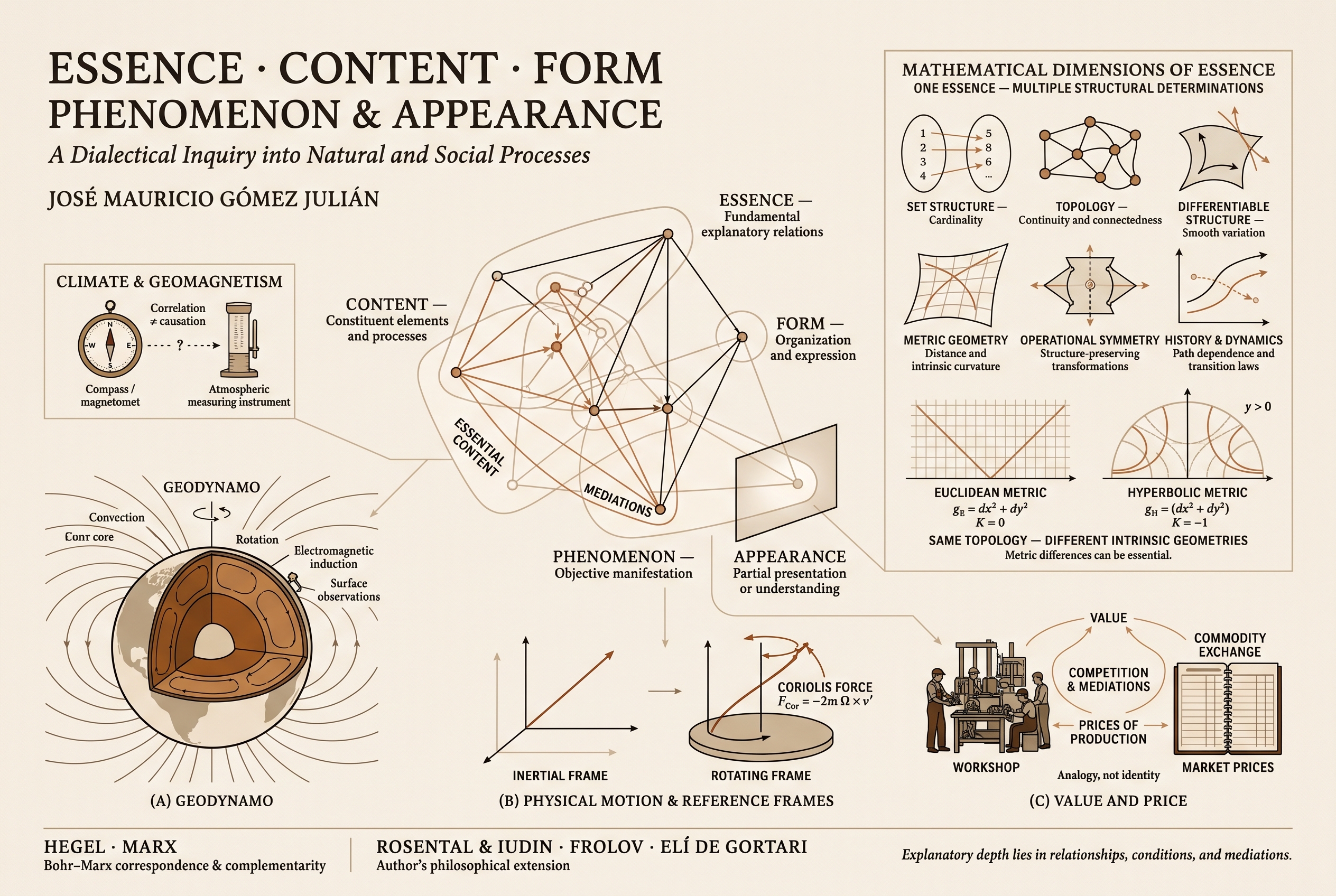
On the Essence, Content, Form, Phenomenon, and Appearance of the Processes of Reality
Categories, mediations, and knowledge of natural and social processes
JOSÉ MAURICIO GÓMEZ JULIÁNKnowing a process requires reconstructing its relationships
Reality is not exhausted by its immediate presentation. A temperature variation, a magnetic signal, a price, or motion observed from a platform can be recorded precisely and still require an explanation of the relationships that produce it. The question of essence begins when we investigate what makes a manifestation possible and why it takes a particular form.
This essay examines five categories—essence, content, form, phenomenon, and appearance—within dialectical materialism. Its purpose is not to offer five isolated definitions, but to reconstruct their relationships, differences, and usefulness for studying natural and social processes. A process’s material unity does not eliminate its determinations; analytically distinguishing those determinations does not turn them into separate entities.
The central problem is methodological: how can essence–phenomenon and content–form be articulated when the object of research contains multiple components, scales, relationships, and instances of mediation? Philosophical tradition provides general categories; scientific practice requires specifying which relationships explain the process, how they are organized, and through what evidence they can be known.
The proposed contribution is to develop the notion of essential content and clarify the distinction between phenomenon and appearance. Essential content identifies a fundamental articulation within the content of a delimited system. The phenomenon–appearance distinction makes it possible to investigate objective manifestation alongside the conditions of a partial presentation or insufficient understanding. Both proposals are offered as research instruments open to discussion and testing.
The discussion begins with Rosental, Iudin, and Frolov, examines the relationship between material history and logical reconstruction, and develops cases involving climate, geomagnetism, the geodynamo, reference frames, topology, and political economy. Interdisciplinary comparisons are fruitful when they clarify questions and mediations. They do not remove the need to argue within each science or turn an analogy into a physical, mathematical, or economic equivalence.
The elaboration on essence and mathematical structures develops this articulation across several levels: topology is one dimension of the essential, whose relevance is assessed alongside differentiable structure, metric, symmetries, and historical-dynamical determinations. The discussion draws on the author’s manuscript on geometry, history, and lawfulness while expressly distinguishing mathematical results, philosophical interpretation, and research proposals.
Complete revised and expanded edition of the essay published on 10 April 2021. It includes the full development of its arguments, four source illustrations, all 21 revised notes, and the original bibliography with supplementary references. Reformulated passages are integrated into the discussion; the historical Spanish-language document remains available at the end.
Five categories, one articulated process
The table provides an initial orientation. Its definitions are developed and examined in the following sections; they should not be understood as five material compartments or as a universal spatial sequence.
| Category | Guiding question | Necessary qualification |
|---|---|---|
| Essence | Which fundamental relationships explain the delimited process? | It is not a separate thing or, by definition, a spatial center. |
| Content | Which elements, processes, and relationships constitute the object under consideration? | It is not reducible to an unorganized sum. |
| Form | How is that content organized and expressed under particular conditions? | It includes modes of organization, not merely outline or visible aspect. |
| Phenomenon | How does the process manifest itself, and what can be investigated through that manifestation? | It may require instrumental and theoretical mediation. |
| Appearance | Which partial presentation or insufficient interpretation requires explanation? | It is not reducible to subjective fantasy and is not always entirely false. |
Essential content does not add a sixth thing to the object. It designates a reasoned selection of fundamental determinations within a broader content. Its usefulness depends on the question and on the criteria used to establish that selection, not on a merely verbal decision.
The discussion can be read in three movements: categorial foundations; a proposal for differentiation; and applications and methodological consequences. The contents allow readers to return to a definition, compare cases, or consult a note without leaving the same document.
I. Essence
Following the philosophical reasoning of Rosental and Iudin (1971, p. 148), we should begin by stating that both essence and phenomenon are philosophical categories reflecting aspects necessarily inherent in every object of reality. We can define essence as the set of the object’s properties and relationships that are:
The deepest: fundamental relationships that explain the object’s internal structure, identity, and transformations. Depth here is explanatory, not necessarily spatial.
Relatively stable: relationships that maintain a degree of persistence within a timescale and a domain of conditions. Such stability does not mean immobility or perpetual equilibrium. It may consist in the reproduction of an organization, dynamic stability, or the persistence of relationships during a transformation. Conditions that allow an internal equilibrium to be maintained or restored constitute a particular case of this stability, not its universal definition1.
This set, which we shall call the essential set, generally determines the object with respect to the following aspects:
Origin: the conditions of emergence, generative causes, and historical relationships that make the object possible. In ordinary usage, “origin” may mean beginning, motive, birth, source, or root; here its causal and historical meaning must be specified, without thereby introducing a moral cause or a predetermined purpose.
Character: the set of qualities and circumstances through which a thing differs from others in its mode of being or existing2.
Direction of development: the tendencies, possibilities, and constraints of its subsequent evolution. A tendency is not a single destiny and does not exclude external conditions, contingencies, or bifurcations.
Within this interpretive framework, essence can be understood as a mediation between starting points and outcomes: it lies in the object’s process of development. The expression “intermediate place” does not designate the geometrical center of a trajectory, but an articulation of relationships. Nor should the order of exposition of a philosophy be confused with a chronological sequence of material events.
In a materialist reading of the relationship between Hegel and Marx, the decisive difference concerns the foundation attributed to the process: material and social determinations are the starting point of conceptual reconstruction, while the concept is an outcome of knowledge. The opposition cannot simply be reduced to reversing two boxes—“being” and “concept”—since Hegelian logic develops more complex mediations. What is retained from the initial formulation is the question of dominance within a relationship: which conditions explain the genesis, reproduction, and transformation of the totality?
Aufheben, or a sublation that negates and preserves, makes it possible to examine this transformed continuity. In this essay, the dominance of origin is understood as a hypothesis of explanatory priority to be justified in each investigation, not as a law according to which every beginning necessarily dominates every outcome. Marx (2007, pp. 14–18) develops a concrete treatment of this question when analyzing the relationships between production, consumption, distribution, and exchange:
Nothing, then, is simpler for a Hegelian than to identify production and consumption. This occurred not only among socialist essayists, but also among prosaic economists such as Say, who think, for example, that if we consider a people, its production would be its consumption. Or likewise humanity in the abstract. Storch demonstrated Say’s error by pointing out that a people, for instance, does not merely consume its production, but also creates means of production, fixed capital, and so on. (…) Moreover, to consider society as a single subject is to consider it falsely, speculatively. In a subject, production and consumption appear as moments of one act. What matters most here is to emphasize that, whether production and consumption are considered as activities of one subject or of many individuals, in each case they appear as moments of a process in which production is the actual starting point and therefore also the predominant moment.
Consumption as need is itself an internal moment of productive activity. But the latter is the starting point of realization and therefore its predominant factor, the act in which the whole process repeats itself. The individual produces an object and, by consuming it, returns to himself, but as a productive individual who reproduces himself. In this way, consumption appears as a moment of production. In society, by contrast, the relationship between producer and product, once the product is finished, is external, and the object’s return to the subject depends on the subject’s relationships with other individuals. The subject does not take possession of it immediately. Moreover, immediate appropriation of the product is not the subject’s purpose when producing within society.
Between the producer and the products stands distribution, which determines, through social laws, the share of the world of products that falls to the producer, thus intervening between production and consumption (…) Now, does distribution exist as an autonomous sphere alongside production and outside it? (…) Although it appears as a presupposition for the new period of production, it is itself in turn a product of production: not merely of historical production in general, but of historically determinate production.
Essence is thus a “place” in a relational sense: an articulation of relationships among components and with their conditions of existence. A delimited system may have internal and external relationships; if the universe is adopted as a totality by definition, no exterior to that totality is postulated. This conceptual distinction does not itself provide a physical theory of the universe or allow its systems to be counted through an undefined expression such as n − 1.
We call essential or nuclear those relationships whose explanatory function is fundamental to the problem investigated. Their importance cannot be deduced solely from the size of components or from a “relative weight” quantifiable in every case. It must be argued through their causal involvement, the constraints they impose on the system’s behavior, and their ability to explain the object’s production and reproduction. Our present inability to measure that importance does not eliminate the possibility of an objective hierarchy; neither does it authorize us to assert a specific hierarchy without evidence.
Components involved in essential relationships may condition other internal or external relationships. Such dominance is relative to the process, scale, and conditions: a relationship secondary to one question may be decisive for another. A possible connection between Hegelian mediation and Soviet definitions of essence as a set of internal connections is proposed here as a philosophical interpretation; demonstrating a historical genealogy would require further textual study.
Thus, Rosental and Iudin (1971, p. 147) define essence as follows:
Meaning of the given thing, what the thing is in itself, as distinct from all other things and from the variable states it undergoes under the influence of particular circumstances. The concept of “essence” is highly important for every philosophical system and for distinguishing philosophical systems according to their answers to the questions of how essence relates to being and how the essence of things relates to consciousness and thought. For objective idealism, being, reality, and existence depend on the essence of things, understood as something independent, immutable, and absolute. In this case, the essences of things form a peculiar ideal reality that generates and governs all things (Plato, Hegel). For subjective idealist tendencies, essence is a creation of the subject, who projects it outward and represents it in the guise of things.
The only correct standpoint consists in recognizing the reality of things’ objective essence and its reflection in consciousness. Essence does not exist outside things, but within and through them, as their principal general property, as their law. Human knowledge gradually apprehends the essence of the objective world, penetrating it ever more deeply. This knowledge is used to act back upon the objective world with a view to its practical transformation (…)
II. Phenomenon
An analytical introduction to the category of phenomenon must begin by stating that essence and phenomenon constitute a unity: just as there can be no “pure” essences that do not appear, neither are there phenomena devoid of essence. This means that even what appears contains at least some elements of the essential set. A perceptual interpretation can therefore be insufficient without entirely lacking a relationship to the object. Phenomenon should be understood as the set of the object’s properties and relationships that are:
This set represents the way essence manifests or reveals itself.
The definition of essence is further developed in Gómez Julián (2021a, pp. 89–90):
The formulation developed in Lessons in Marxian Gnoseology I (Gómez Julián, 2021a, pp. 89–90) holds that essence should not be imagined as an isolated thing, but as a place where relationships are articulated. Several components and kinds of connection may be involved: each component’s internal relationships, relationships between components, and their relationships with the totality. The unity of essence refers to the integration of the process investigated; it does not require that this process have a single simple cause.
The limiting example of a self-contained totality helps us think about internal relationships without postulating an exterior. The original reference to the Big Bang should be read as a conceptual illustration of that problem, not as a cosmological claim that the universe was a particle situated in a container, that it had an ordinary “external surface,” or that we know all of its initial conditions.
The relationship to mathematics requires distinguishing several structural determinations: topological—such as continuity and connectedness—differentiable, metric—such as distances, angles, and curvature, depending on the framework—and algebraic-operational. A topological space is a set equipped with a topology; it is not, by mathematical definition, the “place of the whole essence.” Organizing a process may additionally require a specified history and dynamics. The unity of essence does not require reducing those relationships to one type of structure.
The comparison highlights organizations not exhausted by visible shape, without identifying topology with essence or geometry with appearance. Both disciplines investigate local and global structures; metric differences may be intrinsic and explanatorily fundamental. The following subsection develops how these dimensions are articulated and how mathematical preservation differs from causal or explanatory relevance.
There is also a problem of establishing hierarchies: distinguishing components may be easier than identifying the relationships that articulate them, and characterizing relationships between components may be easier than reconstructing every internal process within each component. These differences depend on the object, scales, information, and available techniques. In quantum theory, they cannot simply be attributed to imprecise instruments: the formalism’s own constraints must be respected and distinguished from its philosophical interpretations5.
The methodological thesis retained here is that investigating relationships more deeply may require more precise measurements, better models, and new experimental devices. It does not follow that every property can be known simultaneously with arbitrary precision, or that every difficulty in knowledge is merely technological.
One essence, multiple mathematical determinations
The relationship between essence and mathematics is not exhausted by topology. An organization can be investigated through set-theoretic, topological, differentiable, metric, algebraic-operational, and historical-causal determinations. Within this essay’s philosophical framework, these dimensions formalize different aspects of essential relationships; their articulation must be justified with respect to the concrete process. No independent essence is postulated for each discipline, and not every material system is assumed to require representation as a Riemannian manifold.
The manuscript Geometry, History, and Lawfulness: Dialectical Materialist Foundations of Spaces with Metric Structure develops this perspective through a hierarchy of preservations and the question of the historical constitution of symmetries (Gómez Julián, 2026, §§1.7–1.8, 4.2.1, and 8). Its conceptual orientation is incorporated here: investigate which relationships are preserved, which change, and how different determinations of one object are articulated. That orientation must be distinguished from the validity of each theorem, conjecture, or extension proposed in the manuscript.
Structural dimensions and criteria of preservation
| Dimension | What it characterizes | Relevant preservation or equivalence |
|---|---|---|
| Set-theoretic | Cardinality and correspondences between elements, when sets without additional structure are considered. | Bijections preserve cardinality; they do not by themselves guarantee continuity, smoothness, or distances. |
| Topological | Continuity, neighborhoods, connectedness, compactness, and other properties defined by the topology. | Homeomorphisms preserve topological structure. This preservation does not determine all differentiable or metric information. |
| Differentiable | Compatible smooth atlases, tangent spaces, and the framework for formulating differential variations. | Diffeomorphisms preserve differentiable structure. The structure makes it possible to formulate dynamics but does not itself select an evolution law. |
| Metric-geometric | Lengths, distances, and, in Riemannian geometry, angles and intrinsic curvature. | Isometries preserve the metric. Intrinsic properties derived from it are not merely features of an external silhouette. |
| Algebraic-operational | Composition of transformations and symmetries of specified structures. | Groups, their actions, and their invariants are investigated. Being a Lie group requires the appropriate conditions, not merely the word “symmetry.” |
| Historical-causal and dynamical | Interaction order, inherited constraints, path dependence, and transition rules. | Which maps preserve those relationships and are compatible with evolution must be specified. Irreversible transitions do not automatically constitute a group of invertible transformations. |
The table distinguishes aspects that may depend on one another. On a Riemannian manifold, for example, the metric tensor determines its Levi-Civita connection—the torsion-free connection compatible with the metric—and, through it, curvature. These objects should not be counted as invariably independent data. Nor is differentiable structure obtained simply by renaming topology (Meinrenken, 2002, §§1 and 12–18).
On a fixed smooth manifold M equipped with a Riemannian metric g, transformations preserving additional structure satisfy the following inclusions:
The inclusions express additional preservations; they need not be strict for every object. Adding a structure does not mean producing it through a bijection, and a Lie group is not a universal final rung following every metric.
Why a metric difference can be essential
Consider one set, the upper half-plane U = {(x, y) ∈ ℝ² : y > 0}, with its usual topology and differentiable structure. We can equip it with the restricted Euclidean metric and the Poincaré hyperbolic metric:
With these normalizations, their Gaussian curvatures are KE = 0 and KH = −1.
Both metrics induce the same topology on U, but they are not isometric: they differ in an intrinsic property, curvature. The identity of the topological and differentiable underlying space does not erase differences in distance and geodesic geometry. The example uses the hyperbolic model described by Schwartz (2005) and its curvature formulation presented by Banchoff (§9.6); compatibility of Riemannian distance with manifold topology is established in Meinrenken (2002, Theorem 14.7).
A difference not distinguished by topological classification can therefore be fundamental to a geometric explanation or to a model whose dynamics depend on the metric. It is not merely an altered drawing or a passive coordinate change: distinct metric tensors have been specified on the same space. “Phenomenal from the topological standpoint” can only mean that a distinction does not enter that equivalence; it does not demonstrate that the distinction is inessential to the object or process investigated.
Symmetries, history, and the process’s lawfulness
Symmetries provide a way to investigate what remains under determinate transformations. What is preserved must nevertheless be specified: a topology, a metric, a causal order, an action, or an evolution law. Admissibly transforming a state, preserving geometry, and being a symmetry of dynamics are not interchangeable descriptions. Historical information can impose constraints not contained in topology considered alone.
The author’s manuscript proposes reconstructing operational lawfulness by articulating topology, differentiable structure, history, and metric. This elaboration takes up that question as a research program, without asserting as a universal mathematical consequence that any history and any metric produce a unique physical symmetry group. Noninvertible transitions may call for semigroups or other composition structures; these must be justified for the model rather than treating every historical transformation as a Lie-group element.
Mathematical invariance and explanatory relevance
Two questions must be distinguished: what does a class of transformations preserve? and which relationships are fundamental to explaining this process? The first determines equivalences and invariants relative to specified structures. The second requires justification of mechanisms, dependencies, constraints, and evidence. Even the group consisting only of the identity leaves every property invariant, without that observation itself selecting which properties explain the process.
The unity of essence can thus be understood as an articulation of determinations whose mathematical reconstruction requires several levels when the problem demands them. Selecting essential content may jointly involve topological, differentiable, metric, algebraic, historical, and dynamical relationships. The purpose is not to multiply names for one datum, but to avoid mistaking preservation of one structure for complete knowledge of the object.
III. The dialectical relationship between essence and phenomenon
Essence thus appears as determining, and phenomenon as determined; phenomenon is given immediately, whereas essence is concealed. In terms of features, phenomenon is richer than essence, but essence is deeper than phenomenon. The essence of an object is always one, although it manifests in many phenomena; phenomenon is more changeable than essence. One phenomenon may manifest several essences, even opposing ones; phenomenon may express essence in a distorted or inadequate manner, which is the appearance of objects within the universal system called reality. Explanatory unity concerns the delimited object: that a phenomenon results from several processes does not oblige us to attribute mutually contradictory essences to one thing in the same sense. Partial appearance must be explained through the relationships that produce it.
When manifestation is interpreted partially, insufficiently, or in a distorted way, the investigator may reach mistaken conclusions about the process. The problem is confusing what is immediately observed with a sufficient explanation of reality, not denying reality to the observable. In this edition, “real” designates what actually exists, and “reality” the concrete totality of processes, relationships, and conditions of existence; neither term is restricted to what is directly perceptible. A measurement is real, but its causal significance requires investigation.
Contradiction, however, exists not only between essence and phenomenon, but also within essence itself; these are the object’s fundamental contradictions, which determine its general development6.
(Rosental & Iudin, 1971, p. 148). Essence is mutable.
The contradiction between essence and phenomenon conditions the complex and contradictory character of the process of knowledge: ‘(…) if the form of manifestation and the essence of things directly coincided, all science would be superfluous’ (K. Marx and F. Engels, vol. XXV, part II, p. 384). To penetrate without limit from phenomenon toward essence, discover the essence of things behind external phenomena, and find the grounds for why essence manifests in one way rather than another: such is the aim of knowledge. Through immediate contemplation, human beings become acquainted with things on the surface, with phenomena. Knowledge of essence is achieved through abstract thought.
In science, the transition from knowledge of phenomenon to knowledge of essence takes the specific form of a transition from experiment (observation) to explanation through description.
(Rosental & Iudin, 1971, p. 148).
IV. Form
Following Rosental and Iudin (1971, pp. 190–191), both form and content are philosophical categories that disclose the internal sources of the unity, integrity, and development of material objects. These categories thus reflect aspects necessarily inherent in every object of reality. “Inherent” means something united to a thing by its nature in such a way that it cannot be separated from it (Real Academia Española, 2020).
Form therefore also partially expresses content7, but an analysis based solely on form—even assuming it has been adequately identified—will generally lead, at best, to a significantly incomplete and therefore significantly defective, harmfully one-sided account.
V. Content
Content should be understood as
(…) the set of elements and processes constituting the basis of objects and conditioning their existence, development, and the replacement of their forms. The category of form expresses the internal connection and mode of organization and interaction of the phenomenon’s elements and processes, both with one another and with external conditions. The development of form and content is the development of two aspects of the same phenomenon: the differentiation of a unity, giving rise to contradictions and conflicts that lead to the abandonment of the form and the modification of the content.
(Rosental & Iudin, 1971, p. 191).
In this sense,
The unity of form and content is relative and transitory, and is disrupted by changes, conflicts, and the struggle between them. The source of the [contradictions] between form and content lies in the difference between their functions in development.
(Rosental & Iudin, 1971, p. 191).
VI. The dialectic in the interrelationship between form and content
Following the Soviet authors, content is the basis of development, while form is the thing’s mode of existence. Content has its own movement—it contains the thing’s essence—while form depends on content. Content contains possibilities of development beyond those form may permit; content is the guiding element of development, while form has relative independence and may facilitate or obstruct development. A change of form results from a change in content itself, which conditions content’s guiding role in development. Form never remains invariant. But a change or elimination of form does not always occur abruptly; more often it results from a gradual intensification of contradictions between form and content. Changes of form are also influenced by external conditions, factors, and connections that do not directly belong to content.
Form has a relative independence that grows stronger with the history of a given form. The stability of form is a factor securing the progressive development of content. Yet that same stability, which stimulates development in early stages, becomes a source of conservatism over time. Contradictions between form and content are not contradictions between a passive and an active side. The real process unfolds through their reciprocal action as opposites actively influencing the development of the thing or object. The mismatch between form and content caused by form lagging behind content is highly important for development, but characterizes only one of its contradictions.
The resolution of contradictions between form and content depends on their character, degree of development, and the conditions under which they arise. Resolution may occur by changing form in accordance with changes in content, changing content in accordance with a new form, rejecting form, subordinating an old form to new content, and so on. In passing from one qualitative state to another, the old form is either eliminated or transformed, with the qualification that it cannot be eliminated before the premises and elements of a more developed form have been prepared within it.
This is the dialectical process of Aufheben8, in which the old form is rarely discarded completely and absolutely. The new form does not always become dominant at once, but begins to prevail gradually. Old forms support development less effectively than new ones, and for this reason the new form comes to occupy an increasingly important place. This character of the old form’s Aufheben also makes regressive development—the restoration of old forms—possible. The dialectic of content and form is strikingly manifested in society’s constant renewal and development.
As Frolov (1984, pp. 85–86) explains, form and content are categories that
(…) reflect the interconnection of two aspects of natural and social reality: the elements and processes composing the object or phenomenon, ordered in a particular way—that is, content—and the mode of existence and expression of this content and its various modifications—that is, form. The concept of form is also used in the sense of the internal organization of content; the problem of form is thereby further developed in the category of structure. In pre-Marxist philosophy, especially idealist philosophy, form was reduced to structure, while content was identified with a certain unordered collection of elements and properties—with “matter.” This helped establish and preserve, over a prolonged historical period, idealist representations of the primacy of form over content. In materialist dialectics, structure and internal ordering are considered necessary components of content.
As structure and organization are modified, the object’s content and its physical and chemical properties change substantially. In registering the multiple modifications of content and its modes of existence and manifestation, form also possesses a structure. The interaction of content and form necessarily includes, within development, both the action of the various components of content upon form and the action of form upon content, taking account of their objective relationship of subordination. In this interaction, content represents the object’s guiding, determining side, while form changes depending on changes in content and the concrete conditions of its existence. In turn, form, possessing relative autonomy, actively acts back upon content: a form corresponding to content accelerates its development, whereas a form that no longer corresponds to changed content impedes its development.
The interrelationship of content and form is a typical example of the interconnection of dialectical opposites, characterized both by their unity and by the contradictions and conflicts between them. The unity of content and form is relative and temporary; mutual conflicts and contradictions inevitably arise in the course of development. As a result, a mismatch between content and form emerges, ultimately resolved by the “shedding” of the old form and the emergence of a new form appropriate to the changed content. The emergence, development, and overcoming of contradictions between content and form, and their struggle—mutual transitions between content and form, the “filling” of an old form with new content, form acting back upon content, and so on—constitute an important component of the dialectical theory of development. The relationship of content and form is particularly complex and contradictory, in the dialectical sense, in the development of society.
Contradictions between content and form in the spheres of the mode of production, base and superstructure, and economy and politics constitute a highly important driving force of social development.
At the level of thought, Frolov adds:
In thought, content and form are fundamental concepts of the science of logic. In materialist dialectics as logic—dialectical logic—the content of thought means natural and social reality insofar as it appears before us as the object of theoretical scientific thought: as a set of concepts, representations, theories, various abstractions, and idealizations established in the historical development of knowledge. Forms of thought are different ways in which the social subject engages with the object on the ideal plane, directed toward reproducing the regularities and properties of objective reality in the content of thought: categories, ascent from the abstract to the concrete, various forms of inference, and so on. The set of forms of thought organizes cognitive content in a particular way and guides the subject’s thinking in the processes of acquiring new knowledge.
Internal organization, expression, and structure
Form here has a broader meaning than silhouette: it includes organization and modes of expression. Depending on the question, an internal structure may be analyzed as the form of organization of a content and, simultaneously, as part of the content of a broader totality. This analytical relativity does not mean arbitrariness: the object delimited and the relationships investigated must be specified.
Nor should form–content interaction be reduced to an active part acting upon a purely passive one. The explanatory priority assigned to content is compatible with feedback effects, organizational constraints, and mutually conditioning changes. An institution, a structure of circulation, or a technical device may facilitate or block material possibilities without thereby becoming a self-sufficient cause.
VII. Connections and differences between the categorial pairs
The Soviet sources examined reveal analogies and connections between essence–phenomenon and content–form. This essay’s hypothesis is that these connections make their methodological articulation possible; it does not assume that the entire Marxist tradition has asserted a strict identity between the two pairs. Nor are these categories inhabitants of two unrelated worlds.
To examine the problem, we turn to Rosental’s The Problems of Dialectics in Marx’s Capital (1961). The following quotations retain passages on relationships between concepts, degrees of knowledge, value, price, and the development of forms. What these sources state must be distinguished from the inferences proposed here on their basis.
Therefore, concepts reflecting concrete reality must be connected with one another and transform into one another; otherwise they would not faithfully reflect reality in perpetual development. All this explains why Lenin considered the essential content of logic to lie in the relationships between concepts, their transformations, and their connection.
(Rosental, The Problems of Dialectics in Marx’s Capital, 1961, p. 414).
As Capital demonstrates, the categories of phenomenon and essence express degrees and the deepening of knowledge, which moves from external, superficial aspects toward internal, essential ones. This movement from phenomenon toward deeper essence gives the process of knowledge its dialectical character.
(Rosental, The Problems of Dialectics in Marx’s Capital, 1961, pp. 279–280). Here essence and phenomenon are understood as theoretical descriptions of the development of knowledge.
We have just examined the logical relationship between the categories of chance and necessity. But these categories, which register particular aspects of the whole, are closely connected through relationships and transformations with categories such as essence and phenomenon, the singular—or particular—and the general, content and form, cause and effect, interaction, and so on. For example, the relationship between value and price is intimately reflected in the mutual connection not only of necessity and chance, but also of essence and phenomenon, the general and the singular, and content and form. The problem of essence and phenomenon is closely connected with the abstract and the concrete. Linking essence with phenomenon, law with its concrete forms of expression, involves an advance from the abstract to the concrete.
The intermediate links on which Marx insists so strongly are discovered precisely in the course of this advance, which will be discussed later.
(Rosental, The Problems of Dialectics in Marx’s Capital, 1961, p. 446). This passage makes explicit transformations between pairs of categories, including the two pairs investigated in this essay.
For example, if the category of content is directly connected with the category of form in dialectical logic, this is not arbitrary: in real phenomena and processes themselves, the aspects reflected in the concepts of content and form do not exist without one another and interpenetrate while also opposing one another.
(Rosental, The Problems of Dialectics in Marx’s Capital, 1961, p. 440). This explicitly establishes the direct connection between content and form and its gnoseological foundation. In this sense, it seems to imply that the categories “content” and “form” are used to study the historical trajectory of reality’s phenomena and processes; however, this still does not settle the question of the analytical sphere to which essence–phenomenon belongs.
Value—content—and exchange-value—form—constitute a unity. Commodity exchange encounters the limits of an outdated form of value and requires the emergence of a new, higher, and more complete form, generating a contradiction between content and form.
(Rosental, The Problems of Dialectics in Marx’s Capital, 1961, p. 442). The same implication noted in relation to page 440 is visible here.
If Kant is to be believed, phenomenon and essence, the singular and the universal, constitute two unconnected worlds, entirely separated from one another. For idealist “empiricists”—Berkeley, Hume, and others—sensations constitute the only reality, and nothing else exists outside them. For all idealists, in a word, the problem of phenomenon and essence, the singular and the universal, the sensible and the abstract, was insoluble.
(Rosental, The Problems of Dialectics in Marx’s Capital, 1961, p. 253). By referring to Kant and to the categories “the singular” and “the universal,” and describing a gnoseological problem the idealists cited by Rosental could not resolve, the passage makes it plausible to regard essence–phenomenon as categories used to study the historical trajectory of phenomena and processes through the historical evolution of thought.
Knowing the price of a commodity requires no analysis, but knowing value as the basis of price requires scientific analysis. Concerning forms of expression and their basis, Marx writes: “The former reproduce themselves directly and spontaneously as mental forms developing on their own; the latter must be discovered by science.” Phenomenon and essence therefore indicate degrees of deepening knowledge. Marx writes that discovering, for example, the concealed basis or secret of wages required a long historical period, but that once this basis is known, nothing is easier than understanding the necessity of that form of expression.
(Rosental, The Problems of Dialectics in Marx’s Capital, 1961, pp. 264–265). This reflection appears to support the implications inferred from page 253. The same author, a compiler of the 1965 Philosophical Dictionary as well as earlier and later editions9, states the following about the philosophical category of phenomenon:
(From the Greek φαινόμενον: representation, phenomenon.) A concept designating what is given in experience and known through the senses. In Kant’s philosophy, phenomenon is distinguished in principle from noumenon, which lies beyond the limits of experience and is inaccessible to human contemplation. Through the concept of phenomenon, Kant sought radically to separate essence and appearance, considering the former unknowable (agnosticism). From the standpoint of dialectical materialism, there is no sharp boundary between phenomenon and essence: essence comes to be known through phenomenon. (Phenomenalism, phenomenology.)
(Rosental & Iudin, Philosophical Dictionary, 1971, p. 171). This reference also appears to confirm the interpretation of essence–phenomenon reached through Rosental (The Problems of Dialectics in Marx’s Capital, 1961, p. 253).
The preceding reading distinguishes two analytical emphases without turning them into ontological compartments:
1. Content–form makes it possible to investigate the constitution, organization, and historical trajectory of real processes. It also allows the content and forms of thought to be studied, as Frolov’s exposition shows.
2. Essence–phenomenon makes it possible to investigate the objective relationship between determinations and manifestations and reconstruct the advance of knowledge toward deeper explanatory relationships. Its gnoseological function does not eliminate the objectivity of what is known.
The object’s real history and the history of knowledge of it are connected, but do not automatically coincide. Logical reconstruction can grasp relationships already operating before they were known and can revise inherited categories. Correspondence between the two pairs is therefore partial, argued, and problem-dependent, rather than an equivalence between interchangeable words.
VIII. Differentiation and generalization of the categories
VIII.I. Correspondence, complementarity, and essential content
In this essay, “Bohr–Marx correspondence principle” designates a materialist appropriation of the correspondence principle and its interpretation in Soviet philosophy. It is not the conventional name of a physical principle jointly formulated by Bohr and Marx. “Bohr–Marx complementarity” likewise names the author’s proposed philosophical generalization, whose scope must be distinguished from Bohr’s quantum complementarity.
The Soviet source formulates the correspondence principle as follows:
It is one of the fundamental methodological principles of scientific development. Its philosophical significance consists in expressing the movement of knowledge from relative truths toward an ever fuller absolute truth. It was first formulated during the period of the complete collapse of the concepts of classical physics (Bohr, 1913). According to the correspondence principle, whenever scientific conceptions undergo a rupture, the fundamental laws of the new theory created through that rupture possess characteristics such that, in a limiting case, assigning an appropriate value to a characteristic parameter in the new theory transforms them into the laws of the old theory. For example, the laws of quantum mechanics become those of classical mechanics when the magnitude of the quantum of action can be neglected. The correspondence principle can be traced in the history of mathematics, physics, and other sciences.
It reflects the law-governed connection between old and new theories, arising from the internal unity of qualitatively different levels of matter. Such unity conditions not only the integrity of science and its history, but also the immense heuristic role of the correspondence principle in penetrating a qualitatively new sphere of phenomena. A scientific interpretation of this principle discloses the dialectic of cognition and demonstrates the inconsistency of relativism.
(Rosental & Iudin, Philosophical Dictionary, 1971, p. 375).
The relationship between continuity and transformation in theories offers a methodological orientation: a generalization must clarify what it preserves, what it modifies, and under which conditions it recovers an earlier formulation. Adding names is insufficient. Nor does correspondence between scientific theories guarantee that any philosophical classification is correct; it poses a question to be resolved through argument and concrete applications.
Connections between essence–phenomenon and content–form thus raise the problem of their differences: what distinguishes each pair, what they share, and which mediations can be constructed without dissolving them into verbal identity.
The distinction between an objective process and its subjective reconstruction is retained here, while the reversal of labels in the initial formulation is corrected: both pairs may refer to objective relationships, and both participate in knowledge. Thought is not an immobile or necessarily “ossified” copy of the real; it is a historical, social, practical activity that abstracts, organizes, tests, and transforms its representations. The object’s material priority does not make that activity superfluous.
The effort to systematize dialectical logic—developed in different stages of Soviet philosophy and in the work of Elí de Gortari, among others—requires specifying how natural and social phenomena are described. A rigorous history of these programs cannot be reduced to 1917–1989 or treat them as a school without internal differences. That context nevertheless helps situate this essay’s ambition: to articulate philosophical categories and scientific practices without replacing each discipline’s specific work.
In meteorological systems with strange attractors, for example, simply calling a set of processes “content” and their organization “form” may be too general for some research questions. Variables, scales, connections, boundary conditions, and mechanisms must be identified. It does not follow that chaotic systems cannot be formalized. Lorenz’s work (1963) precisely demonstrates the investigation of nonperiodic behavior through deterministic nonlinear differential equations.
Formalizing a system, solving its equations, explaining its mechanisms, and accurately predicting its long-term trajectory must be distinguished. Sensitivity to initial conditions limits certain forecasts even when a model is mathematically defined. The relevant criticism of an excessively dichotomous description concerns its possible explanatory insufficiency for a concrete problem, not a supposed universal inability of formal logic, mathematics, or computers to study motion.
Expanding analytical layers may help construct material subsequently integrated through synthesis, in the methodological sense discussed by Marx and Rosental and developed in Lessons in Marxian Gnoseology I. The aim is to adapt questions and distinctions to the object by considering different angles of a natural or social investigation.
Not every generalization automatically offers advantages. Its fruitfulness may not be immediate, but it must be examinable: which distinctions does it introduce, which relationships does it help reconstruct, and which problems does it solve better than the previous classification? Expanding vocabulary is only one possible means for this work.
The proposal introduces an explicitly constructed category: essential content. It is “artificial” only in the sense of being a deliberate conceptual construction; its legitimacy depends on distinguishing relevant real relationships, not on having invented a word. It is intended to contribute to the systematization of dialectical materialist philosophy and communication between disciplines, without imposing a single classification that ignores their objects and methods.
Within content–form, essential content designates the articulated set of determinations of content fundamental to explaining the delimited process. It does not indiscriminately encompass everything contained in the system or identify the essential with what is most numerous, heaviest, or spatially innermost.
Essential content can therefore be mathematically articulated across several dimensions. The relevance of a topological relationship does not exclude a metric relationship, causal constraint, or evolution law from being equally fundamental to the process. All these levels need not be imposed on every object: which are involved and how they condition one another must be justified. The distinction developed in One essence, multiple mathematical determinations prevents essential content from being identified with an isolated topology.
Within essence–phenomenon, that same set may be investigated as the process’s essence: the questions concern how its determinations manifest themselves, through which mediations, and by what evidence they can be known. This duality is functional: one articulation of relationships is examined through different questions. A shift of perspective does not make every use of “content” synonymous with “essence.”
At the manifestation end of the relationships, appearance allows partial, superficial, or distorted presentations to be discussed, but should not be treated as automatically equivalent to form or phenomenon. The author’s studies of the negative binomial distribution and of eigenspaces, eigenvectors, and eigenvalues provide the application precedents mentioned in the document: Gómez Julián (2020; 2021b), originally published under the pseudonym Isadore Nabi. The proposal is made explicit here so readers can understand it without consulting those works.
Making the proposal operational
Using “essential content” requires specifying the process to be explained; its temporal and spatial scales; the content initially considered; the relationships proposed as fundamental; and the evidence that would allow this selection to be revised. The term must not function as a certificate of depth awarded by an investigator to their own explanation.
| Operation | Question | Expected outcome |
|---|---|---|
| Delimit | Which process, under which conditions? | An explicit object of research. |
| Describe content | Which components, processes, and relationships are involved? | An organized inventory open to revision. |
| Identify mediations | How are mechanisms and observables related? | A testable causal or explanatory reconstruction. |
| Propose essential content | Which relationships are fundamental to this explanation? | A reasoned hierarchy, not a label. |
| Test | Which results support or challenge the selection? | Limited confirmation, modification, or abandonment of the proposal. |
Additional usefulness would be assessed by comparing explanations: does it distinguish previously conflated mechanisms, make omitted conditions explicit, generate new hypotheses, or avoid invalid inferences? If it merely renames an existing distinction, its contribution would be terminological. If it improves reconstruction of the process and guides testing, its scope would be methodological.
The essay calls “Bohr–Marx complementarity” the articulation of perspectives that makes it possible to study one totality through the material history of its relationships and through the logical reconstruction of those relationships. A single category may acquire differentiated functions according to the question without artificially duplicating objects.
This proposal retains the interest in connecting historical and logical trajectories, as well as essence–phenomenon and content–form. Its relationship to Bohr is analogical and methodological: it does not demonstrate formal equivalence with quantum-observable complementarity or attribute to Marx a theory he did not formulate. Soviet contributions provide philosophical precedents for the interpretation of correspondence; the extension proposed here must stand on its own coherence and usefulness.
One final theoretical difficulty nevertheless remains. The classical definition of appearance describes it as the
External manifestation, directly given to the senses, of the essence of things or, more precisely, of some part of essence. In this sense, appearance is equivalent to phenomenon. A subjective moment is present: phenomenon expresses the subject’s essence inadequately, in a distorted way—a partially submerged object appears broken, the Sun appears to revolve around Earth, and so on. Nevertheless, reducing appearance solely to this subjective moment would be mistaken, since it is connected in one way or another with objective essence, of which it is a manifestation. The subjective element giving rise to an erroneous representation of a phenomenon’s essence is itself often conditioned by objective factors. Knowledge must trace appearance back to its essence and explain how the latter manifests in the former. (Essence and phenomenon.)
(Rosental & Iudin, Philosophical Dictionary, 1971, pp. 20–21). This seems to contradict the preceding discussion flagrantly—or at least apparently.
In complex systems and latent-variable models—for example, hierarchical probabilistic models—access to relationships not directly observed requires mediations: indicators, measurement assumptions, estimation procedures, and tests. Quantum theories and hidden-variable proposals associated with de Broglie and Bohm likewise raise questions about relationships between formalism, observables, and interpretation.
A latent variable in a statistical model is not thereby a physical entity or a demonstrated essence. Likewise, a theory’s probabilistic character does not automatically decide its ontological interpretation. Classical statistical mechanics provides an important precedent for investigating mediation between microscopic and macroscopic descriptions, without thereby reducing quantum probability to classical ignorance.
The methodological conclusion is that mediation may increase and the categories used should make that increase explicit. Moving from data to explanatory structures depends not only on improving instruments, but also on revising identification assumptions, inferences, and conditions of validity.
In simple contexts, a relatively undifferentiated distinction between immediate presentation and explanation of the process may suffice. In more complex contexts, phenomenon and appearance should be distinguished: phenomenon is the objective, investigable manifestation; appearance is its partial presentation or an insufficient interpretation whose genesis requires explanation. This differentiation may also be useful in classical problems and does not depend exclusively on the involvement of probabilities.
The reference to Born and Schrödinger’s wave function identifies a domain in which the relationship between observable outcomes and theoretical description is particularly important. It does not authorize identifying quantum probability theory with a simple extension of classical statistics. The proposed philosophical generalization retains the requirement of correspondence: more detailed distinctions should allow less detailed classifications to be recovered when the question and conditions permit.
Categories are understood here as conceptual instruments for reconstructing articulations of relationships. The more complex the relevant relationships, the greater the possible need to differentiate them. This need is demonstrated through explanatory function, not by invoking complexity as a slogan.
Essence, content, and form allow different abstractions of the object and its modes of manifestation. They do not necessarily constitute successive spatial strata or a universal ladder always to be climbed in the same order. Research can advance, revisit its distinctions, and modify its initial delimitation.
In the social sciences, reference to Durkheim’s social facts reminds us that phenomena also have objective social conditions and relationships. “Social fact,” however, has a specific theoretical meaning in Durkheim; it is not simply synonymous with every social phenomenon. The essay’s materialist thesis is that manifestations and knowledge of them have material and historical conditions, even when far-reaching abstractions are required.
Just as the first generalization was justified through the two studies mentioned—one abstract and another concrete–abstract, in the sense developed by Enrique Dussel as the concrete-in-thought and discussed in Gómez Julián’s Lessons in Marxian Gnoseology I (2021a)—the second generalization, distinguishing “phenomenon” and “appearance,” will now be examined.
VIII.II. Earth’s magnetic field and the climate system
Consider the preceding discussion in relation to Kilifarska, Bakhmutov, and Melnyk’s study (2020) of connections between Earth’s magnetic field and climate, itself evidently a complex analysis.
To undertake this task, the concept of climate must first be introduced10. Kilifarska, Bakhmutov, and Melnyk (2020, p. 43) characterize it through prevailing meteorological conditions over prolonged periods—temperature, wind direction and speed, precipitation, and cloudiness—and their relationship with the hydrosphere, cryosphere, land surface, its absorption and emission properties, and the biosphere.
Broadly, climate is described through statistical properties of atmospheric conditions and the climate system, including means, variability, distributions, and extremes, for a time interval and a location or region. The customary reference to thirty years concerns the conventional period of World Meteorological Organization climatological normals; it does not mean that climate exists only after that interval or that thirty observations always constitute a large or sufficient sample.
The quantity and resolution of data, their autocorrelation and quality, and the research question condition the information available. Thirty years of daily observations are not equivalent to thirty independent observations. Distinguishing record duration, number of data points, and effective sample size is indispensable to prevent a climatological convention from becoming an incorrect statistical rule (WMO, climatological normals).
The components of the climate system interact continuously. Solar radiation is its principal external energy source; the energy balance also depends on how energy is absorbed, reflected, emitted, and redistributed. Atmospheric composition, aerosols, clouds, oceans, ice, and the surface participate in this balance.
Kilifarska, Bakhmutov, and Melnyk (2020, p. 44) refer to Herschel (1801) when reviewing historical precedents for hypotheses about solar variations and climate. That historical reference does not itself establish a causal attribution of contemporary climate change. Its relevance here is to show that climate explanations distinguish mechanisms, timescales, and mediated relationships.
The reference work organizes its discussion into external and internal variations. The former include changes in solar luminosity and magnetic activity, orbital parameters, cosmic rays, and lithospheric activity; the latter include oceans, albedo, sea ice, atmospheric composition, climate modes, and living systems. The following figure preserves the chapter outline presenting that organization.
In Kilifarska, Bakhmutov, and Melnyk’s account (2020, p. 44), possible external influences include particles of solar, galactic, or extragalactic origin; volcanism, tectonics, continental movement, and changes in relief; and geomagnetic and orbital changes. Ocean circulation, albedo, atmospheric composition, and the activity of living beings, including humans, are examined within the system’s processes. The full set of mechanisms discussed is thus retained without treating the book’s classification as the only possible taxonomy.
This expository organization must be distinguished from IPCC terminology. In IPCC glossaries, solar variations, volcanic eruptions, and anthropogenic changes in greenhouse gases or land use may act as external forcings of the climate system. “External” depends on the delimitation of the system and does not necessarily mean “extraterrestrial.” Nor is every influence a radiative forcing: forcing factors, response processes, feedbacks, and internal variability must be distinguished (IPCC, glossary).
Atmospheric composition illustrates the point: an imposed change in carbon dioxide can be a forcing, while a water-vapor response to a temperature change can function as a feedback. Classification requires specifying the process and its conditions, not merely naming the material component.

Enlarge figure and read its interpretation
Reading the outline: 3.1, external forcings and mechanisms of influence (p. 44): solar luminosity (44), solar magnetic field (48), orbital parameters and Milankovitch cycles (50), galactic cosmic rays (51), lithospheric activity (53). 3.2, internal variations around an average climate state (58): oceans (59), planetary albedo (60), sea ice (60), atmospheric composition (61), climate modes (61), living systems (62). 3.3, regional character of variations and the challenge to hypotheses (63). References (64).
Consider the role of lithospheric activity11, particularly the movement of tectonic plates. The example is useful because it draws on familiar spatial representations without assuming that every explanatory relationship is geometrical. The following figures show tectonic processes and a comparison of temperature and geomagnetic-field variations, respectively.
Methodologically, these materials require different reconstructions: a tectonic diagram represents mechanisms and spatial relationships, whereas a time series represents measured or reconstructed variations. An image, a classification, and a correlation are not the same kind of evidence.

Enlarge figure and read its interpretation
The diagram connects convergent, transform, and divergent boundaries, seafloor spreading, subduction, volcanic arcs, mountain belts, ocean ridges, continental rifts, and mantle regions. Arrows represent relative movements. Its function in the essay is to illustrate spatial relationships and mechanisms; the image does not demonstrate a particular climatic influence.

Enlarge figure and read its interpretation
The image presents decadal averages in latitude bands from 40° to 70° in both hemispheres over an approximately century-long interval. Magnetic curves use the intensity axis; thermal curves use the temperature axis. Legends distinguish magnetic reconstructions and temperature series. Visual coincidence of changes does not itself establish causality; inference requires examining data, scales, mechanisms, and alternative explanations.
The second of these two figures compares variations in winter surface air temperature and geomagnetic intensity over a century-long interval. Temperature curves appear in red and gray tones and magnetic curves in black. The source graph presents decadal averages for latitude bands in both hemispheres, making attention to its scales, data, and averaging procedures necessary.
These materials constitute only part of the book’s analysis. Their complexity does not exhaust possible explanations and must be assessed by comparing hypotheses, measurements, and results from other investigations. The object and the means of investigation simultaneously condition what can be known, although physical complexity must not be confused with limitations of the measurement procedure.
The coexistence or covariation of two curves does not demonstrate that one variable causes the other. An explanation requires an identifiable mechanism, compatible magnitudes, control of alternative factors, and assessment of uncertainties. The geomagnetic discussion is retained here as a case of mediation and comparison between hypotheses, not as an established explanation of contemporary warming. Specifically, the IPCC (2021, chapter 7, §7.3.4.5) assesses the contribution of galactic cosmic rays to effective radiative forcing between 1750 and 2019 as negligible. That assessment concerns that mechanism and period; it does not eliminate every conceivable geophysical question.
The philosophical interest of the case allows three questions to be posed about our categories’ ability to guide analysis.
The first question is whether simply naming “content” and “form” suffices to represent and explain the interaction of processes shown in both figures. The second is whether those two general designations suffice to reconstruct even one figure in detail. The third concerns the integrated analysis of the book’s chapter summarized in the reproduced outline: how would its variables, mechanisms, and scales be integrated?
The proposed answer is that these two designations alone do not provide all the necessary specification. This does not demonstrate that dialectical materialism possesses only two categories or that its classical categories are useless. It indicates the need for mediations and operational distinctions when seeking to guide a concrete investigation, as in the Marxian study of political economy.
The coexistence of many variables raises problems of classification, estimation, prediction, causal identification, and probabilistic modeling. The involvement of several sciences adds compatibility problems between concepts, instruments, and scales. Criticizing a theory’s philosophical presuppositions is not equivalent to automatically rejecting its empirical content because of its categories’ intellectual origin. Critical appropriation requires showing what is preserved, what is transformed, and which results support the transformation.
Now consider Earth’s layers alone, as shown in the following illustration.

Enlarge figure and read the English key
English key to the Spanish labels: corteza = crust; astenosfera = asthenosphere; manto externo / interno = outer / inner mantle as named in this historical diagram; núcleo externo / interno = outer / inner core; corteza continental / oceánica = continental / oceanic crust. The diagram also names the Conrad, Mohorovičić, Gutenberg, and Lehmann discontinuities, and one spelled “Dahn.” The drawing’s terminology is preserved as documentation of the original figure; it does not replace a current geological classification. The text and notes distinguish compositional and mechanical criteria and avoid automatically identifying physical layers with philosophical categories.
The illustration of Earth’s layers distinguishes three problems. First, explaining a process may require relationships among several components: in the geodynamo, the liquid outer core, solid inner core, and conditions of exchange with the mantle participate in different ways12. The “unity” of essence refers to an explanatory articulation, not to a requirement that every process have exactly two components or that the geographical core automatically be a philosophical essence.
Second, component selection depends on the problem. In a model restricted to certain core dynamics, some of the exterior may be treated through boundary conditions or approximations. It cannot be concluded that the crust or mantle is universally irrelevant to internal geodynamics. The mantle regulates thermal exchanges important to core evolution; different questions require different delimitations.
Third, a component’s observability does not determine its explanatory importance. In political economy, price is a manifestation to be explained and also a relevant datum for testing theoretical reconstructions; it is not discarded because it is immediate. The comparison with Earth poses a methodological question: which manifestations and conditions must be included to explain the delimited process? The answer requires arguments from each discipline.
The original text asks whether, in some analyses, selected content may coincide with essence, whereas in others a broader content must be distinguished from its essential articulation. Essential content makes this difference explicit. It does not authorize identifying one terrestrial layer with “form,” another with “content,” and another with “essence” without explaining their functions.
The reference to the commodity also requires precision: use-value, value, and exchange-value are not interchangeable names. Use-value concerns the commodity’s material usefulness; value refers, in Marx’s theory, to socially necessary abstract labor, while exchange-value expresses a relationship through which value manifests. Utility is not a substance that produces value when added to exchange-value. The question of hierarchy and mediations between these determinations is retained, while avoiding the assignment of universal dominance through analogy with geological layers.
The usefulness of distinguishing essence, content, form, and appearance must be assessed through the relationships it helps reconstruct and the questions it helps resolve. The image suggests a problem; it does not itself prove the philosophical classification.
The preceding generalizations are proposed as means for formulating more precise models and experimental practices: they could subdivide manifestations, distinguish relationships, and make mediations explicit according to each investigation’s theoretical and empirical needs. This is the usefulness sought, not an outcome demonstrated merely by introducing categories.
The development connects with Lessons in Marxian Gnoseology I and the aspiration to articulate its foundations with particular studies. Assessment would require applying the proposal, comparing explanations, and determining whether the distinction actually improves the design, testing, and interpretation of models. Subdivisions should respond to the object and question rather than multiplying without criteria.
Topology and geometry offer another instructive comparison13. Their vocabularies are not limited to open and closed sets: they include neighborhoods, boundary, connectedness, disjoint sets, and—in structures with a suitable metric or uniformity—boundedness. A set can be simultaneously open and closed, or neither; classification depends on the space and topology under consideration.
The richness of these categories distinguishes properties that a binary description does not develop by itself. However, topology should not be identified with “interior” or metric structure with “exterior”: these are types of mathematical structure. Mathematics also models transformations, flows, temporal evolution, and relationships between spaces; its definitions do not condemn it to describing only static reality.
The lesson drawn here for Marxist research is the value of producing precise, articulated distinctions according to the problem. The scope of formalization can be discussed philosophically without denying its ability to study dynamic processes. An additional category is justified if it clarifies previously conflated relationships; the number of terms alone does not ensure deeper knowledge.
This richness is not merely a multiplication of names: it distinguishes dimensions of essential relationships. Topological equivalence does not itself decide differentiable, metric, or dynamical equivalence. As the example of two metrics on one half-plane shows, what one classification does not distinguish may be fundamental to another explanation. “Metric” therefore does not mean “merely apparent,” and “topological” does not designate the whole of essence.
The question can be transferred to political economy: if value is investigated as a fundamental determination of commodities, how are the price of production and market price—called “commercial” price in the initial formulation—reconstructed together? What additional relationships would need to be considered for interest or rent?
It is not assumed that there are only two types of price or that all these determinations can be ordered along a single scale. The proposal is to use the developed distinctions to clarify groupings, levels, and mediations, alongside the historical and gnoseological conditions discussed in Lessons in Marxian Gnoseology I. Their explanatory ability must be demonstrated through a concrete economic analysis.
Value, prices, and levels of mediation
The question of the price of production, market price—called commercial price in the preceding passage—interest, and rent shows what the proposed distinction should contribute. These determinations are not simply placed in concentric circles around value. They require reconstructing competition, profit-rate equalization, conditions of realization, credit, property, and surplus distribution, depending on the object investigated.
A broader content of economic relationships can be considered, and within it we can ask which determinations are essential to explaining a specific outcome. The apparent autonomy of an income stream may then be analyzed as an objective social form of manifestation, without denying its real effects. The task is to reconstruct historically determinate mediations, not to declare illusory every phenomenon that fails to coincide immediately with the theory of value.
This elaboration preserves the essay’s interdisciplinary ambition: to learn from other sciences’ problems of organization, scale, and observability. An analogy’s fruitfulness is judged by the questions it helps clarify; the validity of each explanation is judged within the corresponding field.
VIII.III. Second case study: dynamo theory
Reference frames and inertial forces
What are fictitious forces? As will become clear, this concept is highly important for understanding natural phenomena from a dialectical materialist perspective. Consider the example discussed in Physics Stack Exchange (2012), for which several preliminary concepts must first be introduced briefly.
Following the gnoseological descriptions discussed in Gómez Julián’s Lessons in Marxian Gnoseology I (2021a, pp. 184–185), including Marx’s construction of simple and expanded reproduction schemes, the relevant preliminary distinction must be established: because the categories below concern non-inertial reference frames, inertial reference frames must first be introduced.
An inertial reference frame is one in which a body subject to zero net force remains at rest or moves at constant velocity in a straight line. This is the content of Newton’s first law. The second law relates net force, mass, and acceleration within the domain of Newtonian mechanics.
A frame translating at constant velocity relative to an inertial frame is also inertial. A frame accelerating or rotating relative to it is non-inertial; inertial terms are incorporated to write equations in that frame in a Newtonian-like form. Constant acceleration does not make a frame inertial either (OpenStax, University Physics, §5.2).
The document relates this distinction to schemes of simple and expanded reproduction of capital. The comparison may be retained as an invitation to examine conditions of reproduction and transformation, but not as a scientific equivalence: a change of physical reference frame is not the same process as an expansion in the scale of accumulation, and an economy with simple reproduction is not an economy without dynamics. Each case requires its own variables, laws, and conditions.
The passage cited from Einstein (2005, p. 66), paraphrased here from the document’s transcription, states the special principle of relativity:
If a coordinate system K is chosen in which physical laws have their simplest form, those laws are also valid in another system K′ translating uniformly relative to K. The qualification “special” restricts this equivalence to uniform translational motion; it does not simply extend it to non-uniform motion of K′ relative to K.
A paraphrase of the cited passage, not a verbatim reproduction of the 2005 translation. The principle is also satisfied by Galilean and Newtonian mechanics within the domain of the comparison.
With these concepts clarified, we can turn to the discussion of fictitious forces in Physics Stack Exchange (2012).
Describing a system from an accelerated—and therefore non-inertial—frame introduces terms called inertial or fictitious forces. “Fictitious” here means that the term does not represent an additional interaction between bodies of the same kind as a contact or gravitational force in the inertial description. Its frame dependence does not make the relative motion it helps describe imaginary.
Consider a free ball with negligible net force in an idealized region. It is insufficient to say that space is empty: a vacuum may contain fields, and a ball may interact with them. The relevant assumption is the approximate absence of net force on the ball in the chosen inertial frame.
If the observer accelerates with acceleration a relative to that frame and the observer’s axes do not rotate, the measured relative acceleration of the ball is −a. In the observer’s frame, the form of the equation of motion can be preserved by adding F_inertial = −m a. The ball has acquired no new unknown interaction: the frame from which its motion is described has changed.
The correct inference therefore distinguishes two statements: there is relative acceleration with respect to the accelerated frame, but no additional physical force on the ball need be postulated in the inertial description. An objective result requires specifying the frame and the transformation between descriptions.
The prime indicates acceleration measured in the non-inertial frame; mass is treated as constant in the Newtonian regime.
Lumen Physics brings together everyday examples of accelerated frames: taking off in an aircraft, turning a corner in a car, rotating on a merry-go-round, and describing the circulation of a tropical cyclone. These examples show that the same motion can be described from different frames and that equations must be adapted to the chosen frame.
Language about what “seems to act” does not imply that consciousness creates the phenomenon. Relative motion can be measured objectively; the task is to distinguish physical interactions from terms associated with the acceleration or rotation of coordinates14. Inertial effects also appear with ideal, correctly designed instruments free from calibration error.
Theoretical mediation enters into interpretation: which frame is used, which forces are included, and which transformation connects one description with another? Instrumental corrections may be needed in a particular experimental situation, but inertial forces do not exist because of a defect in the apparatus. Nor does understanding the case require appeal to quantum-gravity problems15.
The gnoseological lesson is to review the descriptive model and measurement procedure together. Sometimes transforming coordinates or including inertial terms suffices; in other cases the instrument, its calibration, or its data processing must also be adapted. Theory and practice are reciprocal: observational conditions guide model formulation, while theoretical demands can motivate new experiments.
Incorporating inertial forces has several methodological implications. It allows equations to be written for accelerating and rotating observers, descriptions to be compared, and coordinates suited to the problem to be selected. Such a frame change is an operation within a physical theory; it is not itself a new theory of matter.
From the essay’s dialectical perspective, the example invites us to think of motion through relationships and mediations, without identifying all movement with spatial displacement. Elí de Gortari’s Dialectics of Physics is a reference for the philosophical program mentioned. Assessing that program does not replace deriving and testing each physical equation.
In a purely translational description, F_inertial = −m a_frame summarizes the corresponding term. Rotating frames additionally involve centrifugal and Coriolis terms and, if angular velocity varies, an Euler term. The complexity of the description is made explicit and can be tested against measurements.
The essay proposes an analogy with capitalist competition’s role in the relationship between values, prices of production, and market prices. Within Marx’s theory, the formation and redistribution of profit and conditions of product realization require mediations between value production and its market expressions. Circulation does not itself create the aggregate value attributed by the theory to social labor, although it participates in value’s realization and distribution and in capital’s reproduction.
The analogy warns that a manifestation cannot be adequately interpreted without reconstructing the system of relationships producing it. It does not establish that competition is literally an inertial force or that transforming values into prices is a coordinate transformation. “Labor,” “value,” “force,” and “energy” belong here to different theories: political economy’s abstract labor cannot simply be measured in joules, and social circulation cannot be eliminated by changing observers.
Retaining the comparison therefore requires specifying its scope: it helps formulate questions about mediations but does not demonstrate a mathematical identity between physics and economics. Relationships between values and prices require economic arguments of their own; accelerated frames require their physical derivations. A more complete description may be better suited to the object without “more holistic” being, by itself, a criterion of verification.
The relationship F_inertial = −m a_frame clearly illustrates this limit. The term depends on the frame’s acceleration and allows relative motion to be described; it does not prove an economic thesis. Its usefulness for analysis and synthesis16 consists in showing that an observable result must be interpreted through explicit conditions rather than as an arbitrary appearance.
The geodynamo: generation, organization, and manifestation
Dynamo theory17 investigates how the motion of an electrically conducting fluid can maintain a magnetic field. On Earth, thermal and compositional convection18, rotation and its Coriolis effects19, electromagnetic induction, and dissipative losses are involved. Merely adding “convection + Coriolis” as two isolated ingredients is insufficient: their couplings and the conditions enabling dynamo action must be considered.
The liquid outer core plays a central role in field generation. High temperatures prevent explaining Earth’s field as that of an ordinary giant permanent magnet. The solid inner core may influence the field through its growth, thermal and compositional exchange, and coupling with the surrounding fluid; its stabilizing role should not be presented as a universal consequence already demonstrated by one study20.
The problem is particularly well suited to distinguishing internal field, surface manifestations, and inferential mediations: a signal measured at the surface does not reproduce the entire structure of the field in the core.
| Analytical level | Concrete question |
|---|---|
| Manifestation | Which field variations are measured at the surface or reconstructed from records? |
| Content | Which fluids, conducting properties, motions, exchanges, and boundaries are involved? |
| Form of organization | How are flow and field structured under rotation and geometrical constraints? |
| Proposed essential content | Which couplings explain the maintenance and evolution of the field in the model considered? |
| Testing | Which constraints are imposed by geomagnetic, paleomagnetic, seismic, and geodetic data? |
The classification does not replace magnetohydrodynamic equations. It makes visible which question corresponds to each description and how the parts of the explanation connect.
The example also clarifies the articulation of levels: describing continuity and connections in the fluid domain does not itself determine conductivity, boundary geometry, rotational conditions, thermal and compositional evolution, or the law connecting flow with field. Depending on the question and model, some of these relationships may jointly belong to its essential content. Philosophical classification does not replace physical data or make topology a sufficient explanation of the geodynamo.
The relationship between internal generation and external manifestation shows both the process’s unity and the need to distinguish its mediations. Knowing a surface field requires measurements; explaining its origin additionally requires models of motion, material properties, energy exchanges, and observational constraints. None of these tasks can be replaced solely by the name of a philosophical category.
The philosophical difficulty of the example lies in structures and processes interacting dynamically and nonlinearly. Relationships may produce collective patterns, reorganizations, and outcomes not understood by enumerating isolated components. Speaking of new information requires specifying the quantity or organizational change being studied; not every interaction creates information in the same technical sense.
Self-organization is a problem to investigate, not a property to be assigned by definition to any system called complex. When a pattern is said to self-organize, the energy or matter exchanges, constraints, and mechanisms enabling its formation must be explained. The dialectical perspective can guide these questions without replacing investigation of their answers.
Essence thus interacts with form through mediation, via content, which interacts with both as a first mediation: immediately in the sense of being less mediated, rather than necessarily unmediated in an absolute sense. Complexity also arises because all these elements are, colloquially, “together and mixed up,” though not so thoroughly as to make a logical distinction for analysis and synthesis impossible, since their unity is relative rather than absolute21.
Phenomenon is an objective manifestation of the process and may provide information about its fundamental relationships. Content encompasses components and processes with different functions: some directly participate in the essential explanation of the delimited problem; others provide conditions, mediations, or effects. “More internal” and “more external” may serve as metaphors for dependence or mediation, but their spatial relevance depends on each object.
Geological classification provides an example of subdivision. Gass, Smith, and Wilson (2008, p. 52, according to the reference used in the document) distinguish mantle regions in the cited discussion. General geological terminology should distinguish upper mantle, transition zone, and lower mantle when the problem requires it; the lower mantle extends to the boundary with the outer core. These are material divisions based on compositional, mineralogical, or mechanical criteria, not universal philosophical assignments.
The possibility of establishing more detailed divisions supports the methodological demand to specify classification criteria. It does not oblige us to assign a fixed philosophical category to each layer or demonstrate that the essential explanation always lies in the component with the smallest radius.
In the terminology proposed by this study, “appearance” names a partial presentation or superficial understanding that may lead to an inadequate interpretation of the object. The superficial is not necessarily false: it may be true and still insufficient to explain the process. Phenomenon retains its objectivity and provides both a starting point and a test for knowledge.
Deeper investigation means reconstructing relationships of form, content, and essence, identifying mediations, and returning to manifestations with a more determinate explanation. There is no obligation always to follow a rigid sequence of “appearance → phenomenon → form → content → essence.” Actual research can proceed recursively and correct its initial hierarchy. Intellectual apprehension does not close knowledge either: explanation must remain testable and revisable.
From categories to testable research
The proposal’s value depends on its ability to guide effective research operations. A philosophical taxonomy can organize questions, detect reductions, and reveal previously implicit mediations. It does not replace the identification of mechanisms, derivation of consequences, or confrontation with evidence. Articulating the sciences requires a working relationship between philosophy and disciplines, not the subordination of results to predetermined labels.
1. Delimiting the system and the question
It must be specified whether the investigation concerns a historical genesis, present dynamics, a response to perturbations, or a statistical regularity. Boundary conditions, scales, and variables are selected in relation to that question. What is external to a modeled system may be internal to a broader totality without making the choice of boundaries irrelevant.
2. The relationship between observation and explanation
Records, indicators, derived results, and postulated entities are distinguished. A model may reproduce observations through different mechanisms; we must therefore ask which aspects are identified and which remain compatible with alternative explanations. Moving toward the essential is a task of explanatory discrimination, not a movement away from data.
3. Criteria of explanatory importance
Selecting essential relationships may draw on established mechanisms, structural dependencies, invariances within a domain, and predictable changes when certain conditions are modified. No isolated criterion holds universally. High correlation is insufficient to demonstrate causality; a necessary condition is not always a sufficient explanation. Relevance must be argued in relation to the process.
4. Articulation between levels
A macroscopic regularity cannot always be deduced by simply adding microscopic components. Aggregation, interaction, constraints, the emergence of patterns, and feedback are investigated. Likewise, the priority of certain social relationships does not eliminate the relative autonomy or efficacy of institutions, legal forms, or representations. Determining mediations helps avoid both reductionism and an unspecified invocation of totality.
5. Revising the categories
A classification must change when it conflates levels, prevents a mechanism from being recognized, or fails to distinguish incompatible results. In the methodological use defended here, correspondence requires explaining how what remains valid in an earlier formulation is preserved within a more determinate reconstruction. The proposed complementarity requires perspectives to provide articulable information rather than merely coexist without criteria for relating them.
Identifying essential determinations also requires specifying which mathematical structure is preserved and for which question it is explanatory. Shared topology does not ensure shared metric or dynamics; shared symmetries do not replace knowledge of mechanisms and conditions. This distinction prevents a partial equivalence from becoming an exhaustive explanation.
Conclusions
Essence, content, form, phenomenon, and appearance are distinctions for investigating an articulated, changing reality. Differentiating them does not break the process’s unity; it prevents that unity from becoming undifferentiated identity. Essential content seeks to identify fundamental relationships within broader contents and examine how they are organized, manifest, and become known.
Essence thus appears as a relational unity susceptible to multiple mathematical determinations. Topology may formalize one of them; differentiability, metric, transformation structures, and the process’s history may contribute others. Their articulation, rather than identifying one layer with the whole essence, guides the selection of essential content and explanation of its manifestations.
Distinguishing phenomenon from appearance allows both objective manifestations and conditions of their partial presentation or insufficient interpretation to be investigated. The objectivity of a social appearance or relative motion does not oblige us to accept every immediate interpretation as true. Explanation reconstructs why the process presents itself in that way and which relationships make it intelligible.
Climatic, geodynamic, mathematical, and economic cases present different problems of scale, mediation, and hierarchy. Comparing them enriches philosophical questions when their scientific differences are preserved. An explanation’s depth does not depend on locating it beneath a surface, multiplying categories, or proclaiming a totality: it depends on the relationships reconstructed, conditions of validity, and evidence against which it can be tested.
The program remains open. Its robustness requires clear definitions, historical reconstruction of categories, precise disciplinary applications, and a willingness to correct hypotheses. Scientific and social practice can transform research questions and categories; this is one consequence of taking the historical and processual character of knowledge seriously.
Notes and supplementary discussions
The document’s numbering is retained. These notes are part of the argument; their clarifications are integrated with the revised formulations in the main text.
- NOTE 01
Equilibrium means a state in which certain contributions balance, not their physical destruction. In translational mechanical equilibrium, net force is zero; when rotation is investigated, torque balance must also be considered. Dynamic equilibrium and steady states require criteria suited to the system. Balancing tendencies does not mean annihilating components or demonstrate that every object tends toward equilibrium. The original formulation of “relative mutual destruction” is retained in its intended sense of compensation, with this physical qualification.
- NOTE 02
“Mode of being” here designates the determinate manner in which an object exists. Its aspect before an observer is a manifestation of that mode, but does not exhaust its existence or relationships. Distinguishing character from presentation prevents defining being exclusively through appearance.
- NOTE 03
The document associates essence with greater homogeneity and stability. Such homogeneity should be understood as a possible organizational coherence, not as identity among components: a stable structure may depend on heterogeneous elements, asymmetries, and differentiated relationships. Its minimum stability must be investigated, not assumed by definition.
- NOTE 04
Access to essential relationships is usually mediated by abstractions, models, inferences, and instruments. The oppositions “internal/external,” “stable/changeable,” and “immediate/mediated” express analytical emphases, not mutually exclusive properties universally attributable to two classes of things. An observable phenomenon may also require complex instrumental mediations.
- NOTE 05
Uncertainty, measurement, and interpretation
The original note cites a popular definition of the uncertainty relation attributed to Wikipedia (2021): the impossibility of simultaneously determining certain pairs of quantities, such as position and linear momentum, with arbitrary precision. The reference is retained in the historical bibliographical record; research sources on different uncertainty relations are added to support the discussion.
Rosental and Iudin (1971, p. 398), in the transcription used by the document, state:
“A thesis in quantum mechanics formulated by Heisenberg in 1927 concerning the impossibility of simultaneously determining a particle’s position and momentum exactly. Uncertainty relations take the form of quantitative relationships between the so-called indeterminacies of conjugate variables: position and momentum, and also time and energy. The smaller the indeterminacy of a particle’s position, the greater that of its momentum, and vice versa. An analogous relationship exists between determinations of a particle’s time and energy. The uncertainty relation is an objective characteristic of microcosmic phenomena connected with their corpuscular and wave nature; the ‘indeterminacies’ are inherent in the micro-object’s real state and do not in any way denote a limit to knowledge. Heisenberg and Bohr inferred the uncertainty relation from the influence of the instrument determining a particle’s position on its momentum—for example, the effect on an electron’s momentum of the aperture in a diaphragm through which it passes—and from the influence of the instrument determining its momentum on its position in space. Similarly, one describes how instruments measuring time affect a particle’s energy and how instruments measuring energy affect the possibility of determining time exactly. Positivist philosophical conclusions have been inferred from the uncertainty relation, such as denying the causal conditioning of an elementary particle’s states and denying the objectivity of the microcosm, its independence from cognitive activity—so-called ‘instrumental’ idealism [Instrument]. Criticism of such idealist distortions of quantum mechanics from materialist positions has helped clarify its true meaning.”
This quotation documents the source’s philosophical interpretation, which must be distinguished from mathematical constraints. For position and momentum, the preparation uncertainty relation bounds the product of their standard deviations in the same state: σx σp ≥ ℏ/2. It does not merely describe poor instrument quality. Measurement error and disturbance of another observable are related but different problems (Busch, Lahti, & Werner, 2014).
The image of a photon colliding with an electron introduces disturbance associated with measurement, but is not a universal derivation of all uncertainty relations. Nor can it be concluded that measuring a gravitational perturbation eliminates those constraints and reduces every error to zero. A proposed gravitational measurement would have to specify its interaction, observables, and own limits; it does not itself invalidate quantum formalism.
Operationally defining a procedure does not require adopting an idealist ontology. Likewise, rejecting idealism does not permit disregarding verified physical constraints. The world’s objectivity is compatible with precise limits on what a theory simultaneously attributes to its states and measurements. The energy–time relationship requires specific treatment: in the usual formalism, time does not always play the same operator role as position, so the position–momentum relation should not be transferred mechanically.
The original concern with causality, objectivity, and the human capacity to know remains open as a philosophical discussion. It must be distinguished from specific empirical or mathematical statements, with each subjected to the appropriate argument.
- NOTE 06
The document replaces “global” with “general” in its quotation from Rosental and Iudin to emphasize that essential relationships are not considered a single absolute determinant. This intervention is made explicit when retaining that version: the replacement should not be attributed to the source’s literal wording. External conditions, mediations, and contingencies can also participate in development.
- NOTE 07
A form may partially express a content. The degree of partiality and recoverable information depend on the problem. It is not assumed that every form always expresses its content “minimally” or that the same proportion of information applies to all phenomena.
- NOTE 08
Aufheben: negating, preserving, and sublating
The document cites Hegel (1968, pp. 97–98) to highlight the German verb’s double meaning: it signifies both preserving or maintaining and, at the same time, causing to cease or bringing to an end. This is precisely the linguistic tension of Aufheben; there is no need to claim that German lacked a word including preservation. The spelling is standardized from the variant “Auffheben” that also appeared.
On this reading, eliminating and preserving are not two wholly separate acts: a determination is negated while moments of it are preserved in a transformed configuration. “Eliminate–preserve–sublate” helps explain this, but should not become a universal three-step recipe. Preservation and negation are determined by the process and are not necessarily symmetrical.
According to the passage cited by the author, Dri (2007, p. 48) explains that in the Phenomenology of Spirit the subject traverses configurations in which the preceding one is eliminated, preserved, and sublated. The observation on page 49 distinguishes this transformation from a mere mixture of heterogeneous ingredients. Translating Aufheben as the Spanish superación—or English “sublation”—therefore requires a conceptual account making both preservation and negation visible.
“Synthesis,” however, should not in every usage be reduced to mixing two flavors. In this essay, analysis and synthesis designate operations of distinguishing relationships and reconstructing them within a totality. A totality’s unity does not imply homogeneity in all its components: internal heterogeneity may constitute its organization.
The original comparisons with microstates and macrostates, relationships between values and prices, and wave–particle duality are retained as problems of articulation between descriptions. They are not identities between theories or proofs by analogy of a thesis about Hegel. A totality may be an individual, a collective, or a delimited system; in each case, the relationships allowing it to be treated as such must be identified.
- NOTE 09
To situate Mark Moiseevich Rosental and his compilations, the document refers to Philosophy in the Soviet Union and the biographical entry on Rosental at the Proyecto Filosofía en español. Both links and the reference to different dictionary editions are retained.
- NOTE 10
Kilifarska, Bakhmutov, and Melnyk use concepts and discussions connected to climate literature, including the IPCC, according to the reference to their preface (p. viii) recorded in the document. This does not mean that every hypothesis in the book represents an IPCC conclusion. The Panel was established in 1988 by the World Meteorological Organization and the United Nations Environment Programme; its assessments cover climate change’s scientific basis, impacts, adaptation, and mitigation. Shared vocabulary is distinguished here from validation of a particular hypothesis. The Spanish typo alienados (“alienated”) is corrected to alineados (“aligned”), the intended meaning in the original note.
- NOTE 11
The lithosphere is the mechanically rigid envelope comprising the crust and uppermost mantle. Its thickness varies and is not generally limited to 10–50 km; it should not be confused with crustal thickness. The compositional distinction crust–mantle and the mechanical distinction lithosphere–asthenosphere follow different criteria. This difference is relevant to the argument about levels of classification.
- NOTE 12
“Inner core” and “outer core” compare positions within Earth’s core: both lie inside the planet. The document’s observation prevents confusing “outer” with being outside Earth. Their explanatory importance, however, does not follow exclusively from spatial position.
- NOTE 13
The argument does not claim that Marxism possesses only essence–phenomenon and content–form or investigates reality with two categories. It holds that certain questions may require additional distinctions compatible with reconstructing the whole. Objects appear through phenomena and are investigated as processes with histories and conditions of manifestation. Knowledge changes because it is partial and revisable, and because the processes investigated may themselves change. This double historicity justifies examining and, when necessary, reformulating abstract categories.
The elaboration on mathematical structures of the essential sharpens this criterion: philosophical categories are not identified one-to-one with mathematical branches. Preserving continuity does not exhaust preserving metric relationships, dynamics, or historical constraints. Different equivalences must be defined and their explanatory relevance justified.
- NOTE 14
In Newtonian mechanics, net force determines the change in linear momentum; with constant mass, F = m a. Interactions may produce changes in motion and deformations. An inertial force is a term dependent on the accelerated frame, not an additional interaction always requiring an equivalent real force acting on the same body. A description’s use of that term does not imply distortion of a properly conducted measurement. “Fictitious force,” “inertial force,” and “pseudoforce” are the designations compared here.
- NOTE 15
The document raises a question about compatibility between physical theories that should be delimited: quantum mechanics and special relativity are articulated in quantum field theories; constructing a complete, empirically established quantum theory of gravitation is a different problem. The validity of theories in different domains does not require one automatically to refute another. Quantum-gravity research has a history far longer than one decade and is unnecessary for deriving classical inertial forces. The note is retained with this distinction between domains, approximations, and open questions.
- NOTE 16
“Analytical–synthetic” refers to distinguishing relationships and reconstructing their articulation, following the methodological usage developed in Lessons in Marxian Gnoseology I. Synthesis, mixture, and Aufheben should not be equated without explanation. Abstraction retains its connection with empirical testing and practice.
- NOTE 17
What dynamo theory explains
The original note refers to a Wikipedia entry (2021) drawing on Axel Brandenburg’s article (2007), Hydromagnetic Dynamo Theory. The specialist reference is incorporated directly. The theory investigates how a conducting fluid in motion can regenerate a magnetic field and compensate for dissipative losses over prolonged periods.
Earth, the Sun, and other astrophysical bodies present different conditions. The geodynamo involves metallic fluid in the outer core; the solar case involves plasma and processes distributed across regions of the star, which should not be reduced without qualification to a single location. The original mention of Mercury and the Jovian planets is retained as part of the problem’s planetary scope, not as a claim of an identical mechanism in all of them.
Magnetohydrodynamic equations connect fluid motion with the electromagnetic field. Rotation or electrical conductivity alone is insufficient: flow, medium properties, scales, and conditions for dynamo excitation and maintenance must be investigated. The Spanish typo convence (“convinces”) is corrected to convecta (“convects”) in the description of the fluid.
- NOTE 18
Convection is transport associated with fluid motion and is one mechanism of heat transfer alongside conduction and radiation. Evaporation is not synonymous with convection. In the core, compositional differences can drive motion in addition to thermal buoyancy; thermal and compositional convection are therefore distinguished.
- NOTE 19
Coriolis and centrifugal force
In a frame whose axes rotate with angular velocity Ω, the Coriolis force on a mass m with relative velocity v′ is FCor = −2m Ω × v′ = 2m v′ × Ω. Centrifugal force is Fcf = −m Ω × (Ω × r). The document’s expression, m Ω × (r × Ω), is equivalent to the latter. The conventions and relative character of velocity are made explicit here.
Centrifugal force depends on position relative to the axis and angular velocity. Coriolis force depends on relative velocity and frame rotation, not on “two angular velocities,” as a repeated phrase in the original note suggested. If Ω varies with time, the Euler term also appears: FE = −m (dΩ/dt) × r. These terms correspond to defined conditions of the frame and do not require acceleration of varying magnitude: uniform rotation already produces a non-inertial frame.
A merry-go-round helps distinguish them. A person maintained at a fixed radius requires an interaction producing centripetal acceleration in the inertial description; the centrifugal term appears in the rotating description. If the person walks radially relative to the platform, relative velocity gives rise to the Coriolis term. Contact forces and motion constraints must be included to determine the actual trajectory; it cannot be inferred solely from the observer’s sensation.
Tangential and angular velocity are different quantities. If the person is initially at rest relative to the platform, their inertial tangential velocity is Ω × r. As radius changes, evolution depends on interactions and applied torques, not on a universal rule conserving that tangential velocity. A pedagogical explanation is available in OpenStax, §6.4.
Finally, an expression’s lack of explicit position dependence does not demonstrate that it is unrelated to every topological consideration or prove that it describes an effect without cause. Relationships between metric structure, geometry, topology, and causality cannot be deduced from the presence or absence of a single variable in an equation. The document’s StackExchange (2014) reference was insufficiently identified; it is retained in the bibliographical provenance record, while an identifiable teaching source supports the clarifications provided here.
- NOTE 20
Internal field, surface signals, and energy sources
Buffett (2010) obtains an indirect estimate of the internal magnetic field from the dissipation of tidally driven motion and its effects on Earth’s nutation. The distinction between internal field and surface signals is relevant to mediation: observables constrain a reconstruction without constituting a complete copy of the mechanism.
Aubert, Labrosse, and Poitou (2009) investigate geodynamo evolution models combining core thermodynamics and numerical simulations. In the discussion cited by the document, increased power associated with inner-core nucleation may accompany a shift in the field-generating region, so an internal increase need not be reflected with equal intensity at the surface. Mediations can attenuate a signal without making the process unreal.
The original note also refers to Science 2.0 under a date recorded as 2020. The corresponding information also appears in a University of California, Berkeley release by Robert Sanders dated 16 December 2010. It reports Buffett’s estimate that around 60% of the power considered comes from the exclusion of light elements during inner-core growth. This estimate belongs to that discussion and date, rather than representing a universal, invariant proportion of all terrestrial energy.
Inner-core growth may contribute to compositional buoyancy in the outer core. Its influence should not be reduced to a substance that “stabilizes” the field by itself; nor does estimating an energy contribution demonstrate a philosophical law whereby one of two components always dominates every object’s evolution. The case investigates differentiated functions and dependencies; the hierarchy must be established through models and evidence.
- NOTE 21
The unity of components is historical and conditioned. Analytically distinguishing them does not require their material separation at the object’s genesis or guarantee a unique decomposition. Research must justify its division and then reconstruct the interactions that division makes it possible to investigate.
IX. References
Information on historical editions is retained as recorded in the document. Supplementary sources support clarifications in this edition; unidentified details are flagged rather than completed by conjecture.
Bibliography of the original main text
- Einstein, A. (2005). The Foundation of the General Theory of Relativity. In 100 Years of Gravity and Accelerated Frames: The Deepest Insights of Einstein and Yang-Mills (pp. 65–119). World Scientific. Translation cited by the document; original work published in 1916.
- Frolov, I. T. (1984). Diccionario de filosofía [Dictionary of Philosophy] (O. Razinkov, Trans.). Editorial Progreso. Collection of philosophical dictionaries and sources.
- Gass, I., Smith, P., & Wilson, R. (2008). Introducción a las ciencias de la Tierra [Introduction to the Earth Sciences]. Reverté. Edition and pages follow the reference used in the document.
- Kilifarska, N. A., Bakhmutov, V. G., & Melnyk, G. V. (2020). The Hidden Link between Earth’s Magnetic Field and Climate. Elsevier. Source of the reproduced climatic and geomagnetic materials.
- Lumen Physics. (Consulted by the original document on 10 April 2021). Fictitious Forces and Non-inertial Frames: The Coriolis Force. Teaching chapter cited.
- Marx, K. (2007). Elementos fundamentales para la crítica de la economía política (Grundrisse), 1857–1858 [Foundations of the Critique of Political Economy] (Vol. I). Siglo XXI.
- Gómez Julián, J. M. (2020). Algunas reflexiones sobre la distribución binomial negativa II: un análisis teórico y aplicado [Some Reflections on the Negative Binomial Distribution II: A Theoretical and Applied Analysis]. Document published under the pseudonym Isadore Nabi. Reference document. Historical URL recorded in the PDF: original archive.
- Gómez Julián, J. M. (2021a). Lecciones de gnoseología marxiana I [Lessons in Marxian Gnoseology I]. Document published under the pseudonym Isadore Nabi. Link recorded in the historical document.
- Gómez Julián, J. M. (2021b, 2 April). Una interpretación multidisciplinaria de los espacios característicos, vectores característicos y valores característicos [A Multidisciplinary Interpretation of Eigenspaces, Eigenvectors, and Eigenvalues]. Published under the pseudonym Isadore Nabi. Reference document. Historical URL: original archive.
- Real Academia Española. (Recorded consultation: 5 July 2020). Inherente [Inherent]. Diccionario de la lengua española [Dictionary of the Spanish Language].
- Rosental, M. (1961). Los problemas de la dialéctica en «El Capital» de Marx [The Problems of Dialectics in Marx’s Capital]. Ediciones Pueblos Unidos.
- Rosental, M., & Iudin, P. (1971). Diccionario filosófico [Philosophical Dictionary]. Tecolut. Page references to the cited edition are retained. Digital reference collection.
- Physics Stack Exchange. (2012, 24 April). How fictitious are fictitious forces?. Discussion cited by the document. A source of discussion and explanation, distinguished from the added research and teaching sources.
- Physics Stack Exchange. (2012, 8 February). Why can’t we think of free fall as upside down rocket?. Cited discussion.
- Un Blog de Dibujos. (Recorded consultation: 9 April 2021). Capas de la Tierra [Earth’s Layers]. Noches en vela. Provenance indicated in the document. The consultation date is not identified with the page’s publication date.
Sources cited in notes and indirect references
- Hegel, G. W. F. (1968). Ciencia de la lógica [Science of Logic]. Solar / Hachette. Reference cited in the note on Aufheben (pp. 97–98).
- Dri, R. (2007). Hegel y la lógica de la liberación: la dialéctica del sujeto-objeto [Hegel and the Logic of Liberation: The Subject–Object Dialectic]. Biblos. Reference in the author’s syllabus, University of Buenos Aires.
- De Gortari, E. (1964). Dialéctica de la física [Dialectics of Physics]. Universidad Nacional Autónoma de México. UNAM historical catalogue. The 1964 edition is identified; the document did not specify a particular edition.
- Buffett, B. A. (2010). Tidal dissipation and the strength of the Earth’s internal magnetic field. Nature, 468, 952–954. doi:10.1038/nature09643.
- Aubert, J., Labrosse, S., & Poitou, C. (2009). Modelling the palaeo-evolution of the geodynamo. Geophysical Journal International, 179(3), 1414–1428. doi:10.1111/j.1365-246X.2009.04361.x.
- Brandenburg, A. (2007). Hydromagnetic dynamo theory. Scholarpedia, 2(3), 2309. doi:10.4249/scholarpedia.2309.
- News Staff. (n.d.). First Measurement of Magnetic Field Inside Earth’s Core. Science 2.0. Popular-science page mentioned in note 20. The document assigned this reference to 2020 without a complete bibliographical entry; that date is not retained as verified information.
- Wikipedia. (2021; historical reference without an identified revision). Entries concerning the uncertainty principle and dynamo theory. The document did not record complete titles, revisions, and links; provenance is retained without inventing a particular revision. This edition’s clarifications refer to Busch, Lahti, and Werner, and to Brandenburg.
- Physics Stack Exchange. (2014; incomplete historical reference). Discussion of centrifugal and Coriolis forces cited in note 19. The document provides no title, author, or link allowing unambiguous identification. OpenStax is added for the physical discussion; missing details are not invented.
- Indirect references retained: Herschel (1801), mentioned through Kilifarska, Bakhmutov, and Melnyk (2020); Marx and Engels, vol. XXV, part II, p. 384, cited through Rosental and Iudin (1971, p. 148). Mentions of Lenin, Dussel, Born, Schrödinger, de Broglie, Bohm, Durkheim, Kant, Berkeley, and Hume identify interlocutors or precedents for the argument; no additional direct quotations or bibliographical entries for unspecified works are attributed to them here.
Supplementary references for this edition
- Busch, P., Lahti, P., & Werner, R. F. (2014). Measurement uncertainty relations. Journal of Mathematical Physics, 55, 042111. doi:10.1063/1.4871444. Authors’ version.
- Lorenz, E. N. (1963). Deterministic nonperiodic flow. Journal of the Atmospheric Sciences, 20(2), 130–141. doi:10.1175/1520-0469(1963)020<0130:DNF>2.0.CO;2.
- World Meteorological Organization. (n.d.). WMO Climatological Normals. Official definitions. Consulted for this edition on 29 October 2026.
- OpenStax. (n.d.). University Physics, Volume 1, §5.2, Newton’s First Law; and College Physics, §6.4, Fictitious Forces and Non-inertial Frames: The Coriolis Force. Teaching sources for the mechanical clarifications.
- IPCC. (2021). Climate Change 2021: The Physical Science Basis. Working Group I, chapter 7, The Earth’s Energy Budget, Climate Feedbacks, and Climate Sensitivity, especially §7.3.4.5, Galactic Cosmic Rays.
- IPCC. (2007). AR4 Working Group I, Glossary, entry External forcing. See also the glossary of the report on the ocean and cryosphere for climate system and forcing.
- Sanders, R. (2010, 16 December). First measurement of magnetic field in Earth’s core. University of California, Berkeley. Institutional release on Buffett’s research.
- Gómez Julián, J. M. (2026). Geometría, historia y legalidad: fundamentos dialéctico-materialistas de los espacios con estructura métrica [Geometry, History, and Lawfulness: Dialectical Materialist Foundations of Spaces with Metric Structure]. Working manuscript supplied by the author; date recorded in its metadata: 1 January 2026. Relevant sections: §§1.7–1.8, 4.2.1, and 8. Its philosophical contribution is distinguished here from the status of its results and conjectures.
- Meinrenken, E. (2002). Riemannian Geometry. Course notes, University of Toronto, Spring 2002. Author’s text. See §§12–18 and Theorem 14.7.
- Schwartz, R. (2005, 17 October). Math 181, Handout 7. Brown University. Hyperbolic half-plane model.
- Banchoff, T. (n.d.). 9.6: The Upper Half-Plane. Differential geometry teaching materials, Brown University. Metric and curvature of the hyperbolic half-plane.
About this edition
The historical essay, published on 10 April 2021 under the pseudonym Isadore Nabi, is presented under the current authorship of JOSÉ MAURICIO GÓMEZ JULIÁN. Self-citations are standardized under that name, while the bibliography retains the provenance necessary to identify earlier publications.
This complete edition develops the eight argumentative sections, all subdivisions and cases, the four figures, the 21 notes, and the references of the 41-page document. Note numbering is retained, while the contents are adapted for navigation. Illustrations come from the PDF and retain their information and reference colors. Captions add context; figures can be enlarged within this page. The English key to Figure 4 explains its original Spanish labels.
Spelling, punctuation, word forms, and line breaks have been standardized. Unfinished transitions on pages 21, 24, and 34 are completed through explanatory development. The reference to Frolov (1984, p. 142) on page 5 was followed by an empty quotation: no quotation is fabricated to fill it; the author is retained and the question developed through passages actually present and identified references. Extended quotations are transmitted from the historical document with typographical normalization; indirect attributions are identified.
Substantive revisions clarify: the relative stability and mutability of essence; reality and perception; the interconnection of objective and cognitive levels; the authorial status of the Bohr–Marx designations; formalization of chaotic systems; climatological periods versus sample size; forcing classifications; the scope of the geomagnetic case; limits of geological and economic analogies; inertial frames and frame-dependent forces; quantum uncertainty; Aufheben; and criteria of material organization. Physically incorrect formulations are reformulated while retaining the problem they sought to examine, and bibliographical details left incomplete in the original are identified.
The orientation tables, operational explanations, methodological section, and conclusions develop this edition’s argument. They are not presented as quotations from historical authors. The downloadable file preserves the source document for comparison of formulations and pagination.
This English edition translates the complete revised Spanish HTML, including its cases, elaborations, notes, references, and figure commentary. Original-language bibliographical titles are retained with English reading translations where helpful. The archival PDF remains in Spanish and is reproduced byte for byte; it is supplementary to the full English reading text above.
This revision adds an elaboration on the articulation of set-theoretic, topological, differentiable, metric, algebraic-operational, and historical-dynamical determinations, drawing on the author’s manuscript Geometry, History, and Lawfulness. It adds non-isometric metrics on one topological and differentiable underlying space, distinguishes invariance from explanatory relevance, and connects that distinction with essential content, the geodynamo, methodology, and conclusions. The manuscript’s philosophical program is distinguished from established results; no general theorem determining every physical lawfulness is imported.
Leave a Comment/Deja un Comentario