Espartaco

“Is that to say we are against Free Trade? No, we are for Free Trade, because by Free Trade all economical laws, with their most astounding contradictions, will act upon a larger scale, upon the territory of the whole earth; and because from the uniting of all these contradictions in a single group, where they will stand face to face, will result the struggle which will itself eventuate in the emancipation of the proletariat.”

Karl Heinrich Marx · Marx-Engels Collected Works, Vol. VI, p. 290

28,745 views since December 2020

28,745 visitas desde diciembre de 2020

EnglishEspañol

Category: Political Science

  • Is It Scientifically Possible for Central America To Be a Single Country?

    Is It Scientifically Possible for Central America To Be a Single Country?

    Political Science & History

    Science, Youth, and the Rebirth of a Central American Nation

    The Origins of Scientific Unionism in Central America and Its Unavoidable Future

    History is rarely kind to fragmented nations. At the dawn of the 20th century, Central America was a collection of small, vulnerable republics plagued by authoritarian rule, economic volatility, and the looming shadow of international imperialism. Yet, from the cloistered halls of the University of San Carlos in Guatemala, a quiet revolution was brewing. It was led not by generals, but by students. This is the story of how a group of young intellectuals pioneered “Scientific Unionism”—a movement to reunite Central America not through romantic nostalgia, but through the rigorous application of social sciences.

    Based on Margarita Silva Hernández’s illuminating research, this post explores the historical genesis of this movement. Furthermore, it asks a vital question for today’s political scientists and economists: If Scientific Unionism was valid a century ago, is it not an absolute, long-term historical inevitability for Central America’s survival on the global stage today?

    The Catalyst: 1898 and the Shift in Global Power

    To understand the birth of Scientific Unionism, we must look at the pivotal year of 1898. The Spanish-American War resulted in a resounding victory for the United States, establishing it as a first-rank global power with expansionist ambitions in the Caribbean and Central America. For a group of young university students, this was not merely a geopolitical shift; it was an existential threat. They perceived the conflict as a clash between the Anglo-Saxon and Latin worlds, sparking a profound anti-imperialist consciousness.

    Simultaneously, the region was suffering the aftershocks of the 1897 coffee price crash. The liberal economic model, heavily reliant on agricultural exports and foreign capital (like the newly formed United Fruit Company), had left the isthmus vulnerable. The students saw the economic crisis as a symptom of a deeper disease: the fragmentation of Central America. To them, the petty dictators of the region were complicit in this backwardness, suppressing social mobility and selling out national resources.

    The Birth of Scientific Unionism

    On June 18, 1899, a clandestine group of students formed a society called El Derecho (The Law). Led by a young Nicaraguan, Salvador Mendieta, these students—mostly in their late teens and early twenties—originated from across the isthmus. They were the children of provincial merchants and professionals, united by a shared frustration with the lack of political mobility under authoritarian regimes.

    What set El Derecho apart from previous attempts at Central American unity was their methodological approach. They did not want to simply restore the old Federal Republic of the 1820s through military decrees. Instead, they turned to sociology. Influenced by the positivist ideas of Auguste Comte, Herbert Spencer, and John Stuart Mill, they sought to discover the “social laws” governing Central America.

    “They designated their movement ‘scientific unionism’ to evidence the intellectual condition of its founders and the scientific-social bases of their working methods.”

    Their thesis was clear: Central America was a single nation artificially divided. To reunite it, one could not rely on mere political pacts (which had repeatedly failed, such as the brief “Greater Republic” in 1898). Instead, they needed to build a cultural unity. They believed that through civic education, the eradication of localism, and the application of scientific principles to governance, they could forge a strong, unified state capable of resisting foreign intervention and achieving modernization.

    From Theory to Political Action

    The students of El Derecho did not remain in the classroom. They organized five Central American Student Congresses between 1901 and 1911, creating a regional network of young thinkers. They published pamphlets, established night schools for workers, and delivered public conferences. They positioned themselves as the intellectual vanguard destined to replace the old oligarchic guard.

    Naturally, this provoked the wrath of local dictators. Manuel Estrada Cabrera in Guatemala met their denunciations with brutal repression. Students were imprisoned—some, like Marciano Castillo, dying in the penitentiary—and the movement was forced into exile. By 1904, the students had evolved into a formal political entity: the Central American Unionist Party (PUCA). The student movement had matured into a regional political force.

    A Modern Perspective: The Inevitability of Union

    The preceding sections summarize the historical findings of Margarita Silva Hernández. The following section represents the extrapolation of this blog’s author, using the historical foundation of Scientific Unionism to pose contemporary political and economic questions.

    When Salvador Mendieta and his peers looked at Central America in 1899, they applied the scientific method to diagnose a fractured region. If we apply modern political science and economic theory to Central America today, does the scientific case for union remain valid? The data suggests not only that it is valid, but that it has become a historical inevitability.

    Geopolitical Scale and Relevance: In the 19th century, Mendieta feared absorption by the US. Today, the threat is irrelevance in a multipolar world dominated by giants. A united Central America would encompass a territory of approximately 423,000 square kilometers—larger than Germany. This is not merely a trivia fact; it implies a geopolitical footprint capable of negotiating on equal terms with global powers, managing its own maritime routes, and securing a strategic position between two oceans.

    Diversifying the Production Matrix: Historically, the region has suffered from a monoculture export model (coffee then, and various agricultural or low-tier assembly maquilas now). A unified state would possess an unprecedented diversity of microclimates, resources, and cultural demographics. This diversity would allow for a scientifically planned diversification of the production matrix. The agricultural backbone (coffee, bananas, sugarcane, livestock) would not be abandoned, but rather complemented. A single Central American market of over 50 million people provides the necessary domestic consumer base to justify intense, state-sponsored industrialization. It creates a rationale for heavy infrastructure, regional supply chains, and a unified digital economy.

    The Science of Scale: Modern economics validates the original premise of Scientific Unionism. Fragmented states suffer from duplicated bureaucratic costs, border frictions, and an inability to capture economies of scale. A unified Central America would eliminate these inefficiencies. It could pool its scientific and intellectual capital—much like the students of El Derecho envisioned—into a single educational and technological ecosystem.

    Therefore, the question is no longer merely historical. If Central America wishes to be more than a peripheral zone of extraction for larger economies, union is not a romantic dream of the past; it is a scientific, economic, and historical necessity for the future. The students of 1899 understood the math of their era. We must be brave enough to do the math of ours.

    ~ Exploring the past to architect the future ~

  • Fiscal and Monetary Policy Usually Hold Hands

    Fiscal and Monetary Policy Usually Hold Hands

    Fiscal and Monetary Policy Usually Hold Hands: What 60 Years of U.S. Data Reveal About Economic Independence

    Fiscal and Monetary Policy Usually Hold Hands

    What 60 years of U.S. data reveal about the myth of independent economic instruments

    Imagine you are steering a ship with two sets of controls—one for the rudder and one for the engine. Conventional wisdom says these controls work independently: you can adjust the rudder without affecting the engine, and vice versa. For more than seventy years, this is essentially how mainstream economics has treated a country’s fiscal policy (government spending and lending) and its monetary policy (interest rates and central bank operations). Each set of tools was supposed to be independent of the other, allowing policymakers to pursue multiple goals at the same time without interference.

    A new study published in the Revista Cubana de Economía Internacional challenges that assumption head-on. Using six decades of quarterly U.S. data—from January 1960 to October 2022—and a battery of modern Bayesian statistical techniques, economist José Mauricio Gómez Julián finds that American fiscal and monetary instruments are far from independent. They are, in fact, deeply intertwined, both in straightforward linear ways and in more complex, nonlinear patterns. The implications ripple outward from econometric theory into the practical world of how governments manage economies.

    The Rule That Started It All

    The story begins in 1952, when the Dutch economist Jan Tinbergen—who would later share the first Nobel Memorial Prize in Economic Sciences—formulated a deceptively simple principle: to achieve n independent policy goals, you need at least n independent policy instruments. Known today as the “Tinbergen Rule,” this idea became a cornerstone of economic policy theory. It told governments that if they wanted to control inflation, unemployment, and growth simultaneously, they needed at least three tools that did not overlap in their effects.

    The American economist James Tobin later sharpened this: instruments are independent when “the effects of any instrument on the targets are not proportional to those of any other, or of any combination of others.” In modern econometrics, this independence assumption has been formalized as super exogeneity—a technical condition saying that the statistical relationships between economic variables remain stable even when policymakers intervene. If super exogeneity holds, a central bank can freely adjust interest rates without worrying that the Treasury’s spending decisions will systematically interfere with those adjustments.

    “If a central bank is free to choose the adjustments to its instruments to pursue its final objectives, it has instrument independence.”

    — Laurence H. Meyer, former Federal Reserve Governor

    The problem? Despite its foundational role in economic theory, nobody had rigorously tested this assumption econometrically for the U.S. case—until now.

    Six Instruments, Six Decades

    The study examines six economic policy instruments, divided into two groups:

    Instruments Studied

    • Fiscal instruments: Federal government current spending (GCGF) and federal government policy lending (GACL)
    • Monetary instruments: The effective federal funds rate (FEFR), the Federal Reserve discount rate (TD), other assets held by the monetary authority (TDFG), and the 3-month Treasury bill secondary market rate (LT3M)

    Data sourced from the Federal Reserve Economic Data (FRED) database and YCharts, spanning 252 quarterly observations.

    With these variables in hand, the researcher embarked on a two-stage investigation. First, he tested whether each pair of instruments showed any meaningful statistical association. Then, he built a predictive model to see whether one instrument could be reliably forecasted from the others—which would be impossible if they were truly independent.

    Stage One: Mapping the Web of Connections

    The preliminary analysis used three different correlation measures—Pearson, Kendall, and Spearman—in both their classical (frequentist) and Bayesian versions. The results were striking. Eight pairs of instruments showed significant correlations, with partial correlation coefficients at or above 0.5 in absolute value. For context, a Pearson correlation of 0.5 means one variable explains about 25% of the variation in another—a substantial relationship by any standard.

    Some highlights from the correlation analysis:

    1. The 3-month Treasury bill rate and federal policy lending showed a strong positive correlation (Pearson partial correlation of approximately 0.78).
    2. Federal policy lending and the discount rate were also strongly positively correlated (about 0.77).
    3. Federal government spending and federal policy lending were negatively correlated (about −0.69), suggesting that as one rises, the other tends to fall.
    4. Government spending showed negative correlations with all three monetary interest rate instruments (around −0.59 to −0.61).

    The fact that these correlations held across different statistical measures and survived the stationarity adjustments (seasonal corrections applied via the X-13ARIMA-SEATS method) gives them added credibility. The seasonality adjustments also provided strong evidence that the variables follow approximately normal distributions, further validating the correlation analysis.

    Linearity, Quadratics, and Beyond

    Correlation tells you that two variables move together, but not how they move together. Is the relationship a straight line? A curve? Something more exotic? To answer this, the study employed Bayesian linear regression models and RESET tests (a standard diagnostic for detecting nonlinear relationships), both reinforced with Bayesian bootstrapping—a resampling technique that generates thousands of synthetic datasets to test the robustness of results.

    The findings revealed that most instrument pairs have linear relationships, but in two notable cases—the discount rate versus policy lending, and the federal funds rate versus government spending—quadratic (curved) relationships also play a role. This means the effect of one instrument on another is not constant; it changes depending on the level of the variable, adding a layer of complexity that the Tinbergen framework simply does not account for.

    For example, the relationship between the federal funds rate and government spending follows a parabolic pattern: at lower spending levels, the federal funds rate behaves one way, and at higher spending levels, it behaves differently. This kind of interaction is precisely what “independence” was supposed to rule out.

    Stage Two: Building the Model

    Armed with a clear map of which instruments are connected and how, the researcher constructed a Bayesian Generalized Linear Model (BGLM) to predict federal government policy lending (GACL) from the other instruments. This was not an arbitrary choice: among all the instruments studied, GACL emerged as the most consistently dominated—meaning it is explained by other instruments 75% of the time rather than explaining them. It was the natural candidate for the response variable.

    To handle the nonlinear relationships identified in Stage One, the model used natural cubic splines—flexible mathematical curves that can bend to fit complex patterns without requiring the researcher to guess the exact shape in advance. Think of splines as a series of smoothly connected curve segments that together approximate any function, much like a skilled draftsman’s French curve. The model also incorporated the central bank’s asset holdings (TDFG) as a log-normally distributed random variable, based on the best-fitting distribution identified through empirical testing.

    Model Performance at a Glance

    • Average R-squared: 0.908—the model explains about 91% of the variation in federal policy lending
    • Mean Absolute Error: 68.5 (on a variable that ranges from 146 to 1,682)
    • Root Mean Squared Error: 92.8
    • Convergence (R-hat): 1.0—indicating the Markov Chain Monte Carlo simulations ran cleanly
    • Multicollinearity check: Generalized VIF values below 10 for all effective predictors

    In plain terms: a fiscal instrument can be predicted with high accuracy from a combination of fiscal and monetary instruments. If these tools were truly independent, this would be impossible. The model’s strong performance is the mathematical proof that the independence assumption does not hold.

    What Does History Say?

    The econometric findings do not exist in a vacuum. The study enriches its statistical conclusions with historical evidence from American economic policy, and the alignment is remarkable.

    Consider the Troubled Asset Relief Program (TARP), launched during the 2008 financial crisis. As former Federal Reserve Vice Chairman Alan Blinder has written, TARP “was not about cutting taxes, spending money, or lowering interest rates.” It was not purely fiscal policy, nor was it purely monetary policy. It was a hybrid—designed jointly by the Treasury and the Federal Reserve, using taxpayer money to purchase potentially depreciating financial assets. It was, in Blinder’s words, “financial stability policy, something the U.S. government had not needed since the Great Depression.”

    “TARP was not about cutting taxes, spending money, or lowering interest rates. Instead, it was about putting taxpayer money at risk by purchasing assets that could decline in value. The program was also jointly designed by the Treasury and the Federal Reserve.”

    — Alan S. Blinder, A Monetary and Fiscal History of the United States, 1961–2021 (2022)

    The same pattern recurred with the bank stress tests announced in February 2009—again a joint product of the Treasury and the Fed, again neither purely fiscal nor purely monetary. And it happened once more in 2020, when the COVID-19 pandemic demanded unprecedented coordination between fiscal stimulus checks and the Fed’s asset purchases. Each crisis forced policymakers to blur the lines between fiscal and monetary tools, confirming at the practical level what the data confirm statistically.

    So Which Side Dominates?

    One of the study’s more intriguing findings is a pattern of fiscal dominance. In five out of eight significant instrument pairings, the fiscal instrument is the “dominant” variable—meaning it serves as the predictor rather than the predicted. Federal government spending (GCGF) in particular emerges as a highly dominant instrument, while federal policy lending (GACL) is predominantly the variable being explained.

    However, this is not a clean sweep for fiscal policy. In two cases, monetary instruments dominate fiscal ones, and in one case the direction depends on whether the relationship is modeled linearly or quadratically. The overall picture is one of asymmetric but bidirectional interdependence—fiscal instruments tend to drive the relationship, but monetary instruments are far from passive.

    Why This Matters Beyond the Ivory Tower

    If you are not an economist, you might wonder why the independence of policy instruments matters. The answer is practical and consequential.

    Central bank independence—the idea that monetary authorities should operate free from political pressure—is one of the most widely advocated institutional designs of the past four decades. But this advocacy typically focuses on independence from electoral cycles: the Fed should not cut interest rates simply because an election is approaching. The study’s findings do not challenge that kind of independence. What they challenge is a different, more technical assumption: that the tools themselves operate in separate silos.

    The study concludes that fiscal and monetary authorities in the U.S. are not independent in their instruments—the Treasury’s spending decisions and the Fed’s rate decisions are statistically entangled. This does not mean that central bank independence from political cycles is undesirable or unviable. Quite the opposite: the author suggests that if fiscal and monetary instruments are this deeply intertwined, both fiscal and monetary authorities should perhaps enjoy independence from electoral pressures, not just the central bank.

    Moreover, the finding that fiscal instruments tend to dominate has a subtle but important implication: in complex economic scenarios—financial crises, pandemics, supply shocks—monetary policy alone may be insufficient. The historical record confirms this. The U.S. recovery from the 2008 crisis, which “eventually broke all longevity records,” was driven not by monetary easing alone but by an unprecedented combination of fiscal stimulus and monetary accommodation working in concert.

    Limitations and Open Questions

    The author is admirably transparent about what the study does and does not accomplish:

    1. The analysis is specific to the United States and to the 1960–2022 period. Whether the same patterns hold in other economies remains an open question.
    2. The study examines instrument-to-instrument relationships but does not directly model how these instruments jointly affect policy goals like growth, employment, and price stability—though the author recommends this as a natural next step.
    3. The model presented is robust but not necessarily the best possible model. The goal was to test the independence assumption, not to optimize predictive power, and for that purpose the model is more than adequate.
    4. The strong coordination between U.S. fiscal and monetary authorities may partly explain the findings, but the author argues that the underlying economic dynamics themselves also contribute—the variables are intertwined not just because policymakers coordinate, but because the real economy forces them to.

    The Bottom Line

    For over seven decades, mainstream economic theory has assumed that fiscal and monetary policy instruments are independent of each other. This assumption underpins the Tinbergen Rule, shapes how economic models are built, and influences how central banks are designed. The study by Gómez Julián applies modern Bayesian econometrics to 60 years of American data and finds, with considerable statistical rigor, that this assumption does not hold.

    The instruments of U.S. economic policy are deeply interdependent—in linear ways, in curved ways, and in historically documented, crisis-tested ways. A fiscal instrument can be predicted with over 90% accuracy from a combination of other fiscal and monetary instruments. The Tinbergen Rule’s condition of independent instruments is not just violated; it is violated comprehensively.

    This does not invalidate the Tinbergen framework entirely, but it does suggest that a new paradigm is needed—one that starts from the reality of interdependence rather than the ideal of independence. The economic instruments of the world’s largest economy do not work in isolation. Perhaps it is time our theories stopped assuming they do.

    · · ·

    Reference: Gómez Julián, J. M. (2023). “Análisis econométrico de las relaciones entre los instrumentos de política económica en Estados Unidos.” Revista Cubana de Economía Internacional, 10(2), 72–97. Available at: revistas.uh.cu

    This post is an accessible summary of the original peer-reviewed research article. All quantitative claims and methodological details are drawn directly from the published paper. The interpretations offered here aim to make the findings approachable for a broad audience without distorting the author’s conclusions. Readers seeking the full technical treatment are encouraged to consult the original article.

  • ON THE IMMANENT DIALECTIC IN THE COMMODITY METAMORPHOSIS

    ON THE IMMANENT DIALECTIC IN THE COMMODITY METAMORPHOSIS

    The Hidden Logic Inside Every Price Tag — Reading Marx Through Hegel’s Syllogisms
    Political Economy × Philosophy

    The Hidden Logic Inside Every Price Tag

    How Hegel’s syllogisms reveal the contradictions Marx saw in every commodity — and why those contradictions still matter for understanding capitalism’s future.

    Every time you buy a cup of coffee, two completely different things happen at once. The coffee satisfies a need — warmth, caffeine, pleasure. But it also embodies a social relationship: someone grew the beans, someone roasted them, someone set a price. That double life of every commodity is what Marx called the contradiction between use value and exchange value. An economist recently set out to show that this contradiction follows an exact logical structure — one that Marx sketched but never fully completed.

    Why This Paper Exists

    Karl Marx built his critique of political economy on the logical scaffolding of the German philosopher G.W.F. Hegel. This is not a minor footnote: Hegel’s dialectical logic — the idea that concepts develop through contradiction, moving from thesis to antithesis to synthesis — is the engine room of Capital. Marx famously said he turned Hegel “right side up,” replacing idealism with materialism. But he kept the machinery.

    The problem, as Gómez Julián points out, is that Marx never finished the philosophical job. He used Hegel’s logic to analyze commodities, money, and prices, but he never fully explained how the internal contradictions of the commodity resolve themselves at the level of pure logic. He identified the cycle M–D–M (commodity–money–commodity) and even mapped it onto Hegel’s qualitative syllogism. But then he stopped the philosophical analysis and moved on to economics. This paper tries to pick up where Marx left off.

    “The contradiction between use value and exchange value is one of the most fundamental discoveries of Marxian Economics, a principle without which all the conclusions of the theory of value and money remain dead.”
    — Roman Rosdolsky, cited in the article

    Three Words You Need: Use Value, Exchange Value, Money

    Before going further, let’s make sure the key terms are crystal clear — no economics degree required.

    • Use value is what a thing is good for. A coat keeps you warm. Bread feeds you. This is qualitative — it answers the question “what does it do?”
    • Exchange value is what a thing can be traded for. The coat might be worth three loaves of bread, or $80. This is quantitative — it answers the question “how much is it worth?”
    • Money is the universal translator. It lets every commodity express its exchange value in one common language (dollars, euros, colones). But money also separates buying from selling, creating new contradictions.

    The central tension is this: a commodity is both a useful object and a bearer of abstract social value. These two identities don’t sit comfortably together. The article’s claim is that this tension follows a precise logical structure that Hegel’s system can decode.

    Hegel’s Toolkit: Concept, Judgment, Syllogism

    Hegel’s Science of Logic develops in three stages that mirror how we think. Gómez Julián draws on all three:

    The Concept (Begriff) has three “moments”: universality (what something shares with everything in its class), particularity (what distinguishes it within that class), and singularity (the concrete, individual thing that unites both). Think of it this way: “fruit” is universal; “citrus” is particular; “this orange in my hand” is singular.

    The Judgment (Urteil) is what happens when those moments are set against each other — when we say something is this but also is not that. It’s the moment of contradiction.

    The Syllogism (Schluss) is the resolution. It’s the logical form in which the contradiction finds its movement — not by disappearing, but by developing into something richer. A syllogism has a major term (universal), a minor term (particular), and a middle term (singular) that mediates between them.

    Everyday Analogy Imagine a job market. Workers (particular individuals) want wages (universal standard). The job interview is the singular mediation — the concrete encounter where “this worker” meets “the market price for labor.” The contradiction between what a worker needs and what the market offers doesn’t vanish; it plays out in the negotiation. Hegel’s syllogism captures the logical skeleton of exactly this kind of process.

    Syllogism No. 1 — The Act of Buying and Selling

    The first syllogism Gómez Julián develops is what Hegel calls the syllogism of reflection in its exclusive form. It addresses the most basic question: how can a commodity and money — two fundamentally different things — be exchanged at all?

    Consider the act of selling (M → D). The seller has a particular commodity — say, a specific handmade chair. Money plays the role of the universal: it’s the general equivalent against which all commodities measure themselves. What bridges the two? The social nexus — the web of production relations, market norms, and shared conventions that make exchange possible in the first place.

    In the act of buying (D → M), the logic mirrors itself: money (now universal) is exchanged for a particular commodity, again mediated by the social nexus. The syllogism looks like this:

    Selling: M → D Particular (commodity) — Singular (social nexus) — Universal (money)

    Buying: D → M Universal (money) — Singular (social nexus) — Particular (commodity)

    The key insight is that the social nexus is not an add-on — it is the logical middle term. Without it, the contradiction between a chair and a stack of bills would be irreducible. Marx himself recognized this when he wrote that “a relation of social production appears as something existing outside individuals.” The chair doesn’t inherently “know” it’s worth $200. That knowledge is embedded in social practice.

    Syllogism No. 2 — Price vs. Value

    The second syllogism tackles a subtler problem. Even after an exchange happens, there’s a gap: the price of a commodity almost never equals its value (the socially necessary labor time embedded in it). Prices fluctuate with supply, demand, speculation, season, mood. Marx acknowledged this explicitly:

    “The price-form … allows for the possibility of a quantitative incongruity between price and the magnitude of value — that is, a deviation of the former from the latter.”

    Gómez Julián uses Hegel’s syllogism of analogy to model this. In this syllogism, the middle term is a singularity taken in its essential universality — a particular thing considered not just as itself but as representative of its genus. Here’s how it maps:

    Price–Value Relation: S — U — P Singular: exchange value (the real labor time, which never appears directly on the market — it enters the “capricious volatility of competition”)
    Universal: price (the monetary expression, which carries value inside it but also differs from it — “value in-itself and also value distinct from itself”)
    Particular: exchange value over the long run (the average around which supply and demand oscillate)

    The punchline is elegant: price and value are never identical at a single point in time, but value is always the gravitational center around which prices orbit. This is not a failure of the system — it’s the way the contradiction moves. As Marx wrote, echoing Hegel: identity here is “the identity of negation.”

    Think of It Like This A stock’s price on any given day can be wildly off from its “intrinsic value” (however you measure it). But over time, market forces push the price back toward something like fair value. The deviation is not noise — it’s how the market processes information. Gómez Julián is arguing that this pattern is not just an empirical regularity but a logical necessity embedded in the structure of commodities.

    Syllogism No. 3 — The Big One Marx Identified But Didn’t Complete

    Marx himself noticed that the cycle M–D–M (commodity–money–commodity) can be mapped onto Hegel’s qualitative syllogism P–U–S (particular–universal–singular). The two M’s in the cycle play different roles:

    The first M is particular — it’s a specific commodity I own and want to get rid of (say, the chair I made). The D (money) is universal — it can buy anything. The second M is singular — it’s the concrete commodity I actually need (say, groceries). The money mediates, translating my particular surplus into the particular thing I lack.

    But here’s where the article makes its most original contribution. Marx only named the syllogism and stopped. Gómez Julián argues that the full Hegelian development reveals something Marx left implicit: the commodity embodies both social labor (exchange value) and private labor (use value). Money — as the “universal equivalent” — is the form in which these two kinds of labor temporarily reconcile. But reconciliation is not resolution. The contradiction persists and drives the system forward.

    “The development of the commodity does not suppress this contradiction: rather, it creates the forms in which it can move.”
    — Marx, cited in the article

    Marx compared this to planetary motion: a body is constantly falling toward the sun and constantly being flung away. The orbit is not a resolution of gravity vs. inertia — it is the contradiction in motion. Commodity circulation works the same way.

    From Logic to Collapse: The Tendency of the Rate of Profit to Fall

    The paper doesn’t stop at philosophy. It follows the thread all the way to what Marx considered the long-run fate of capitalism: the tendency of the average rate of profit to fall.

    The logic runs as follows. The average rate of profit is the weighted average of profit rates across all sectors of the economy:

    Average Rate of Profit g'M = Σ wᵢ · g'ᵢ

    where g'M = average profit rate, wᵢ = weight of sector i‘s capital in total social capital, g'ᵢ = profit rate in sector i.

    As capitalism develops, technological innovation replaces living labor (variable capital) with machinery and materials (constant capital). This raises productivity — each worker produces more. But it also means each commodity contains less total labor time and therefore less surplus labor time (the source of profit). Even though the proportion of surplus time within each commodity may rise (higher exploitation rate), the absolute mass of surplus per unit falls.

    To compensate, capitalists must produce at exponentially larger scales — what Marx called the “faux frais” (overhead costs) of production and circulation. Meanwhile, technological unemployment grows, wages are pressured downward, and social tensions mount. The article presents this as the logical terminus of the contradictions embedded in the commodity itself.

    For Non-Economists Imagine a bakery that replaces bakers with machines. Each loaf now costs less labor to make, so the profit per loaf shrinks. The bakery compensates by selling far more loaves — and by cutting the remaining workers’ wages. Scale this across the whole economy, and you get Marx’s picture: profits per unit fall, production must explode, workers are squeezed, and the system becomes increasingly fragile. That’s the “falling rate of profit” thesis.

    Why Does This Matter?

    You don’t have to agree with Marx’s conclusions to appreciate what this paper accomplishes. It demonstrates three things:

    • Hegel’s logic is not decorative. The syllogistic structures are not metaphors — they are the formal architecture that makes Marx’s economic categories cohere. Ignoring them leaves Capital half-read.
    • Contradictions are not bugs — they’re features. The gap between use value and exchange value, between price and value, between private labor and social labor, is not a flaw in capitalism. It’s the mechanism that keeps it moving. Understanding this changes how you think about crises: they’re not accidents but structural expressions of unresolved logical tensions.
    • The long-run trajectory matters. Whether or not capitalism “collapses” in the dramatic sense Marx envisioned, the falling-rate-of-profit framework offers a structural explanation for secular stagnation, financialization, and the persistent pressure to expand into new markets — themes that remain urgently relevant.
    · · ·

    At its heart, Gómez Julián’s paper is an invitation to read Marx the way Marx read Hegel — not as a collection of slogans, but as a living logical system where every economic category carries a philosophical skeleton inside it. The commodity is not just a thing with a price. It is a logical knot tying together private desire, social labor, monetary abstraction, and historical trajectory. Untying that knot — or at least seeing its shape — is the first step toward understanding why economies work the way they do, and why they sometimes don’t.

    Original article: Gómez Julián, J. M. (2017). “Sobre la dialéctica inmanente en la metamorfosis mercantil.” Revista de Filosofía, Universidad de Costa Rica, 56(145), 45–53. ISSN 0034-8252.

    About the original author: José Mauricio Gómez Julián holds a B.A. in Economics from Universidad Latina de Costa Rica. The paper was received in April 2016 and approved in June 2016.

    This blog post is an explanatory summary, not a peer review. For the full mathematical derivations and primary-source quotations, consult the original article.

  • HOW TO CONDUCT ECONOMIC POLICY IN THE PRESENCE OF A FIXED CAPITAL SURPLUS OR DEFICIT WITHOUT RESORTING TO PAPER MONEY?

    HOW TO CONDUCT ECONOMIC POLICY IN THE PRESENCE OF A FIXED CAPITAL SURPLUS OR DEFICIT WITHOUT RESORTING TO PAPER MONEY?

    How Can Economic Policy Address Fixed-Capital Surpluses or Deficits Without Resorting to Paper Money?
    A Blog for the Curious Economist — and Everyone Else
    The Capital Question
    Marxist Political Economy Economic Policy 8 min read

    How Can Economic Policy Address Fixed-Capital Surpluses or Deficits Without Resorting to Paper Money?

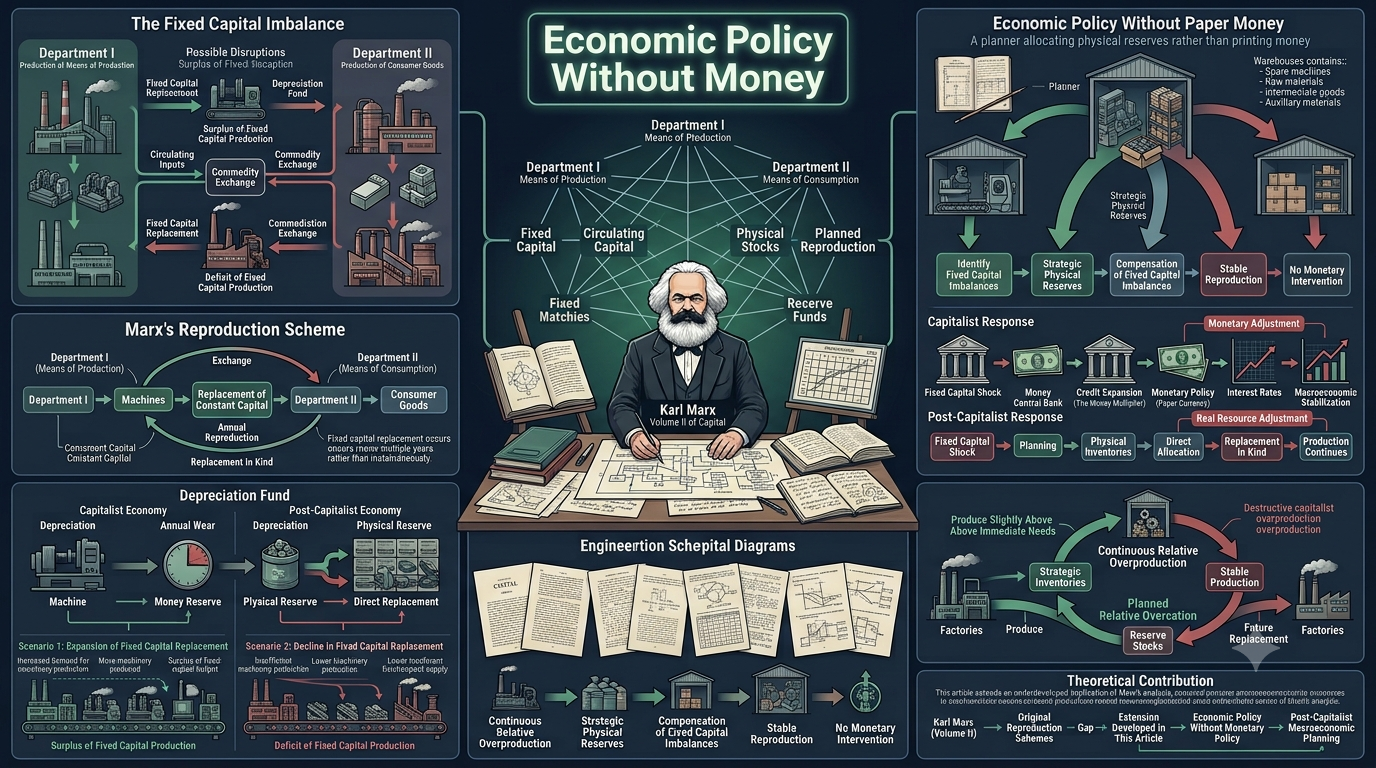
    Starting from a problem outlined only embryonically by Marx in Volume II of Capital, this article examines how a post-capitalist society could address surpluses and deficits of fixed capital without resorting to paper money or, more generally, to monetary policy.

    MG
    José Mauricio Gómez Julián
    Contribuciones a la Economía • January 2016 • ISSN 1696-8360

    In contemporary economies, it is difficult to conceive of an economic policy intended to manage the surplus or deficit of a commodity without resorting, in one way or another, to monetary policy. The article begins from this observation and focuses the problem on a particularly important variable: fixed capital. Its objective is to demonstrate that, in a post-capitalist society, it would be possible to control surpluses and deficits of fixed capital without resorting to paper money or to variables associated with it.

    Introduction: The Problem and Its Scope

    The analysis constitutes a complementary theoretical development of a problem raised by Marx in Volume II of Capital. The article uses the same theoretical example as Marx, while noting that the phenomenon may originate from various causes that fall outside the scope of its analysis. Likewise, the imbalance need not occur exclusively between the major sectors of the economy: it can arise at both the intersectoral and intrasectoral levels.

    In a capitalist society, the consequences of these imbalances are not essentially different from those caused by the surplus — overproduction — or deficit — scarcity — of any other commodity. Foreign trade may provide a short-term outlet. In the case of a surplus, it can make it possible to transform into means of consumption part of the commodity of Sector I that has become immobilized in monetary form; in the case of a deficit, it can contribute to disposing of the remaining commodities associated with the amortization of fixed capital. But this solution does not eliminate the contradiction: it merely displaces it into a broader sphere, expanding its field of action and potentially the magnitude of its consequences.

    The central problem is not simply how much fixed capital exists, but how to maintain its proportionality with circulating capital when the physical replacement of the former varies from one year to another.

    The Two Theoretical Scenarios

    The reasoning is developed through the relationship between two sectors: the sector producing means of production and the sector producing means of consumption. The decisive question is how the relationship between the fixed and circulating components of constant capital changes when the proportion of fixed capital that must be physically replaced varies.

    1

    First Scenario

    If the portion of the production of means of production devoted to replacing the fixed capital of the sector producing means of consumption increases, while the total production intended to supply that sector with constant capital remains unchanged, the increase in amortization alters the proportion between the replacement of fixed capital and the circulating elements required. A larger portion of the fixed capital restored in monetary form flows toward the sector producing means of production in order to recover its natural form, so that more money circulates with the unilateral function of a means of purchase, while the mass of commodities exchanged between the two sectors changes.

    Outcome → SURPLUS IN FIXED-CAPITAL PRODUCTION
    2

    Second Scenario

    If the proportion of the fixed capital of the sector producing means of consumption that must be reproduced in kind — that is, physically replaced all at once — decreases, the portion that only needs to be replaced in money through the reserve fund increases correspondingly. The mass of circulating elements of constant capital reproduced by the sector producing means of production remains unchanged, while the production of fixed capital subject to replacement decreases.

    Outcome → DEFICIT IN FIXED-CAPITAL PRODUCTION

    The Economic Policy Proposal

    The article then takes its decisive step. Once the capitalist mode of production — and, with it, paper money in the terms of the argument being developed — has been abolished, the problem of proportionality between fixed and circulating capital is fundamentally reduced to the fact that the magnitude of fixed capital that is exhausted and must be physically replaced may vary from one year to another. These variations can offset one another successively, while, ceteris paribus, the remaining portion of constant capital required for the annual production of articles of consumption — raw materials, auxiliary materials, and intermediate materials — need not decrease.

    The answer proposed by the article is continuous relative overproduction: producing a certain quantity of fixed capital beyond immediate requirements and maintaining stocks of raw materials, auxiliary materials, and intermediate materials above annual needs.

    These surplus use-values would not be commodities produced without an outlet, but rather a reserve fund. Its function would be to provide the production process with whatever portion of constant capital is required at any given moment: fixed capital when there is a deficit in its fixed component, or circulating elements when the imbalance requires reinforcement of that component. The purpose is to prevent variations in the replacement of fixed capital from reducing or disrupting the reproduction of the system.

    In this way, the proposal does not consist in eliminating the material variations that give rise to the imbalances, but rather in consciously maintaining reserves capable of compensating for them. The year-to-year fluctuation in the physical replacement of fixed capital remains; what changes is the social mechanism through which society responds to it.

    Why the Same Policy Would Not Work Under Capitalism

    The article stresses that such a policy would have a completely different meaning within a capitalist society. There, it would constitute an element of anarchy because planning does not belong to the essence of the system. Moreover, capitalist overproduction is not “relative” in the specific sense employed by the proposal: it generates commercial crises. Nor does it take the form of continuous overproduction consciously maintained as a reserve; instead, commercial crises display a cyclical character.

    The fundamental difference therefore lies in the organization of the production process. In the post-capitalist framework proposed by the article, the surplus is deliberately produced as a reserve of use-values in order to guarantee reproduction; under capitalism, overproduction emerges within a system whose dynamics are not governed by such conscious planning and leads to commercial crises.

    • • •

    A Brief Final Assessment

    The article concludes by shifting attention from the technical problem to the history of Marxist theory. Gómez Julián points out that the Dictionary of Political Economy by Borisov, Zhamin, and Makarova — which he takes as a synthesis of Soviet economic theory of its time — neither develops nor even mentions this problem in its entries on “Fixed Capital,” “Simple Reproduction,” or “Expanded Reproduction.”

    This omission is particularly significant for the author because Marx had already posed the problem, although only in embryonic form, on pages 414–417 of Volume II of Capital. Gómez Julián regards the issue as vitally important both for Marxist theory and for the construction of a communist society or any other post-capitalist society.

    From this, he formulates a deliberately severe criticism of Soviet Marxism: he interprets the absence of this theoretical development as evidence that numerous foundations of the theory were not adequately understood either theoretically or practically, and he polemically connects that assessment with the historical outcome symbolized by November 9, 1989.

    The Article’s Thesis, in Summary

    The argument can be condensed as follows: year-to-year variations in the portion of fixed capital that must be physically replaced generate imbalances between fixed and circulating capital. Under capitalism, these imbalances manifest themselves within a commodity and monetary structure and may result in overproduction, scarcity, and crisis. In a post-capitalist society, by contrast, the article proposes dispensing with paper money in dealing with this problem through continuous relative overproduction of fixed capital and circulating elements, with the resulting surpluses accumulated as reserve funds and used according to the material requirements of reproduction.

    This post presents in accessible language the argument developed by José Mauricio Gómez Julián. The phenomenon analyzed may arise from various causes — which the article does not examine because of its chosen scope — and may occur at both the intersectoral and intrasectoral levels. For the original theoretical development and its direct connection with Marx, see: Gómez Julián, J. M. (2016), “¿Cómo realizar política económica ante superávit o déficit de capital fijo sin recurrir al papel moneda?”, Contribuciones a la Economía.
    Original Article Gómez Julián, José Mauricio. “¿Cómo realizar política económica ante superávit o déficit de capital fijo sin recurrir al papel moneda?” Contribuciones a la Economía, January 2016, ISSN 1696-8360.
    Full text: https://dialnet.unirioja.es/servlet/articulo?codigo=9041512

    Main references in the article: Karl Marx, Capital, Fondo de Cultura Económica, 2010; Borisov, Zhamin, and Makarova, Dictionary of Political Economy, 1965.

    The Capital Question — Political economy explained through its fundamental theoretical problems.

  • ABSOLUTE ADVANTAGE VS COMPARATIVE ADVANTAGE: A MULTIDIMENSIONAL COMPARISON

    ABSOLUTE ADVANTAGE VS COMPARATIVE ADVANTAGE: A MULTIDIMENSIONAL COMPARISON

    International Trade · Economic Theory · Econometrics

    International Trade Theories Versus the Outcomes of Trade Agreements:
    Absolute or Comparative Advantage?

    Based on: Gómez Julián, J. M. (2025). “Teorías del comercio internacional versus resultados de los tratados comerciales: ¿ventaja absoluta o comparativa?” Revista Cubana de Economía Internacional, 12(1), 36–57. Read the original paper (Spanish)

    Economic theory has offered different explanations for the causes and benefits of international trade. Among them, two fundamental approaches stand out: absolute advantage and comparative advantage. The research by José Mauricio Gómez Julián examines these theories not only at the conceptual level, but also in light of the outcomes observed following the adoption of trade agreements.

    The aim of the study is to determine whether the outcomes resulting from the adoption of trade agreements between countries —especially when significant technological asymmetries exist between them— constitute evidence in favor of the theory of absolute advantage or of theories grounded in comparative advantage.

    To carry out this comparison, the paper considers three dimensions: the mathematical generalizability of the theories, the historical context in which they were developed, and the available econometric evidence.

    Absolute Advantage and Comparative Advantage

    Absolute advantage, associated with the tradition of Adam Smith, explains trade on the basis of absolute differences in countries’ productive capacities. From this perspective, differences in productivity and costs between economies are directly relevant to understanding their trade relations.

    Comparative advantage, developed from the work of David Ricardo and later extended by other theories of international trade, holds that exchange can generate benefits even when one country possesses absolute advantages over another, provided that relative differences allow for specialization.

    The paper confronts these two approaches by asking which of them has greater capacity to explain the actual outcomes associated with trade agreements, particularly when the countries participating in them exhibit substantial differences in their technological capabilities.

    Three Dimensions for Comparing the Theories

    1. Mathematical Generalizability

    The first dimension examined is the mathematical generalizability of the theories. The analysis considers the extent to which formulations corresponding to absolute advantage and comparative advantage retain a logical foundation when attempts are made to extend them beyond their particular formulations.

    This comparison forms part of the criterion used by the study to determine the relative soundness of both theoretical traditions, together with the historical and econometric evidence.

    2. Historical Context of Their Development

    The second dimension is the historical context in which the theories of international trade were formulated. The paper does not consider theoretical constructions in isolation from the historical conditions in which they emerged, but instead incorporates that context as part of the assessment of their explanatory capacity.

    In this way, the research relates the historical development of the different theories to the contemporary problem of explaining the outcomes of trade agreements between economies that may exhibit considerable technological differences.

    3. Econometric Evidence

    The third dimension concerns the econometric evidence. For this purpose, the study considers two types of models:

    • Computable General Equilibrium (CGE) models, employed in the analysis of the expected effects of trade agreements.
    • Objective Bayesian Generalized Linear Models, used to empirically examine the relationships present in the data.

    The empirical component incorporates information from the UNITED STATES-COSTA RICA TRADE AND DEVELOPMENT INDICATORS (1991–2019) database, compiled by Gómez Julián in 2024, which brings together indicators concerning trade relations and development in the relationship between the United States and Costa Rica.

    In the application of the objective Bayesian generalized linear models, relationships between one dependent variable and one independent variable are examined, with 14 dependent variables being analyzed. In this way, the contrast between the theories is not confined to abstract reasoning, but also incorporates empirical outcomes related to the observed effects of trade agreements.

    The Central Result

    The comparison of mathematical generalizability, historical context, and econometric evidence leads to a definite conclusion. According to the study, theories of international trade grounded in comparative advantage do not display a rigorous logical and empirical foundation, whereas the opposite result is found for the theory of absolute advantage.

    The outcomes observed in contexts characterized by significant technological asymmetries therefore provide evidence favorable to absolute advantage over comparative advantage as an explanation of the trade relations analyzed.

    The importance of technological differences between economies is therefore central to interpreting the outcomes of trade agreements. Treating those differences as secondary leads to conclusions different from those that emerge when the theories are confronted with the empirical results examined in the study.

    What Does This Imply for Trade Agreements?

    The paper’s conclusions extend to the way trade agreements should be analyzed. The results indicate that views regarding these agreements and the structures they adopt must take into account the technological and wage asymmetries existing between the parties.

    These asymmetries are not a secondary element. On the contrary, they are fundamental to understanding the consequences that trade integration can have between economies with different productive capacities and to properly evaluating the outcomes obtained after the adoption of such agreements.

    The study further concludes that trade agreements constitute a fundamental instrument capable of encouraging or discouraging countries’ growth and sustainable development. Their outcomes therefore cannot be assessed solely through theoretical assumptions about the general benefits of exchange, but must instead be confronted with the specific conditions and actual results of the economies involved.

    A Comparison Between Theory and Outcomes

    The paper’s central argument can be summarized as a confrontation between the predictions and foundations of international trade theories and the concrete outcomes associated with trade agreements.

    By combining the analysis of mathematical generalizability, historical context, and econometric evidence, the research concludes that the explanation based on absolute advantage possesses stronger logical and empirical support than explanations grounded in comparative advantage within the problem under study.

    Consequently, the analysis of trade agreements must pay particular attention to technological and wage differences between countries, since these differences are decisive for understanding the effects such agreements may produce on their trajectories of growth and development.

    Reference: Gómez Julián, J. M. (2025). Teorías del comercio internacional versus resultados de los tratados comerciales: ¿ventaja absoluta o comparativa? Revista Cubana de Economía Internacional, 12(1), 36–57. https://revistas.uh.cu/rcei/article/view/11142/9584

  • Inflation Is (Not) Always And Everywhere A Monetary Phenomenon

    Inflation Is (Not) Always And Everywhere A Monetary Phenomenon

    Beyond the Phillips Curve — Inflation, Technological Change, and Surplus Value
    Political Economy Oct.–Nov. 2025 · 10 min read

    Beyond the Phillips Curve

    A study using U.S. data from 1968 to 2021 finds no significant long-run inverse relationship between inflation and unemployment and argues, from a Marxist perspective, that inflation functions as a real-wage adjustment mechanism through which the benefits of technological change can be transformed into relative surplus value.

    For decades, the Phillips Curve has occupied a central place in mainstream macroeconomics: the idea that inflation and unemployment maintain an inverse relationship that constrains economic policy choices. This study subjects that relationship to empirical scrutiny and develops an alternative explanation of inflation from the standpoint of Marxist political economy.

    Using U.S. data for the period 1968–2021, the research finds no statistically significant long-run relationship between inflation and unemployment. Instead, it identifies relevant relationships among indicators of technological change —proxied by research and development (R&D) expenditure— prices, real wages, and the rate of surplus value.

    The central hypothesis is that inflation should not be understood solely as an imbalance between supply and demand or as a purely monetary phenomenon. Within the framework developed in the paper, it also functions as a wage-adjustment mechanism within the process of capitalist accumulation.

    What Is Really at Stake with the Phillips Curve

    The paper reconstructs the intellectual development of the Phillips Curve: William Phillips’s 1958 work on unemployment and changes in nominal wages, followed by the adaptation by Samuelson and Solow to the relationship between unemployment and inflation. This historical reconstruction describes how the theory was formulated and consolidated; it does not, by itself, amount to conceding that a universal and stable economic relationship between the two variables actually exists.

    The empirical question is precisely whether that inverse relationship withstands scrutiny against the data. For the United States over the period studied, the answer obtained is negative: when long-run relationships are examined and controls are introduced, no statistically significant inverse association emerges that could sustain the conventional trade-off.

    The Exact Scope of This Conclusion The study does not need to claim that a single historical sample has, by itself, demonstrated the universal nonexistence of every possible Phillips Curve. What it demonstrates is that the relationship does not appear significantly in the U.S. data analyzed. The research therefore functions as a first piece in a broader empirical program: if the general claim that such a curve exists is to be evaluated, the analysis must be replicated across other periods, countries, economic structures, and specifications. This study lays the first stone; completing the structure requires further evidence.

    An Empirical Strategy Broader Than a Simple Correlation

    The study combines descriptive analysis, Bayesian inference, time-series tools, and a Bayesian model of the rate of surplus value. The different techniques do not serve the same purpose: each examines a different component of the proposed structure.

    Bayesian Correlations

    Ordinary and partial Pearson and Kendall correlations are estimated among indicators of technological change, inflation, and unemployment. Partial correlations make it possible to control for variables such as nominal GDP, real GDP, and real wages. Evidence is evaluated through Bayes factors, using BF > 3 as the criterion for substantial evidence in favor of a correlation.

    The results cannot be reduced to the statement that “more R&D always means more inflation.” Ordinary correlations vary depending on the source of R&D and the price indicator: both positive and negative relationships appear. Once controls are introduced, however, particularly important positive relationships emerge between federal and capitalist R&D expenditure and the Consumer Price Index.

    The role of real wages is also central: when their effect is controlled for, several negative correlations between sources of technological change and total inflation cease to be statistically significant. This is consistent with the hypothesis that the real wage occupies a mediating position within the mechanism under study.

    Granger Causality

    The Granger tests in the paper are not used to claim that “unemployment does not cause inflation.” Their object is the temporal relationship between indicators of technological change and price indicators, using one, two, and three lags.

    With one lag, statistically significant relationships are found between all types of technological-change indicators and all types of price indicators. In addition, the average p-values are lower when technological indicators act as explanatory variables than when prices do. With two lags, price indicators explain capitalist R&D; with three, technological change again predominates as a temporal determinant of prices.

    The result, therefore, is more complex than mechanical causality in a single direction: interactions and feedback effects are present, although the temporal pattern provides important evidence supporting the role of technological change.

    Error Correction Models

    After the relevant tests of the properties of the series, the error correction models find that federal R&D expenditure statistically determines core inflation, the CPI, and the PPI; that capitalist R&D determines the CPI and the PPI; and that R&D from other sources likewise determines several price indicators.

    In the opposite direction, core inflation appears as the channel through which prices can determine indicators of technological change. Again, the result describes a dynamic structure containing feedback effects rather than a simplistic one-way causal arrow.

    · · ·

    Wages Tell a Story Too

    The study directly examines the dynamics of wages and prices. The series do not possess the same probability structure: nominal wage growth fits a Gamma distribution, total inflation growth a Cauchy distribution, and core inflation growth a logistic distribution.

    That difference matters. Directly comparing parameters from such different distributions can lead to incorrect conclusions. The paper therefore uses trend-cycle analysis with Daubechies wavelets, allowing the temporal dynamics to be compared without imposing a common distributional structure.

    The resulting trends show that price indicators lie systematically above nominal and real wages in the comparisons performed. This connects inflationary dynamics with the evolution of purchasing power and sets the stage for the Marxist mechanism at the theoretical core of the paper.

    The Marxist Mechanism: From Innovation to Real-Wage Adjustment

    When a capitalist introduces a technological innovation that raises productivity, the firm can produce commodities under better conditions than its competitors and temporarily obtain extraordinary surplus value: an advantage arising from operating ahead of the prevailing average conditions of production.

    But that advantage cannot last indefinitely. Competition drives the diffusion of the technology. Other capitalists adopt the new techniques in order not to fall behind, and as the innovation becomes generalized, the pioneer’s extraordinary advantage disappears.

    This is where the central element of the hypothesis enters. In the face of productivity increases, inflation can operate as a real-wage adjustment mechanism: prices rise without requiring nominal wages to be directly reduced, and if nominal wages do not rise proportionally, workers’ purchasing power declines.

    In this way, the benefits of technological change can continue to affect the rate of surplus value positively even after the innovation has diffused. The mechanism is not simply that “inflation absorbs a cost gap.” Its decisive distributive element is the relative reduction of the real wage in relation to productivity growth.

    Technological innovation
    federal and private R&D
    →
    Extraordinary surplus value
    temporary advantage
    →
    Technological diffusion
    capitalist competition
    →
    Pressure on the
    rate of profit
    →
    Inflation
    real-wage adjustment
    →
    Lower purchasing power
    of labor
    →
    Relative surplus value
    for the capitalist class
    →
    Accumulation and
    inequality
    Fig. 1 — A simplified version of the mechanism developed in Diagram 1 of the paper.

    The Test Connecting Technology, Prices, and Surplus Value

    One of the most important empirical components of the study is an objective Bayesian generalized linear model. The dependent variable is the natural logarithm of the gross rate of surplus value; the natural logarithm of aggregate R&D expenditure and the natural logarithm of the Consumer Price Index are used as explanatory variables.

    49–61% interval of variance in the gross rate of surplus value explained by aggregate R&D and the CPI
    0.709 median coefficient for aggregate R&D expenditure
    0.195 median coefficient for the CPI

    The model reaches an R² of 0.55. Because it is formulated in logarithms, the coefficients can be interpreted as elasticities. It also presents favorable cross-validation indicators and variance inflation factors of 1.17 for both explanatory variables.

    This result is especially important because it empirically connects three components that the theoretical interpretation presents as related: technological change, inflation, and the rate of surplus value. The finding goes beyond observing that technology and prices move together; both contain substantial information for explaining variation in the gross rate of surplus value.

    · · ·

    What the Paper Actually Argues About Inflation

    The proposed Marxist interpretation treats inflation as part of the distributive struggle between capital and labor. When rising prices reduce real wages, productivity gains can primarily benefit capital through an increase in the rate of surplus value.

    From this perspective, inflation performs a systemic function: it contributes to transforming the temporary effects of extraordinary surplus value into relative surplus value for the capitalist class as a whole, preserving the benefits of innovation even after new technologies have become generalized.

    Inflation thus appears not as a mere monetary accident, but as a mechanism connected to capitalist accumulation, real-wage adjustment, and the distribution of income between capital and labor.

    This does not imply denying that monetary variables can play a role. The more precise claim is that reducing inflation to a purely monetary phenomenon is insufficient to explain the empirical and distributive relationships examined in the study.

    What the Paper Does Not Claim to Have Finished

    The paper explicitly defines its own boundaries. The research uses only U.S. data and covers the period 1968–2021. Its results should therefore not be presented as though a single study had exhausted the historical demonstration of the nonexistence of the Phillips Curve in every economy, period, or context.

    But this limitation does not neutralize the finding. If a relationship presented for decades as a fundamental component of macroeconomic theory fails to appear in a long U.S. time series examined through a broad statistical strategy, there is substantive reason to question its generality and continue putting it to the test.

    The First Piece of the Puzzle The appropriate conclusion is neither “the curve has been universally refuted by a single sample” nor “perhaps the curve remains valid and this result is merely an anomaly.” The study provides a first empirical piece of a larger problem. Completing the puzzle requires replicating this type of research across more countries, historical periods, and economic structures. Each additional replication will make it possible to assess how far the general claim of an inverse relationship between inflation and unemployment can be sustained —or dismantled.

    The Limitations Matter — and They Also Show Where to Go Next

    R&D expenditure as a share of GDP is a proxy for technological change rather than an exhaustive measure of it. It does not fully capture technological spillovers, international technology transfers, organizational innovations, learning by doing, informal incremental improvements, or the creative adoption of already existing technologies.

    At the same time, the paper defends its use because it provides long, comparable, methodologically standardized series and because a well-documented relationship exists between R&D and subsequent measures of productivity. Precisely because it omits real forms of technological change, the indicator can be interpreted as a conservative lower bound for total technological change.

    The study also notes that the relationships it finds are complex and may be affected by variables not incorporated into the analysis. In addition, although the theoretical core is outlined and subjected to econometric examination, it must still be connected with other components of Marxist theory, such as economic cycles and the tendency of the average rate of profit to fall.

    And What Does All This Mean for Economic Policy?

    Here it is important not to attribute conclusions to the paper that it does not yet develop. The study does not present a completed theory of monetary policy and does not conclude, for example, that a particular interest-rate decision simply amounts to “treating the symptom rather than the disease.”

    Instead, it explicitly identifies these questions as an area for future research: the implications must be developed both for workers’ union organization and for economic policymakers, and the relationship between the proposed theory and contemporary monetary policies —particularly inflation-targeting regimes— remains to be examined.

    The immediate implication of the paper therefore comes before any specific policy prescription: if inflation has a structural dimension linked to technological change, real wages, surplus value, and income distribution, then a theory attempting to explain it exclusively through monetary variables leaves out an essential part of the phenomenon.

    · · ·

    Beyond the Curve

    The contribution of the study can be condensed into three results: it finds no statistically significant long-run relationship between inflation and unemployment for the United States over the period examined; it finds evidence of relevant relationships between technological change and inflation; and it obtains results consistent with the hypothesis that inflation reduces real wages and allows productivity gains to affect the rate of surplus value.

    The importance of the argument does not lie simply in replacing one correlation with another. The change in perspective is deeper: it moves from treating inflation as an isolated price problem to locating it within the reproduction and accumulation of capital and within the struggle over the distribution of the value produced.

    Within this framework, the question is no longer merely why prices rise. It also becomes: What happens to the benefits of technological improvements once they become generalized? How are productivity gains distributed between capital and labor? What role does variation in the real wage play in that process?

    These relationships —rather than a simple mechanical trade-off between inflation and unemployment— are what the paper proposes placing at the center of the analysis.

  • Discovering the Truth: Genetics, Archaeology, and the Palestinian Descendants of the Ancient Jews

    Discovering the Truth: Genetics, Archaeology, and the Palestinian Descendants of the Ancient Jews

    The Ancient Judeans of Judea as Direct Ancestors of Contemporary Palestinians

    Archaeology, paleogenomics, historiography, epigraphy, and linguistics against the exile and “return” narrative: a synthesis of José Mauricio Gómez Julián’s monograph.
    The monograph begins with a historical question carrying direct political implications: Who, strictly speaking, are the descendants of the ancient Judeans of Judea?

    Its thesis is that the convergence of critical archaeology of the southern Levant, historiography, epigraphy, paleogenomics and population genetics, and historical linguistics indicates that contemporary Palestinians constitute the most direct demographic heirs of the ancient populations of the region, including the Judeans of the Kingdom of Judah. Modern Jewish populations, by contrast, exhibit heterogeneous demographic histories, with varying proportions of Levantine ancestry alongside components acquired through migrations, conversions, and admixture with European, African, and Asian populations.

    The argument does not depend on a single discipline. Its core lies precisely in the cross-corroboration of independent lines of evidence: the Canaanite origin of the earliest Israelites, the absence of a general Roman expulsion from Palestine, archaeological continuity across the Byzantine and Islamic transitions, genomic evidence, and linguistic and toponymic continuity.
    A central methodological caveat: the monograph explicitly distinguishes between robust consensuses, well-founded conclusions, and questions that remain open. It does not claim that every detail carries the same degree of certainty. In particular, no genome from an individual unambiguously identifiable as a “Judean” of the Kingdom of Judah has yet been published in a peer-reviewed journal. The specific connection to the Judeans is therefore inferred through the convergence of archaeological and historical continuity with genetic comparisons involving ancient Levantine populations, rather than through a direct comparison between a “Judean genome” and modern Palestinians.

    From the Bible as Foundational Narrative to Critical History

    The investigation begins with the methodological problem of using the Bible as though it were a historical chronicle. It reviews the historiographical revolution associated with Thomas L. Thompson, Niels Peter Lemche, Philip R. Davies, and Keith W. Whitelam—the so-called “minimalist school”—and confronts it with maximalist objections and intermediate positions such as those of William G. Dever and Lester Grabbe.

    The fundamental point is not that all biblical content is devoid of historicity. The monograph specifically emphasizes that extreme positions have increasingly given way to a middle ground: historically useful material does exist, particularly from the first millennium BCE onward, but the patriarchal narratives, the Exodus, the military conquest of Canaan, and the United Monarchy on the scale depicted in the biblical text do not possess the archaeological support traditionally attributed to them.

    Mario Liverani provides one of the study’s key interpretive frameworks through his distinction between “normal history” and “invented history”: the ancient political entities of Israel and Judah must be reconstructed through archaeology, epigraphy, textual criticism, and comparative sources, whereas the great foundational narratives must also be analyzed as political-theological constructions developed by the post-exilic community.

    The Earliest Israelites Emerged from Canaan

    One of the most robust pillars of the argument is the autochthonous Canaanite origin of the earliest Israelites. Around 1200 BCE, approximately 250 small unwalled villages emerged in the central highlands. Their pottery displays continuity with Late Bronze Age traditions, there are no widespread destruction layers attributable to an external conquest, and the organization of the settlements is compatible with local populations undergoing sedentarization.

    Israel Finkelstein and William G. Dever, despite their profound historiographical and chronological disagreements, converge on this point: the populations later identified as Israelites emerged primarily from within Canaanite society, rather than as a foreign population that conquered Canaan from outside.

    Epigraphy: Merneptah and Tel Dan

    The monograph incorporates a line of evidence that the previous HTML version largely omitted: epigraphy. The Merneptah Stele, dating to approximately 1208 BCE, contains the earliest known extra-biblical reference to “Israel” and identifies it through an Egyptian determinative corresponding to a people or socioethnic group, rather than a territorial state.

    The Tel Dan Stele, from the ninth century BCE, contains the sequence generally interpreted as “House of David.” The reading was challenged by some minimalists but is accepted by the majority of specialists. For the monograph, these inscriptions establish a crucial distinction: criticizing the biblical narrative does not require denying the historical existence of Israel or of a Davidic dynasty. What the extra-biblical evidence does not confirm is the Exodus, the conquest of Canaan, or a Solomonic empire on the scale described in the Bible.

    From Canaanite Polytheism to Yahwistic Monotheism

    Another substantial component of the paper concerns the religious evolution of Israel. Drawing on Mark S. Smith, William G. Dever, Othmar Keel, Christoph Uehlinger, and Thomas Römer, the monograph presents Yahwistic monotheism not as the starting point of Israelite history, but as the outcome of a prolonged historical process.

    Textual, archaeological, and epigraphic evidence indicates the coexistence of Yahweh, El, Baal, and Asherah at different moments in Israelite religion. The inscriptions from Kuntillet Ajrud and Khirbet el-Qom, together with Judean pillar figurines, altars, standing stones, and other material remains, document religious practices incompatible with the retrospective image of a primordial monotheistic Israel.

    The process appears to have developed from polytheism and monolatry toward increasingly exclusive monotheism, accelerated by the crisis of the Babylonian exile and consolidated during the Persian period. The possible influence of Zoroastrianism on later elements of Judaism—dualism, eschatology, and angelology—is explicitly treated as an open debate, not as an established conclusion.

    The Philistine Case

    The monograph also uses the Philistines as an example of the historical capacity of the Levantine substrate to absorb migrant populations. Ancient DNA from Ashkelon reveals a component related to southern Europe in the early Iron Age that becomes undetectable roughly two centuries later, coinciding with increasing cultural integration into the Canaanite environment.

    This does not lead to the conclusion that Palestinians are simply “descendants of the Philistines.” The argument is broader: contemporary Palestinians represent a historical synthesis of successive populations of the southern Levant—Canaanites, Israelites, Judeans, Samaritans, Philistines, Phoenicians, and other groups—upon a local substrate characterized by strong demographic continuity.

    Assyrians, Babylonians, and the Difference Between Deporting an Elite and Emptying a Territory

    The monograph repeatedly distinguishes historically documented deportations from the idea of complete demographic emptying. Following the Assyrian conquest of the Kingdom of Israel, part of the population was deported, another part fled toward Judah, and a substantial number remained in the territory. Imperial deportation disproportionately affected political, administrative, and specialized elites; it did not automatically mean eliminating the entire peasant population.

    The same principle applies to the Babylonian conquest. Jerusalem suffered profound destruction and real deportations occurred, but other areas—particularly Benjamin—show rural continuity. The so-called “Babylonian exile” is therefore interpreted as a political, institutional, and cultural rupture of enormous importance, but not as the physical disappearance of the population of Judah.

    During the Persian period, Judaism progressively consolidated as a differentiated religious system. This transformation provides the historical context within which the monograph situates the composition and reorganization of a fundamental portion of the biblical tradition.

    From Ioudaios to “Jew”: Hasmonean Conversions and the Transformation of Identity

    The Hasmonean expansion of the second and first centuries BCE constitutes another turning point. John Hyrcanus I imposed circumcision and observance of Jewish law upon the Idumeans; Aristobulus I did likewise with Iturean populations. The Herodian dynasty itself descended from this Idumean population incorporated into Judaism.

    Following Shaye J. D. Cohen, the monograph emphasizes the semantic transformation of Ioudaios: from a primarily ethno-geographic designation—“Judean,” an inhabitant of Judea—it came to acquire religious and cultural meanings as well. From that point onward, one could become Jewish without having been born Judean. This transformation constitutes a conceptual precondition for understanding the later expansion of the diaspora.

    The Myth of a Total Roman Expulsion

    The wars against Rome were devastating. The destruction of the Second Temple in 70 CE and, especially, the Bar Kokhba revolt of 132–135 CE caused enormous human and material losses in Judea. The monograph does not minimize that destruction.

    What it rejects is a different proposition: that Rome deported the Jewish population of all Palestine en masse and emptied the land. Hadrian prohibited Jewish access to Aelia Capitolina—Jerusalem—but there is no evidence of a Roman policy of total deportation from Palestine. Settlement continuity in several regions and the relocation of the center of Jewish life toward Galilee contradict such a scenario.

    Rabbinic centers arose in Galilee at places such as Usha, Sepphoris, and Tiberias; the Mishnah was compiled there around 200 CE and the Jerusalem Talmud later followed. Roman destruction was therefore enormously significant institutionally and regionally, but it did not result in the physical disappearance of the Jewish population from the land.

    • Historiographical consensus: the absence of a mass Roman expulsion of all Jews from Palestine is not a thesis exclusive to Shlomo Sand. Historians such as Israel Bartal and Anita Shapira acknowledge that the idea of a collective exile imposed by Rome belongs much more to popular culture than to specialist historiography.
    • Necessary qualification: accepting that there was no general expulsion does not mean denying the deaths, enslavements, local displacements, and destruction produced by the Roman wars.
    • Diaspora: major Jewish communities outside Palestine predated the Roman wars and must be explained through a combination of migrations, demographic growth, and conversion rather than through a single episode of expulsion.

    From Permanence to Conversion: Continuity of the Palestinian Population

    This is one of the central links in the monograph. If the rural population was not generally expelled, the question becomes what happened to it. The proposed answer is a progressive religious transformation upon a largely continuous demographic base.

    Between the fourth and seventh centuries, an increasing share of Palestine’s population Christianized under Byzantine rule. Following the Arab conquest of 634–638, Islamization was likewise not immediate. The demographic models and archaeological evidence examined in the paper place the process across several centuries, extending into the later medieval period.

    Gideon Avni finds remarkable continuity in settlement patterns and material culture across the Byzantine-Islamic transition. Richard Bulliet and other researchers likewise show that conversion to Islam followed a gradual trajectory. The implication is fundamental to the argument: the population’s religion changed far more rapidly than its biological composition.

    Jewish Continuity Never Disappeared Either

    The monograph stresses that Jewish presence in Palestine was never completely extinguished. Jewish communities survived throughout Late Antiquity, the Middle Ages, and the Ottoman period; the so-called Musta’arabim, Arabized autochthonous Jews, shared language and many everyday practices with their Muslim and Christian neighbors.

    This does not contradict the thesis of Palestinian continuity. On the contrary, for the paper it demonstrates that remaining in the territory did not require preserving any particular religion: different branches of a historically related population could remain Jewish, convert to Christianity, or later convert to Islam.

    Ben-Gurion, Ben-Zvi, Borochov, and Belkind

    The monograph assigns particular importance to the fact that several early Zionist leaders argued, before the consolidation of the national conflict, that the Palestinian fellahin descended substantially from ancient Jewish and Canaanite populations that had remained on the land and subsequently changed religion.

    David Ben-Gurion and Yitzhak Ben-Zvi defended this continuity in works published in 1918; Ber Borochov had articulated a similar thesis in 1905, Israel Belkind rejected in 1928 the idea that Jews had ceased to inhabit the country after Rome, and Ben-Zvi returned to the local ancestry of the fellahin in 1929. The paper argues that this interpretation subsequently lost prominence as the political requirements of the Zionist movement changed.

    Paleogenomics: Continuity, Admixture, and the Limits of What DNA Can Demonstrate

    Paleogenomics supplies the quantitative dimension of the argument, but the monograph explicitly warns against treating statistical categories as though they were perfectly bounded historical populations.

    The study by Agranat-Tamir and colleagues analyzed dozens of genomes from the Bronze and Iron Age Levant. Despite the region’s cultural and political diversity, these individuals exhibit a related genetic base and provide a reference point for studying continuity with present-day populations.

    • Contemporary Palestinians: the models examined in the monograph place approximately 81% to 87% of their ancestry in Bronze Age Levantine populations, complemented by later components, including African and European contributions.
    • Ashkenazi Jews: different whole-genome studies identify a clearly admixed population. Carmi et al. model it as approximately 50% Middle Eastern and 50% European, while other analyses produce somewhat different ranges depending on methodology. A substantial share of the European component derives from southern Europe.
    • Ashkenazi bottleneck: the modern population derives from a severe genetic bottleneck estimated at approximately 350 individuals around 600–800 years ago.
    • Erfurt: DNA from 33 medieval Ashkenazi Jews from the fourteenth century reveals greater genetic heterogeneity than exists today, subsequently reduced through genetic drift and endogamy.
    • Y chromosome: approximately 70% of Jewish Y chromosomes and 82% of Muslim Palestinian Y chromosomes analyzed by Nebel et al. belonged to the same broad chromosomal pool, dominated by J1 and J2 lineages, indicating a deep shared Levantine patrilineal substrate.
    • Mizrahi Jews: they constitute a crucial qualification. The monograph cites Levantine ancestry proportions on the order of 80–90% among different Mizrahi populations, comparable to those of Palestinians.
    What the data most precisely permit us to say: contemporary Palestinians exhibit, at the whole-genome level, very high proximity to ancient Levantine populations and greater continuity than that observed among Ashkenazim, whose demographic history includes substantial European admixture. But this does not mean that modern Jews lack Levantine ancestry. The monograph explicitly rejects that symmetrical conclusion.

    Nor is there yet a published dataset of genomes unambiguously identified as Judeans of the Kingdom of Judah. The preliminary Kiriath-Jearim data mentioned in the study point toward continuity with Canaanite profiles, but formal publication remains pending. Moreover, tools such as qpAdm lose discriminatory power when historical source populations are closely related, and components generated by programs such as ADMIXTURE are statistical constructs, not historical peoples literally preserved in DNA.

    The Khazar Hypothesis

    The monograph also distinguishes between the historical existence of conversion to Judaism among the Khazar elite—which is not generally disputed—and the much stronger claim that Khazars constituted the principal origin of Ashkenazi Jews. Modern genomic analyses do not identify the massive Caucasian or Central Asian contribution that such a hypothesis would require. Accordingly, the paper regards the Khazar hypothesis as the primary explanation of Ashkenazi origins as refuted by genomics.

    Genetics cannot ground territorial rights; but it can test genealogical claims when those claims are themselves employed as political arguments.

    Language: Canaanite → Hebrew → Aramaic → Arabic

    The linguistic argument complements the genetic evidence. Hebrew belongs to the Canaanite group of languages. With the expansion of the great Mesopotamian empires, Aramaic progressively became a lingua franca and displaced Hebrew in many everyday functions, without implying replacement of the population.

    Following the Islamic conquest, a structurally similar process occurred. Arabic replaced Greek in administration under the Umayyads and progressively displaced Aramaic among the local population. The linguistic transition unfolded over centuries.

    Accordingly, the sequence Canaanite → Hebrew → Aramaic → Arabic represents for the monograph not a succession of four peoples replacing one another, but largely a succession of languages spoken over a historically continuous population base.

    Toponymy and Ethnography: Memory Preserved in the Landscape

    Place names reinforce this interpretation. Beit Lahm (Bethlehem), Beisan (Beth-shean), Bir as-Saba (Be’er Sheva), ‘Anata (Anathoth), Seilun (Shiloh), and numerous other toponyms display the preservation and phonetic transformation of ancient names within Palestinian Arabic.

    The study also recovers the ethnographic work of Tawfiq Canaan and Hilma Granqvist. Canaan documented Palestinian peasant practices with possible pre-Islamic and pre-Christian antecedents, including the term ard ba’liyyeh for rain-dependent farmland, which linguistically preserves the name of Baal, the ancient Canaanite storm deity.

    Modern Hebrew

    The paper contrasts this organic continuity with the modern revival of Hebrew. Drawing particularly on Ghil’ad Zuckermann, it characterizes Israeli Hebrew as a language revitalized in the nineteenth and twentieth centuries upon ancient Semitic foundations but with significant structural influence from European languages—especially Yiddish—spoken by many of the revivalists.

    The monograph acknowledges that more radical formulations, such as that of Paul Wexler, do not represent the linguistic consensus. Its argument does not depend upon them: it is sufficient to distinguish between a consciously revitalized language and a dialect chain that evolved historically in the same territory.

    The Jewish Diaspora as a Historical Mosaic

    If Rome did not collectively expel the population of Palestine, the enormous Jewish diaspora already present in antiquity still requires explanation. The monograph’s answer is not monocausal. The diaspora formed through migration, voluntary conversion, forced conversion, and marital absorption of local populations, with different relative weights depending on place and period.

    Hasmonean conversions demonstrate at an early stage that Jewish belonging could be acquired. During the Greco-Roman world, proselytes and “God-fearers” existed, although the precise scale of active proselytism remains debated among specialists such as Louis Feldman and Martin Goodman.

    The extraordinary demographic expansion of ancient Judaism—from a comparatively small population after the Babylonian conquest to several million people during the Roman period—constitutes for the paper strong evidence that conversion played a substantial role that natural increase alone would struggle to explain.

    The monograph then examines highly diverse cases: the Himyarite kingdom of southern Arabia, the disputed traditions concerning Berber conversions, Beta Israel in Ethiopia, Bene Israel and Cochin Jews in India, the Jews of Kaifeng in China, and Sephardic and Ashkenazi communities in Europe. The result is not a single genealogy but a mosaic of communities with different biological and cultural histories connected through Judaism.

    Two simplifications explicitly rejected by the paper:

    1. It is not sustainable to claim that all modern Jews descend biologically in a linear and homogeneous manner from the ancient Israelites.

    2. It is equally unsustainable to claim that modern Jews have no genetic connection whatsoever to the ancient Levant.

    The evidence instead indicates a history of Levantine continuity combined with very different degrees of admixture depending on the community.

    The Historiographical and Political Implications

    The monograph does not present its demographic conclusions as politically neutral. Its theoretical starting point is explicitly Gramscian: historical narratives can become mechanisms of hegemony when they begin to operate as legitimizing “common sense” within present political relations.

    From this perspective, the narrative of an ethnically continuous people expelled by Rome and “returned” two thousand years later performs, according to the paper, a specific political function: it transforms a modern colonization into the restoration of ancestral sovereignty. The investigation contrasts that narrative with the documented history of European Zionism, the Balfour Declaration of 1917, the British Mandate, organized immigration, the 1947 partition, the Nakba of 1948, and the subsequent American patronage of Israel.

    The paper therefore situates the State of Israel within the modern history of settler colonialism and Western geopolitical interests in the Middle East, arguing that the biblical-genealogical narrative operates as one of its mechanisms of cultural legitimation.

    This interpretation is not presented as a criticism of Judaism or of Jews as a population. The monograph devotes a specific section to Jewish and Israeli critics of Zionism—including Tony Judt, Judith Butler, Norman Finkelstein, and the Israeli “new historians”—precisely in order to distinguish Judaism, Jewish identity, historiography, and the political project of Zionism.

    What the Monograph Regards as Established—and What It Does Not

    • Robust consensus: the earliest Israelites emerged primarily from the local Canaanite substrate rather than through an external conquest of Canaan of the kind described in Joshua.
    • Robust consensus: Rome did not carry out a mass deportation of the entire Jewish population of Palestine following the wars of the first and second centuries CE.
    • Robust consensus according to the paper’s synthesis: a predominant share of the Palestinian population descends from ancient populations of the Levant that remained in the region while undergoing successive religious and linguistic transformations.
    • Well-founded conclusion, with qualifications: Jewish diaspora communities formed through varying combinations of Levantine ancestry, migration, conversion, and admixture with local populations.
    • Well-founded conclusion: the Canaanite–Hebrew–Aramaic–Arabic linguistic sequence is compatible with language shifts without general demographic replacement.
    • Well-founded conclusion: Jews and Palestinians share a deep Levantine genetic substrate; present differences reflect divergent later histories of permanence, migration, endogamy, admixture, and genetic drift.
    • Open debates and limitations: no DNA has yet been published from individuals unambiguously attributable to the Judeans of the Kingdom of Judah; the relative magnitude of ancient proselytism remains disputed; genetic proportions depend on statistical models and reference populations; and some religious and historiographical questions, such as the extent of Zoroastrian influence, remain open.

    Conclusion: Continuity Through Transformation

    The monograph’s final thesis is not that Palestinians constitute a biologically “pure” or immutable population. It is almost the opposite: historical continuity can coexist with migrations, admixture, religious change, cultural transformation, and profound linguistic replacement.

    Over millennia, the population of the southern Levant absorbed Canaanites, Israelites, Judeans, Samaritans, Philistines, and other groups. Assyrian, Babylonian, Persian, Hellenistic, Roman, Byzantine, and Arab conquests profoundly transformed the region’s institutions, religions, and languages without producing, in most of these episodes, the complete replacement of its population.

    Within this historical process, the paper argues that contemporary Palestinians represent the principal demographic continuity of the ancient populations that remained in the territory, including the ancient Judeans, whereas modern Jewish populations follow heterogeneous trajectories: some—particularly Mizrahi populations—retain very high levels of Levantine ancestry; others—such as Ashkenazi Jews—combine substantial Levantine ancestry with an equally substantial European contribution.

    The study therefore rejects two extremes simultaneously: both the notion of homogeneous and exclusive biological continuity between all modern Jews and the ancient inhabitants of Judea, and the inverse claim that modern Jews lack Levantine roots.

    Finally, the monograph insists upon a fundamental normative boundary: genetics does not confer territorial rights, and genetic proximity does not determine who deserves citizenship, dignity, self-determination, or political rights. Its relevance emerges when a particular historical genealogy is itself used as political justification. In such cases, the author argues, historical, archaeological, linguistic, and genomic sciences are entitled to subject that genealogy to scrutiny.

    In this way, archaeology, historiography, epigraphy, genetics, and linguistics converge upon the thesis organizing the entire investigation: the history of Palestine is far more a history of human continuity through successive transformations than a history of total expulsion followed, two thousand years later, by the return of the same population.


  • Political Economy and Probability Theory: Marx, Adam Smith, and the Law of Large Numbers

    Political Economy and Probability Theory: Marx, Adam Smith, and the Law of Large Numbers

    The Political Economy Notebook
    Exploring Economics Beyond the Textbook

    Do All Workers Get Exploited the Same?
    Testing a Marxian Assumption with Probability Theory

    How sixty years of U.S. sectoral data and non-classical laws of large numbers were used to examine a foundational assumption behind the Marxian average rate of profit

    ~ 9 min read

    A consequential assumption sits behind Marxian analyses of the average rate of profit whenever differences in the degree of labor exploitation across productive sectors are not explicitly modeled: sectoral rates of surplus value may be treated as tending toward uniformity. Adam Smith supplied the original economic argument for such a tendency, and within Marxian political economy the proposition acquired central importance. But can that tendency be defended when actual sectors are neither independent nor statistically identical? A 2022 paper by José Mauricio Gómez Julián in Ciencia Económica approaches the question from three directions at once: probability theory, the concrete labor-market mechanisms discussed by Smith and Marx, and statistical evidence from the United States between 1960 and 2020.

    The Problem, in Plain Language

    In Marxian theory, surplus value is the value produced by labor beyond the value represented by labor-power. Empirically, the paper approximates the rate of surplus value using modern national accounts: gross operating surplus is taken as a representation of surplus labor time and employee compensation as a representation of necessary labor time. Their ratio provides the sectoral rate used in the statistical analysis.

    The issue matters because the tendency toward uniform sectoral rates of surplus value is part of the foundation on which the formation of an average rate of profit and, consequently, Marxian prices of production rests. But an important nuance is easily lost here. The paper does not treat prices of production as pre-existing equilibrium prices around which market prices merely oscillate. Drawing on Carchedi and de Haan, it emphasizes a dynamic interpretation: market prices exist first, and capitalist competition — including technological competition and movements of capital — pressures them toward a systemic average. Prices of production exist through this very process of convergence rather than as a fixed center established in advance.

    The empirical question is therefore not whether every industry displays exactly the same exploitation rate at every instant. The proposition under examination is a tendency toward asymptotic uniformity: as the analysis approaches a sufficiently long period and/or a sufficiently large collection of relevant sectors, do sectoral rates behave in a way consistent with convergence toward a global expected value?

    Why the Asymptotic Perspective Matters

    The paper connects this question to Marx’s theory of knowledge. Its argument is that Marx’s method cannot be reduced to the passive acceptance of isolated empirical facts. Through a materialist appropriation of Hegelian dialectics, the analysis privileges totality: the phenomenon must be understood through its relations, its development, and the larger system of which it forms a part. In the paper, the term asymptotic regime condenses this idea statistically — a sufficiently long time horizon, a sufficiently large number of units, or both.

    This matters because a sector observed in isolation may differ substantially from another sector. Uniformity, if it exists, need not appear as point-by-point equality. It may instead be a property that becomes visible only when the system is considered on a sufficiently large scale.

    Enter the Law of Large Numbers

    The mathematical framework is the Law of Large Numbers (LLN). In broad terms, laws of large numbers describe conditions under which averages stabilize around an expected value as the amount of information grows. The strong version concerns almost-sure convergence; the weak version concerns convergence in probability.

    The difficulty is immediate. Classical formulations typically rely on strong assumptions such as independence and identical distribution. Those conditions are not realistic for capitalist sectors. Industries interact through production chains, competition, wages, technology, demand, and capital movements; and their productive structures differ. The paper’s own statistical results confirm that the sectoral variables are neither identically distributed nor, in general, linearly independent.

    That does not make the LLN irrelevant. Rather, the theoretical part of the paper asks whether more general versions of the law can accommodate the structure of the economic problem. The answer is qualified: several mathematical results relax different parts of the classical assumptions, but they do not all do so in the same way.

    What the Mathematical Literature Actually Establishes

    • Li, Rao and Wang (1995): study a strong law for weighted sums of independent random variables with multidimensional indices under specific structural and moment conditions.
    • Adler and Rosalsky (1987): establish a strong-law result for normalized weighted sums of independent and identically distributed random variables.
    • Chen and Sung (2016): generalize weighted-sum results under stochastic-dominance and weighting conditions, relaxing restrictions relevant to the distributional structure.
    • Sung (2011): is especially important for the economic application because it provides sufficient conditions under which the variables may be dependent, subject to moment and other technical requirements.
    • Andrews (1988) and Davidson (2021): provide weak-law results and a broader framework for weakly dependent processes, including mixingale-type structures relevant to econometrics.
    “Smith’s proposition concerning the law of tendency toward uniformity is consistent with the logic behind certain varieties of the Law of Large Numbers.” Translation of the paper’s conclusion — Gómez Julián, 2022

    The word certain is essential. The paper does not claim that simply invoking a non-classical LLN automatically proves the Marxian proposition. Formal consistency depends on satisfying the conditions of the particular theorem being used. In some cases this may require transformations of the dataset — for example, grouping or disaggregating sectors, arranging observations in structures such as triangular arrays, or estimating missing periods where appropriate. Whether such requirements can actually be met depends on the concrete dataset.

    What Counts as a Productive Sector?

    Before performing the statistical analysis, the paper faces a specifically Marxian classification problem: not every activity appearing in national accounts necessarily belongs in the calculation of the average rate of profit. The relevant sectors are those treated as productive in relation to the circuit of capital and the production of surplus value.

    This is particularly important for services. Drawing on the literature on productive and unproductive labor, the study distinguishes activities that directly produce surplus value, activities that facilitate its production elsewhere, and activities outside the relevant circuit of capital. After harmonizing sector classifications across the historical period and applying those theoretical criteria, the empirical analysis works with 36 productive sectors.

    What the U.S. Data Show

    The empirical component uses data from the U.S. Bureau of Economic Analysis for the period 1960–2020. Sectoral rates of surplus value are constructed from gross operating surplus and employee compensation, and the study then examines probability distributions, pairwise Pearson correlations, and the differences between sectoral location measures and their global counterparts.

    Key Empirical Findings

    • The sectors are not identically distributed: among the 36 sectors, 16 are best fitted by a Uniform distribution, 13 by Cauchy, 3 by Logistic, 2 by Log-Normal, and 2 by Weibull. None is best described by a Normal distribution.
    • The sectors are not generally linearly independent: 630 pairwise Pearson correlations are calculated. Their mean is approximately 0.081 and their median approximately 0.140.
    • Substantial pairwise dependence is not rare: 256 of the 630 correlations — about 40.63% — are at least 0.30. The paper therefore rejects the idea that the sectors can generally be treated as linearly independent.
    • Most summary measures of the differences are close to zero: relative to the global mean, the sum of sectoral differences is approximately 3.38 × 10⁻¹⁴ and their mean approximately 9.38 × 10⁻¹⁶. Relative to the global median, the corresponding values are also small.
    • There is an important exception: the median of the differences calculated relative to the global mean is not close to zero. The paper therefore describes the evidence as a tendency toward reciprocal nullification in general, not as perfect cancellation in every statistic.
    • The differences have different distributional forms: those calculated relative to the global mean are best fitted by a Cauchy distribution, with Logistic as the second-best option; those relative to the global median are best fitted by a Uniform distribution, with Normal as the second-best option.

    This pattern is important precisely because the empirical data do not reproduce the assumptions of the classical LLN. The sectors remain heterogeneous and interconnected. Yet the descriptive behavior of their deviations provides evidence, in the author’s interpretation, in favor of a tendency toward reciprocal nullification when the system is considered as a whole.

    Why Conventional Significance Tests Were Set Aside

    The paper originally considers tests for differences between sectoral means or medians and their global counterparts, including Student’s t procedures and Wilcoxon procedures, together with bootstrapping. It ultimately argues that the available inferential tests are not appropriate for drawing valid conclusions from this particular structure of data.

    The problem is not simply non-normality. Depending on the procedure, assumptions concerning distributional form, linear independence, pairing, and equal sample sizes become relevant. The economic variables are interdependent by construction, and bootstrapping does not solve the entire difficulty: although resampling can break the relation between the immediately compared groups, it does not eliminate dependence among the sectoral components that make up the global group.

    An especially important nuance is that the discarded tests did indicate statistically significant differences. The paper nevertheless refuses to treat those results as valid inferential evidence because the required conditions are not adequately satisfied. It therefore replaces that inferential route with a descriptive — or, as the paper itself suggests, perhaps more accurately semi-descriptive — analysis based on the behavior and probability distributions of the differences.

    Smith, Marx, and the Economic Mechanism

    The probability argument is only one dimension of the paper. A second dimension returns to Adam Smith’s account of labor-market adjustment. Smith argues that the total advantages and disadvantages of different employments in the same locality must either be equal or continually tend toward equality; otherwise workers and capital would move in ways that erode unusually favorable or unfavorable conditions.

    The paper organizes Smith’s discussion around seven factors affecting compensation: the simplicity or difficulty of the work; whether it is pleasant or unpleasant; danger and effects on health; regularity or temporariness of employment; the degree of trust placed in the worker; the probability of professional success; and subjective considerations such as passion for an occupation, reputation, confidence in one’s abilities, and confidence in one’s luck.

    These factors matter because they do not imply isolated sectors. Quite the opposite: sectoral rates can be linked directly through the organic interdependence of capitalist production and indirectly through common forces affecting wages and working conditions. In this sense, the economic mechanism described by Smith and Marx is more naturally compatible with generalized probabilistic frameworks that permit dependence than with a classical model requiring reciprocal independence.

    • • •

    So What Does the Paper Actually Establish?

    The conclusion is favorable to the uniformity hypothesis, but it is carefully delimited. At the theoretical level, the logic of Smith’s tendency toward uniform sectoral rates of surplus value is consistent with certain strong and weak versions of the Law of Large Numbers that allow correlated variables and/or do not require identical distributions. This formal consistency is conditional on the concrete requirements of the relevant mathematical results being satisfiable.

    At the empirical level, the U.S. data show precisely the heterogeneity and interdependence that rule out a simplistic classical-LLN argument. At the same time, the descriptive analysis of sectoral deviations produces results that point in a direction favorable to Smith and Marx’s proposition that sectoral rates tend toward uniformity.

    This is therefore not a demonstration that every capitalist economy, in every historical period, must exhibit a uniform rate of surplus value. Nor does the study claim that all sectors possess the same rate at each moment. Its narrower and more defensible conclusion is that the assumption used in long-run Marxian analyses of the average rate of profit has both a plausible probabilistic formulation and empirical evidence in its favor for the U.S. case examined.

    That distinction matters. The paper’s contribution is not to eliminate sectoral diversity, but to ask whether diversity at the level of the parts can coexist with an asymptotic regularity at the level of the whole. Its answer is cautiously affirmative — and it is precisely the combination of heterogeneity, interdependence, and systemic regularity that makes the problem mathematically and economically interesting.

    Original article: Gómez Julián, J. M. (2022). “Sobre la validez del supuesto de uniformidad en las tasas de plusvalía sectorial desde la teoría de las probabilidades.” Ciencia Económica, Año 11, No. 17, Universidad Nacional Autónoma de México, Facultad de Economía. DOI: 10.22201/fe.24484962e.2022.11.17.2. Open Access under CC BY-NC-ND 4.0.