
Product Redefinition and Reallocation in the U.S. Input–Output Matrix
Technology Assumptions and the Hybrid Procedure Used by the U.S. Bureau of Economic Analysis
An industry may produce goods and services with different input structures. To address this heterogeneity, the Bureau of Economic Analysis (BEA) combines the redefinition of selected secondary products and the reallocation of their inputs with a subsequent matrix derivation based on the industry-technology assumption. This note explains the procedure, distinguishes its component operations, and shows why it matters for interpreting interindustry relationships.
I. The Problem of Secondary Production
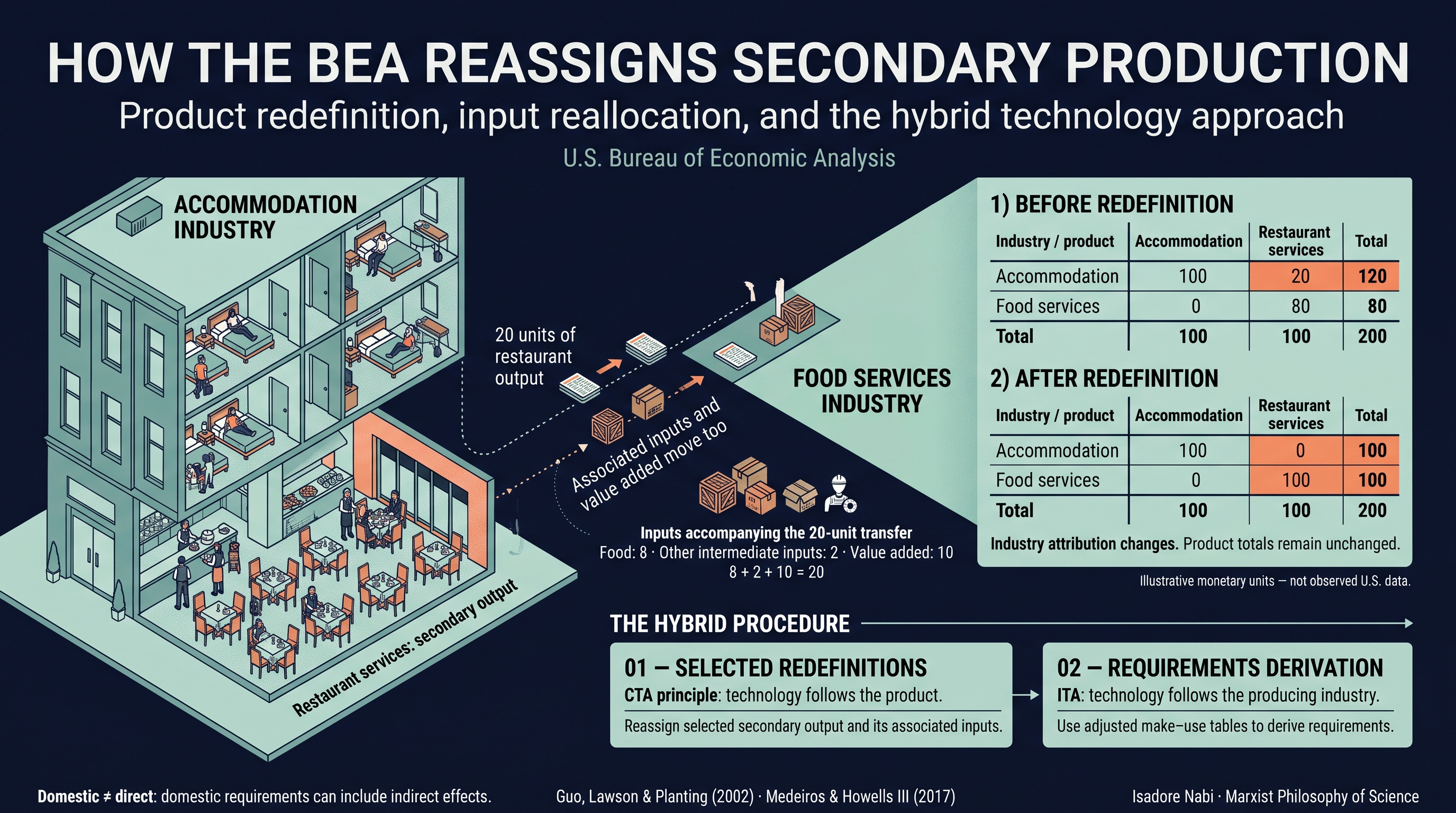
An industry need not produce only one type of good or service. A hotel, for example, may provide accommodation while also offering restaurant services. Although both activities belong to the same establishment, their requirements for food, labor, energy, and other resources may differ considerably.
In standard make and use tables, products are initially recorded under the industry that produces them. A distinction is drawn between primary products, which are characteristic of an industry, and secondary products. The difficulty arises when the input structure of a secondary activity differs substantially from that of the primary activity.[3]
The methodological question is therefore how to construct relationships between output and inputs that support the study of interindustry linkages without automatically assigning the same technology to heterogeneous activities. The procedure examined here addresses this problem by adjusting the industrial attribution of selected activities.
II. Two Technology Assumptions
Transforming the make-use system into a symmetric representation requires assumptions about the inputs attributable to secondary products. Two formulations are central: the industry-technology assumption (ITA) and the commodity-technology assumption (CTA).[1]
| Assumption | Proposition | Implication |
|---|---|---|
| ITA Industry technology | Products made by an industry share its input structure. | Inputs to secondary production are estimated from the producing industry. |
| CTA Commodity technology | Each product has an input structure independent of the industry producing it. | Technology is associated with the product, even when it is secondary in its industry of origin. |
These assumptions express different ways of representing production. They should not be interpreted as universal empirical identities. The choice affects the transformation of the tables and, consequently, the interpretation of the resulting coefficients.
III. The BEA’s Hybrid Procedure
In the documentation examined here, the BEA uses a hybrid approach: it combines selective adjustments informed by commodity technology with a subsequent derivation based on industry technology. It is useful to distinguish two broad stages without confusing them with the operations carried out within the first stage.[1][2]
First stage: redefining output and reallocating its inputs
Secondary products are selected when their inputs differ substantially from those of the primary product of the originating industry. Their output is attributed to the industry in which those products are primary: this operation constitutes the redefinition of output.[5][6]
The adjustment must be accompanied by the reallocation of the associated inputs, including intermediate inputs and value-added components. Moving output alone would leave the records of products and costs out of alignment. These adjustments produce the supplementary tables known as after redefinition tables.[2]
This stage approximates the CTA principle, but it does not amount to mechanically applying a pure CTA model to the entire economy. The manual also specifies that reallocations should use an input structure appropriate to the redefined activity, rather than necessarily applying the receiving industry’s entire input pattern.
Second stage: deriving the requirements tables
Starting from the adjusted tables, the mathematical derivation uses the ITA to handle the remaining secondary production. The existence of secondary products therefore does not imply that all must first be redefined: some remain in their producing industry and are treated according to this second assumption.[1]
- Standard tablesPrimary and secondary output is recorded in its industry of origin.
- After redefinition tablesSelected secondary output is transferred and its associated inputs are reallocated.
- Derivation of requirementsCoefficients and cumulative relationships are calculated using the specified technology assumptions.
IV. An Example: Hotels and Restaurants
The BEA uses restaurant services produced by hotels to illustrate redefinition from accommodation to food services.[3] The following example develops that idea using hypothetical figures in monetary units; it does not reproduce observations from the U.S. economy.
| Industry / product | Accommodation | Restaurant services | Total |
|---|---|---|---|
| Accommodation | 100 | 20 | 120 |
| Food services | 0 | 80 | 80 |
| Total by product | 100 | 100 | 200 |
| Industry / product | Accommodation | Restaurant services | Total |
|---|---|---|---|
| Accommodation | 100 | 0 | 100 |
| Food services | 0 | 100 | 100 |
| Total by product | 100 | 100 | 200 |
Suppose that this output of 20 is associated with 8 of food inputs, 2 of other intermediate inputs, and 10 of value added. When the output is redefined, these components must also be moved from the accommodation column to the food services column in the use table. The reallocated amount is 20, equal to the value of the transferred output.
Central idea · This note’s synthesisRedefinition changes the industrial attribution of output while preserving product totals.
The procedure changes the statistical representation: the restaurant may continue to operate within the hotel. The receiving industry in the adjusted tables is an analytical category to which the corresponding output and inputs are attributed.
V. From Adjusted Tables to Requirements
Once the supplementary tables have been obtained, two distinctions must be kept separate: the distinction between direct and indirect effects, and the distinction between the domestic and imported origin of production.
| Dimension | Distinction |
|---|---|
| Production linkages | Direct requirements describe inputs used immediately. Requirements incorporating indirect effects also capture successive links in the supply chain. |
| Origin of production | Domestic requirements consider production within the country. The tables the BEA calls total requirements also incorporate the imported component. |
To construct domestic requirements, the BEA starts with intermediate uses after redefinition and subtracts the imported component. It then calculates direct coefficients and market shares, which it combines to obtain the different domestic requirements tables.[4]
A direct requirements table should therefore not be defined as though it already incorporated all indirect effects. These emerge when successive relationships between suppliers and purchasers are developed through the corresponding matrix structure.
VI. Scope and Methodological Interpretation
The purpose of these adjustments is to obtain a more homogeneous relationship between products and inputs. This analytical gain has a counterpart: industries after redefinition depart from the boundaries used in standard tables and from their immediate correspondence with the industrial classification. The BEA manual explicitly identifies this tension between homogeneity and classificatory consistency.[2]
An implication for analysis follows: before comparing sectoral coefficients or indicators, it is useful to check whether they come from tables before or after redefinition. The category “industry” does not necessarily retain the same statistical content in both representations.
Descriptive and predictive uses must also be distinguished. The tables may represent average technological relationships for a reference year. Using them to simulate large changes requires evaluating the assumptions of constant returns to scale and no input substitution, which may become restrictive when the hypothetical economy departs from the observed one.[4]
Greater homogeneity in a table does not, by itself, demonstrate that its coefficients describe invariant technologies. Economic interpretation requires attention both to the construction procedure and to the conditions of the particular application.
VII. Conclusions
The treatment of secondary production is a substantive methodological decision in constructing input–output tables. In the hybrid approach examined here, the first stage redefines selected activities and reallocates their inputs; the second uses the industry-technology assumption to derive requirements from the adjusted tables.
Redefinition changes attribution across industries while preserving product totals. The calculation of direct coefficients must, in turn, be distinguished from the derivation of cumulative relationships incorporating indirect effects. Neither of these distinctions can be replaced by the distinction between domestic and imported production.
Understanding these operations makes it possible to read the input–output matrix as a constructed representation of production relationships: a tool whose scope depends on its sources, classifications, and technology assumptions. That understanding is indispensable for a rigorous interpretation of interindustry relationships.
VIII. References
- Guo, J., Lawson, A. M., & Planting, M. A. (2002). From Make-Use to Symmetric I-O Tables: An Assessment of Alternative Technology Assumptions (WP2002-03). Paper presented at the 14th International Conference on Input-Output Techniques, Montreal. Full text at the BEA (PDF).
- Horowitz, K. J., & Planting, M. A. (2006; updated April 2009). Concepts and Methods of the U.S. Input-Output Accounts. Bureau of Economic Analysis. In particular, chapters 4, 9, and 12. Methodological manual (PDF).
- U.S. Bureau of Economic Analysis. (2011, May). Measuring the Nation’s Economy: An Industry Perspective. A Primer on BEA’s Industry Accounts. Revised version. Full document (PDF).
- Medeiros, G., & Howells III, T. F. (2017, March). Introducing Domestic Requirements Tables for 1997–2015. Survey of Current Business. Bureau of Economic Analysis. Article and mathematical derivation (PDF).
- U.S. Bureau of Economic Analysis. (2005, November 16). What are redefinitions, and where are they described? Frequently asked questions. Read the institutional explanation.
- U.S. Bureau of Economic Analysis. (2018, April 13). Redefinition. Glossary. Read the definition.
Leave a Comment/Deja un Comentario