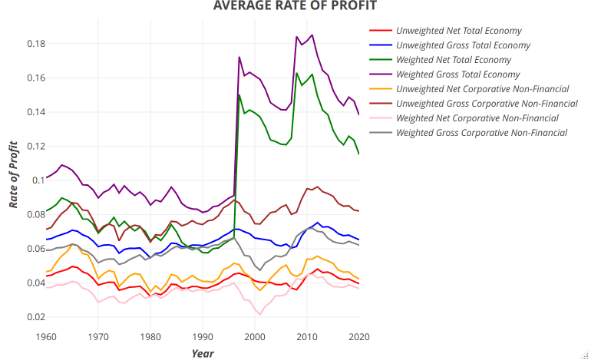
Sectorial Exclusion Criteria in the Marxist Analysis of the Average Rate of Profit: The United States Case (1960-2020)

LINK TO ARTICLE (ENLACE AL ARTÍCULO): https://doi.org/10.31219/osf.io/seqbf

PROBLEM STATEMENT AND OBJECTIVES

The article addresses the lack of a theoretically grounded criterion for determining which economic activities should be included or excluded when estimating the long-term Marxist average rate of profit (ARP). The main objective is to provide a standard Marxist decision criterion for the inclusion and exclusion of economic activities in the calculation of the ARP, applied to the case of U.S. economic sectors between 1960 and 2020.

THEORETICAL FRAMEWORK

The study is based on Marxist theory, specifically on the Marxist definition of productive labor, its location in the circuit of capital, and its relationship with the production of surplus value. Emphasis is placed on the distinction between productive and unproductive labor, as well as the difference between productive and unproductive consumption. The theoretical framework also incorporates considerations about the role of gold as the foundation of money value, even after the abandonment of the gold standard.

METHODS AND TECHNIQUES

The study uses a variety of econometric and time series analysis techniques:

  1. Daubechies wavelet transform filters with increased symmetry
  2. Empirical mode decomposition
  3. Hodrick-Prescott filter embedded in an unobserved components model
  4. Various unit root tests
  5. Principal Component Analysis (PCA)
  6. Singular Value Decomposition (SVD)
  7. Backward elimination with linear and generalized linear models
  8. Dynamic factor autoregressive model

RESULTS

  1. Criteria were established for the inclusion and exclusion of economic sectors in the calculation of the Marxist ARP.
  2. The application of these criteria to the U.S. economy resulted in the exclusion of sectors such as wholesale and retail trade, finance and insurance, real estate, and government.
  3. The ARP calculated with the sectors included according to the established criteria showed a long-term decreasing trend, consistent with Marxist theory.
  4. Econometric analyses (PCA, SVD, backward elimination, dynamic factor autoregressive model) largely supported the proposed exclusion criteria.
  5. The results were consistent both theoretically and econometrically with the logic of Marxist political economy.

CONCLUSIONS

  1. The proposed criteria for the inclusion and exclusion of sectors in the calculation of the Marxist ARP are gnoseologically and econometrically valid for the case of the U.S. economy between 1960 and 2020.
  2. These criteria showed internal consistency with the central assumption of the theory of production prices, which is also the theoretical core of Marxism applied to economic analysis.
  3. The criteria also demonstrated objective consistency regarding which sectors are relevant in capitalist economic dynamics.
  4. The study reveals the need for additional research for other capitalist economies and has the potential to impact the applied analysis of production prices.
  5. The long-term decreasing trend of the ARP was confirmed, a fundamental finding in Marxist theory.
  6. The study provides a solid methodological basis for future research on the ARP and the dynamics of capitalism from a Marxist perspective.

PLANTEAMIENTO DEL PROBLEMA Y OBJETIVOS
El artículo aborda la falta de un criterio teóricamente fundamentado para determinar qué actividades económicas deben incluirse o excluirse al estimar la tasa media de ganancia (TMG) marxista a largo plazo. El objetivo principal es proporcionar un criterio de decisión estándar marxista para la inclusión y exclusión de actividades económicas en el cálculo de la TMG, aplicado al caso de los sectores económicos de Estados Unidos entre 1960 y 2020.

MARCO TEÓRICO
El estudio se basa en la teoría marxista, específicamente en la definición marxista de trabajo productivo, su ubicación en el circuito del capital y su relación con la producción de plusvalía. Se hace hincapié en la distinción entre trabajo productivo e improductivo, así como en la diferencia entre consumo productivo e improductivo. El marco teórico también incorpora consideraciones sobre el papel del oro como fundamento del valor del dinero, incluso después del abandono del patrón oro.

MÉTODOS Y TÉCNICAS
El estudio utiliza una variedad de técnicas econométricas y de análisis de series temporales:

  1. Filtros de transformada wavelet de Daubechies con simetría aumentada.
  2. Descomposición en modos empíricos.
  3. Filtro Hodrick-Prescott incrustado en un modelo de componentes no observables.
  4. Diversas pruebas de raíz unitaria.
  5. Análisis de Componentes Principales (ACP).
  6. Descomposición en Valores Singulares (DVS).
  7. Eliminación hacia atrás con modelos lineales y lineales generalizados.
  8. Modelo autorregresivo de factores dinámicos

RESULTADOS

  1. Se establecieron criterios para la inclusión y exclusión de sectores económicos en el cálculo de la TMG marxista.
  2. La aplicación de estos criterios a la economía estadounidense resultó en la exclusión de sectores como el comercio mayorista y minorista, finanzas y seguros, bienes raíces, y el gobierno.
  3. La TMG calculada con los sectores incluidos según los criterios establecidos mostró una tendencia decreciente a largo plazo, consistente con la teoría marxista.
  4. Los análisis econométricos (ACP, DVS, eliminación hacia atrás, modelo autorregresivo de factores dinámicos) respaldaron en gran medida los criterios de exclusión propuestos.
  5. Los resultados fueron consistentes tanto teórica como econométricamente con la lógica de la economía política marxista.

CONCLUSIONES

  1. Los criterios propuestos para la inclusión y exclusión de sectores en el cálculo de la TMG marxista son válidos gnoseológica y econométricamente para el caso de la economía estadounidense entre 1960 y 2020.
  2. Estos criterios mostraron consistencia interna con la suposición central de la teoría de los precios de producción, que es también el núcleo teórico del marxismo aplicado al análisis económico.
  3. Los criterios también demostraron consistencia objetiva con respecto a qué sectores son relevantes en la dinámica económica capitalista.
  4. El estudio revela la necesidad de investigaciones adicionales para otras economías capitalistas y tiene el potencial de impactar el análisis aplicado de los precios de producción.
  5. Se confirmó la tendencia decreciente a largo plazo de la TMG, un hallazgo fundamental en la teoría marxista.
  6. El estudio proporciona una base metodológica sólida para futuras investigaciones sobre la TMG y la dinámica del capitalismo desde una perspectiva marxista.

Quantitative Theory of Money or Prices? A Historical, Theoretical, and Econometric Analysis

LINK TO ARTICLE (ENLACE AL ARTÍCULO): https://doi.org/10.31219/osf.io/eskmx

PROBLEM STATEMENT AND OBJECTIVES

The article addresses the relationship between money and prices, analyzing the validity of two main theories: the quantitative theory of money (neoclassical) and the quantitative theory of prices (Marxist). The main objective is to determine which of these theories better explains economic reality and the practical implications of this relationship.

THEORETICAL FRAMEWORK The study starts with a critique of David Hume’s quantitative theory of money, the basis of neoclassical monetary theory. It is contrasted with Marx’s theory, which posits that prices determine the quantity of money in circulation and not vice versa. The role of gold as the foundation of money’s value is analyzed, even after the abandonment of the gold standard, arguing that there exists a “flexible gold standard” in current monetary policy.

METHODS AND TECHNIQUES

The study uses quarterly data from the United States (1959-2022), Canada (1961-2022), United Kingdom (1986-2022), and Brazil (1996-2022). Various econometric and machine learning techniques are employed:

  1. Univariate Bayesian regression
  2. RESET tests for non-linear relationships
  3. Bayesian generalized linear models (BGLM)
  4. Empirical distribution fitting
  5. Bayesian cross-validation
  6. Machine learning and deep learning models (random forests, Bayesian neural networks, support vector machines)
  7. Model ensemble through boosting

RESULTS

The econometric and statistical learning analyses consistently show that:

  1. Money is not neutral in either the short or long term.
  2. There is a non-linear feedback relationship between prices, quantity of money, and the price of gold.
  3. The relationship between money in circulation and the price of gold varies according to the time segment, sometimes being direct and sometimes inverse.
  4. The direct relationship between money in circulation and prices is confirmed. The developed models show high predictive and explanatory performance for all countries analyzed.

CONCLUSIONS

  1. The neutrality of money postulated by neoclassical theory is rejected.
  2. The Marxist theory that prices determine the quantity of money in circulation is confirmed, but a complex and feedback relationship between both variables is recognized.
  3. Gold continues to play a fundamental role in the international monetary system, albeit more flexibly than in the past.
  4. The relationship between money, prices, and gold constitutes a complex system in the sense of chaos theory.
  5. The effectiveness of controlling prices directly or through the contraction of the money supply is theoretically justified. The article concludes that this approach is not only consistent with observed facts but also provides a broader and deeper explanation of monetary phenomena than neoclassical theory.

PLANTEAMIENTO DEL PROBLEMA Y OBJETIVOS

El artículo aborda la relación entre el dinero y los precios, analizando la validez de dos teorías principales: la teoría cuantitativa del dinero (neoclásica) y la teoría cuantitativa de los precios (marxista). El objetivo principal es determinar cuál de estas teorías explica mejor la realidad económica y las implicaciones prácticas de esta relación.MARCO TEÓRICOEl estudio parte de una crítica a la teoría cuantitativa del dinero de David Hume, base de la teoría monetaria neoclásica. Se contrasta con la teoría de Marx, que postula que los precios determinan la cantidad de dinero en circulación y no al revés. Se analiza el papel del oro como fundamento del valor del dinero, incluso después del abandono del patrón oro, argumentando que existe un “patrón oro flexible” en la política monetaria actual.

MÉTODOS Y TÉCNICAS

El estudio utiliza datos trimestrales de Estados Unidos (1959-2022), Canadá (1961-2022), Reino Unido (1986-2022) y Brasil (1996-2022). Se emplean diversas técnicas econométricas y de aprendizaje automático:

  1. Regresión bayesiana univariada.
  2. Pruebas RESET para relaciones no linealesModelos lineales generalizados bayesianos (BGLM).
  3. Ajuste de distribuciones empíricas.
  4. Validación cruzada bayesiana.
  5. Modelos de aprendizaje automático y aprendizaje profundo (bosques aleatorios, redes neuronales bayesianas, máquinas de vectores de soporte).
  6. Ensamblaje de modelos mediante boosting.

RESULTADOS

Los análisis econométricos y de aprendizaje estadístico muestran consistentemente que:

  1. El dinero no es neutral ni a corto ni a largo plazo.
  2. Existe una relación de retroalimentación no-lineal entre precios, cantidad de dinero y precio del oro.
  3. La relación entre el dinero en circulación y el precio del oro varía según el segmento temporal, siendo a veces directa y a veces inversa.
  4. Se confirma la relación directa entre el dinero en circulación y los precios.

Los modelos desarrollados muestran un alto rendimiento predictivo y explicativo para todos los países analizados.

CONCLUSIONES

  1. Se rechaza la neutralidad del dinero postulada por la teoría neoclásica.
  2. Se confirma la teoría marxista de que los precios determinan la cantidad de dinero en circulación, pero se reconoce una relación compleja y de retroalimentación entre ambas variables.
  3. El oro sigue jugando un papel fundamental en el sistema monetario internacional, aunque de manera más flexible que en el pasado.
  4. La relación entre dinero, precios y oro constituye un sistema complejo en el sentido de la teoría del caos.
  5. Se justifica teóricamente la eficacia de controlar los precios directamente o mediante la contracción de la masa monetaria.

El artículo concluye que este enfoque no solo es consistente con los hechos observados, sino que proporciona una explicación más amplia y profunda de los fenómenos monetarios que la teoría neoclásica.

Quasi-Newton methods: L-BFGS

BFGS In this previous post, we described how Quasi-Newton methods can be used to minimize a twice-differentiable function whose domain is all of . BFGS is a popular quasi-Newton method. At each iteration, we take the following steps: Solve for in . Update with . Update according to the equation where and . Limited memory […]

Quasi-Newton methods: L-BFGS

Higher Sense of Purpose in Life May Be Linked to Lower Mortality Risk

Source: Boston University Growing research indicates that one’s purpose—i.e., the extent to which someone perceives a sense of direction and goals in their life—may be linked to health-protective benefits such as better physical functioning and lower risks of cardiovascular disease or cognitive decline. Now, a new study led by a Boston University School of Public […]

Higher Sense of Purpose in Life May Be Linked to Lower Mortality Risk

Quasi-Newton methods in optimization

Consider the unconstrained minimization problem where is twice differentiable and . Newton’s method is a second-order descent method for finding the minimum. Starting at some initial point, at the th iteration we update the candidate solution with the formula where and are the gradient and Hessian of respectively, and is a step size chosen appropriately […]

Quasi-Newton methods in optimization

Affine hull vs. convex hull

The affine hull and convex hull are closely related concepts. Let be a set in . The affine hull of is the set of all affine combinations of elements of : The convex hull of is the set of all convex combinations of the elements of : Putting the definitions side by side, we see […]

Affine hull vs. convex hull

Exact line search and backtracking line search

Assume we are trying to minimize some convex function which is differentiable. One way to do this is to use a descent method. A general descent method can be described as follows: Given a starting point in the domain of , iterate over the following 3 steps until some stopping criterion is satisfied: Choose a […]

Exact line search and backtracking line search

What are the KKT conditions?

Consider an optimization problem in standard form: with the variable . Assume that the ‘s and ‘s are differentiable. (At this point, we are not assuming anything about their convexity.) As before, define the Lagrangian as the function Let and be the primal and dual optimal points respectively (i.e. points where the primal and dual […]

What are the KKT conditions?

Lagrange dual, weak duality and strong duality

Consider an optimization problem in standard form: with the variable . Let be the domain for , i.e. the intersection of the domains of the ‘s and the ‘s. Let denote the optimal value of the problem. The Lagrange dual function is the function defined as the minimum value of the Lagrangian over : The […]

Lagrange dual, weak duality and strong duality

The Lagrange dual function is always concave

Consider an optimization problem in standard form: with the variable . Let be the domain for , i.e. the intersection of the domains of the ‘s and the ‘s. The Lagrangian associated with this problem is the function defined as with domain . The Lagrange dual function is the function defined as the minimum value […]

The Lagrange dual function is always concave