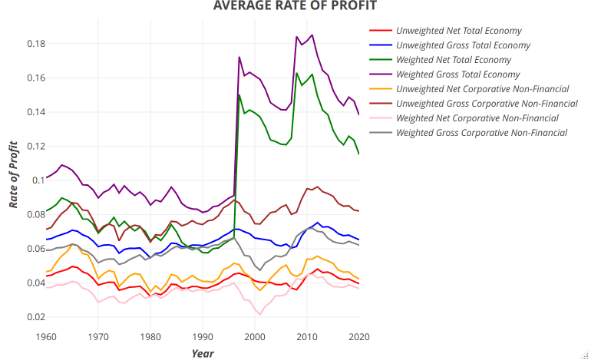
Sectorial Exclusion Criteria in the Marxist Analysis of the Average Rate of Profit: The United States Case (1960-2020)

LINK TO ARTICLE (ENLACE AL ARTÍCULO): https://doi.org/10.31219/osf.io/seqbf

PROBLEM STATEMENT AND OBJECTIVES

The article addresses the lack of a theoretically grounded criterion for determining which economic activities should be included or excluded when estimating the long-term Marxist average rate of profit (ARP). The main objective is to provide a standard Marxist decision criterion for the inclusion and exclusion of economic activities in the calculation of the ARP, applied to the case of U.S. economic sectors between 1960 and 2020.

THEORETICAL FRAMEWORK

The study is based on Marxist theory, specifically on the Marxist definition of productive labor, its location in the circuit of capital, and its relationship with the production of surplus value. Emphasis is placed on the distinction between productive and unproductive labor, as well as the difference between productive and unproductive consumption. The theoretical framework also incorporates considerations about the role of gold as the foundation of money value, even after the abandonment of the gold standard.

METHODS AND TECHNIQUES

The study uses a variety of econometric and time series analysis techniques:

  1. Daubechies wavelet transform filters with increased symmetry
  2. Empirical mode decomposition
  3. Hodrick-Prescott filter embedded in an unobserved components model
  4. Various unit root tests
  5. Principal Component Analysis (PCA)
  6. Singular Value Decomposition (SVD)
  7. Backward elimination with linear and generalized linear models
  8. Dynamic factor autoregressive model

RESULTS

  1. Criteria were established for the inclusion and exclusion of economic sectors in the calculation of the Marxist ARP.
  2. The application of these criteria to the U.S. economy resulted in the exclusion of sectors such as wholesale and retail trade, finance and insurance, real estate, and government.
  3. The ARP calculated with the sectors included according to the established criteria showed a long-term decreasing trend, consistent with Marxist theory.
  4. Econometric analyses (PCA, SVD, backward elimination, dynamic factor autoregressive model) largely supported the proposed exclusion criteria.
  5. The results were consistent both theoretically and econometrically with the logic of Marxist political economy.

CONCLUSIONS

  1. The proposed criteria for the inclusion and exclusion of sectors in the calculation of the Marxist ARP are gnoseologically and econometrically valid for the case of the U.S. economy between 1960 and 2020.
  2. These criteria showed internal consistency with the central assumption of the theory of production prices, which is also the theoretical core of Marxism applied to economic analysis.
  3. The criteria also demonstrated objective consistency regarding which sectors are relevant in capitalist economic dynamics.
  4. The study reveals the need for additional research for other capitalist economies and has the potential to impact the applied analysis of production prices.
  5. The long-term decreasing trend of the ARP was confirmed, a fundamental finding in Marxist theory.
  6. The study provides a solid methodological basis for future research on the ARP and the dynamics of capitalism from a Marxist perspective.

PLANTEAMIENTO DEL PROBLEMA Y OBJETIVOS
El artículo aborda la falta de un criterio teóricamente fundamentado para determinar qué actividades económicas deben incluirse o excluirse al estimar la tasa media de ganancia (TMG) marxista a largo plazo. El objetivo principal es proporcionar un criterio de decisión estándar marxista para la inclusión y exclusión de actividades económicas en el cálculo de la TMG, aplicado al caso de los sectores económicos de Estados Unidos entre 1960 y 2020.

MARCO TEÓRICO
El estudio se basa en la teoría marxista, específicamente en la definición marxista de trabajo productivo, su ubicación en el circuito del capital y su relación con la producción de plusvalía. Se hace hincapié en la distinción entre trabajo productivo e improductivo, así como en la diferencia entre consumo productivo e improductivo. El marco teórico también incorpora consideraciones sobre el papel del oro como fundamento del valor del dinero, incluso después del abandono del patrón oro.

MÉTODOS Y TÉCNICAS
El estudio utiliza una variedad de técnicas econométricas y de análisis de series temporales:

  1. Filtros de transformada wavelet de Daubechies con simetría aumentada.
  2. Descomposición en modos empíricos.
  3. Filtro Hodrick-Prescott incrustado en un modelo de componentes no observables.
  4. Diversas pruebas de raíz unitaria.
  5. Análisis de Componentes Principales (ACP).
  6. Descomposición en Valores Singulares (DVS).
  7. Eliminación hacia atrás con modelos lineales y lineales generalizados.
  8. Modelo autorregresivo de factores dinámicos

RESULTADOS

  1. Se establecieron criterios para la inclusión y exclusión de sectores económicos en el cálculo de la TMG marxista.
  2. La aplicación de estos criterios a la economía estadounidense resultó en la exclusión de sectores como el comercio mayorista y minorista, finanzas y seguros, bienes raíces, y el gobierno.
  3. La TMG calculada con los sectores incluidos según los criterios establecidos mostró una tendencia decreciente a largo plazo, consistente con la teoría marxista.
  4. Los análisis econométricos (ACP, DVS, eliminación hacia atrás, modelo autorregresivo de factores dinámicos) respaldaron en gran medida los criterios de exclusión propuestos.
  5. Los resultados fueron consistentes tanto teórica como econométricamente con la lógica de la economía política marxista.

CONCLUSIONES

  1. Los criterios propuestos para la inclusión y exclusión de sectores en el cálculo de la TMG marxista son válidos gnoseológica y econométricamente para el caso de la economía estadounidense entre 1960 y 2020.
  2. Estos criterios mostraron consistencia interna con la suposición central de la teoría de los precios de producción, que es también el núcleo teórico del marxismo aplicado al análisis económico.
  3. Los criterios también demostraron consistencia objetiva con respecto a qué sectores son relevantes en la dinámica económica capitalista.
  4. El estudio revela la necesidad de investigaciones adicionales para otras economías capitalistas y tiene el potencial de impactar el análisis aplicado de los precios de producción.
  5. Se confirmó la tendencia decreciente a largo plazo de la TMG, un hallazgo fundamental en la teoría marxista.
  6. El estudio proporciona una base metodológica sólida para futuras investigaciones sobre la TMG y la dinámica del capitalismo desde una perspectiva marxista.

WHY MARXISTS CANNOT IGNORE CIRCULATING CAPITAL!

defending-turnover-for-the-last-timeDownload klems-1987-2021Download This posting is a courtesy to those commenting on turnover and circulating capital in a recent post on Michael Roberts blog. On the spreadsheet, which is vast, all calculations for the graphs are coloured. to help the reader navigate it.

WHY MARXISTS CANNOT IGNORE CIRCULATING CAPITAL!

En favor de la simplicidad: un paradigma para la economía política del siglo 21

Alan Freeman Universidad Metropolitana de Londres RESUMEN Esta es una pre-publicación del capítulo con el mismo nombre que ha sido publicado por primera vez en Freeman et al (2001), reproducido con el amable permiso de los editores. Lo he reacomodado para uso académico como un texto por separado, con las referencias incluidas y con notas […]

En favor de la simplicidad: un paradigma para la economía política del siglo 21

SOBRE LA CREACIÓN Y DESTRUCCIÓN DE VALOR EN LOS SISTEMAS DE ECONOMÍA POLÍTICA CAPITALISTA EN PARTICULAR Y EN LOS SISTEMAS ECONÓMICOS EN GENERAL (BORRADOR)

ISADORE NABI

REFERENCIAS

Alan. (25 de Julio de 2011). ENGLISH LENGUAGE & USAGE. Obtenido de Stack Exchange: https://english.stackexchange.com/questions/35508/difference-between-partly-and-partially#:~:text=Use%20partly%20when%20the%20%22in,it’s%20also%20%22partly%20closed%22.

Andrews, D. W. (1991). An Empirical Process Central Limit Theorem for Dependent Non-identically Distributed Random Variables . Journal of Multivariate Analysis, 187-203.

Berk, K. (1973). A CENTRAL LIMIT THEOREM FOR m-DEPENDENT RANDOM VARIABLES WITH UNBOUNDED m. The Annals of Probability, 1(2), 352-354.

Borisov, E. F., & Zhamin, V. A. (2009). Diccionario de Economía Política. (L. H. Juárez, Ed.) Nueva Guatemala de la Asunción, Guatemala, Guatemala: Tratados y Manuales Grijalbo.

Cockshott, P., & Cottrell, A. (2005). Robust correlations between prices and labor values. Cambridge Journal of Economics, 309-316.

Cockshott, P., Cottrell, A., & Valle Baeza, A. (2014). The Empirics of the Labour Theory of Value: Reply to Nitzan and Bichler. Investigación Económica, 115-134.

Cockshott, P., Cottrell, A., & Zachariah, D. (29 de Marzo de 2019). Against the Kliman theory. Recuperado el 22 de Marzo de 2021, de Paul Cockshott: http://paulcockshott.co.uk/publication-archive/Talks/politicaleconomy/Against%20the%20Kliman%20price%20theory.pdf

Dedecker, J., & Prieur, C. (2007). An empirical central limit theorem for dependent sequences. Stochastic Processes and their Applications, 117, 121-142.

Díaz, E., & Osuna, R. (2007). Indeterminacy in price–value correlation measures. Empirical Economics, 389-399.

Emmanuel, A. (1972). El Intercambio Desigual. Ensayo sobre los antagonismos en las relaciones económicas internacionales. México, D.F.: Sigloveintiuno editores, s.a.

Farjoun, E., & Marchover, M. (1983). Laws of Chaos. A Probabilistic Approach to Political Economy. Londres: Verso Editions and NLB.

fast.ai. (3 de Diciembre de 2017). How to calculate Weighted Mean Absolute Error (WMAE)? Obtenido de Forums: https://forums.fast.ai/t/how-to-calculate-weighted-mean-absolute-error-wmae/8575

Flaschel, P., & Semmler, W. (1985). The Dynamic Equalization of Profit Rates for Input-Output Models with Fixed Capital. En Varios, & W. Semmler (Ed.), Competition, Instability, and Nonlinear Cycles (págs. 1-34). New York: Springer-Verlag.

Flores Morador, F. (2013). Marx and the Moral Depreciation of Technology: Labor Value as Information. Social Science Research Network Electronic Journal, 1-16. Obtenido de https://internt.ht.lu.se/media/documents/project-778/Marx_and_the_moral_depreciation_of_technology.pdf

Fröhlich, N. (2012). Labour values, prices of production and the missing equalisation tendency of profit rates: evidence from the German economy. Cambridge Journal of Economics, 37(5), 1107-1126.

Glick, M., & Ehrbar, H. (1988). Profit Rate Equalization in the U.S. and Europe: An Econometric Investigation. European Journal of Political Economy, 179-201.

Gloria-Palermo, S. (2010). Introducing Formalism in Economics: The Growth Model of John von Neumann. Panoeconomicus, 153-172.

Godwin, H., & Zaremba, S. (1961). A Central Limit Theorem for Partly Dependent Variables. The Annals of Mathematical Statistics, 32(3), 677-686.

Guerrero, D. (Octubre-diciembre de 1997). UN MARX IMPOSIBLE: EL MARXISMO SIN TEORÍA LABORAL DEL VALOR. 57(222), 105-143.

Investopedia. (23 de Agosto de 2020). The Difference Between Standard Deviation and Average Deviation. Obtenido de Advanced Technical Analysis Concepts : https://www.investopedia.com/ask/answers/021215/what-difference-between-standard-deviation-and-average-deviation.asp

Kliman, A. (2002). The law of value and laws of statistics: sectoral values and prices in the US economy, 1977-97. Cambridge Journal of Economics, 299-311.

Kliman, A. (2005). Reply to Cockshott and Cottrell. Cambridge Journal of Economics, 317-323.

Kliman, A. (2014). What is spurious correlation? A reply to Díaz and Osuna. Journal of Post Keynesian Economics, 21(2), 345-356.

KO, M.-H., RYU, D.-H., KIM, T.-S., & CHOI, Y.-K. (2007). A CENTRAL LIMIT THEOREM FOR GENERAL WEIGHTED SUMS OF LNQD RANDOM VARIABLES AND ITS APPLICATION. ROCKY MOUNTAIN JOURNAL OF MATHEMATICS, 37(1), 259-268.

Kuhn, T. (2011). La Estructura de las Revoluciones Científicas. México, D.F.: Fondo de Cultura Económica.

Kuroki, R. (1985). The Equalizartion of the Rate of Profit Reconsidered. En W. Semmler, Competition, Instability, and Nonlinear Cycles (págs. 35-50). New York: Springer-Velag.

Landau, L. D., & Lifshitz, E. M. (1994). Curso de Física Teórica. Mecánica (Segunda edición corregida ed.). (E. L. Vázquez, Trad.) Barcelona: Reverté, S.A.

Leontief, W. (1986). Input-Output Economics. Oxford, United States: Oxford University Press.

Levins, R. (Diciembre de 1993). A Response to Orzack and Sober: Formal Analysis and the Fluidity of Science. The Quarterly Review of Biology, 68(4), 547-55.

LI, X.-p. (2015). A Central Limit Theorem for m-dependent Random Variables under Sublinear Expectations. Acta Mathematicae Applicatae Sinica, 31(2), 435-444. doi:10.1007/s10255-015-0477-1

Marquetti, A., & Foley, D. (25 de Marzo de 2021). Extended Penn World Tables. Obtenido de Extended Penn World Tables: Economic Growth Data assembled from the Penn World Tables and other sources : https://sites.google.com/a/newschool.edu/duncan-foley-homepage/home/EPWT

Marx, K. H. (1989). Contribución a la Crítica de la Economía Política. (M. Kuznetsov, Trad.) Moscú: Editorial Progreso.

Marx, K. H. (2010). El Capital (Vol. I). México, D.F.: Fondo de Cultura Económica.

Mindrila, D., & Balentyne, P. (2 de Febrero de 2021). Scatterplots and Correlation. Obtenido de University of West Georgia: https://www.westga.edu/academics/research/vrc/assets/docs/scatterplots_and_correlation_notes.pdf

Mora Osejo, L. (1 de Enero de 1992). Reseñas y Comentarios. John von Neumann and Modern Economics. Goodwin, Dore, Chakavarty. Cuadernos de Economía, 12(17), 215-221. Obtenido de https://revistas.unal.edu.co/index.php/ceconomia/article/view/19349/20301

Moseley, F. (2015). Money and Totality. Leiden, South Holland, Netherlands: BRILL.

Nabi, I. (2020). SOBRE LA LEY DE LA TENDENCIA DECRECIENTE DE LA TASA MEDIA DE GANANCIA. Raíces Unitarias y No Estacionariedad de las Series de Tiempo. Documento Inédito. Obtenido de https://marxistphilosophyofscience.com/wp-content/uploads/2020/12/analisis-del-uso-de-la-prueba-de-hipotesis-en-el-contexto-de-la-especificacion-optima-de-un-modelo-de-regresion-isadore-nabi-2.pdf

Nabi, I. (2021). Lecciones de Gnoseología Marxiana I. Documento Inédito. Obtenido de https://marxianstatistics.com/2021/04/09/lecciones-de-gnoseologia-marxiana-i-lessons-of-marxian-gnoseology-i/

NABI, I. (1 de Abril de 2021). SOBRE LA METODOLOGÍA DEL U.S. BUREAU OF ECONOMIC ANALYSIS PARA LA REDEFINICIÓN Y REASIGNACIÓN DE PRODUCTOS EN LA MATRIZ INSUMO-PRODUCTO DE ESTADOS UNIDOS. Obtenido de ECONOMÍA POLÍTICA: https://marxianstatistics.com/2021/04/01/sobre-la-metodologia-del-u-s-bureau-of-economic-analysis-para-la-redefinicion-y-reasignacion-de-productos-en-la-matriz-insumo-producto-de-estados-unidos/

NABI, I., & B.A., A. (1 de Abril de 2021). UNA METODOLOGÍA EMPÍRICA PARA LA DETERMINACIÓN DE LA MAGNITUD DE LAS INTERRELACIONES SECTORIALES DENTRO DE LA MATRIZ INSUMO-PRODUCTO DESDE LOS CUADROS DE PRODUCCIÓN Y USOS PARA EL CASO DE ESTADOS UNIDOS 1997-2019. Obtenido de EL BLOG DE ISADORE NABI: https://marxianstatistics.com/2021/04/01/una-metodologia-empirica-para-la-determinacion-de-la-magnitud-de-las-interrelaciones-sectoriales-dentro-de-la-matriz-insumo-producto-desde-los-cuadros-de-oferta-utilizacion-para-el-caso-de-estados-uni/

OECD. (25 de Septiembre de 2005). SCRAPPING. Obtenido de GLOSSARY OF STATISTICAL TERMS: https://stats.oecd.org/glossary/detail.asp?ID=2395

Parzen, E. (1957). A Central Limit Theorem for Multilinear Stochastic Processes. The Annals of Mathematical Statistics, 28(1), 252-256.

Pasinetti, L. (1984). Lecciones Sobre Teoría de la Producción. (L. Tormo, Trad.) México, D.F.: Fondo de Cultura Económica.

Real Academia Española. (18 de 03 de 2021). Diccionario de la lengua española. Obtenido de Edición del Tricentenario | Actualización 2020: https://dle.rae.es/transitar?m=form

Real Academia Española. (23 de Marzo de 2021). Diccionario de la lengua española. Obtenido de Edición Tricentenario | Actualización 2020: https://dle.rae.es/ecualizar?m=form

Rosental, M. M., & Iudin, P. F. (1971). DICCIONARIO FILOSÓFICO. San Salvador: Tecolut.

Rosental, M., & Iudin, P. (1971). Diccionario Filosófico. San Salvador: Tecolut.

Sánchez, C. (Diciembre de 2013). Inconsistencia de la teoría neoclásica: aplicación del análisis dimensional a la economía. ECONOMÍA HOY, 4-6. Obtenido de https://www.uca.edu.sv/economia/wp-content/uploads/012-ECONOMIA-HOY-A-DIC2013.pdf

Sánchez, C., & Ferràndez, M. N. (Octubre-diciembre de 2010). Valores, precios de producción y precios de mercado a partir de los datos de la economía española. Investigación Económica, 87-118. Obtenido de https://www.jstor.org/stable/42779601?seq=1

Sánchez, C., & Montibeler, E. E. (2015). La teoría del valor trabajo y los precios en China. Economia e Sociedade, 329-354.

StackExchange. (12 de Enero de 2014). Mean absolute deviation vs. standard deviation. Obtenido de Cross Validated: https://stats.stackexchange.com/questions/81986/mean-absolute-deviation-vs-standard-deviation

Steedman, I., & Tomkins, J. (1998). On measuring the deviation of prices from values. Cambridge Journal of Economics, 379-385.

U.S. Bureau of Economic Analysis. (1 de Abril de 2021). The Domestic Supply of Commodities by Industries (Millions of dollars). Obtenido de Input-Output Accounts Data | Data Files. Supply Tables – Domestic supply of commodities by industry ● 1997-2019: 15 Industries iTable, 71 Industries iTable: https://apps.bea.gov/iTable/iTable.cfm?reqid=52&step=102&isuri=1&table_list=3&aggregation=sum

U.S. Bureau of Economic Analysis. (1 de Abril de 2021). The Domestic Supply of Commodities by Industries (Millions of dollars). Obtenido de Input-Output Accounts Data | Supplemental Estimate Tables. After Redefinition Tables. Make Tables/After Redefinitions – Production of commodities by industry after redefinition of secondary production ● 1997-2019: 71 Industries iTable: https://apps.bea.gov/iTable/iTable.cfm?reqid=58&step=102&isuri=1&table_list=5&aggregation=sum

U.S. Bureau of Economic Analysis. (1 de Abril de 2021). The Use of Commodities by Industries. Obtenido de Input-Output Accounts Data | Data Files. Use Tables – Use of commodities by industry ● 1997-2019: 15 Industries iTable, 71 Industries iTable: https://apps.bea.gov/iTable/iTable.cfm?reqid=52&step=102&isuri=1&table_list=4&aggregation=sum

U.S. Bureau of Economic Analysis. (1 de Abril de 2021). The Use of Commodities by Industries. Obtenido de Input-Output Accounts Data | Supplemental Estimate Tables. After Redefinition Tables. Use Tables/After Redefinitions/Producer Value – Use of commodities by industry after reallocation of inputs ● 1997-2019: 71 Industries iTable: https://apps.bea.gov/iTable/iTable.cfm?reqid=58&step=102&isuri=1&table_list=6&aggregation=sum

Valle Baeza, A. (1978). Valor y Precios de Producción. Investigación Económica, 169-203.

Walras, L. (1954). Elements of Pure Economics or The Theory of Social Wealth. (W. Jaffé, Trad.) Homewood, Ilinois, Estados Unidos: Richard D. Irwin, Inc.

Wikipedia. (25 de Enero de 2021). Trabajo (física). Obtenido de Magnitudes termodinámicas: https://es.wikipedia.org/wiki/Trabajo_(f%C3%ADsica)

Wikipedia. (17 de Marzo de 2021). Work (physics). Obtenido de Energy (physics): https://en.wikipedia.org/wiki/Work_(physics)

Wooldridge, J. M. (2010). Introducción a la Econometría. Un Enfoque Moderno (Cuarta ed.). México, D.F.: Cengage Learning.

Zachariah, D. (Junio de 2006). Labour value and equalisation of profit rates: a multi-country study. Indian Development Review, 4, 1-20.