ZERO TO BIRTH: HOW THE HUMAN BRAIN IS BUILT

breathwork-science's avatarbreathwork-science

Written by William A. Harris

A BOOK WITH MANY SIDES

Review by Gunnel Minett

The average adult human brain weighs about 1.5 kg and accounts for about 2% of the adult body weight. It is very similar in shape and form for most human beings. Still it is unique to each individual. By the time a child is born the brain has billions of neurones that are wired together through trillions of interconnections into what can only be described as the most sophisticated supercomputer we can only begin to imagine.

This book describes the journey from the fertilised egg to the moment a new human being is born, and beyond. It is written by an experimental neurobiologist, describing the development of neurobiology which has lead to the increase in understanding of human evolution as well as the human brain.

Still, the story of how this development takes place is filled…

View original post 404 more words

Ukraine: the invasion of capital

Imagen tomada de Translator without Borders.

michael roberts's avatarMichael Roberts Blog

Last week, Ukraine’s foreign private creditors agreed to the country’s request for a two-year freeze on payments on about $20bn of foreign debt.  This would enable Ukraine to avoid defaulting on its overseas borrowings.  Unlike other ‘emerging economies’ in debt distress, it seems that foreign bondholders are happy to help Ukraine out – if only for two years.  The move will save Ukraine $6bn over the period, helping to reduce pressure on central bank reserves, which slid by 28 per cent year-to-date, despite significant foreign aid.

Ukraine’s economy is, not surprisingly, in a desperate state. Real GDP is projected to decline by more than 30% in 2022 and the unemployment rate is at 35% (Constantinescu et al. 2022, Blinov and Djankov 2022, National Bank of Ukraine 2022). “We are grateful for the private sector support of our proposal in such terrible times for our country,” responded Yuriy Butsa, Ukraine’s deputy…

View original post 1,647 more words

Don’t Pay UK: Mass civil disobedience is risky – but it could work

Imagen del encabezado tomada de Left Voice.

Don’t Pay UK is still in its infancy, but the momentum is encouraging. Over the next month, we will see whether it can mount a serious campaign which will force the government’s hand, or simply wither away.

Don’t Pay UK: Mass civil disobedience is risky – but it could work

Russia under Putin

Imagen tomada de worldometers.

michael roberts's avatarMichael Roberts Blog

In my last post, I described how Western capital is planning to take over and control Ukraine’s resources and exploit its labour force to the maximum in order to boost the profitability of both Ukraine’s domestic capitalists (oligarchs) and foreign multi-nationals.

However, there is a problem for Western capital and Ukraine’s oligarchs: it’s Russia. The war has already led to Russian forces gaining control of at least $12.4trn worth of Ukraine’s resources in energy (cola), metals and mineral deposits, apart from agricultural land. If Putin’s forces succeed in annexing Ukrainian land seized during Russia’s invasion, Kyiv would permanently lose almost two-thirds of its deposits. Moscow now controls 63% of Ukraine’s coal deposits, 11% of its oil, 20% of its natural gas, 42% of its metals, and 33% of its rare earths.

So any rebuilding effort funded by Western capital has a major obstacle.  “Not only will Ukraine have lost…

View original post 1,752 more words

Rank and trace are equal for a real symmetric idempotent matrix

kjytay's avatarMathematical Odds & Ends

Proposition. Let $latex mathbf{X} in mathbb{R}^{n times n}$ be a matrix that is symmetric ($latex mathbf{X}^top = mathbf{X}$) and idempotent ($latex mathbf{X}^2 = mathbf{X}$). Then the rank of $latex mathbf{X}$ is equal to the trace of $latex mathbf{X}$. In fact, they are both equal to the sum of the eigenvalues of $latex mathbf{X}$.

The proof is relatively straightforward. Since $latex mathbf{X}$ is real and symmetric, it is orthogonally diagonalizable, i.e. there is an orthogonal matrix $latex mathbf{U}$ ($latex mathbf{U}^top mathbf{U} = mathbf{I}$) and a diagonal matrix $latex mathbf{D}$ such that $latex mathbf{D} = mathbf{UXU}^top$ (see here for proof).

Since $latex mathbf{X}$ is idempotent,

$latex begin{aligned} mathbf{X}^2 &= mathbf{X},
mathbf{U}^top mathbf{D}^2 mathbf{U} &= mathbf{U}^T mathbf{DU},
mathbf{D}^2 &= mathbf{D}. end{aligned}$

Since $latex mathbf{D}$ is a diagonal matrix, it implies that the entries on the diagonal must be zeros or ones. Thus, the number of ones on the diagonal (which is $latex text{rank}(mathbf{D})…

View original post 16 more words

Asymptotic distribution of the Pearson chi-square statistic

Imagen tomada de ResearchGate.

kjytay's avatarStatistical Odds & Ends

I recently learned of a fairly succinct proof for the asymptotic distribution of the Pearson chi-square statistic (from Chapter 9 of Reference 1), which I share below.

First, the set-up: Assume that we have $latex n$ independent trials, and each trial ends in one of $latex J$ possible outcomes, which we label (without loss of generality) as $latex 1, 2, dots, J$. Assume that for each trial, the probability of the outcome being $latex j$ is $latex p_j > 0$. Let $latex n_j$ denote that number of trials that result in outcome $latex j$, so that $latex sum_{j=1}^J n_j = n$. Pearson’s $latex chi^2$-statistic is defined as

$latex begin{aligned} chi^2 = sum_{text{cells}} dfrac{(text{obs} – text{exp})^2}{text{exp}} = sum_{j=1}^J dfrac{(n_j – np_j)^2}{np_j}. end{aligned}$

Theorem. As $latex n rightarrow infty$, $latex chi^2 stackrel{d}{rightarrow} chi_{J-1}^2$, where $latex stackrel{d}{rightarrow}$ denotes convergence in distribution.

Before proving the theorem, we prove a lemma that we will…

View original post 614 more words

General chi-square tests

Imagen tomada de Lifeder.

kjytay's avatarStatistical Odds & Ends

In this previous post, I wrote about the asymptotic distribution of the Pearson $latex chi^2$ statistic. Did you know that the Pearson $latex chi^2$ statistic (and the related hypothesis test) is actually a special case of a general class of $latex chi^2$ tests? In this post we describe the general $latex chi^2$ test. The presentation follows that in Chapters 23 and 24 of Ferguson (1996) (Reference 1). I’m leaving out the proofs, which can be found in the reference.

(Warning: This post is going to be pretty abstract! Nevertheless, I think it’s worth a post since I don’t think the idea is well-known.)

Let’s define some quantities. Let $latex Z_1, Z_2, dots in mathbb{R}^d$ be a sequence of random vectors whose distribution depends on a $latex k$-dimensional parameter $latex theta$ which lies in a parameter space $latex Theta$. $latex Theta$ is assumed to be a non-empty open subset…

View original post 696 more words

Will global inflation subside?

“El riesgo de una recesión global absoluta está aumentando. Si los bancos centrales continúan aumentando sus tasas de política, todo lo que hará será aumentar el costo de los préstamos para los consumidores y las empresas, lo que llevará a las empresas más débiles a la bancarrota y suprimirá la demanda en todos los ámbitos. Claro, eso finalmente puede reducir la inflación, pero solo a través de una depresión.”

Imagen tomada del Banco Mundial.

michael roberts's avatarMichael Roberts Blog

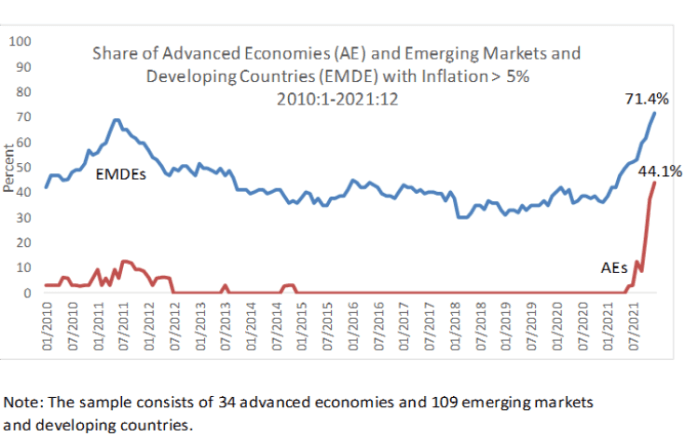
Is the global inflationary spiral peaking?  And if it is and inflation is set to fall over the next year, then has the inflation scare been just a momentary blip and now things will start to turn back to the previously low pace of inflation in the prices of goods and services?

That seems to the view of investors in financial assets in the US, where the stock market has rallied by as much as 20% from lows in mid-June; and both government and corporate bond yields have steadied. Markets seem to believe in what is called the ‘Fed pivot’, where the US Federal Reserve, having hiked its policy rate aggressively since April, will now start to end its hikes going into 2023 as inflation subsides.

Certainly, there is some evidence of peaking inflation in the US where the consumer price inflation (CPI) rate slowed more than expected in July…

View original post 1,703 more words

GENERALIDADES SOBRE LA TEORÍA ESTADÍSTICA DE ENCUESTAS POR MUESTREO. PARTE II

ISADORE NABI

La imagen del encabezado ha sido tomada de QuestionPro.

MUESTREO SISTEMÁTICO

ISADORE NABI

Historia y Definición Conceptual (Ochoa, 2015):

El muestreo sistemático era muy popular en el pasado, antes de que la aparición de los ordenadores hiciese trivial un problema que siempre había dado muchos quebraderos de cabeza a los investigadores: elegir individuos de forma aleatoria dentro de una muestra. En la medida en que los ordenadores nos han facilitado la tarea de generar números aleatorios, este problema ha desaparecido.

También se sigue utilizando para seleccionar individuos a lo largo del tiempo. Por ejemplo, para estudiar la satisfacción de un servicio, podemos elegir sistemáticamente encuestar a 1 de cada n clientes que nos visitan. En estas circunstancias, en las que puede existir diferente varianza entre individuos en diferentes periodos de tiempo, el muestreo sistemático puede ser incluso más preciso que el muestreo aleatorio puro.

Es una técnica dentro de la categoría de muestreos probabilísticos – y que por lo tanto requiere tener un control preciso del marco muestral de individuos seleccionables junto con la probabilidad de que sean seleccionados – consistente en escoger un individuo inicial de forma aleatoria entre la población y, a continuación, seleccionar para la muestra a cada enésimo individuo disponible en el marco muestral.

El muestreo sistemático es un proceso muy simple y que sólo requiere la elección de un individuo al azar. El resto del proceso es trivial y rápido. Los resultados que obtenemos son representativos de la población, de forma similar al muestreo aleatorio simple, siempre y cuando no haya algún factor intrínseco en la forma en que los individuos están listados que haga que se reproduzcan ciertas características poblacionales cada cierto número de individuos. Este suceso es realmente poco frecuente.

Pasos (QuestionPro, 2022) y (QuestionPro, 2022):

  1. Es necesario desarrollar una audiencia estructural (muestra) definida para que el investigador comience a trabajar en el aspecto del muestreo.
  2. El investigador a cargo debe determinar el tamaño de la muestra ideal, es decir, cuántas personas de la población completa se van a elegir.
  3. La clave para obtener resultados precisos razonables y prácticos es tener una audiencia grande. Por ejemplo, si una ONG busca formar un muestreo sistemático de 500 voluntarios de una población de 5000, puede seleccionar a cada décima persona de la población (esto es básicamente de lo que se trata el muestreo sistemático).
  4. Una vez que se decida el número de tamaño de la muestra, se debe asignar un número a cada miembro de la muestra.
  5. Decide cuál será el intervalo de esta muestra. Este es básicamente la distancia estándar entre los elementos. Específicamente, el intervalo de muestreo (i) se calcula dividiendo el número de elementos en el marco de muestreo (N) por el tamaño de la muestra específica (n). El ejemplo mencionado anteriormente sugiere que el intervalo de muestra debe ser 10, que es el resultado de la división de 5000 (N= tamaño de la población) y 500 (N = tamaño de la muestra) (i) = N/n = 5000/500 = 10. El investigador debe seleccionar miembros que cumplan con este criterio. En este caso sería una persona de cada 10.
  6. Se debe elegir un número de manera aleatoria como miembro inicial (r) de la muestra, y este intervalo se agregará al número aleatorio para seguir agregando miembros tal que r, r+i, r+2i, r+3i, … (hasta agotar el marco de muestreo) serán elementos de la muestra.

Ventajas (QuestionPro, 2022):

  1. Es extremadamente simple y conveniente para los investigadores crear, conducir y analizar las muestras.
  2. Como no es necesario enumerar a cada miembro de la muestra, el muestreo sistemático es mejor para representar a una población de manera más rápida y sencilla.
  3. Las muestras creadas se basan en la selección de miembros libre de favoritismos.
  4. En los otros métodos de muestreo hay posibilidades de que los conglomerados creados sean altamente sesgados, y esto comúnmente no sucede en el muestreo sistemático, ya que los miembros se encuentran a una distancia fija el uno del otro.
  5. El factor de riesgo involucrado en este método de muestreo es extremadamente mínimo.
  6. En caso de que haya diversos miembros de una población, el muestreo sistemático puede ser beneficioso debido a la distribución uniforme de los miembros que son seleccionados para formar una muestra.

Referencias

Ochoa, C. (5 de Mayo de 2015). Muestreo probabilístico: muestreo sistemático. Obtenido de netquest: https://www.netquest.com/blog/es/blog/es/muestreo-sistematico

QuestionPro. (21 de Agosto de 2022). ¿Cómo realizar un muestreo sistemático? Obtenido de Investigación de Mercado: https://www.questionpro.com/blog/es/como-realizar-un-muestreo-sistematico/

QuestionPro. (21 de Agosto de 2022). Muestreo sistemático: fácil, sencillo y económico. Obtenido de Encuestas: https://www.questionpro.com/blog/es/muestreo-sistematico/